
US and Iran Sign 60-Day Ceasefire Deal, Reopening Strait of Hormuz Amid Israeli Backlash
The United States and Iran have signed a 14-point memorandum of understanding, establishing a 60-day ceasefire that lifts the US naval blockade and reopens the Strait of Hormuz. While the deal stabilizes global markets, it has sparked profound anger in Israel over perceived American concessions.
By Factlen Editorial Team
- US Administration & Mediators
- Prioritizes global economic stability and the reopening of maritime trade over maximalist military goals.
- Critical Observers & Regional Voices
- Highlights the geopolitical concessions made to Iran and the deep feelings of betrayal within Israel.
- Humanitarian & Global Markets
- Focuses on the relief of averting a global depression and the massive task of resettling displaced civilians.
What's not represented
- · Lebanese Civilians
- · Gulf State Financial Ministers
- · Commercial Shipping Operators
Why this matters
The 60-day ceasefire averts a looming global economic depression by reopening the Strait of Hormuz to international shipping, but it fundamentally reshapes Middle Eastern security alliances by leaving Iran's nuclear and proxy infrastructure largely intact.
Key points
- The US and Iran have signed a 14-point memorandum of understanding, establishing a 60-day ceasefire.
- The agreement lifts the US naval blockade and reopens the Strait of Hormuz to avert a global economic depression.
- Iran retains the right to civilian uranium enrichment and its ballistic missile program, but reaffirms it will not develop nuclear weapons.
- A proposed $300 billion reconstruction fund for Iran will be financed by regional Gulf partners.
- The deal includes a clause ensuring Lebanon's territorial integrity, sparking profound anger and feelings of betrayal in Israel.
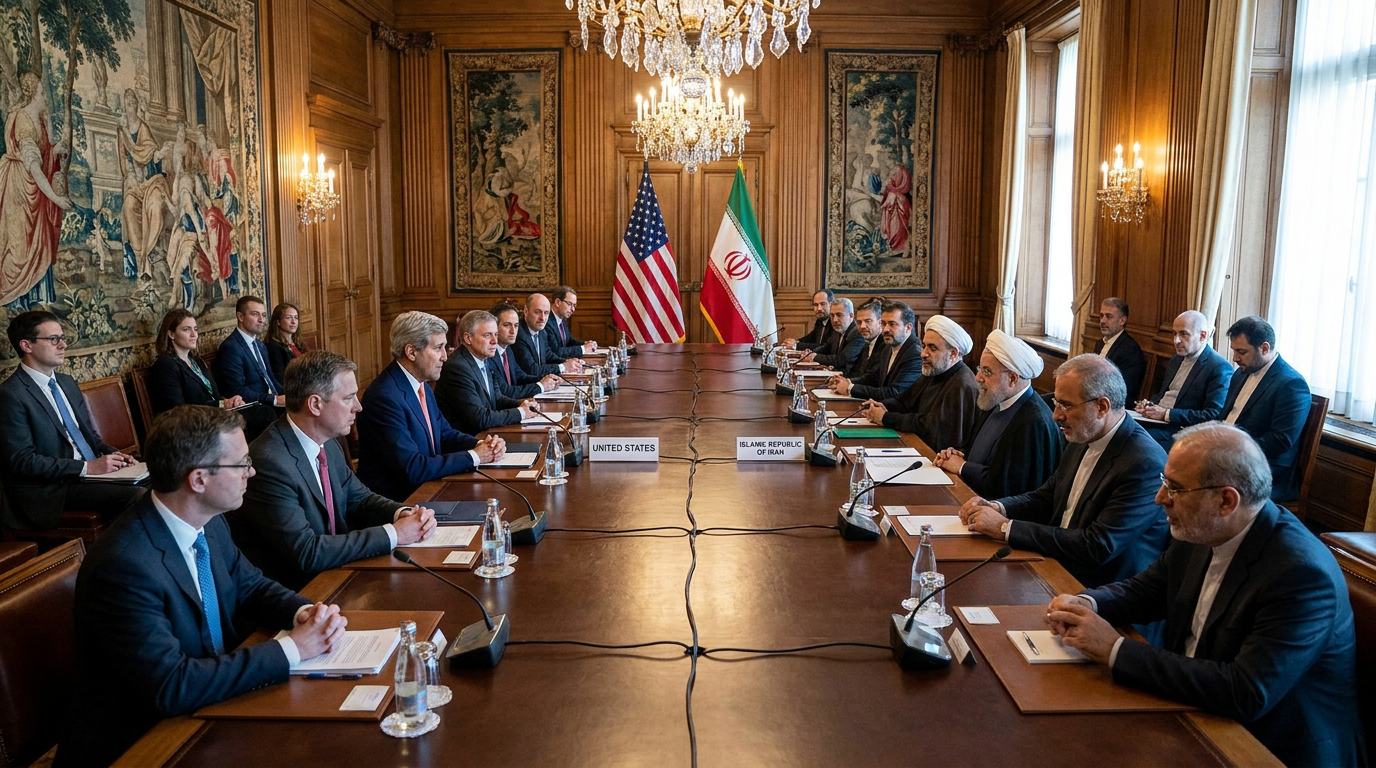
On Wednesday, the geopolitical landscape of the Middle East shifted dramatically as the United States and Iran remotely signed a comprehensive 14-point memorandum of understanding. The agreement, finalized while President Donald Trump attended the G7 summit in Evian, France, and Iranian President Masoud Pezeshkian signed from Tehran, establishes a 60-day ceasefire in a devastating regional war. This diplomatic breakthrough pauses months of intense military exchanges that had fundamentally destabilized the region and threatened to draw in neighboring powers. By formalizing the cessation of hostilities, the two nations have opened a narrow window for negotiating a permanent peace treaty, though the underlying tensions remain deeply entrenched.[1][3]
The immediate catalyst for the sudden diplomatic breakthrough was the sheer necessity of global economic survival. For months, the escalating conflict had effectively closed the Strait of Hormuz, a vital maritime chokepoint that facilitates the transit of roughly a fifth of the world's daily oil supply. The closure was choking off international trade routes, spiking energy costs, and threatening what the US administration explicitly described as a looming "worldwide depression." Faced with the prospect of a catastrophic global recession, negotiators prioritized the rapid reopening of the strait over achieving a total military victory, recognizing that the economic fallout of a prolonged blockade was politically and financially untenable for the West.[1]
Beyond the economic imperatives, the human toll of the war had reached staggering proportions since the conflict erupted in late February following joint US-Israeli strikes. According to the latest data from the UN refugee agency, the intense exchanges of ballistic missiles and retaliatory airstrikes internally displaced 3.2 million people within Iran alone. The violence also spilled heavily into neighboring territories, forcing over a million people from their homes in Lebanon amid widespread destruction. The sheer scale of the humanitarian crisis placed immense pressure on international mediators, particularly Pakistan, to broker a pause in the fighting before the regional infrastructure collapsed entirely under the weight of the displaced populations.[5][7]
At the core of the newly signed memorandum is a mutual de-escalation framework designed primarily to reopen global trade routes and stabilize energy markets. In exchange for Iran's commitment to the 60-day pause in fighting, the United States agreed to immediately lift its crippling naval blockade on Iranian ports. Furthermore, Washington committed to issuing sweeping waivers that will allow Iranian crude oil to be legally shipped and sold abroad. This immediate sanctions relief represents a massive lifeline for Tehran's heavily battered economy, effectively ending the maximum pressure campaign that had defined the earlier stages of the conflict and allowing commercial vessels to safely navigate the Persian Gulf once again.[1][4]

The financial concessions granted to Tehran extend significantly further than the immediate resumption of oil exports. The 14-point agreement paves the way for the unfreezing of billions of dollars in Iranian state assets that had been locked in foreign accounts under previous international sanctions regimes. President Trump acknowledged this reality during a press briefing, noting that the funds rightfully belonged to Iran and had simply been frozen at a specific point in time. This massive influx of capital is expected to rapidly stabilize the Iranian rial and provide the government with the necessary liquidity to begin addressing the widespread domestic damage caused by the months of intense aerial bombardment.[1]
Furthermore, the deal outlines the ambitious creation of a massive $300 billion reconstruction fund aimed at rebuilding Iran's war-torn infrastructure and compensating for the extensive economic losses suffered during the conflict. US officials were quick to clarify to domestic audiences that this monumental fund would be financed entirely by regional Gulf partners, rather than American taxpayers. However, securing these contributions will require immense diplomatic maneuvering, as Gulf states are being asked to underwrite the recovery of a nation that recently targeted their own regional interests. Despite the logistical hurdles, the proposed fund serves as a critical financial incentive that brought Iranian negotiators to the table.[1][6]
On the nuclear front, the agreement marks a stark and controversial departure from the maximalist demands previously championed by Washington during the 2025 negotiations. While Iran formally reaffirmed its commitment that it will not procure or develop nuclear weapons, the United States made a major concession by acknowledging Tehran's basic right to enrich uranium for civilian use. This pivot effectively abandons the previous US position that demanded the complete dismantling of Iran's domestic enrichment capabilities. By allowing civilian enrichment to continue under international observation, the administration opted for a pragmatic containment strategy rather than insisting on the total capitulation of Iran's nuclear infrastructure.[1][3]
The memorandum also notably omits any requirement for Iran to dismantle or scale back its formidable ballistic missile program, a point of intense contention that had derailed previous diplomatic efforts. Throughout the conflict, Iran's missile capabilities proved highly resilient and capable of striking deep into allied territory, making their removal a primary objective for regional hawks. However, the final text of the 60-day ceasefire leaves the missile program entirely intact, focusing strictly on preventing the weaponization of Iran's nuclear stockpile. This omission has drawn sharp criticism from defense analysts who argue that it leaves Tehran with its primary conventional deterrent fully operational and ready to deploy if the peace talks collapse.[6]
However, the final text of the 60-day ceasefire leaves the missile program entirely intact, focusing strictly on preventing the weaponization of Iran's nuclear stockpile.
In return for these sweeping financial and diplomatic lifelines, Iran agreed to formally restrain its extensive network of foreign proxy militias across the Middle East. Most crucially, this commitment includes reining in Hezbollah, the heavily armed Lebanese militant group that has been engaged in near-daily cross-border fire with Israeli forces since the broader war began. By leveraging its influence over these allied factions, Tehran has promised to enforce the ceasefire beyond its own borders, effectively cooling the secondary fronts that had threatened to engulf the entire Levant in a multi-front war. This proxy restraint was a non-negotiable demand for the US and its European allies.[1]
However, the mechanism for restraining Hezbollah comes with a highly controversial caveat known as the Lebanon clause. The agreement explicitly ensures the "territorial integrity" of Lebanon and strictly restrains Israel from conducting further military operations within the country's borders. While US administration officials declined to confirm the exact operational parameters, the clause is widely interpreted as a mandate that will force the Israeli military to halt its cross-border strikes and potentially withdraw from the swathe of southern Lebanon it recently occupied as a buffer zone. This provision effectively shields Hezbollah from further Israeli degradation during the 60-day window.[1]

Consequently, the leadership of Hezbollah has publicly celebrated the ceasefire as a strategic triumph for the resistance axis. Hezbollah's deputy chief, Naim Qassem, hailed the agreement as a "great victory," pointing to the survival of their military infrastructure and the international protection now afforded to Lebanese territory. Similarly, Iranian negotiators framed the deal as a definitive record of US failure, arguing that Tehran successfully outlasted American military pressure to secure sanctions relief without sacrificing its core defensive capabilities. For the allied militias, the memorandum validates their strategy of asymmetric attrition, proving that they could force major concessions by threatening global economic stability.[1]
Inside Israel, the reaction to the Evian breakthrough has been one of profound shock, anger, and disillusionment. Across the political spectrum, citizens and officials have expressed feelings of deep betrayal by the Trump administration, a government they previously viewed as their staunchest and most reliable global ally. The prevailing sentiment is that Washington prioritized its own economic interests and domestic political optics over the existential security needs of the Israeli state. By agreeing to a deal that leaves Iran's nuclear infrastructure and proxy networks largely intact, many Israelis feel that the United States has effectively abandoned them in a highly volatile and hostile region.[2]
In "middle Israel" communities like Rehovot, the fear is palpable that the ceasefire will simply provide Iran with the necessary time and financial resources to rebuild its military infrastructure stronger than before. Residents argue that the lifting of the naval blockade and the unfreezing of billions in assets will inevitably flow toward rearming Hezbollah and advancing Tehran's regional ambitions. With the Lebanon clause actively restraining Israeli military operations, there is a widespread consensus that Israel has been left isolated to face a newly enriched Tehran and an intact proxy network entirely alone, fundamentally altering the country's long-term security calculus.[2]
Defending the sudden diplomatic pivot, President Trump argued that the sheer economic reality of the closed Strait of Hormuz forced his hand, making the concessions a necessary pragmatic choice. "There is nothing as smart as the market," he told reporters, emphasizing that floating billion-dollar commercial ships through a heavily mined and contested waterway was fundamentally untenable for global trade. The administration maintains that no president has ever been tougher on Iran, but that the alternative to the deal was a catastrophic worldwide depression that would have decimated the American economy and triggered widespread domestic unrest ahead of crucial political cycles.[1]

The global financial markets immediately validated the administration's economic rationale, reacting with overwhelming relief to the de-escalation. Following the announcement of the breakthrough in Evian, Brent crude oil prices plummeted to a three-month low, erasing the massive premiums that had been priced in during the height of the naval blockade. Simultaneously, major global stock indices reached record highs on the prospect of stabilized energy costs and the resumption of normalized maritime trade. For international investors and multinational corporations, the 14-point memorandum represents a crucial return to predictability, proving that the threat of a global recession was indeed the primary catalyst for the peace deal.[1][6]
Domestically, the reaction in Washington has been decidedly mixed, reflecting deep partisan and ideological divides over Middle Eastern policy. Hardline Republican lawmakers, traditionally hawkish on Iran, expressed deep skepticism about Tehran's willingness to adhere to the terms of the memorandum. Yet, even staunch critics like Senator Lindsey Graham conceded that the sheer necessity of reopening the straits made the diplomatic gamble "worth a try." While many remain uncomfortable with the financial concessions granted to Tehran, there is a bipartisan consensus that a prolonged closure of the Persian Gulf was an unacceptable scenario that required immediate, albeit imperfect, diplomatic intervention.[3]
On the international stage, European leaders attending the G7 summit were unequivocally supportive of the breakthrough, releasing a joint statement that praised the agreement as a historic opportunity. The allied nations commended the deal for preventing a nuclear-armed Iran while bringing a desperately needed halt to the regional bloodshed. For European economies, which are highly sensitive to fluctuations in global energy prices and the downstream effects of Middle Eastern instability, the reopening of the Strait of Hormuz was celebrated as a massive diplomatic victory that averts a severe economic contraction across the Eurozone.[3]

Despite the immediate economic relief and the cessation of major hostilities, the current peace remains highly fragile and deeply contested. The memorandum is only a 60-day extension designed to provide a temporary window for negotiating a permanent, comprehensive treaty. With the future administration of maritime services in the Strait of Hormuz still unresolved, and Israel actively questioning its commitments under the Lebanon clause, the ultimate success of the Evian breakthrough hangs in the balance. The coming weeks will test whether this pragmatic pause can evolve into lasting stability, or if it merely serves as a brief intermission in a broader regional conflict.[4][6]
How we got here
February 2026
Joint US-Israeli strikes escalate into a full-scale regional war, displacing over 3 million Iranians.
March 2026
Iran blocks the Strait of Hormuz, severely disrupting global shipping and spiking oil prices.
April 8, 2026
A temporary two-week ceasefire is brokered by Pakistan, though low-level hostilities continue.
June 17, 2026
President Trump and President Pezeshkian remotely sign a 14-point memorandum of understanding, establishing a 60-day ceasefire.
Viewpoints in depth
US Administration's view
The agreement was a necessary economic intervention to prevent a global depression.
President Trump and his administration frame the deal as a pragmatic victory that achieved its primary goal: reopening the Strait of Hormuz. By lifting the naval blockade and unfreezing assets, the US prioritized the stabilization of global markets over maximalist military objectives. Officials argue that securing Iran's pledge not to develop nuclear weapons, even while allowing civilian enrichment, is a historic step that averts a broader, unwinnable regional conflict.
Israel's view
The ceasefire is a dangerous capitulation that leaves existential threats intact.
Across the Israeli political spectrum, the agreement is viewed as a profound betrayal. Citizens and officials argue that the deal rewards Iranian aggression by providing billions in sanctions relief without dismantling Tehran's ballistic missile program or its nuclear infrastructure. Furthermore, the clause ensuring Lebanon's territorial integrity is seen as a shield for Hezbollah, leaving Israel isolated and vulnerable to a reconstituted network of proxy forces.
Iran and Allied Forces' view
The memorandum is a strategic triumph that broke the US naval blockade.
Iranian leadership and allied militia groups, including Hezbollah, have publicly celebrated the agreement as a record of US failure. By securing the right to civilian uranium enrichment and forcing the lifting of crippling economic sanctions, Tehran believes it has successfully outlasted American military pressure. The proposed $300 billion reconstruction fund is viewed as necessary reparations, while the Lebanon clause is celebrated as a definitive check on Israeli regional operations.
What we don't know
- Whether Iran and Oman will reach a long-term agreement on the administration of maritime services in the Strait of Hormuz.
- If Israel will comply with the Lebanon territorial integrity clause and withdraw its forces from the southern buffer zone.
- How the proposed $300 billion reconstruction fund will be governed and which Gulf states will ultimately contribute.
Key terms
- Strait of Hormuz
- A vital maritime chokepoint between the Persian Gulf and the Gulf of Oman, through which roughly 20% of the world's oil supply passes.
- Naval Blockade
- A military operation in which the US Navy prevented commercial and military vessels from entering or leaving Iranian ports.
- Memorandum of Understanding (MOU)
- A formal agreement outlining the terms of the 60-day ceasefire and the framework for a permanent peace treaty.
- Uranium Enrichment
- The process of increasing the concentration of the U-235 isotope, which can be used for civilian nuclear power or, at high levels, for nuclear weapons.
Frequently asked
What does the US-Iran ceasefire actually do?
It establishes a 60-day pause in fighting, lifts the US naval blockade on Iranian ports, unfreezes Iranian assets, and reopens the Strait of Hormuz to global shipping.
Does the deal stop Iran from enriching uranium?
No. While Iran reaffirmed it will not develop nuclear weapons, the US conceded Iran's right to enrich uranium for civilian use and did not force the dismantling of its ballistic missile program.
How does the agreement affect Israel and Lebanon?
The deal includes a clause ensuring Lebanon's territorial integrity, which restrains Israeli military operations there, while Iran agreed to rein in Hezbollah.
Who is paying for Iran's reconstruction?
A proposed $300 billion reconstruction fund will reportedly be financed by regional Gulf partners, not the United States.
Sources
Source coverage
7 outlets
3 viewpoints surfaced






[1]The GuardianCritical Observers & Regional Voices
Trump signs Iran peace plan, claiming deal averts 'worldwide depression'
Read on The Guardian →‘It’s a big mistake’: Israelis feel betrayed and angry after Iran peace deal
Read on The Guardian →[3]CBS NewsUS Administration & Mediators
Trump formally signs U.S.-Iran deal as questions linger about nuclear program, missiles
Read on CBS News →[4]AxiosUS Administration & Mediators
U.S. and Iran reach deal but need Trump's final approval, officials say
Read on Axios →[5]AP NewsHumanitarian & Global Markets
Global displacement fell in 2025 but still high, UN finds
Read on AP News →[6]WikipediaUS Administration & Mediators
2026 Iran war ceasefire
Read on Wikipedia →[7]UNHCRHumanitarian & Global Markets
Global Trends Report: Forced Displacement in 2025 and Early 2026
Read on UNHCR →
More in news politics
See all 7 stories →US-Iran Peace Deal
US and Iran Sign Historic Ceasefire to End 110-Day War, Opening Path to Final Deal
6 sources
US-Iran Deal
Israel and Hezbollah Renew Ceasefire as Lebanon Flare-Up Threatens US-Iran Peace Deal
7 sources
Nature Therapy
Fact-Checking the 'Nature Prescription': Does 120 Minutes a Week Actually Improve Health?
7 sources

Reproductive Rights
Virginia Enacts Landmark Right to Contraception and Equity Laws
7 sources
Every angle. Every day.
Get news politics stories with full source coverage and perspective breakdowns delivered to your inbox.