
Beyond the Soundbite: How Deliberative Polling is Reshaping Local Democracy
As traditional surveys struggle with polarization and uninformed responses, communities are increasingly turning to citizens' assemblies to make complex local decisions.
By Factlen Editorial Team
- Deliberative Advocates
- Argue that the public is entirely capable of understanding complex policy if given the right environment and resources.
- Democratic Reformers
- View citizens' assemblies as a necessary structural fix to bypass the polarization and gridlock of modern partisan politics.
- Institutional Realists
- Support the concept but warn about the high financial costs and the political friction of delegating advisory power to unelected groups.
What's not represented
- · Taxpayer Watchdogs
- · Disenfranchised Voters
Why this matters
Traditional polls often capture snap judgments based on limited information, leading to polarized and ineffective local policies. Deliberative models offer a proven mechanism for communities to find consensus on complex issues like zoning, climate action, and municipal budgets.
Key points
- Traditional polls often capture uninformed snap judgments, leading to polarized and inaccurate representations of public opinion.
- Deliberative polling selects a demographically representative sample of citizens to study an issue deeply before giving their opinion.
- Participants receive vetted briefing materials and have the opportunity to question competing experts directly.
- The process has been shown to reduce extreme polarization by forcing citizens to listen to opposing viewpoints in a structured setting.
- While highly effective for complex issues, the process is expensive and requires genuine political commitment to implement the findings.
The fundamental flaw of modern community polling is that it frequently asks people for their opinions on complex civic issues they have not had the time or resources to study. When a pollster calls to ask about municipal zoning reform or a multi-decade climate action plan, the average respondent is forced to give a snap judgment based on surface-level impressions.[1][7]
Political scientists refer to this dynamic as "rational ignorance." Because the cost of acquiring deep knowledge on every local policy outweighs the perceived benefit to a single voter, citizens naturally remain uninformed. Consequently, traditional surveys often capture "phantom opinions"—responses given by individuals who do not actually hold a strong view but feel compelled to answer the pollster's question, often relying on partisan cues rather than factual understanding.[1]
In response to these limitations, a growing number of municipalities and regional governments are abandoning standard surveys in favor of a radically different approach: Deliberative Polling and Citizens' Assemblies. These methods seek to bypass the outrage and polarization of modern politics by fundamentally changing how public opinion is measured.[7]
Pioneered in 1988 by James Fishkin at Stanford University, the concept of Deliberative Polling asks a profoundly different question. Instead of measuring what the public thinks right now, the method is designed to reveal what the public would think if they had the time, resources, and expert access to truly understand the issue at hand.[1][2]

The process begins not with a mass phone bank, but with the careful construction of a "mini-public." Organizers randomly select a group of citizens—typically ranging from 100 to 600 people—ensuring that the cohort perfectly mirrors the broader community's demographics in age, gender, race, income, and educational background.[2][3]
This random, stratified selection is crucial to the model's success. Traditional local town halls are notoriously skewed, often dominated by the loudest voices, highly motivated activists, or residents with abundant free time. A citizens' assembly, by contrast, brings the quiet majority into the room, ensuring that historically marginalized or disengaged demographics have an equal seat at the table.[4][7]
Once the representative sample is selected, participants are given a baseline questionnaire to record their initial, uninformed opinions on the targeted issues. This establishes a statistical starting point before any education or debate takes place.[1][3]
Following the initial survey, the education phase begins. Participants receive carefully balanced briefing materials detailing the policy options. These documents are relentlessly vetted by advisory committees representing all sides of the political spectrum to ensure absolute neutrality, factual accuracy, and plain-language accessibility.[2][3]
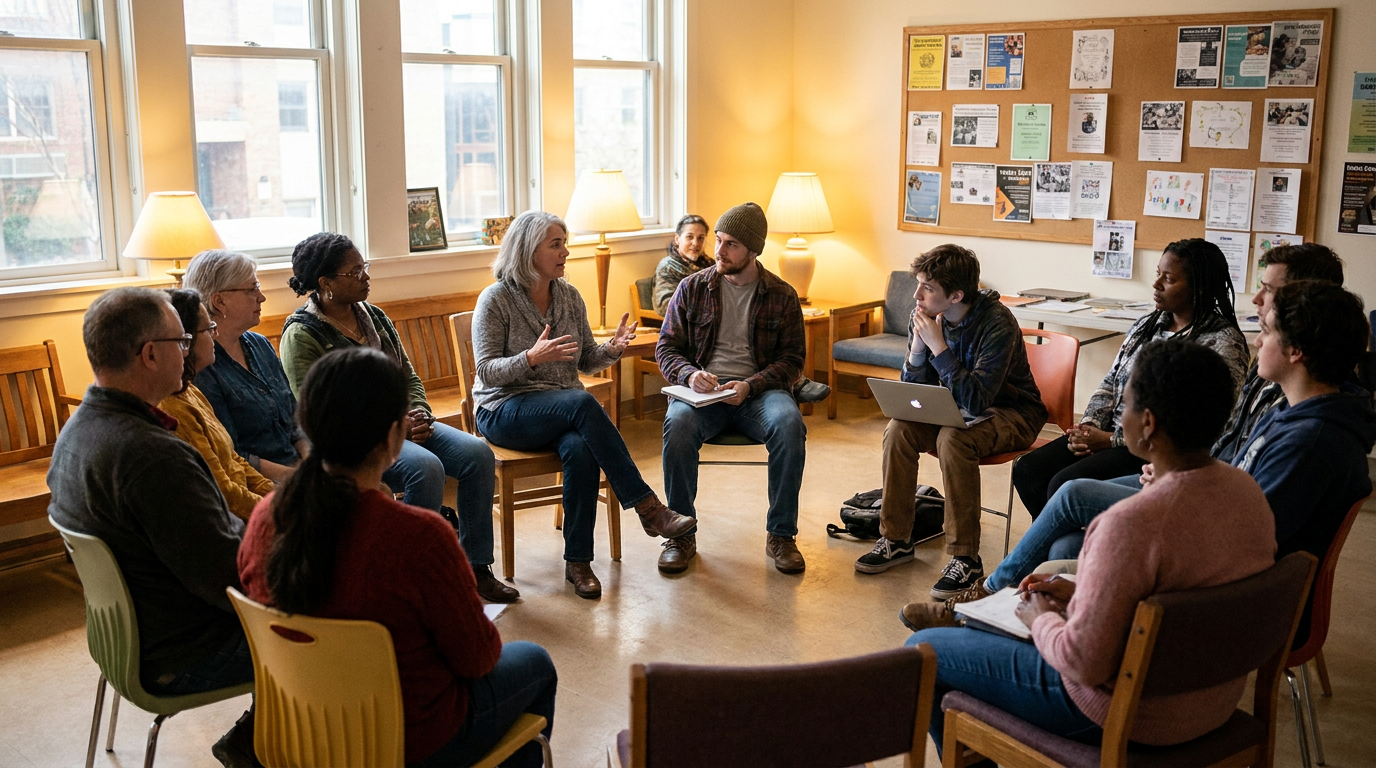
The core of the process is the deliberation itself. Citizens gather to discuss the materials in small groups. Depending on the scope of the project, these events can take the form of an intensive one-to-three-day in-person weekend, or they can be spread across four to five weeks in voice-only online sessions.[3]
Trained moderators guide these small-group discussions. Their job is not to steer the outcome or inject their own opinions, but to ensure that everyone speaks, respect is maintained, and no single personality dominates the conversation. The environment is explicitly designed to foster listening rather than debating.[3]
The environment is explicitly designed to foster listening rather than debating.
During these sessions, the small groups formulate specific questions, which they then pose to a plenary panel of competing experts and policymakers. This allows everyday citizens to interrogate the data directly, challenging assumptions and demanding clarity from authorities in real time.[2][3]
Crucially, the goal of a deliberative poll is not to force a consensus. Participants are never pressured to agree with one another, vote on a final resolution, or sign a joint declaration. The objective is simply to weigh the competing arguments and understand the trade-offs inherent in any policy decision.[3]
At the end of the event, the citizens take the exact same questionnaire they completed at the beginning. The delta between the first poll and the second poll represents the community's "considered opinion"—a highly accurate map of where a fully informed public would land.[1][2]

The results of these exercises are often striking. Researchers at Newcastle University have found that these assemblies consistently reduce political polarization. When forced to listen to each other and debate reasonably in a structured environment, citizens frequently abandon extreme partisan positions in favor of nuanced, pragmatic compromises.[4]
This method has been deployed globally to tackle some of the thorniest local and national issues. Municipalities have used citizens' assemblies to break gridlock on controversial zoning laws, design adult social care frameworks, and draft comprehensive municipal climate action plans that traditional politicians were too fearful to touch.[4][5]
However, the model is not without significant hurdles, the primary barrier being resources. Recruiting a representative sample, paying participants for their time—which is essential to ensure lower-income citizens can afford to attend—and hiring neutral experts makes deliberative polling an expensive undertaking.[2][3]

A single local assembly can cost tens of thousands of dollars and take upwards of six months to properly organize. This heavy logistical lift makes the process impractical for rapid-response decision-making, reserving it primarily for long-term, structural community challenges.[2][6]
Furthermore, the political stakes for local leaders are high. Research from the Constitution Unit highlights that if local councils commission an assembly but fail to act on its recommendations, it can severely damage public trust and breed deeper cynicism.[6]
Citizens who dedicate days of their lives to studying an issue expect their conclusions to carry weight in the real world. When assemblies are treated merely as public relations exercises or when politicians cherry-pick the results, the community backlash is often fierce and sustained.[6][7]
Despite these logistical and political challenges, the shift toward deliberative democracy represents a hopeful evolution in civic life. By investing in the public's capacity to understand complex trade-offs, communities are proving that everyday citizens are more than capable of navigating the nuances of modern governance when given the right tools.[5][7]
How we got here
1988
James Fishkin at Stanford University first develops the concept of Deliberative Polling to combat rational ignorance.
1996
The first major national deliberative poll is held in the United States, proving the model's viability at scale.
2010s
Citizens' assemblies gain significant traction across Europe as a tool to address complex issues like climate change and social care.
2020
The Climate Assembly UK demonstrates the effectiveness of large-scale, long-term deliberative processes on national policy.
2023
Stanford's Deliberative Democracy Lab launches AI-assisted online platforms to help scale the deliberative process globally.
Viewpoints in depth
Deliberative Democracy Advocates
Argue that the public is entirely capable of understanding complex policy if given the right environment.
Proponents of this model view traditional polling as fundamentally flawed because it captures uninformed snap judgments. They argue that when citizens are given the time, resources, and respect to study an issue, they consistently prove capable of navigating complex trade-offs. For this camp, deliberative polling is not just a research tool, but a necessary evolution of democracy that cures the "rational ignorance" plaguing modern civic life.
Local Government Officials
Value the deep insights but worry about the high cost and the political risk of delegating authority.
Many municipal leaders appreciate the nuanced, compromise-oriented recommendations that emerge from citizens' assemblies, especially on politically toxic issues like zoning or budget cuts. However, they grapple with the practical realities of the model. Assemblies are expensive and slow, and officials often face political friction when unelected "mini-publics" suggest policies that conflict with the platforms of elected representatives.
Traditional Pollsters
Maintain that while deliberative polling is great for policy formulation, traditional polling remains necessary.
Traditional public opinion researchers acknowledge the value of deliberative models for education and long-term planning. However, they argue that understanding what the broader, uninformed public currently believes is still a vital metric for political reality. In their view, a deliberative poll shows what people *should* think, but a traditional poll shows how they will actually vote tomorrow—making both tools necessary for a functioning democracy.
What we don't know
- Whether the high costs of running citizens' assemblies can be reduced enough to make them a routine part of local governance.
- How effectively AI and virtual platforms can replicate the empathy and consensus-building of in-person deliberation.
- If local governments will consistently commit to implementing assembly recommendations, or if the process will be co-opted for public relations.
Key terms
- Deliberative Polling
- A research method that measures what the public would think about an issue if they had the opportunity to become fully informed and discuss it with peers.
- Citizens' Assembly
- A representative group of citizens selected at random to deliberate on a specific policy issue and make formal recommendations to the government.
- Rational Ignorance
- The concept that citizens often remain uninformed on complex issues because the time and effort required to acquire the information outweighs the perceived benefit.
- Phantom Opinions
- Survey responses given by individuals who do not actually hold a strong view but feel compelled to answer a pollster's question, often guessing based on partisan cues.
- Mini-public
- A small group of people randomly selected to be demographically representative of the wider population, used as a microcosm of the community.
Frequently asked
How are participants chosen for an assembly?
Participants are selected through a process of random, stratified sampling. Organizers ensure the final group mathematically mirrors the broader community's demographics in terms of age, gender, race, and income.
Do politicians have to follow the recommendations?
Usually no. Unless a local government explicitly commits to making the results binding beforehand, the outcomes of a citizens' assembly serve as highly informed advisory recommendations.
How much does a citizens' assembly cost?
Costs vary widely based on scale, but they typically range from tens of thousands to over a hundred thousand dollars. The budget covers participant compensation, venue rentals, expert fees, and professional moderation.
Is this different from a standard town hall meeting?
Yes. Traditional town halls are open to anyone, which often results in the loudest or most motivated activists dominating the room. Assemblies use random selection to ensure the quiet majority is represented.
Sources
Source coverage
7 outlets
3 viewpoints surfaced






[1]Stanford Center for Deliberative DemocracyDeliberative Advocates
What is Deliberative Polling?
Read on Stanford Center for Deliberative Democracy →[2]ParticipediaDeliberative Advocates
Deliberative Polling: Process, Interaction, and Decision-Making
Read on Participedia →[3]CivicusDeliberative Advocates
Tool: Deliberative Polling
Read on Civicus →[4]Newcastle UniversityDemocratic Reformers
How citizens' assemblies can improve democracy
Read on Newcastle University →[5]European Democracy HubDemocratic Reformers
Getting Real About Citizens' Assemblies
Read on European Democracy Hub →[6]Constitution UnitInstitutional Realists
Do councils follow up on citizens' assembly recommendations?
Read on Constitution Unit →[7]Factlen Editorial TeamInstitutional Realists
Synthesis by Factlen editorial team
Read on Factlen Editorial Team →
Every angle. Every day.
Get community stories with full source coverage and perspective breakdowns delivered to your inbox.