
How Local Open-Source AI Works: The Rise of Small Language Models
A new generation of highly efficient, open-source AI models is moving intelligence out of the cloud and directly onto consumer laptops and smartphones.
By Factlen Editorial Team

- Local AI Developers
- Advocates for open-source models emphasize the freedom to build without vendor lock-in, zero latency, and offline capability.
- Enterprise Security Teams
- Corporate IT and compliance officers prioritize data sovereignty, ensuring proprietary data never leaves the internal network.
- AI Researchers & Analysts
- Industry observers tracking the balance between the broad reasoning of massive cloud models and the hyper-efficiency of local SLMs.
What's not represented
- · Hardware Manufacturers
Why this matters
Running AI locally eliminates recurring subscription costs, allows for offline use, and ensures absolute data privacy—meaning your personal or corporate data never leaves your device.
Key points
- Small Language Models (SLMs) like Llama 3 and Phi-3 offer powerful AI capabilities without requiring massive cloud infrastructure.
- Local inference ensures absolute data privacy, as sensitive information never leaves the user's device.
- Tools like Ollama and LM Studio have made deploying local AI accessible to both developers and non-technical users.
- Enterprises are adopting a routing strategy, using free local models for routine tasks and reserving paid cloud APIs for complex reasoning.
For the past three years, the artificial intelligence narrative has been dominated by massive scale. The prevailing assumption was that useful AI required data centers the size of football fields, billions of dollars in compute, and constant internet connectivity to cloud APIs.[7]
But in 2026, a quiet revolution has inverted that model. The "bigger is better" era is making room for a new paradigm: Small Language Models (SLMs) running entirely locally on consumer hardware.[2]
Instead of renting intelligence from tech giants, developers and businesses are downloading highly capable models directly to their laptops, smartphones, and edge devices. This shift is democratizing AI access, eliminating recurring costs, and solving some of the industry's most stubborn privacy challenges.[5]
To understand the shift, it helps to look at the numbers. Large Language Models (LLMs) like GPT-4 or Claude 3 operate with hundreds of billions—sometimes over a trillion—parameters. SLMs, by contrast, typically range from 1 billion to 8 billion parameters.[1]

Despite their compact footprint, these models punch far above their weight class. Meta's Llama 3 (8B) and Microsoft's Phi-3 (3.8B) frequently outperform the massive, 30-billion-plus parameter models from just a year or two ago on practical reasoning tasks.[3]
The secret to this efficiency lies in the training data. Rather than scraping the entire unfiltered internet, researchers have begun training SLMs on "textbook quality" synthetic data and heavily curated datasets.[4]
By feeding the models higher-quality information, they learn logic and reasoning without needing the sheer volume of parameters required to memorize the entire web.[2][4]
By feeding the models higher-quality information, they learn logic and reasoning without needing the sheer volume of parameters required to memorize the entire web.
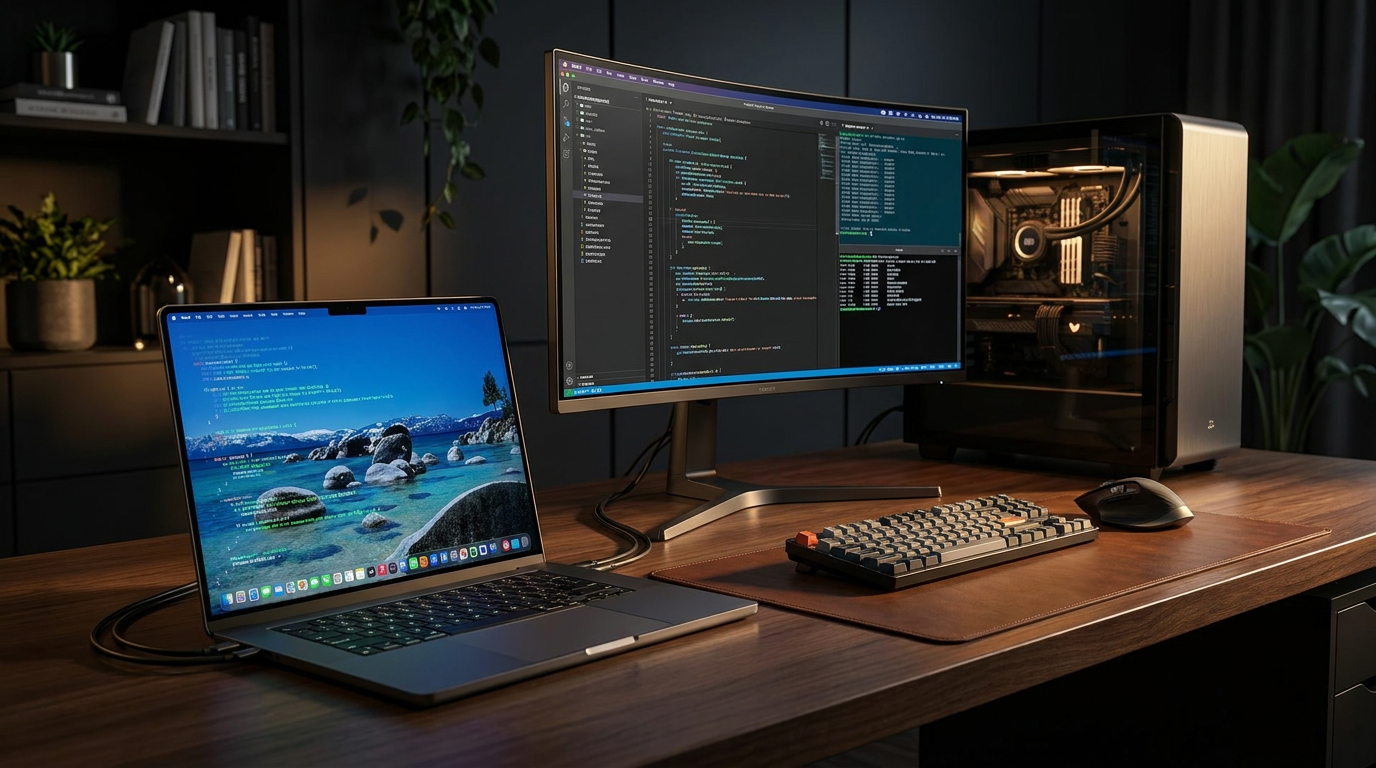
Running these models locally requires specialized software engines. The breakthrough came with technologies like llama.cpp, an open-source inference engine that allows complex models to run efficiently on standard CPUs and consumer-grade GPUs, bypassing the need for expensive enterprise hardware.[6]
On top of that engine, two distinct software ecosystems have emerged to make local AI accessible. For developers, Ollama has become the industry standard. Operating primarily as a command-line interface and background server, Ollama allows engineers to pull models and integrate them into applications via a local API with just a few keystrokes.[2][6]

For non-technical users and researchers, LM Studio provides a polished graphical interface. It functions like a desktop app store for AI, allowing users to browse, download, and chat with various open-source models visually, complete with parameter tuning and side-by-side comparisons.[5][6]
The driving force behind this local AI boom is not just cost—it is data sovereignty. When a user queries a cloud-based LLM, their prompt is sent to external servers. For enterprises handling protected health information, financial records, or proprietary source code, that shared-responsibility model introduces unacceptable security risks.[3]
Local inference solves this instantly. Because the model runs entirely on the host machine, sensitive data never leaves the network perimeter. This absolute privacy is becoming a hard requirement for businesses navigating strict regulatory frameworks like the EU AI Act and GDPR.[4]
Beyond privacy, local models offer an unparalleled latency advantage. Cloud APIs suffer from inherent network delays—the time it takes for a request to travel to a server, process, and return. Edge computing eliminates this round-trip entirely, enabling the real-time, zero-lag responses required for autonomous systems and fast-paced interactive applications.[2][5]

The economics are equally compelling. Cloud AI relies on a pay-per-token model, which can become prohibitively expensive at scale. Local models require an upfront hardware investment but operate with zero recurring API costs, fundamentally changing the ROI equation for AI-integrated software.[4][5]
This does not mean massive cloud models are obsolete. SLMs lack the broad, encyclopedic world knowledge of their larger counterparts. If tasked with writing a thesis on 18th-century philosophy, an SLM will struggle. But if asked to extract an invoice number from a document or summarize a meeting transcript, they perform with near-perfect accuracy.[4]
Consequently, modern AI architectures are adopting a "routing" strategy. A fast, local SLM acts as the first line of defense, handling 80% of routine queries instantly and privately. Only when a prompt requires deep, complex reasoning does the system silently escalate the request to a massive cloud-based LLM.[4][7]
Ultimately, the rise of open-source local AI represents a maturation of the technology. Intelligence is no longer a centralized utility that must be rented; it is becoming a fundamental, decentralized capability built directly into the devices we use every day.[7]
How we got here
Early 2023
The release of LLaMA by Meta sparks the open-source AI movement, leading to rapid community optimization.
Late 2023
Tools like llama.cpp and Ollama emerge, making it dramatically easier to run models on standard laptops.
Mid 2024
Microsoft releases the Phi-3 family, proving that models under 4 billion parameters can rival massive models in reasoning.
2025-2026
Enterprises begin adopting local SLMs en masse to comply with data privacy regulations and eliminate recurring API costs.
Viewpoints in depth
Local AI Developers
Advocates for open-source models emphasize the freedom to build without vendor lock-in.
For the open-source community, the appeal of local AI is absolute control. Tools like Ollama and LM Studio allow developers to rapidly prototype applications without worrying about API rate limits, sudden pricing changes, or internet connectivity. By running models locally, engineers can build AI-powered features that work on airplanes, in remote locations, or in highly secure offline environments.
Enterprise Security Teams
Corporate IT and compliance officers prioritize data sovereignty above all else.
For enterprise security, sending proprietary code, customer leads, or patient data to third-party APIs is increasingly viewed as an unacceptable risk. Local SLMs satisfy strict regulatory frameworks like the EU AI Act and GDPR by keeping data entirely on-premise. This allows companies to deploy AI assistants for internal document processing and coding without exposing their intellectual property to the cloud.
Cloud AI Providers
Proponents of massive centralized models argue that true reasoning requires massive scale.
While acknowledging the utility of SLMs, cloud providers maintain that the most complex, multi-step reasoning tasks still require trillion-parameter models. They argue that SLMs are excellent for narrow, well-defined tasks like extraction and summarization, but lack the emergent capabilities and broad world knowledge that only massive data center infrastructure can provide.
What we don't know
- How quickly hardware manufacturers will integrate dedicated Neural Processing Units (NPUs) into baseline consumer devices to further accelerate local AI.
- Whether future regulatory frameworks will require specific licensing for highly capable open-source models running entirely offline.
Key terms
- Small Language Model (SLM)
- An AI model typically ranging from 1 billion to 8 billion parameters, optimized to run efficiently on consumer hardware rather than massive data centers.
- Inference
- The process of running live data through a trained AI model to generate a response or prediction.
- Quantization
- A technique that compresses an AI model's size by reducing the precision of its numbers, allowing it to run on devices with less memory.
- llama.cpp
- An open-source software library that allows complex AI models to run efficiently on standard computer processors without requiring specialized enterprise hardware.
- Parameter
- The internal variables or 'synapses' an AI model learns during training; a rough measure of a model's size and complexity.
Frequently asked
Can I run these models on my current laptop?
Yes. Models like Phi-3 and Llama 3 8B are designed to run efficiently on standard consumer hardware, including modern MacBooks and Windows laptops with decent memory.
Are local models as smart as ChatGPT?
They are highly capable at specific tasks like summarizing text, coding, and extracting data, but they lack the broad encyclopedic knowledge of massive cloud models.
Is it legal to use open-source models for business?
Most popular open-weight models, including Llama 3 and Phi-3, have permissive licenses that allow for commercial use, though specific terms vary by model.
What is the difference between Ollama and LM Studio?
Ollama is a command-line tool and API server designed for developers, while LM Studio is a graphical desktop application designed for visual exploration and chatting.
Sources
Source coverage
7 outlets
3 viewpoints surfaced






[1]DataCampAI Researchers & Analysts
Top 15 Small Language Models of 2026
Read on DataCamp →[2]Dev.toLocal AI Developers
Ollama vs LM Studio: Running LLMs Locally
Read on Dev.to →[3]Developers VoiceEnterprise Security Teams
Small Language Models and Edge AI: The Shift to Local Intelligence
Read on Developers Voice →[4]ForgeNexEnterprise Security Teams
Mistral vs. Phi-3: Which Self-Hosted LLM Should You Choose?
Read on ForgeNex →[5]Inero SoftwareEnterprise Security Teams
Local LLM Deployment: Privacy and Offline Accessibility
Read on Inero Software →[6]Zen Van RielLocal AI Developers
Ollama vs LM Studio: Choosing the Right Local AI Tool
Read on Zen Van Riel →[7]Factlen Editorial TeamAI Researchers & Analysts
Synthesis by Factlen editorial team
Read on Factlen Editorial Team →


Every angle. Every day.
Get ai stories with full source coverage and perspective breakdowns delivered to your inbox.