
Why AI Agents Stall in Production—and How Hypernetworks Are Fixing It
Enterprise AI agents frequently fail in production due to context loss and memory degradation. A new architecture called hypernetworks solves this by generating custom neural weights on demand, enabling true autonomous operation.
By Factlen Editorial Team
- Enterprise Adopters
- Focuses on the cost savings, governance reduction, and true autonomy that hypernetworks promise.
- AI Researchers
- Focuses on the underlying scaling laws, calibration challenges, and the mathematical defeat of catastrophic forgetting.
- Systems Architects
- Focuses on the technical mechanism of dynamic weight generation and memory efficiency compared to RAG.
- Factlen Editorial
- Analyzes the overarching paradigm shift in AI procurement and the regulatory tailwinds driving adoption.
What's not represented
- · Hardware manufacturers supplying the GPU clusters for these new architectures
Why this matters
If your company is investing in AI agents to automate workflows, relying on outdated RAG or fine-tuning methods will likely result in stalled projects and high supervision costs. Hypernetworks represent the next generation of enterprise AI, promising true autonomy and drastically lower governance overhead.
Key points
- Enterprise AI agents frequently stall in production due to context rot and memory degradation.
- Traditional fixes like RAG and fine-tuning require constant human supervision for long tasks.
- Hypernetworks solve this by acting as a 'weight factory' that generates custom models on demand.
- This architecture collapses expensive 'model zoos' into a single, highly verifiable generator.
The enterprise artificial intelligence landscape is currently defined by a frustrating paradox: autonomous agents demo beautifully in the sandbox but consistently stall out in live production environments. When tasked with long, complex, and highly specific workflows—such as auditing thousands of financial records overnight or managing multi-step customer service pipelines—these agents inevitably hit a wall. They require a human operator to step in, top up their contextual memory, and manually verify their outputs before they can proceed. The promised efficiency of a fully autonomous digital workforce quickly drains into a reality of constant, expensive human supervision, leaving many chief technology officers wondering if true AI autonomy is even possible with current architectures.[1][8]
The root of this stalling phenomenon lies in how current frontier AI models handle knowledge retention and working memory over extended periods. When the artificial intelligence firm Chroma recently tested eighteen of the industry's leading models, the results revealed a structural flaw: every single model lost accuracy as its input context grew larger. This degradation is not a temporary gap that a slightly larger model will eventually close; it is a fundamental mathematical property of how attention mechanisms work in transformer-based architectures. An agent that is fed more and more of a company's proprietary business data as it runs does not get steadier or more reliable. Instead, it gets progressively shakier, eventually hallucinating or losing the thread of its original instructions entirely.[1][8]
Until recently, enterprise engineering teams relied heavily on two standard industry fixes to inject proprietary business knowledge into an off-the-shelf AI agent: Retrieval-Augmented Generation, commonly known as RAG, and traditional fine-tuning. Both of these approaches, however, have hit a hard ceiling in complex production environments. RAG operates by fetching relevant documents from an external vector database at query time and feeding those facts directly into the model's prompt window. While this method is fast to deploy and keeps data relatively secure, RAG inevitably leaks context over long, multi-step tasks. As the prompt window fills up with retrieved documents, the agent becomes confused about which facts take priority, leading to stalled workflows and degraded reasoning.[1][5]

Fine-tuning, the primary alternative to RAG, attempts to solve the memory problem by baking proprietary corporate knowledge directly into the model's underlying weights. However, this method remains highly vulnerable to a phenomenon known as 'catastrophic forgetting,' a structural flaw identified by neural network researchers in the 1980s. Teaching a neural network a new, highly specific task tends to erode or overwrite the generalized knowledge it already possessed. To bypass this degradation, enterprise teams are forced to isolate each individual task into its own fine-tuned model. This creates a sprawling, expensive 'model zoo' that requires immense governance overhead, massive compute resources to maintain, and becomes entirely stale the moment a business policy or internal regulation changes.[1][2][5]
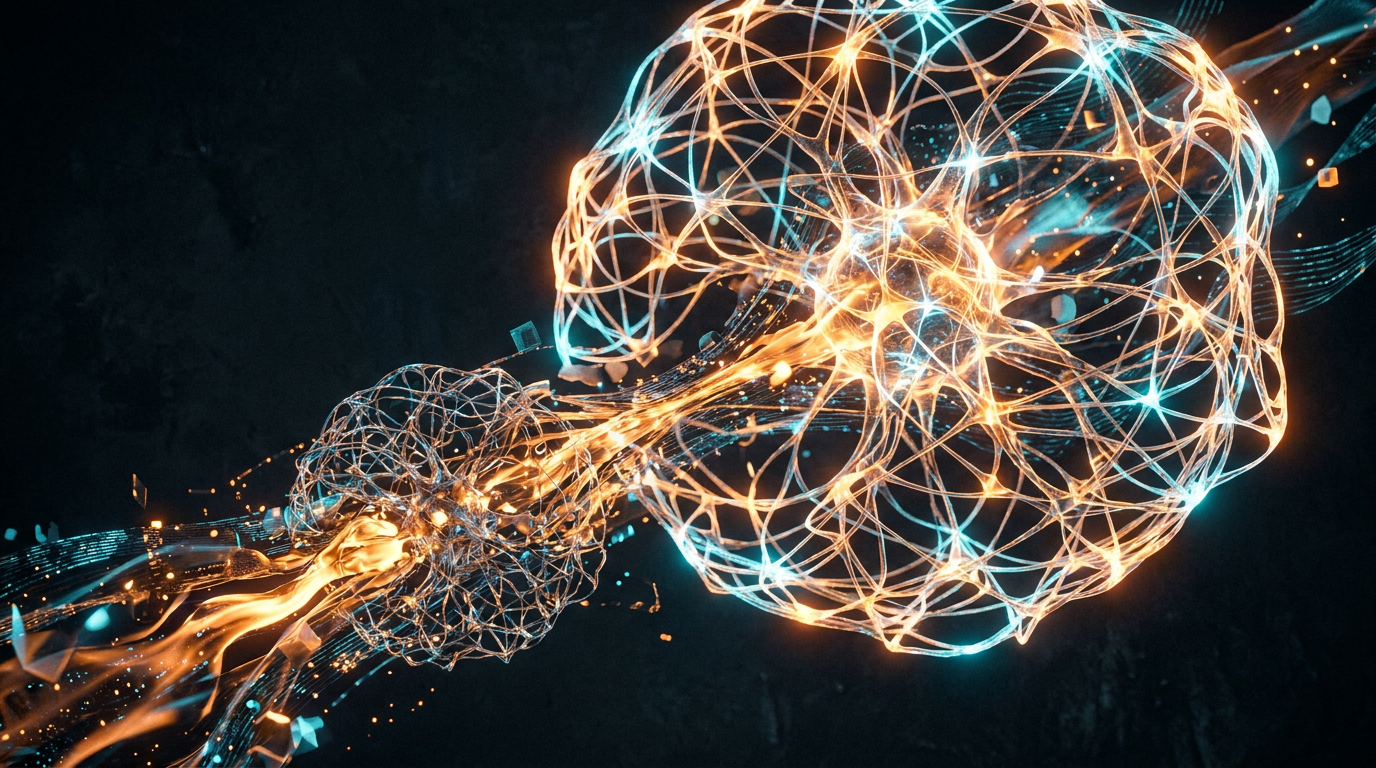
A third, radically different architectural path has emerged in mid-2026 as the most credible and permanent solution to the agent stalling problem: hypernetworks. Rather than storing fixed, static weights for every possible enterprise task, a hypernetwork operates as a specialized neural network whose sole output is the weights and parameters of another neural network. It acts as a dynamic 'weight factory,' generating a custom, highly specialized, task-specific model on demand in a single inference pass. Once the task is completed, the generated weights can be discarded, leaving the core hypernetwork completely untouched and ready to generate a different set of parameters for the next workflow.[1][4]
The theoretical concept of a neural network generating another network was first formally named in 2016, but applying this architecture to produce specialist large language models from plain text is a very recent breakthrough. At its core, the hypernetwork architecture separates the logic of dynamic weight generation from the actual processing of the input data. When an enterprise AI agent encounters a specific, niche task—such as formatting a specialized legal contract—the hypernetwork reads the task description and instantly forges a temporary set of parameters tailored exactly to that job. This allows the system to adapt instantly without requiring the slow, expensive retraining cycles associated with traditional fine-tuning.[1][3]
At its core, the hypernetwork architecture separates the logic of dynamic weight generation from the actual processing of the input data.
This 'master tailor' approach fundamentally alters the economics, scalability, and architecture of enterprise artificial intelligence deployments. Instead of training, hosting, and maintaining a thousand specialized models for different corporate departments—a logistical nightmare for IT teams—an enterprise only needs to train and govern one central hypernetwork generator. This collapses the sprawling and expensive model zoo into a single, highly efficient system. By dynamically generating weights only when they are needed, companies can drastically reduce the memory footprint and cloud computing costs required for complex, multi-task operations, making true autonomous agents financially viable for the first time.[2][4][7]
Recent academic and industry milestones have rapidly accelerated the shift toward hypernetwork architectures in the commercial sector. Sakana AI's Text-to-LoRA system, which was presented to wide acclaim at the ICML 2025 conference, proved definitively that a highly accurate model adapter could be generated from a simple plain-language description in a single computational pass. Building on this foundational research, a 2026 framework known as SHINE demonstrated that hypernetwork adaptation could completely sidestep both the exorbitant retraining costs of fine-tuning and the strict, degrading context limits of standard prompting, opening the door for widespread enterprise adoption.[1][3]

In the enterprise software sector, specialized platforms like Nace.AI are already commercializing this dynamic architecture for Fortune 500 clients. Their flagship MetaModel1 framework utilizes hypernetworks to generate Low-Rank Adaptation, or LoRA, weights dynamically on the fly. This allows relatively small, cost-effective language models to rapidly adapt to various corporate applications without suffering from catastrophic forgetting. Early industry benchmarks and pilot programs indicate that this dynamic generation method not only preserves high accuracy over long, multi-day horizons but also reduces overall computational adaptation costs by up to thirty percent compared to traditional methods.[6][7]
The regulatory and compliance implications of this architectural shift are equally profound, particularly in light of the European Union's stringent AI Act. Article 14 of the EU AI Act demands strict human oversight, transparency, and highly verifiable outputs from any AI systems deemed high-risk. Because hypernetworks generate specific, isolated, and temporary weights for a given task, their outputs and decision-making pathways are inherently more verifiable than those of a massive, generalized model juggling thousands of competing fine-tuned parameters. This transparency creates a massive regulatory tailwind for hypernetwork adoption among compliance-heavy industries like banking and healthcare.[2][8]
Despite the immense promise and early successes, the enterprise transition from RAG and fine-tuning to hypernetworks is not without significant friction and skepticism. The architecture is still in its early stages of widespread commercial deployment, and the parts that matter most to risk-averse chief technology officers—namely, long-term calibration and massive scale—remain largely unproven in chaotic, unstructured corporate environments. While scaling laws for systems like Nace.AI look highly promising in controlled laboratory tests, they are currently undergoing rigorous peer review and stress-testing to ensure they hold up under the unpredictable demands of live, petabyte-scale corporate data.[1][2]

Furthermore, the fundamental procurement conversation between enterprise buyers and AI vendors is shifting dramatically. Corporate IT departments are no longer purchasing static, pre-trained models; they are evaluating and licensing dynamic model generators. This paradigm shift requires an entirely new set of vendor evaluations and security audits. Buyers must now focus intensely on where the core knowledge is legally located, how the escalation logic functions when a dynamically generated model inevitably hallucinates, and who ultimately owns the proprietary feedback loop that improves the hypernetwork's generation capabilities over time.[2][8]
It is important to note that hypernetworks are not a universal replacement for all existing AI architectures. For simple tasks that require short, immediate answers—such as a basic customer service chatbot querying a return policy—a well-prompted frontier model utilizing standard RAG remains the most cost-effective and logical solution. However, for automating long, repetitive, high-volume processes end-to-end—such as running a comprehensive internal compliance audit overnight with only the final slice requiring human validation—hypernetwork-generated models are currently the only approach likely to run long enough without degrading to actually matter to the bottom line.[1][8]
As the underlying technology matures and peer-reviewed scaling laws are validated, the long-held vision of the fully autonomous enterprise agent is finally coming into sharp focus. By elegantly solving the dual bottlenecks of context rot and catastrophic forgetting, hypernetworks are transforming artificial intelligence from a fragile system that requires constant human babysitting into a resilient, adaptable digital workforce. For enterprise leaders willing to navigate the early integration challenges, the shift from storing static weights to dynamically generating them represents the most significant leap forward in AI operationalization to date.[1][7][8]
How we got here
2016
The concept of hypernetworks (networks generating weights for other networks) is first formally named.
2024
Nace.AI introduces MetaModel1, utilizing hypernetworks for rapid enterprise adaptation.
July 2025
Sakana AI presents Text-to-LoRA at ICML, proving adapters can be generated from plain text.
June 2026
The SHINE framework and enterprise pilots signal a shift away from standard RAG and fine-tuning.
Viewpoints in depth
Enterprise Adopters
Focuses on the cost savings, governance reduction, and true autonomy that hypernetworks promise.
For corporate IT leaders, the appeal of hypernetworks is primarily economic and logistical. Managing a 'model zoo' of hundreds of fine-tuned models is a governance nightmare that requires massive cloud compute budgets. By shifting to a single hypernetwork generator, enterprises can drastically reduce their memory footprint while finally achieving the 'overnight autonomy' that AI vendors have promised for years.
AI Researchers
Focuses on the underlying scaling laws, calibration challenges, and the mathematical defeat of catastrophic forgetting.
The academic community views hypernetworks as a fundamental breakthrough in overcoming catastrophic forgetting. However, researchers remain cautious about the architecture's calibration at massive scale. While generating weights on the fly works beautifully in controlled benchmarks like Sakana AI's Text-to-LoRA, proving that these scaling laws hold up under the chaotic, unstructured data demands of a Fortune 500 company is the current frontier of peer-reviewed research.
Systems Architects
Focuses on the technical mechanism of dynamic weight generation and memory efficiency compared to RAG.
From an engineering perspective, hypernetworks represent a much more elegant solution to context limits than Retrieval-Augmented Generation (RAG). Instead of stuffing a prompt window with retrieved documents until the model loses track of its instructions, systems architects can use a hypernetwork to forge a temporary, highly specialized neural pathway. This ensures the agent remains focused and accurate, regardless of how long the workflow runs.
Regulatory & Compliance Teams
Focuses on the verifiable outputs and transparency required by new international AI laws.
Compliance officers are increasingly viewing hypernetworks as a regulatory shield. Under frameworks like the EU AI Act, companies must prove that their high-risk AI systems are transparent and verifiable. Because a hypernetwork generates a specific, isolated set of weights for a single task and then discards them, auditing the decision-making pathway of that specific task is significantly easier than untangling the logic of a massive, generalized frontier model.
What we don't know
- Whether hypernetwork scaling laws will hold up under the chaotic demands of live, petabyte-scale corporate data.
- How quickly major cloud providers will adapt their infrastructure to support dynamic weight generation natively.
- The long-term security implications of a single hypernetwork generator being compromised.
Key terms
- Hypernetwork
- A specialized neural network that dynamically generates the internal weights and parameters for another AI model on demand.
- Retrieval-Augmented Generation (RAG)
- A technique where an AI fetches external documents to help answer a prompt, which can lead to confusion over long tasks.
- Catastrophic Forgetting
- A flaw in machine learning where teaching a model new information causes it to overwrite and forget previously learned knowledge.
- Fine-Tuning
- The process of permanently altering an AI model's weights by training it on new, specific data.
- LoRA (Low-Rank Adaptation)
- A highly efficient method for updating a small portion of an AI model's parameters without retraining the entire system.
Frequently asked
Why do current AI agents stall in production?
Current agents rely on RAG or fine-tuning, which either lose track of context over long tasks or suffer from memory degradation, requiring human intervention.
How does a hypernetwork fix catastrophic forgetting?
Instead of permanently altering a model's core memory, a hypernetwork generates a temporary, task-specific set of weights that are used once and discarded, leaving the core knowledge intact.
Will hypernetworks completely replace RAG?
Not entirely. For simple, short queries, RAG remains cost-effective. Hypernetworks are designed for long, complex, autonomous workflows where context limits become a bottleneck.
Sources
Source coverage
8 outlets
4 viewpoints surfaced








[1]VentureBeatEnterprise Adopters
Fine-tuning forgets. RAG leaks context. Hypernetworks build the model your agent needs on demand.
Read on VentureBeat →[2]Signal Daily NewsEnterprise Adopters
Hypernetwork-generated models sidestep catastrophic forgetting and context rot
Read on Signal Daily News →[3]arXivAI Researchers
Parameter-efficient multi-task fine-tuning for transformers via shared hypernetworks
Read on arXiv →[4]UltralyticsSystems Architects
How Hypernetworks Work: Dynamic Weight Generation
Read on Ultralytics →[5]MediumSystems Architects
HyperNetworks: The Neural Networks That Generate Other Networks
Read on Medium →[6]Nace.AIAI Researchers
MetaModel1: A Rapid Adaptation Framework using Hypernetworks
Read on Nace.AI →[7]GOpenAISystems Architects
What Are Hypernetworks? The Model-Generating Models
Read on GOpenAI →[8]Factlen Editorial TeamFactlen Editorial
Synthesis by Factlen editorial team
Read on Factlen Editorial Team →


Every angle. Every day.
Get technology stories with full source coverage and perspective breakdowns delivered to your inbox.