
US-Iran Peace Summit in Switzerland Cancelled After Violence Flares in Lebanon
A high-stakes diplomatic meeting between the US and Iran was abruptly postponed after a deadly escalation between Israel and Hezbollah derailed the fragile regional ceasefire.
By Factlen Editorial Team
- Global Energy Markets
- Focused entirely on the reopening of the Strait of Hormuz to restore oil supply and curb inflation risks.
- US Administration
- Focused on securing a definitive peace deal to stabilize global energy markets and lower domestic inflation.
- Iranian Negotiators
- Insisting that any bilateral agreement with the US must be predicated on a comprehensive, region-wide cessation of hostilities.
- Israeli Security Establishment
- Maintaining the absolute right to defend its borders against immediate threats, regardless of international diplomatic timelines.
What's not represented
- · Lebanese Civilians
- · European Energy Importers
Why this matters
The collapse of these talks directly threatens global energy markets, raising the risk that the Strait of Hormuz remains closed to commercial shipping. For consumers, this translates to a renewed threat of soaring inflation and higher fuel prices during the summer travel season.
Key points
- A high-stakes US-Iran peace summit in Switzerland was abruptly cancelled following a deadly flare-up of violence in Lebanon.
- Iran withdrew its delegation, insisting that a comprehensive regional ceasefire must precede any bilateral negotiations with Washington.
- The breakdown grounded US Vice President JD Vance's trip and left the reopening of the Strait of Hormuz in jeopardy.
- Global energy markets reacted with renewed anxiety, as analysts warned that prolonged diplomatic failure could send oil prices soaring again.
- Israel and Hezbollah have since renewed their fragile ceasefire, leaving a narrow window to potentially salvage the broader peace agreement.
The sudden collapse of the high-stakes US-Iran peace summit in Switzerland has sent shockwaves through global diplomatic and financial circles. Just days after a preliminary memorandum of understanding was signed to end months of conflict, the diplomatic off-ramp was abruptly closed.[1][2]
The immediate catalyst for the breakdown was not found in Tehran or Washington, but in the hills of southern Lebanon. A sudden and deadly escalation between Israel and the Iran-backed militant group Hezbollah shattered the regional calm required for the talks to proceed.[1][2]
The violence escalated rapidly, resulting in the deaths of four Israeli soldiers and triggering a wave of retaliatory Israeli airstrikes across southern Lebanon and the Bekaa Valley that killed at least 47 people.[1][2]
For the Iranian delegation, the localized flare-up was a dealbreaker. Tehran had explicitly conditioned its participation in the Swiss summit on a comprehensive, region-wide ceasefire that included its allied militant groups.[2]

When the bombs began falling in Lebanon, Iran pulled its lead negotiator, Mohammad Baqer Qalibaf. A senior Hezbollah lawmaker publicly confirmed that Tehran had informed the group that negotiations with the United States could not continue while Washington failed to restrain Israeli military actions.[2]
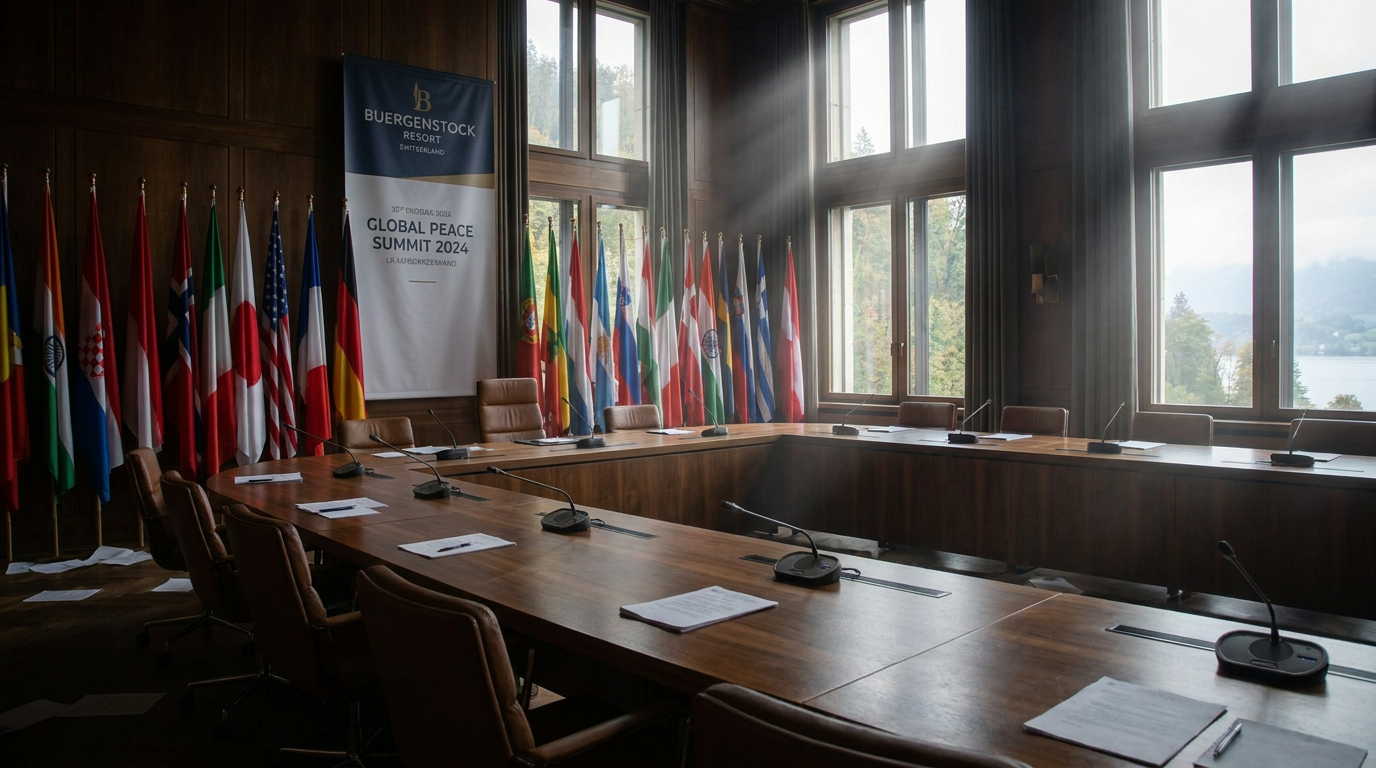
The collapse of the summit played out in dramatic fashion on the American side. US Vice President JD Vance, tasked with leading the peace negotiations, was reportedly at an airbase with his staff, prepared to board a flight to the Buergenstock resort, when the trip was suddenly aborted.[1][2]
The White House was forced to announce that the Vice President would remain in Washington, leaving the highly anticipated diplomatic breakthrough in a state of suspended animation.[1]
The stakes of the Switzerland meeting extended far beyond bilateral relations; they directly implicated the stability of the global economy. The primary objective of the summit was to finalize the reopening of the Strait of Hormuz.[1][5]
The Strait, a narrow waterway through which roughly 20 percent of the world's seaborne crude oil transits, had been effectively closed by Tehran during the height of the conflict.[5]

The closure had previously sent energy prices soaring, with Brent crude peaking at $126 a barrel, triggering widespread fears of a prolonged, structural inflation spike across Western economies.[3][4]
When the preliminary US-Iran agreement was announced earlier in the week, markets breathed a collective sigh of relief. Oil prices tumbled back toward $80 a barrel, and global equities rallied on the prospect of normalized supply chains.[3][5]
When the preliminary US-Iran agreement was announced earlier in the week, markets breathed a collective sigh of relief.
However, the sudden cancellation of the Swiss talks has reignited market anxieties. Financial analysts caution that the path back to pre-war energy prices was already fraught with logistical hurdles, and this diplomatic setback only steepens the climb.[3]
Even if a deal is eventually salvaged, experts note that it will take months for oil, gasoline, and diesel supplies to snap back. Depleted emergency crude stockpiles must be replenished, and the physical removal of naval mines from the Strait could take up to seven weeks.[3][4]
The economic uncertainty carries severe domestic political risks for the US administration. With midterm elections looming, persistently high fuel prices during the peak summer driving season represent a significant vulnerability.[4]

The diplomatic impasse also highlights the intractable position of Israel, which is not a party to the US-Iran negotiations. The Israeli security establishment maintains that it must retain the right to defend its northern border against Hezbollah, regardless of Washington's broader geopolitical timetable.[2][6]
This dynamic creates a structural vulnerability in any US-Iran peace framework: the entire agreement can be held hostage by the actions of non-state actors or allied nations operating on their own security imperatives.[6]
Beyond the immediate crisis in the Strait of Hormuz, the Switzerland summit was also intended to open a 60-day window to negotiate a permanent understanding regarding Iran's nuclear program—a deeply complex issue that has now been pushed further down the road.[1][2]
In a minor reprieve following the summit's cancellation, Israel and Hezbollah agreed to renew their fragile ceasefire after 24 hours of intense violence.[1]
The Swiss foreign ministry confirmed that the talks have been officially postponed, though they noted that preparations at the mountaintop resort remain on standby, ready to facilitate negotiations if the parties return to the table.[2]
How we got here
February 2026
Conflict breaks out, leading to the effective closure of the Strait of Hormuz and a spike in global energy prices.
Mid-June 2026
The US and Iran sign a preliminary memorandum of understanding to end hostilities and reopen shipping lanes.
June 18, 2026
Violence flares between Israel and Hezbollah in Lebanon, resulting in dozens of casualties.
June 19, 2026
Iran withdraws its delegation, forcing the cancellation of the Switzerland summit and grounding the US Vice President's trip.
June 20, 2026
Israel and Hezbollah agree to renew their ceasefire, leaving the status of the broader US-Iran deal uncertain.
Viewpoints in depth
US Administration's view
Focused on securing a definitive peace deal to stabilize global energy markets and lower domestic inflation.
For Washington, the primary objective is decoupling the broader US-Iran peace framework from localized conflicts in the Middle East. The administration views the reopening of the Strait of Hormuz as an urgent economic imperative, necessary to curb inflation and lower summer fuel prices ahead of domestic elections. US officials have expressed frustration that a localized border dispute in Lebanon could be allowed to derail a superpower agreement with massive global economic implications.
Iranian Negotiators' view
Insisting that any bilateral agreement with the US must be predicated on a comprehensive, region-wide cessation of hostilities.
Tehran's diplomatic posture is deeply intertwined with its regional alliances. Iranian negotiators argue that a true peace deal cannot exist in a vacuum while its allies, such as Hezbollah, remain under military pressure. By pulling out of the Swiss summit, Iran signaled that it holds the United States responsible for restraining Israeli military actions, making a comprehensive regional ceasefire a non-negotiable prerequisite for further talks on its nuclear program and maritime shipping.
Israeli Security Establishment's view
Maintaining the absolute right to defend its borders against immediate threats, regardless of international diplomatic timelines.
Israel is not a signatory to the US-Iran memorandum of understanding and refuses to let Washington's diplomatic schedule dictate its national security operations. The Israeli security establishment views Hezbollah's rocket attacks as an intolerable immediate threat that requires swift military retaliation. From this perspective, pausing defensive operations to accommodate a summit in Switzerland would amount to sacrificing core security interests for an agreement they are not even a party to.
What we don't know
- It remains unclear if or when the Switzerland summit will be rescheduled.
- The exact timeline for reopening the Strait of Hormuz to commercial shipping is now entirely uncertain.
- It is unknown whether the US administration will attempt to decouple the Iran nuclear negotiations from the broader regional conflicts.
Key terms
- Strait of Hormuz
- A narrow, strategically vital waterway between the Persian Gulf and the Gulf of Oman, through which roughly 20 percent of the world's seaborne crude oil passes.
- Memorandum of Understanding
- A preliminary, non-binding agreement outlining the broad terms of a deal, which the Switzerland summit was intended to convert into a permanent treaty.
- Brent Crude
- A major global benchmark for pricing oil, used by analysts to gauge the economic impact of geopolitical disruptions in the Middle East.
Frequently asked
Why were the Switzerland peace talks cancelled?
The talks were postponed after a deadly flare-up of violence between Israel and Hezbollah in Lebanon. Iran refused to participate in the summit without a comprehensive regional ceasefire in place.
What was the summit supposed to achieve?
The meeting aimed to finalize a preliminary US-Iran agreement to reopen the Strait of Hormuz to commercial shipping and begin a 60-day negotiation window regarding Iran's nuclear program.
How does this affect global gas prices?
The cancellation has reignited fears of supply disruptions. While oil had dropped to around $80 a barrel on hopes of a deal, analysts warn that prolonged diplomatic failure could send prices soaring again.
Is the peace deal completely dead?
Not necessarily. Israel and Hezbollah have renewed their fragile ceasefire, and the Swiss foreign ministry stated that preparations for the summit remain on standby if the parties agree to return.
Sources
Source coverage
6 outlets
4 viewpoints surfaced






[1]The GuardianGlobal Energy Markets
US-Iran meeting in Switzerland cancelled because of Lebanon fighting
Read on The Guardian →[2]ReutersGlobal Energy Markets
US-Iran meeting in Switzerland cancelled as Hezbollah-Israel fighting flares in Lebanon
Read on Reuters →[3]MorningstarGlobal Energy Markets
Oil dropped on the preliminary agreement, but analysts caution against expecting a near-term return to prewar prices
Read on Morningstar →[4]ForbesUS Administration
A Peace Deal Likely Won't Boost Americans' Economic Views
Read on Forbes →[5]Al-MonitorIranian Negotiators
Oil slips after Saudi-driven rally while equities edge higher
Read on Al-Monitor →[6]Jewish InsiderIsraeli Security Establishment
Israel and Hezbollah exchange fire in southern Lebanon
Read on Jewish Insider →

Every angle. Every day.
Get news politics stories with full source coverage and perspective breakdowns delivered to your inbox.