
The "E-Bike for Skiing": How Wearable Exoskeletons Are Extending Careers on the Slopes
Wearable robotic and mechanical exoskeletons are moving from medical labs to the ski slopes, offering a bionic boost that reduces joint strain and extends endurance.
By Factlen Editorial Team
- Sports Technologists
- Focus on the shift from rigid metal frames to fabric-based pneumatics and AI-driven electric motors.
- Adaptive Skiing Advocates
- Emphasize how the technology democratizes the mountain and extends the athletic lifespan of older skiers.
- Ski Industry Analysts
- Compare the exoskeleton trend to the e-bike boom, focusing on market adoption and consumer endurance.
What's not represented
- · Traditionalist Ski Purists
Why this matters
For decades, aging out of alpine sports due to knee pain or muscle fatigue was considered inevitable. The commercialization of wearable exoskeletons is fundamentally changing the lifespan of a skier, allowing people to stay on the mountain longer, safer, and with significantly less physical pain.
Key points
- Wearable exoskeletons are moving from medical labs to recreational ski slopes, offering a bionic boost to skiers.
- The technology splits into two main categories: unpowered mechanical springs and AI-driven pneumatic or electric actuators.
- Systems can offload up to 30% of a skier's body weight and reduce knee pressure by 40%.
- While highly beneficial for older athletes or those with joint pain, healthy skiers are adopting the tech to maximize endurance.
- Industry experts compare the trend to the rise of e-bikes, predicting widespread adoption through resort rental programs.
For decades, the physical toll of alpine skiing was simply accepted as the price of admission. Burning thighs, aching knees, and the inevitable mid-afternoon fatigue dictated when a day on the mountain was over. For older athletes or those with a history of joint injuries, this physical ceiling often meant an early, reluctant retirement from the sport they loved.[7]
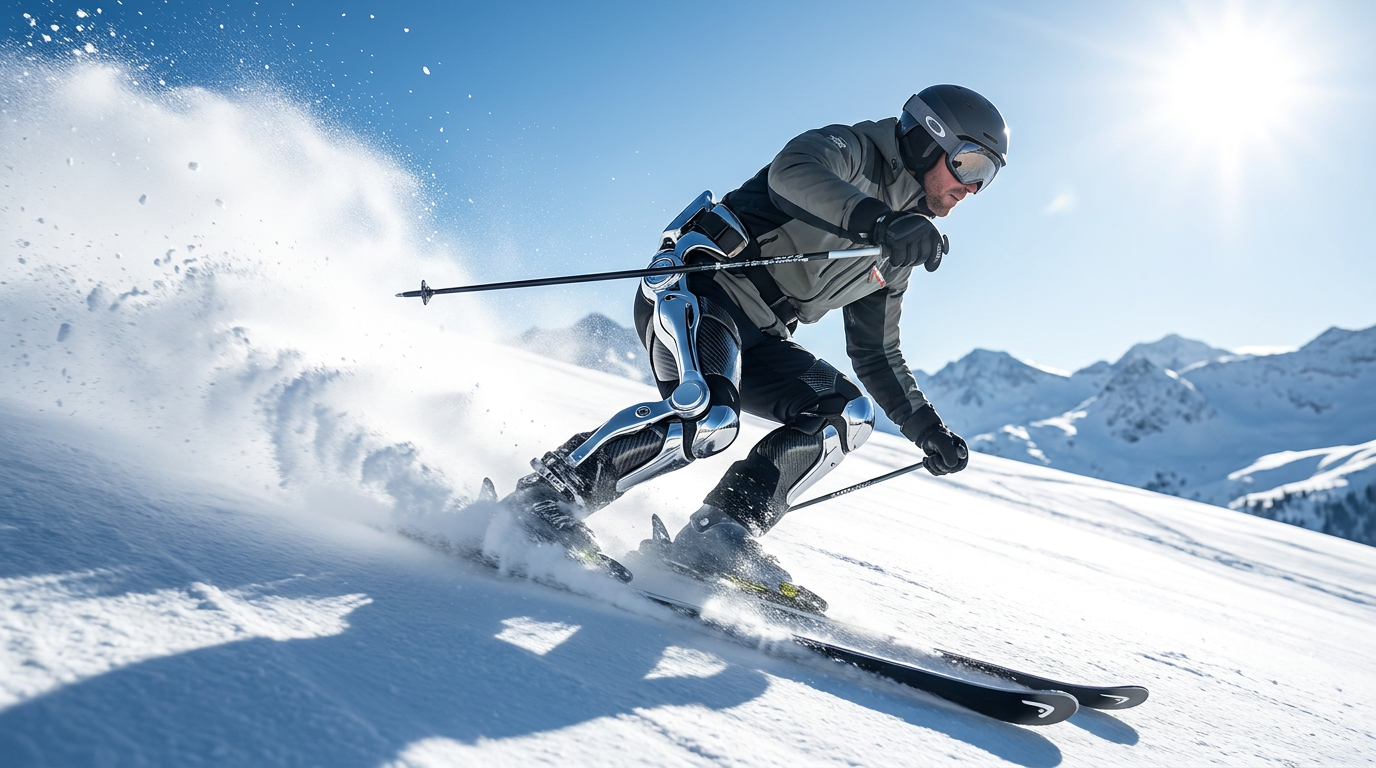
But a quiet revolution is unfolding on the slopes in 2026. Wearable exoskeletons—once strictly confined to medical rehabilitation clinics and military research laboratories—are now commercially available to recreational skiers. These devices are fundamentally altering the biomechanics of the sport, offering a bionic boost that promises to extend both the daily endurance and the overall lifespan of a skier.[1][6]
Industry insiders are increasingly referring to this as the 'e-bike moment' for skiing. Just as pedal-assist electric motors kept older cyclists on the trails and allowed novices to keep pace with experts, bionic ski pants are designed to offload massive amounts of physical strain. The goal is not to ski for the user, but to amplify their natural strength, allowing them to ski longer, harder, and with significantly less pain.[5][7]
The technology currently dominating the market generally falls into two distinct camps: unpowered mechanical spring systems and actively powered robotic actuators. Both approaches aim to achieve the exact same physiological goal—reducing the load on the quadriceps and knee joints by roughly one-third—but they go about it in vastly different engineering ways.[2][3]

On the mechanical side, systems like the French-manufactured Ski-Mojo rely on a clever, entirely unpowered spring mechanism. Typically worn underneath standard, slightly loose ski pants, the device features a powerful, adjustable spring that runs alongside the leg, connecting the rigid shell of the ski boot to a specialized, comfortable pelvic harness.[2]
The physics behind the mechanical approach are elegantly simple. When a skier bends their knees to enter a carve or absorb a sudden bump, the internal spring compresses, storing kinetic energy. As the skier straightens back up to exit the turn, the spring releases that stored energy, providing a physical upward boost that directly mimics and assists the function of the quadricep muscles.[2][5]
Retailers and independent testers report that this passive suspension system absorbs high-impact shocks and micro-vibrations much like a premium mountain bike fork. This dampening effect reduces the sheer pressure on the knee joints by up to 40 percent. Because the system requires no batteries or motors, it remains remarkably lightweight and functions flawlessly in freezing alpine temperatures from first chair to last call.[5]
Retailers and independent testers report that this passive suspension system absorbs high-impact shocks and micro-vibrations much like a premium mountain bike fork.
On the other end of the technological spectrum are actively powered, 'smart' exoskeletons. San Francisco-based Roam Robotics pioneered this specific space with the Elevate, a pneumatic system that deliberately avoids heavy metal motors in favor of compressed air and high-strength fabrics.[1][6]
The Elevate features fabric-based air actuators strapped securely to the skier's thighs. A small, lightweight air compressor—carried in a slim backpack—rapidly inflates and deflates these actuators. Crucially, the entire system is governed by proprietary artificial intelligence software that anticipates the skier's exact movements, automatically adjusting the supportive torque applied to the knee in real-time.[3][6]

Other technology startups, such as Hypershell, have recently introduced AI-powered electric motors mounted directly at the hip. Originally designed to assist with grueling backcountry hiking and ski touring, these advanced systems boast the ability to offset up to 30 kilograms of physical load. They utilize an array of sensors to seamlessly match the user's natural gait, providing a motorized boost on steep, exhausting ascents.[4]
Despite the clear physiological benefits, the aesthetic hurdle has historically been one of the biggest challenges for widespread consumer adoption. Early prototypes looked unmistakably like something out of a science fiction movie, leading to an unfortunate stigma that the gear was exclusively meant for the severely injured or the elderly.[3][7]
However, modern iterations have become remarkably sleek and unobtrusive. Mechanical systems now disappear almost entirely beneath standard snow pants, leaving only a small clip visible at the boot. Meanwhile, powered systems have drastically reduced their overall bulk, resembling high-end, futuristic knee braces rather than clunky robotic armor.[2][3]
Interestingly, as the designs have improved, the target demographic has shifted dramatically. While exoskeletons remain an absolute game-changer for skiers battling osteoarthritis or recovering from previous ACL tears, manufacturers report a surge in adoption from perfectly healthy, highly athletic skiers who simply want to maximize their expensive, time-limited ski vacations.[2][5]

By drastically reducing muscle fatigue, skiers can maintain proper, aggressive technique late into the afternoon—which is traditionally the danger zone when fatigue-related injuries occur. The exoskeleton acts as a true power amplifier, allowing users to carve harder, navigate heavier snow, and chain together more runs without the dreaded sensation of 'leg burn.'[2][5]
As the underlying technology continues to scale and retail prices inevitably drop, major ski resorts are rapidly expanding their on-mountain rental programs, allowing curious skiers to test-drive bionic legs for a single day. The consensus among those who experience the technology is becoming clear: the future of alpine sports might just be augmented, ensuring that the thrill of the descent is accessible for decades to come.[5][6]
How we got here
2013
Roam Robotics is founded by a former Ekso Bionics designer to pursue lightweight, fabric-based exoskeletons.
2018
Early prototypes of the Roam Elevate pneumatic ski exoskeleton become available for demonstration rentals in Lake Tahoe.
2020
AI-driven software is integrated into powered exoskeletons to anticipate skier movements and adjust torque in real-time.
2024–2025
Mechanical systems like the Ski-Mojo gain widespread traction in Europe as a reliable, battery-free alternative.
2026
Next-generation electric and pneumatic exoskeletons hit the consumer market, boasting lighter profiles and seamless integration.
Viewpoints in depth
Sports Technologists
Focus on the shift from rigid metal frames to fabric-based pneumatics and AI-driven electric motors.
Engineers and sports technologists view skiing as the perfect testbed for consumer robotics. Because the rigid ski boots and the skis themselves already bear the weight of the equipment, the user doesn't feel the burden of carrying the exoskeleton. They argue that the shift from heavy metal motors to fabric-based pneumatics and AI-driven electric systems will soon make bionic assistance as common as specialized ski bindings.
Adaptive Skiing Advocates
Emphasize how the technology democratizes the mountain and extends the athletic lifespan of older skiers.
For advocates of adaptive sports, exoskeletons represent a profound leap in accessibility. They argue that the technology democratizes the mountain, allowing older generations to continue skiing with their grandchildren and keeping athletes with chronic joint pain in the sport for decades longer than previously possible. To this camp, the gear is less about performance enhancement and more about preserving quality of life.
Ski Industry Analysts
Compare the exoskeleton trend to the e-bike boom, focusing on market adoption and consumer endurance.
Industry analysts draw a direct parallel between ski exoskeletons and the e-bike boom in cycling. They note that while purists initially scoffed at motorized assistance on the trails, the undeniable benefits in endurance and injury prevention eventually won over the masses. Analysts predict that as prices drop, exoskeletons will become a highly lucrative, mainstream rental option at every major ski resort globally.
What we don't know
- How quickly the cost of actively powered, AI-driven exoskeletons will drop to mass-market consumer levels.
- Whether ski resorts will eventually create dedicated lanes or specific regulations for motorized exoskeleton users if average speeds increase.
- How the long-term use of mechanical assistance affects natural muscle retention and joint health in frequent skiers.
Key terms
- Exoskeleton
- A wearable framework or structure that supports and enhances the physical capabilities of the user.
- Pneumatic Actuator
- A device that converts the energy of compressed air into mechanical motion, used in some exoskeletons to mimic muscle contractions.
- Kinetic Energy
- The energy that an object possesses due to its motion, which mechanical springs store when compressed during a ski turn.
- E-bike Moment
- A paradigm shift in a sport where motorized or mechanical assistance becomes widely accepted, drastically expanding the demographic of participants.
Frequently asked
Do ski exoskeletons ski for you?
No. They do not control your turns or take over the skiing experience. They act as a support system, absorbing shock and providing a boost to your natural muscle movements.
Can you wear them under normal ski pants?
Mechanical systems like the Ski-Mojo are designed to fit entirely underneath standard, slightly loose ski pants. Powered pneumatic systems typically wear over the pants.
Do they require batteries?
It depends on the model. Mechanical spring systems require no power, while pneumatic and electric motor systems rely on rechargeable batteries carried in a small backpack or hip belt.
Are they only for injured skiers?
While highly beneficial for those with knee or back pain, many healthy, athletic skiers use them simply to increase their endurance and ski longer days without muscle fatigue.
Sources
Source coverage
7 outlets
3 viewpoints surfaced







[1]Exoskeleton ReportSports Technologists
Elevate Ski Exoskeleton by Roam Robotics
Read on Exoskeleton Report →[2]Ski-MojoAdaptive Skiing Advocates
Ski-Mojo: The Exoskeleton for Skiing and Snowboarding
Read on Ski-Mojo →[3]OutsideSki Industry Analysts
We Tested a Bionic Exoskeleton for Skiing
Read on Outside →[4]HypershellSports Technologists
Hypershell X Series: AI-Powered Outdoor Exoskeleton
Read on Hypershell →[5]Snow-HowAdaptive Skiing Advocates
Ski-Mojo – the exoskeleton for more fun and less strain when skiing
Read on Snow-How →[6]ForbesSports Technologists
Ambitious Skiers Can Now Rent A Bionic Boost For The Slopes
Read on Forbes →[7]Factlen Editorial TeamSki Industry Analysts
Synthesis by Factlen editorial team
Read on Factlen Editorial Team →

More in sports
See all 8 stories →Sports Finance
How Women's Sports Franchises Became a Billion-Dollar Asset Class in 2026
9 sources

Injury
Premier Lacrosse League Injury Report: Xander Dickson and Zed Williams Make Triumphant Returns
6 sources
Standings
Premier Lacrosse League Standings Tighten as Western Conference Race Heats Up
6 sources
Injury
World Snooker Tour Injury Report: Carrington Completes Comeback as Brecel Nears Return
6 sources

Every angle. Every day.
Get sports stories with full source coverage and perspective breakdowns delivered to your inbox.