
The Science of the 'Negative' Rep: Why Eccentric Training is Transforming Muscle Growth and Longevity
By focusing on the lengthening phase of a muscle contraction, eccentric training allows lifters to handle heavier loads with lower metabolic cost, driving superior gains in strength, hypertrophy, and tendon resilience.
By Factlen Editorial Team
- Sports Scientists
- Focus on maximizing mechanical tension to drive muscle hypertrophy and elite strength adaptations.
- Longevity Researchers
- Value eccentric training for its ability to preserve muscle mass in older adults with minimal cardiovascular strain.
- Rehabilitation Specialists
- Utilize eccentric loading primarily to remodel damaged tendons and prevent future musculoskeletal injuries.
What's not represented
- · Casual gym-goers who prioritize the 'pump' of concentric lifting
- · Endurance athletes concerned about the temporary stiffness caused by eccentric-induced DOMS
Why this matters
Understanding how to properly control the lowering phase of a lift can drastically accelerate muscle growth, bulletproof your tendons against injury, and provide a low-cardiovascular-strain method for older adults to maintain physical independence.
Key points
- Eccentric contractions occur when a muscle lengthens under tension, such as lowering a dumbbell or descending into a squat.
- The human body can handle 105% to 140% more weight during the eccentric phase compared to the concentric (lifting) phase.
- Eccentric training produces greater mechanical tension, leading to superior muscle hypertrophy and strength gains.
- Because it requires less cardiovascular energy, eccentric loading is highly effective for older adults looking to combat muscle loss.
- Controlled eccentric exercises increase tendon stiffness and are the gold standard for rehabilitating chronic tendinopathies.
Walk into any gym, and the focus is almost entirely on the battle against gravity. Lifters grunt as they push a barbell off their chest or strain to pull a deadlift from the floor. This upward, shortening phase of a muscle contraction—known as the concentric phase—has long been the centerpiece of strength training. But sports scientists and longevity researchers are increasingly pointing to the opposite motion as the true driver of physical adaptation. The "negative" or eccentric phase, where the muscle lengthens under tension, is emerging as a critical frontier for both elite performance and healthy aging.[6]
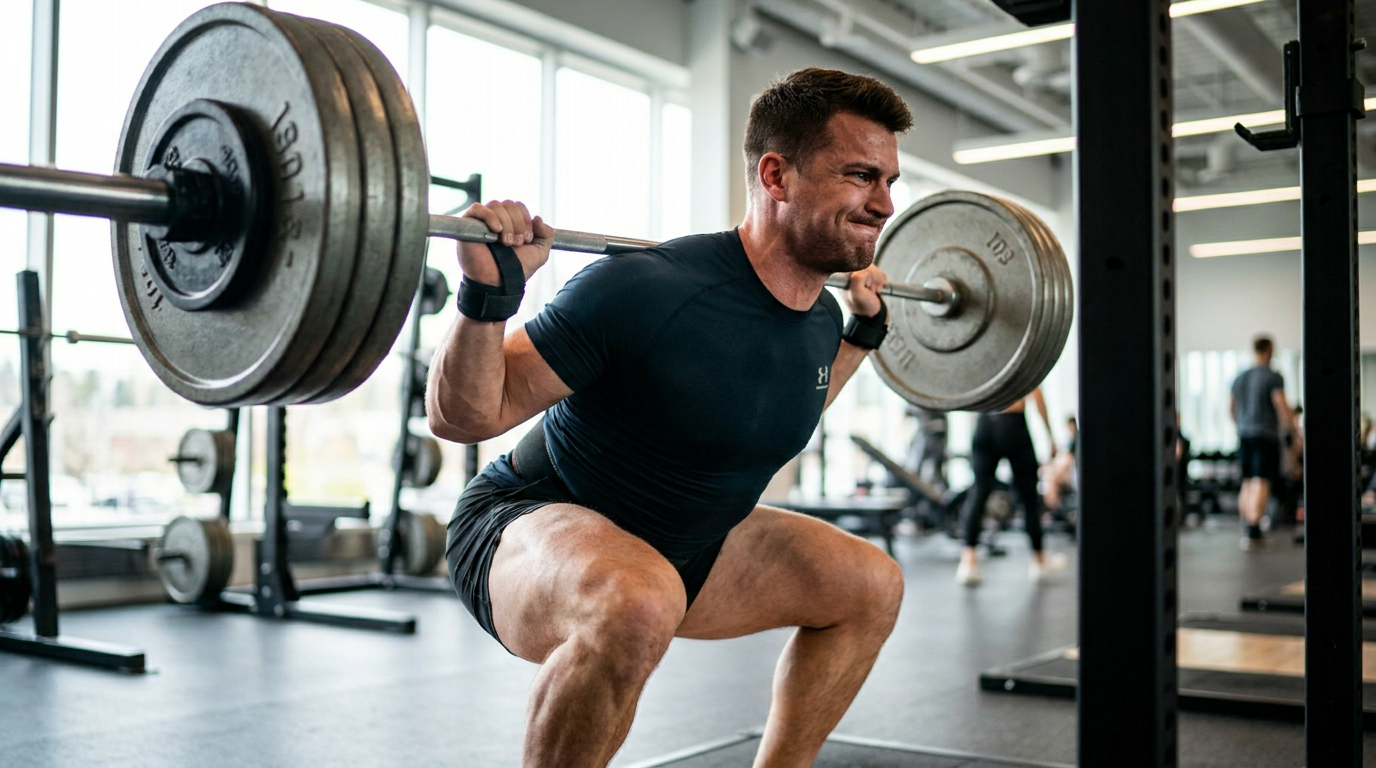
An eccentric contraction occurs when the external force applied to a muscle exceeds the force the muscle itself is generating. Instead of shortening to move a load, the muscle acts as a biological shock absorber, lengthening in a controlled manner to decelerate the weight. Think of the controlled descent of a heavy squat, the lowering of a dumbbell during a bicep curl, or the braking forces absorbed by the quadriceps when running downhill. While it may feel like the "easy" part of a repetition, the physiological cascade triggered by this lengthening under load is profoundly different from concentric lifting.[6]
The most striking biomechanical quirk of the human body is that we are significantly stronger when lowering a weight than when lifting it. Research demonstrates that skeletal muscle can handle loads 105% to 140% heavier during a maximal eccentric contraction compared to a concentric one. Because the body relies on passive structural elements within the muscle fibers to resist the stretch, it can generate massive force without relying entirely on active, energy-consuming cellular motors. This phenomenon, known as "eccentric overload," provides a unique window to expose the nervous system and musculature to tensions they could never achieve through traditional lifting.[4]

This extreme mechanical tension is a potent trigger for muscular hypertrophy—the biological process of building new muscle tissue. A landmark systematic review and meta-analysis of randomized controlled trials found that eccentric training consistently produced superior improvements in muscle thickness and cross-sectional area compared to concentric-only training. When a muscle is forced to lengthen while contracted, the physical strain causes microscopic disruptions to the muscle fibers. These micro-tears, while sounding alarming, are the exact stimulus the body needs to initiate repair, signaling satellite cells to fuse with existing fibers and build them back thicker and stronger.[1][2]
Beyond sheer size, eccentric training alters the very architecture of the muscle. Lengthening contractions preferentially recruit high-threshold motor units—the fast-twitch muscle fibers responsible for explosive power and maximal strength. Because fewer total muscle fibers are recruited during an eccentric movement, the mechanical stress placed on the active fibers is extraordinarily high. This targeted stress forces the nervous system to adapt, improving the efficiency of neural firing rates and leading to rapid gains in overall strength. Studies consistently show that athletes who incorporate heavy eccentric loading see significant improvements in their traditional concentric power.[3][4]
Perhaps the most fascinating aspect of eccentric training is its metabolic efficiency. Despite producing higher force and greater mechanical tension, eccentric contractions require significantly less metabolic energy than concentric contractions. The oxygen demand and ATP (cellular energy) consumption are remarkably low during the lowering phase of a lift. This creates a physiological paradox: the body is performing more total work and experiencing a greater stimulus for growth, yet it is expending less cardiovascular and metabolic effort to do so.[5]

Perhaps the most fascinating aspect of eccentric training is its metabolic efficiency.
This low-energy, high-yield characteristic makes eccentric training a holy grail for longevity and rehabilitation. As humans age, they naturally lose muscle mass and strength—a condition known as sarcopenia—which drastically increases the risk of falls and metabolic disease. Traditional heavy resistance training is often too taxing on the cardiovascular systems or joints of older adults. However, because eccentric exercises demand less oxygen and energy, older populations can safely handle the heavy loads required to stimulate muscle preservation without overwhelming their cardiovascular capacity.[2][5]
The benefits of the "negative" rep extend far beyond the muscle belly, reaching deep into the connective tissues. Tendons, the thick bands of collagen that attach muscle to bone, are notoriously slow to heal and adapt due to their poor blood supply. However, the high mechanical tension of eccentric loading is uniquely effective at stimulating tenocytes—the cells responsible for maintaining tendon structure. Chronic eccentric training increases tendon stiffness and promotes the synthesis of new collagen, making the tissue more resilient to the explosive forces of daily life and athletics.[5]
In fact, eccentric loading has become the gold standard in physical therapy for treating chronic tendinopathies, such as Achilles tendonitis or "jumper's knee" (patellar tendinopathy). By forcing the damaged tendon to lengthen under a controlled load, the tissue is prompted to remodel its disorganized collagen fibers into a stronger, more linear matrix. This rehabilitative success has prompted strength coaches to adopt eccentric protocols not just for recovery, but as a primary tool for injury prevention in healthy individuals.[5][6]

Despite its myriad benefits, eccentric training has a notorious reputation for causing severe delayed-onset muscle soreness (DOMS). Because the lengthening action causes more structural micro-trauma to the muscle fibers than concentric lifting, the subsequent inflammatory repair process can leave individuals feeling stiff and deeply sore 24 to 72 hours after a workout. This intense soreness often discourages beginners from returning to the gym, leading to a misconception that eccentric training is inherently dangerous or overly damaging.[5]
However, the human body possesses a remarkable evolutionary defense mechanism known as the "repeated bout effect." After just a single session of unaccustomed eccentric exercise, the nervous system and muscle architecture rapidly adapt to protect themselves from future damage. If the same eccentric workout is performed a week later, the resulting muscle soreness is drastically reduced, and the markers of muscle damage plummet. This rapid adaptation means that the severe DOMS associated with eccentric training is a temporary hurdle, not a chronic feature of the protocol.[5]
For the everyday gym-goer, harnessing the power of eccentric training does not require complex equipment. The simplest and most accessible method is "tempo training," which involves intentionally slowing down the yielding phase of a standard exercise. By taking three to six seconds to lower a barbell during a bench press or control the descent of a pull-up, lifters can artificially increase the time under tension and reap the hypertrophic benefits of the eccentric phase. This controlled approach also reinforces proper biomechanics, as it is impossible to rely on momentum when moving at a deliberate crawl.[6]

At the elite level, sports scientists are turning to specialized technology to unlock true "eccentric overload." Isoinertial training, which utilizes flywheel devices, has gained massive popularity in professional sports facilities. Instead of lifting a static weight, the athlete pulls against a heavy spinning flywheel. When the concentric pull ends, the flywheel's inertia violently yanks the strap back, forcing the athlete to brake against a load that is dynamically heavier than what they initially pulled. This technology perfectly matches the human strength curve, providing maximal eccentric tension safely and effectively.[6]
As fitness science continues to evolve, the paradigm is shifting from simply moving weight from point A to point B, to understanding how the muscle interacts with resistance throughout the entire range of motion. The concentric phase will always be necessary for completing a lift and generating explosive power. But by respecting and emphasizing the eccentric phase, individuals can unlock a highly efficient pathway to greater strength, denser muscle, and lifelong joint health. The secret to lifting heavier, it turns out, is learning how to lower the weight.[6]
Viewpoints in depth
Sports Scientists
Focus on maximizing mechanical tension to drive muscle hypertrophy and elite strength adaptations.
For researchers focused on athletic performance and muscle growth, the eccentric phase is viewed as the primary driver of structural adaptation. Because the body can handle up to 140% of its concentric one-rep max during the lowering phase, sports scientists advocate for 'eccentric overload' techniques to push the musculature beyond its normal limits. This extreme mechanical tension causes micro-tears in the muscle fibers, which in turn triggers a robust satellite cell response, leading to greater cross-sectional muscle growth than traditional lifting.
Longevity Researchers
Value eccentric training for its ability to preserve muscle mass in older adults with minimal cardiovascular strain.
Experts in aging and sarcopenia view eccentric training through the lens of metabolic efficiency. As humans age, the cardiovascular system often becomes the limiting factor in traditional heavy resistance training. Longevity researchers highlight that eccentric contractions require significantly less oxygen and cellular energy (ATP) than concentric movements. This allows older adults to safely expose their muscles to the high mechanical loads necessary to prevent age-related muscle wasting, without placing dangerous stress on their heart and lungs.
Rehabilitation Specialists
Utilize eccentric loading primarily to remodel damaged tendons and prevent future musculoskeletal injuries.
In the physical therapy clinic, eccentric loading is less about building massive muscles and more about healing stubborn connective tissues. Tendons have poor blood supply and respond best to mechanical strain. Rehabilitation specialists use slow, heavy eccentric exercises to treat chronic conditions like Achilles and patellar tendinopathy. The controlled lengthening forces the disorganized collagen fibers in a damaged tendon to remodel into a stronger, more linear matrix, effectively curing pain and bulletproofing the joint against future injury.
What we don't know
- The exact molecular signaling pathways that differentiate the hypertrophic response of eccentric versus concentric contractions in humans.
- The long-term upper limits of eccentric overload training before central nervous system fatigue outweighs the muscular benefits.
- Whether the 'repeated bout effect' provides the same level of protection against muscle damage in highly trained elite athletes as it does in novices.
Key terms
- Concentric Contraction
- The phase of a muscle contraction where the muscle shortens while generating force, such as lifting a dumbbell during a bicep curl.
- Eccentric Contraction
- The phase where a muscle lengthens under tension to decelerate or control a load, such as slowly lowering a dumbbell.
- Hypertrophy
- The biological process of increasing the size and cross-sectional area of skeletal muscle fibers in response to mechanical tension.
- Sarcopenia
- The age-related, involuntary loss of skeletal muscle mass and strength that increases the risk of falls and metabolic disease.
- Delayed-Onset Muscle Soreness (DOMS)
- The muscle pain and stiffness that typically peaks 24 to 72 hours after performing unaccustomed or intense eccentric exercise.
- Isoinertial Training
- A strength training method using a spinning flywheel to provide constant resistance, allowing for maximal force during both the lifting and lowering phases.
Frequently asked
Do I need special equipment to do eccentric training?
No. While specialized flywheel devices are used by professionals, anyone can achieve eccentric overload by simply slowing down the lowering phase of standard lifts to 3 to 6 seconds.
Why does eccentric training make me so sore?
Lengthening a muscle under heavy load causes more microscopic tears in the muscle fibers than shortening it. This micro-trauma triggers an inflammatory repair process known as delayed-onset muscle soreness (DOMS).
Will I always get extremely sore from these workouts?
No. Thanks to the 'repeated bout effect,' your nervous system and muscle fibers adapt rapidly after just one session. Subsequent eccentric workouts will cause significantly less soreness.
Is eccentric training safe for older adults?
Yes, it is highly recommended. Because eccentric movements require less oxygen and cardiovascular energy, older adults can safely lift the heavier loads needed to prevent muscle loss without overtaxing their hearts.
Sources
Source coverage
6 outlets
3 viewpoints surfaced






[1]University of New MexicoRehabilitation Specialists
Eccentric-Training Controversies, Resolved
Read on University of New Mexico →[2]MDPISports Scientists
Eccentric vs. Concentric Training: A Systematic Review and Meta-Analysis of Randomized Controlled Trials
Read on MDPI →[3]Frontiers in PhysiologySports Scientists
Skeletal Muscle Remodeling in Response to Eccentric vs. Concentric Loading
Read on Frontiers in Physiology →[4]American College of Sports MedicineLongevity Researchers
Focus on Eccentric Loading for Enhancing Muscular Adaptation to Training
Read on American College of Sports Medicine →[5]PubMed CentralRehabilitation Specialists
Eccentric Muscle Contractions: Risks and Benefits
Read on PubMed Central →[6]Factlen Editorial TeamSports Scientists
Synthesis by Factlen editorial team
Read on Factlen Editorial Team →
Every angle. Every day.
Get fitness stories with full source coverage and perspective breakdowns delivered to your inbox.