
Is Climate Change Supercharging El Niño? The Evidence Behind the 2026 Debate
As a potentially record-breaking El Niño emerges in mid-2026, scientists are sharply divided on whether human-driven climate change is directly amplifying the phenomenon's core ocean dynamics or merely worsening its atmospheric impacts.
By Factlen Editorial Team
- Dynamic Amplification Researchers
- Argue that greenhouse warming is fundamentally altering ocean physics, increasing ocean stratification, and making ENSO swings more extreme.
- Historical Variability Climatologists
- Emphasize that current ENSO swings, while severe, still fall within the bounds of long-term paleoclimate records and natural statistical noise.
- Impact & Risk Analysts
- Focus less on the ocean mechanics and more on the undeniable reality that El Niño's atmospheric impacts are compounding in a warmer world.
What's not represented
- · Agricultural sectors in the Global South facing immediate crop failures
- · Insurance actuaries pricing the compounding risks of climate-amplified ENSO events
Why this matters
El Niño dictates global weather patterns, driving multi-billion-dollar agricultural losses, severe droughts, and catastrophic flooding. Understanding whether climate change is permanently amplifying these events is critical for governments and markets trying to prepare for the next decade of extreme weather.
Key points
- A potentially record-breaking El Niño is emerging in mid-2026, sparking intense scientific debate.
- Researchers disagree on whether greenhouse gases are directly strengthening the Pacific Ocean's temperature swings.
- Paleoclimate data shows massive El Niños occurred centuries ago, complicating efforts to link recent extremes solely to human activity.
- There is broad consensus that climate change is worsening the atmospheric impacts, such as floods and droughts.
- The 2026 event is launching from a baseline of unprecedented global ocean heat, creating uncharted territory for climate models.
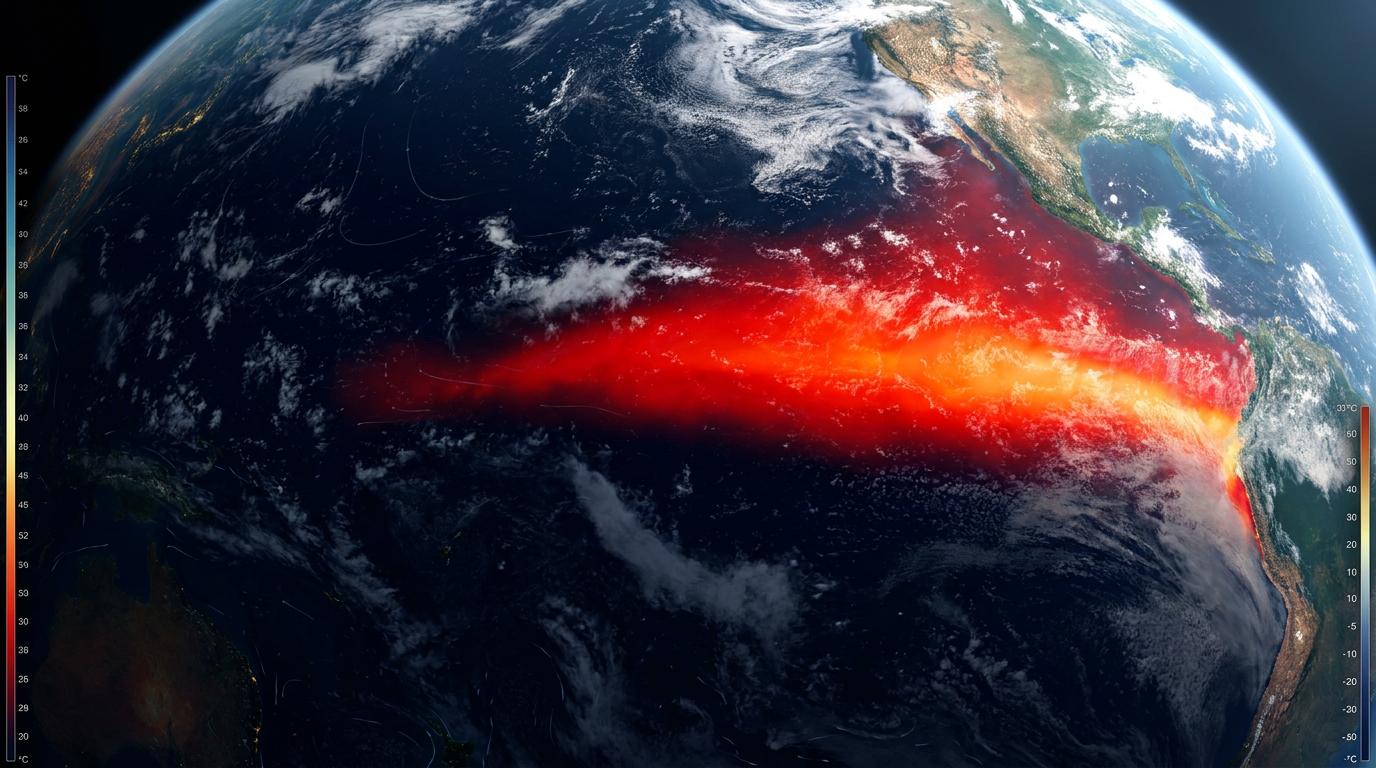
In June 2026, the equatorial Pacific Ocean began exhibiting the unmistakable, rapid warming characteristic of a major El Niño event. As sea surface temperatures spiked well above historical averages, a familiar and high-stakes scientific debate reignited: is human-driven climate change fundamentally supercharging the mechanics of El Niño? The emergence of this potentially record-breaking event has forced climatologists to re-evaluate the boundaries between natural oceanic variability and greenhouse gas amplification.[1][3]
The stakes of this debate extend far beyond academic journals. The El Niño-Southern Oscillation (ENSO) is the single most powerful driver of year-to-year global climate variability. A "super" El Niño can trigger cascading global crises, from devastating droughts in Australia and Indonesia to catastrophic flooding along the western coasts of the Americas. If these events are becoming structurally more intense, global infrastructure and agricultural models are vastly underprepared.[3][6]
To understand the debate, one must first understand the mechanism. Under normal conditions, strong trade winds blow west across the tropical Pacific, pushing warm surface water toward Asia and allowing cold, nutrient-rich water to upwell off the coast of South America. During an El Niño, these trade winds weaken or even reverse. The warm water sloshes back eastward, capping the cold upwelling and releasing massive amounts of heat into the atmosphere.[2]

The core scientific dispute centers on whether greenhouse gas emissions are altering this specific physical mechanism. One camp of researchers argues that the ocean's dynamics are actively changing. They point to recent data suggesting that the amplitude—the extreme highs and lows—of ENSO sea surface temperature anomalies has increased since the mid-20th century, correlating directly with the rise in global carbon emissions.[1][5]
The evidence for this "dynamic amplification" relies heavily on ocean stratification. As the planet warms, the surface of the ocean absorbs the brunt of the heat. This creates a highly buoyant, warm upper layer that resists mixing with the colder, denser water below. Proponents of this theory argue that this steeper temperature gradient makes the ocean more sensitive to wind changes, allowing the surface to heat up much faster and more intensely when the trade winds falter.[5][6]
However, this view is fiercely contested by researchers who emphasize historical natural variability. The Intergovernmental Panel on Climate Change (IPCC) has historically maintained that there is no clear, definitive consensus that climate change is altering the frequency or the core oceanic amplitude of El Niño events. They argue that the ENSO cycle is inherently chaotic and noisy.[4]
However, this view is fiercely contested by researchers who emphasize historical natural variability.
The primary evidence against dynamic amplification comes from paleoclimate records. By analyzing coral cores, tree rings, and ice cores, scientists have reconstructed ENSO patterns going back thousands of years. These records reveal that massive, "super" El Niño events occurred centuries before the Industrial Revolution. For these researchers, the recent string of strong El Niños in 1997, 2015, 2023, and now 2026, while severe, still falls within the statistical bounds of the Earth's natural historical noise.[1][4]

A complicating factor in this debate is the shifting baseline of global ocean temperatures. The oceans have absorbed over 90% of the excess heat trapped by greenhouse gases. Therefore, even if the relative "swing" of an El Niño remains the same as it was a century ago, it is launching from a much higher starting temperature. An average El Niño today results in absolute ocean temperatures that would have been considered extreme in the 1950s.[2][6]
While scientists debate the mechanics of the ocean, there is near-universal consensus on a different, equally critical point: the atmospheric impacts of El Niño are undeniably worsening. Even if the ocean temperature anomaly itself is not supercharged, the atmosphere reacting to that anomaly has fundamentally changed.[1][3][4]
The evidence for worsened impacts is grounded in basic thermodynamics, specifically the Clausius-Clapeyron relation. For every 1°C increase in atmospheric temperature, the air can hold approximately 7% more water vapor. When an El Niño transfers its heat into a warmer modern atmosphere, it supercharges the hydrological cycle. This means that the rainfall delivered to Peru or California is exponentially heavier, and the heatwaves striking Southeast Asia are significantly hotter, regardless of the ocean's exact mechanics.[4][6]

The 2026 El Niño is serving as a real-time stress test for these competing theories. Global ocean heat content reached unprecedented, record-shattering highs in 2024 and 2025. The World Meteorological Organization notes that this current El Niño is developing on top of a global ocean that is already running a severe fever, creating entirely uncharted territory for climate modelers.[2][3]
Some models suggest a "Thermostat Hypothesis," proposing that the Pacific might eventually settle into a permanent El Niño-like state as warming continues. Conversely, other models predict that the warming pattern might actually strengthen the trade winds over time, pushing the system toward more frequent La Niña (cooling) events. The divergence in these models highlights the profound uncertainty still present in long-term ENSO forecasting.[5][6]
Ultimately, the debate over whether climate change is supercharging El Niño hinges on how one defines "supercharging." If the definition requires proof that greenhouse gases are altering the fundamental wind and upwelling mechanics of the Pacific, the evidence remains contested and obscured by natural variability.[1][6]

But if "supercharging" is defined by the severity of the consequences experienced by human populations—the depth of the droughts, the volume of the floods, and the intensity of the heatwaves—the scientific consensus is clear. The compounding risks of El Niño in a warming world are already locked in, making the exact mechanics of the ocean a secondary concern to the immediate need for global adaptation.[3][4][6]
How we got here
1997-1998
The first modern 'super' El Niño causes widespread global disruption, raising initial scientific questions about potential climate links.
2015-2016
Another massive El Niño shatters global temperature records, prompting deeper research into ocean stratification and ENSO variability.
2021
The IPCC AR6 report concludes there is no clear consensus that climate change alters ENSO frequency, but confirms impacts are worsening.
June 2026
A new, highly anomalous El Niño begins rapidly developing, reigniting the scientific debate with fresh, extreme data.
Viewpoints in depth
The Amplification Camp
Researchers who argue that greenhouse warming is fundamentally altering the physics of the Pacific Ocean.
This perspective relies heavily on recent oceanographic data showing increased stratification. Because the surface ocean is absorbing so much heat, it becomes highly buoyant and resists mixing with deeper, cooler waters. Proponents argue this makes the surface layer hyper-sensitive to changes in wind patterns. When trade winds weaken, this thin, hot layer can warm up much faster and reach higher absolute temperatures than it could in the past, effectively supercharging the core mechanics of the El Niño anomaly.
The Natural Variability Camp
Climatologists who emphasize that current ENSO swings are still within historical norms.
Drawing on deep paleoclimate records from coral reefs and ice cores, this camp points out that the Earth has experienced massive, disruptive El Niño events for millennia. They argue that the climate system is inherently noisy, and the recent cluster of strong El Niños is not statistically significant enough to prove a permanent shift in ocean dynamics. From this viewpoint, blaming the mechanics of El Niño on climate change risks oversimplifying a chaotic, naturally occurring cycle.
The Impact-Focused Consensus
Analysts who focus on the compounding damages caused by El Niño in a warmer atmosphere.
Regardless of whether the ocean anomaly itself is 10% stronger or perfectly average, this perspective highlights that the atmosphere reacting to the ocean has fundamentally changed. Because a warmer atmosphere holds more water vapor, the rainfall triggered by an El Niño is exponentially heavier. Conversely, the heatwaves it exacerbates are hotter. For policymakers and risk analysts, the debate over ocean mechanics is secondary to the undeniable reality that the real-world consequences of El Niño are becoming more destructive.
What we don't know
- Whether the frequency of 'super' El Niño events will permanently increase in a +2.0°C warmed world.
- How the melting of polar ice and changes in global ocean circulation will feedback into the ENSO cycle over the next century.
- Whether the Pacific Ocean will eventually settle into a permanent El Niño-like state, as suggested by the 'Thermostat Hypothesis'.
Key terms
- ENSO
- The El Niño-Southern Oscillation, a recurring climate pattern involving changes in the temperature of waters in the central and eastern tropical Pacific Ocean.
- Sea Surface Temperature (SST) Anomaly
- The difference between the current temperature of the ocean surface and its long-term historical average.
- Thermocline
- The transition layer in the ocean between the warmer, mixed water at the surface and the cooler deep water below.
- Clausius-Clapeyron relation
- A physical law dictating that warmer air can hold more water vapor, which leads to more extreme precipitation events as global temperatures rise.
Frequently asked
What exactly is El Niño?
It is the warm phase of the El Niño-Southern Oscillation (ENSO) cycle, characterized by the weakening of trade winds and the abnormal warming of the central and eastern equatorial Pacific Ocean.
Does climate change cause El Niño?
No. El Niño is a naturally occurring climate pattern that has existed for thousands of years. The current scientific debate is focused on whether climate change makes these natural events stronger or more frequent.
How will the 2026 El Niño affect global weather?
While impacts vary, strong El Niños typically bring heavier rainfall and flooding to the southern United States and parts of South America, while causing severe droughts in Australia, Indonesia, and southern Africa.
Sources
Source coverage
6 outlets
3 viewpoints surfaced






[1]The New York TimesDynamic Amplification Researchers
Is Climate Change Supercharging El Niño?
Read on The New York Times →[2]NOAA Climate.govHistorical Variability Climatologists
El Niño/Southern Oscillation (ENSO) Diagnostic Discussion
Read on NOAA Climate.gov →[3]World Meteorological OrganizationImpact & Risk Analysts
WMO Update: El Niño Conditions Emerge in Pacific
Read on World Meteorological Organization →[4]IPCCHistorical Variability Climatologists
Climate Change 2021: The Physical Science Basis (ENSO Chapter)
Read on IPCC →[5]NatureDynamic Amplification Researchers
Increased ENSO variability under greenhouse warming
Read on Nature →[6]Factlen Editorial TeamImpact & Risk Analysts
Synthesis by Factlen editorial team
Read on Factlen Editorial Team →
Every angle. Every day.
Get science stories with full source coverage and perspective breakdowns delivered to your inbox.