
Supreme Court Cements Human Authorship Requirement, Exposing Businesses to AI Copyright Liability
The U.S. Supreme Court has cemented the legal requirement for human authorship by denying an appeal to copyright purely AI-generated art. The decision leaves businesses navigating a perilous new landscape of public domain vulnerabilities and direct infringement liabilities.
By Factlen Editorial Team
- AI Developers & Tech Industry
- Argues that training models is a transformative fair use and that strict copyright enforcement will cripple U.S. technological competitiveness.
- Publishers & Creators
- Argues that AI training constitutes mass infringement and that generative models act as illegal commercial substitutes for their original work.
- Legal & Regulatory Consensus
- Focuses on the strict statutory interpretation of the Copyright Act, maintaining that intellectual property rights are exclusively reserved for human beings.
What's not represented
- · Open-source AI developers
- · International copyright regulators
Why this matters
The Supreme Court's refusal to recognize AI authorship means any unedited AI-generated content your business creates immediately enters the public domain for competitors to use. Furthermore, companies deploying these tools now bear direct legal liability if the AI's output infringes on existing copyrights, fundamentally changing how corporate legal and marketing teams must operate.
Key points
- The Supreme Court denied an appeal to grant copyright to an AI-generated artwork, cementing the human authorship requirement.
- Purely AI-generated content cannot be copyrighted and immediately enters the public domain.
- Businesses using AI tools face direct liability if the generated output infringes on existing copyrights.
- Major publishers filed a class-action lawsuit against Meta in May 2026 over the use of copyrighted training data.
- The tech industry argues that training AI models falls under the 'fair use' doctrine, a claim yet to be definitively resolved by the courts.
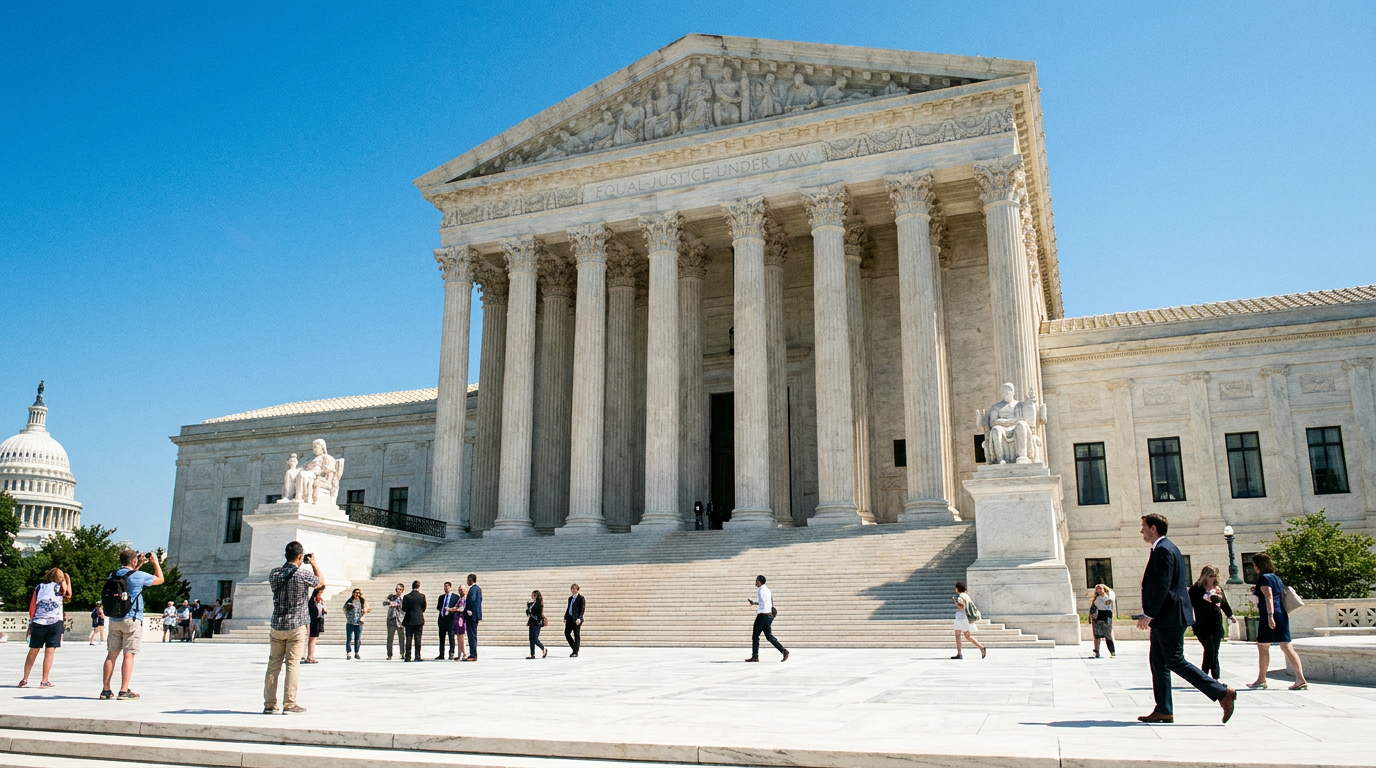
The legal foundation of the generative artificial intelligence economy is rapidly solidifying in mid-2026, and the resulting framework places significant new burdens on businesses and creators. On March 2, 2026, the United States Supreme Court quietly denied certiorari in Thaler v. Perlmutter, ending a highly watched, years-long legal battle over whether an artificial intelligence system can hold a copyright. By refusing to hear the appeal, the Court left intact a definitive ruling from the U.S. Court of Appeals for the District of Columbia Circuit, which established that human authorship is a "bedrock requirement" of American copyright law. For companies integrating generative models into their daily workflows, the decision establishes a stark reality: works created exclusively by autonomous software are fundamentally incapable of receiving intellectual property protection.[2][3]
The litigation was intentionally designed as a boundary-testing legal vehicle. Dr. Stephen Thaler, a computer scientist, developed a generative AI system he named the "Creativity Machine." In 2018, the software autonomously generated a piece of visual art titled "A Recent Entrance to Paradise." Thaler submitted a copyright registration application to the U.S. Copyright Office, explicitly listing the Creativity Machine as the sole author and himself as the owner of the machine. He openly conceded in his application that the submission "lacked traditional human authorship," arguing instead that property rights should flow from the machine to its owner under a modernized interpretation of the law.[2][5]
The U.S. Copyright Office firmly rejected Thaler's application in 2019, sparking the federal lawsuit. In its defense, the Office relied heavily on foundational jurisprudence, specifically citing the 1884 Supreme Court decision in Burrow-Giles Lithographic Co. v. Sarony. In that 19th-century case, which determined that photographs could be copyrighted despite being produced by a machine (a camera), the Court ruled that the protection stemmed from the human photographer's intellectual labor—posing the subject, selecting the lighting, and framing the shot. The Copyright Office argued that, unlike a camera wielded by a human, Thaler's Creativity Machine operated autonomously, severing the necessary link between human intellect and the final creative expression.[5]
When the case reached the D.C. Circuit in 2025, the appellate panel conducted a rigorous statutory analysis of the Copyright Act of 1976. Circuit Judge Patricia A. Millett, writing for the court, noted that while the Act does not explicitly define the word "author," its structural provisions inherently assume a human being. For example, the law measures the duration of a copyright by the author's lifespan, requires joint authors to possess mutual intent, and mandates signatures for registration—capacities that only natural persons possess. The court concluded that Congress clearly intended to limit copyright to human creators, effectively closing the door on machine authorship under current statutes.[2][5]

Thaler's defeat at the Supreme Court mirrors a parallel failure in the realm of patent law. Thaler had previously filed patent applications listing another of his AI systems, DABUS, as the sole inventor of a new beverage container and a flashing light beacon. The U.S. Patent and Trademark Office (USPTO) refused the applications, a decision ultimately affirmed by the Federal Circuit in Thaler v. Vidal. The Supreme Court similarly declined to hear that case. To reinforce this stance, the USPTO issued updated guidance in late 2025 explicitly stating that only natural persons can be named as inventors, even in cases where artificial intelligence plays a highly significant role in the inventive process.[4]
While the Supreme Court's denial provides definitive clarity on purely autonomous AI outputs, it leaves a massive legal gray area regarding AI-assisted human creativity. The D.C. Circuit explicitly noted that its ruling does not prohibit copyrighting works made "with the assistance of artificial intelligence." The rule merely requires that the author be the human who "created, operated, or used" the tool. However, because Thaler intentionally disclaimed any human creative input to force a ruling on machine authorship, the courts were not required to establish a standard for exactly how much human involvement is necessary to cross the threshold into copyrightability.[2][5]
While the Supreme Court's denial provides definitive clarity on purely autonomous AI outputs, it leaves a massive legal gray area regarding AI-assisted human creativity.
This unresolved boundary is currently the source of intense friction between creators and the U.S. Copyright Office. Under current Office guidelines, applicants must explicitly disclose the inclusion of AI-generated content in their works and disclaim protection for those specific components. A human author can copyright the specific arrangement or heavy modification of AI outputs, but the underlying raw generation remains unprotected. Intellectual property lawyers are now advising businesses that they must meticulously document their creative processes—saving prompt histories, iterative edits, and human-directed structural choices—to prove sufficient human authorship in the event of a legal challenge.[1][3][7]
The inability to copyright raw AI outputs creates a severe vulnerability for the corporate sector. If a marketing agency uses an AI tool to generate a comprehensive advertising campaign, or a software firm uses an AI coding assistant to write a proprietary algorithm without meaningful human modification, that content enters the public domain immediately upon creation. According to legal analysts, this means that competitors can legally copy, reuse, or reverse-engineer those assets without facing any copyright infringement penalties. The traditional intellectual property moats that businesses rely on to protect their investments are effectively bypassed.[1][6]
Beyond the loss of protection, businesses utilizing generative tools are now exposed to direct liability risks. Intellectual property attorneys warn that if an AI system generates output that closely mirrors copyrighted training data, the company deploying the tool—not just the developer of the underlying model—is legally responsible for the infringement. The user is considered the responsible party for publishing or commercializing the infringing material. This creates a perilous environment for marketing teams, developers, and content creators who may unknowingly generate and publish protected expressions.[1]

This liability risk is compounding rapidly as the legal battles over the data used to train these models escalate into existential threats for AI developers. In May 2026, a powerful coalition of major publishers—including Hachette, MacMillan, McGraw-Hill, and Elsevier—alongside prominent authors like Scott Turow, filed a landmark class-action lawsuit against Meta. The plaintiffs allege that Meta unlawfully ingested millions of copyrighted books and academic materials to train its Llama series of large language models, specifically pointing to the use of controversial, pirated data repositories.[1][4]
The publishers' lawsuit represents a significant escalation from earlier, smaller-scale creator disputes, bringing the massive legal and financial resources of legacy publishing to bear against the frontier AI industry. The plaintiffs argue that the models serve as commercial substitutes for the original works, capable of summarizing, mimicking, or reproducing the authors' expressions. By ingesting this data without permission or compensation, the publishers claim, AI developers are executing the largest mass copyright infringement in history, directly undermining the economic foundation of the publishing industry.[1][6]
Meta and other leading AI developers are mounting a vigorous defense rooted in the "fair use" doctrine of U.S. copyright law. They argue that training a large language model is a highly transformative process that extracts statistical patterns, syntax rules, and uncopyrightable facts, rather than copying the expressive content of the original works for direct reproduction. The technology industry contends that restricting access to training data would effectively cripple the development of advanced artificial intelligence in the United States, ceding technological leadership to nations with more permissive data-mining laws.[1][6]

The uncertainty surrounding the fair use defense remains the most significant unresolved question in global AI policy. While technology companies frequently point to the early 2010s Authors Guild v. Google case—which permitted Google to scan books to create a searchable database—publishers argue that generative AI is fundamentally different because it generates new, competing market substitutes. Until the Supreme Court or Congress explicitly addresses whether ingesting copyrighted data for model training constitutes fair use, the entire generative AI ecosystem operates under a cloud of profound legal peril.[1][6]
In the interim, the combination of the Thaler precedent and the looming training-data litigation is forcing a rapid shift in corporate behavior. Enterprise software vendors are increasingly offering complex indemnification clauses to protect their enterprise clients from third-party copyright claims, though these often come with strict usage conditions. Simultaneously, corporate legal departments are drafting stringent internal policies governing how employees can use generative tools, mandating human-in-the-loop review processes. The era of unregulated, experimental AI deployment is rapidly closing, replaced by a compliance-driven environment where the provenance of every digital asset must be tracked, verified, and legally defended.[1][3][6]
How we got here
1884
The Supreme Court rules in Burrow-Giles that human intellectual labor is required for copyright, using a camera as an example of a tool.
Nov 2018
Dr. Stephen Thaler applies for copyright for an AI-generated artwork, listing the machine as the author.
Aug 2019
The U.S. Copyright Office rejects Thaler's application due to a lack of human authorship.
Mar 2025
The D.C. Circuit Court of Appeals affirms that the Copyright Act requires human authorship.
Mar 2026
The Supreme Court denies certiorari in Thaler v. Perlmutter, cementing the lower court rulings.
May 2026
Major publishers file a landmark class-action copyright infringement lawsuit against Meta over AI training data.
Viewpoints in depth
AI Developers' View
Argues that training models is a transformative fair use essential for technological progress.
The technology industry contends that training a large language model is fundamentally different from copying a book to sell it. They argue the process is highly transformative, extracting statistical patterns, syntax rules, and uncopyrightable facts rather than reproducing expressive content. Developers warn that if the courts reject the fair use defense, it would effectively cripple the development of advanced artificial intelligence in the United States, forcing companies to move operations to countries with more permissive data-mining laws.
Publishers and Creators' View
Argues that AI training is mass infringement that creates illegal commercial substitutes.
Publishers and authors view the ingestion of their copyrighted works as the largest mass infringement event in history. They point to the use of controversial, pirated data repositories (such as the Books3 dataset) as evidence of unlawful behavior. Crucially, they argue that generative models act as direct commercial substitutes for their original work, capable of summarizing or mimicking their unique expressions, thereby undermining the economic foundation of the publishing industry and failing the fair use test.
Corporate Adopters' View
Focuses on mitigating the severe liability risks and operational burdens of using AI tools.
For businesses deploying AI, the legal debate translates directly into operational risk. Corporate legal departments are deeply concerned about the strict liability they face if an employee generates and publishes infringing content using an enterprise AI tool. In response, companies are demanding robust indemnification clauses from AI vendors, restricting the use of unapproved generative tools, and implementing strict documentation requirements to prove human-in-the-loop involvement for any asset they wish to copyright.
What we don't know
- Exactly how much human prompting, editing, or direction is required to cross the threshold into copyrightability for an AI-assisted work.
- Whether the Supreme Court will ultimately rule that training large language models on copyrighted data constitutes fair use or infringement.
- How the U.S. Copyright Office will handle the massive influx of applications requiring complex disclosures of AI-generated components.
Key terms
- Certiorari
- A formal request for the Supreme Court to review a decision of a lower court. Denying it leaves the lower court's ruling in place.
- Fair Use
- A legal doctrine in U.S. copyright law that permits limited use of copyrighted material without permission for purposes such as criticism, news reporting, teaching, or research.
- Public Domain
- Creative materials that are not protected by intellectual property laws and can be freely used by anyone.
- Indemnification
- A contractual obligation where one party agrees to compensate the other for certain damages or losses, often used by AI vendors to protect clients from copyright lawsuits.
- Transformative Use
- A key factor in fair use analysis that asks whether the new work adds new expression, meaning, or message to the original material.
Frequently asked
Can I copyright an image generated by Midjourney or DALL-E?
No. Under current U.S. law, works created exclusively by artificial intelligence without meaningful human creative input cannot be copyrighted.
What happens if my company uses AI to write code or marketing copy?
That unedited content immediately enters the public domain, meaning competitors can legally copy it. Furthermore, your company could be liable if the AI output infringes on existing copyrights.
Can I get a copyright if I heavily edit the AI's output?
Yes, but only for the portions you personally authored or modified. You must disclose the use of AI in your copyright application and disclaim the AI-generated components.
Why are publishers suing AI companies like Meta?
Publishers allege that AI developers unlawfully used millions of copyrighted books and articles to train their models without permission or compensation, arguing this constitutes mass copyright infringement.
Sources
Source coverage
7 outlets
3 viewpoints surfaced





[1]ForbesPublishers & Creators
Supreme Court Ruling Leaves Businesses Liable For AI Content
Read on Forbes →[2]Baker DonelsonLegal & Regulatory Consensus
Supreme Court Denies Review in Thaler v. Perlmutter
Read on Baker Donelson →[3]Morgan LewisLegal & Regulatory Consensus
Supreme Court Declines to Review AI Copyright Case
Read on Morgan Lewis →[4]Holland & KnightLegal & Regulatory Consensus
Supreme Court Refuses to Hear Case on AI Authorship and Inventorship
Read on Holland & Knight →[5]Constitution CenterLegal & Regulatory Consensus
Supreme Court ends bid for AI copyright
Read on Constitution Center →[6]Factlen Editorial TeamAI Developers & Tech Industry
Synthesis by Factlen editorial team
Read on Factlen Editorial Team →[7]U.S. Copyright OfficeLegal & Regulatory Consensus
Copyright Registration Guidance: Works Containing Material Generated by Artificial Intelligence
Read on U.S. Copyright Office →


Every angle. Every day.
Get ai stories with full source coverage and perspective breakdowns delivered to your inbox.