
Meta Quest 3 vs. Apple Vision Pro: Which Mixed Reality Headset Fits Your Workflow?
While Apple's Vision Pro dominates in display fidelity and productivity, Meta's Quest 3 remains the undisputed champion of gaming and value. A side-by-side look at how the two leading headsets compare for developers, gamers, and professionals in 2026.
By Factlen Editorial Team
- VR Gaming Traditionalists
- Focus on tactile controllers, affordable hardware, and massive game libraries.
- Spatial Computing Advocates
- Focus on high-fidelity displays and seamless ecosystem integration for productivity.
- Mixed Reality Pragmatists
- Focus on the actual value-to-cost ratio and practical daily use cases.
What's not represented
- · Budget-conscious consumers priced out of both ecosystems
- · Educators looking for classroom deployment solutions
Why this matters
Choosing the right mixed reality headset dictates whether you are investing in a high-end spatial productivity tool or an active gaming console. Understanding these trade-offs prevents costly mistakes and ensures the hardware actually matches your daily workflow.
Key points
- The $3,499 Apple Vision Pro excels in spatial computing, offering micro-OLED displays that serve as a genuine laptop replacement.
- The $499 Meta Quest 3 dominates the gaming market, featuring physical controllers and a massive library of dedicated VR titles.
- Apple's headset weighs up to 650 grams and uses a tethered battery, while Meta's 515-gram headset is fully wireless.
- Both devices offer full-color mixed reality passthrough, but Apple prioritizes visual fidelity while Meta focuses on spatial awareness.
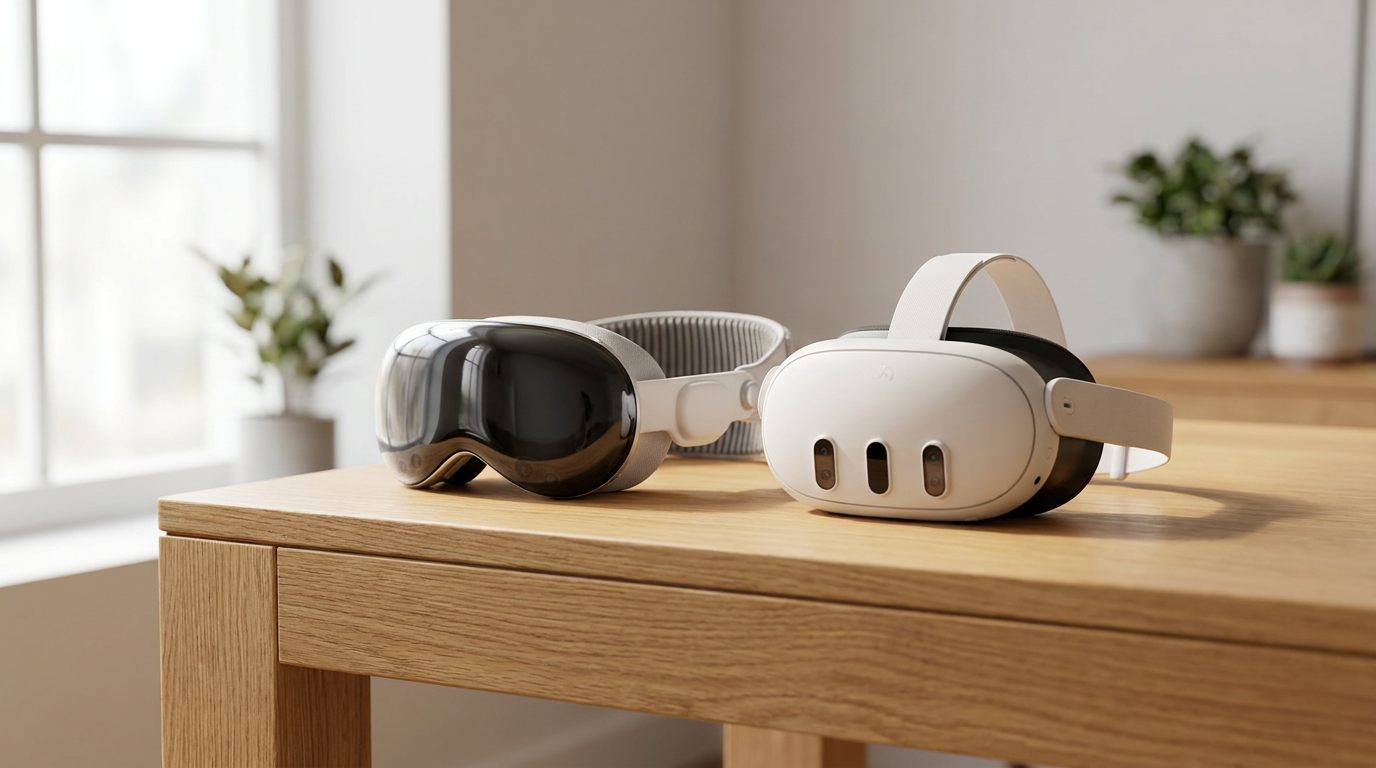
The mixed reality landscape in 2026 is defined by two fundamentally different philosophies. On one side sits the Apple Vision Pro, an ultra-premium spatial computer designed to integrate seamlessly into the Apple ecosystem. On the other is the Meta Quest 3, a mass-market standalone headset built to dominate virtual reality gaming.[1][2]
The price gap immediately establishes the stakes of this comparison. At $3,499, the Vision Pro costs roughly seven times as much as the $499 Quest 3. This massive delta is not merely an Apple brand tax; it reflects two entirely different hardware architectures, component costs, and intended audiences.[1][5]
For the Apple Vision Pro, the primary 'for' argument centers on its unparalleled display technology. The headset utilizes dual micro-OLED panels that pack over 23 million pixels combined, delivering an estimated 3,660 by 3,142 resolution per eye. The evidence for this advantage is overwhelming: text renders with the clarity of printed paper, and movies appear as if viewed in a private IMAX theater, making it a viable laptop replacement.[1][3][4]

Against the Apple Vision Pro, the core trade-offs involve ergonomics and power logistics. The device features a luxurious aluminum and glass build, but this pushes its weight to between 600 and 650 grams, leading to documented neck fatigue during extended use. Furthermore, it relies on a tethered external battery pack that provides only about two hours of general use, restricting true wireless freedom.[3][5]
For the Meta Quest 3, the strongest 'for' argument highlights its unmatched gaming ecosystem and ergonomic practicality. Weighing a lighter 515 grams with a balanced plastic chassis, it is built specifically for active movement and longer play sessions. The evidence lies in its massive, mature library of dedicated VR titles, fitness applications, and social platforms that Apple's app-focused ecosystem currently cannot match.[1][2][3][5]
Against the Meta Quest 3, the primary limitation is its display resolution and reliance on LCD technology. With roughly 2,064 by 2,208 pixels per eye, the visuals are sharp enough for gaming but fall short for intensive, text-heavy productivity. Because LCD panels cannot turn off individual pixels like OLEDs, black levels appear slightly gray in dark scenes, reducing the overall cinematic immersion.[1][3][4]
Evidence regarding input methods further divides the two devices. The Vision Pro relies entirely on a combination of eye tracking and hand gestures, powered by its M2 and R1 chips. This interface feels magical and intuitive for navigating menus or spatial apps, but the lack of physical controllers makes fast-paced, precision gaming nearly impossible without pairing a third-party Bluetooth gamepad.[1][3][4]

Evidence regarding input methods further divides the two devices.
Conversely, the Quest 3 ships with Touch Plus controllers that provide the haptic feedback and sub-millimeter precision required for active VR gaming. While Meta has significantly improved its own hand-tracking capabilities using the Snapdragon XR2 Gen 2 processor, the controllers remain the primary and superior interface, ensuring that gamers have the tactile response they need for competitive play.[2][3][4]
Ecosystem integration represents another major divergence in the 'for' arguments. The Vision Pro seamlessly syncs with the iPhone, iPad, and Mac, allowing users to pull their MacBook displays into a massive virtual workspace instantly. It is a closed but highly polished environment tailored specifically for existing Apple power users who want their digital lives to carry over effortlessly.[3][5]
The Quest 3 champions flexibility over seamless proprietary integration. It can connect to a PC via Link cables or wireless Air Link to play high-end SteamVR games, effectively doubling as a dedicated PC VR headset. This open approach appeals heavily to developers and gamers who want to leverage their existing Windows hardware rather than being locked into a single corporate ecosystem.[1][2]

When examining mixed reality passthrough, both headsets offer full-color views of the real world, but with different priorities. Apple prioritizes dynamic range and color accuracy, utilizing its high-resolution RGB cameras to minimize the screen door effect and make virtual objects look truly grounded in your physical environment.[4][5]
Meta's passthrough is highly functional and a massive upgrade over the grayscale Quest 2, but it is optimized for spatial awareness during active use rather than photorealism. Developers have successfully used the Quest 3's depth projector to create engaging mixed reality games that map to the user's furniture, proving its capability despite exhibiting some grain and warping in lower light conditions.[4][5]
The Apple Vision Pro fits well when your primary goal is spatial computing, high-end media consumption, or extending a Mac workflow into a private, infinite canvas. It is the ultimate device for early adopters, developers, and professionals who can justify the premium price for cutting-edge micro-OLED clarity and seamless Apple ecosystem integration.[1][3]
The Apple Vision Pro does not fit well when you want to play active VR games, engage in virtual fitness, or share the headset easily with family members. Its heavier weight, tethered battery pack, and lack of dedicated motion controllers make it poorly suited for the physical, room-scale experiences that define traditional virtual reality.[1][4]

The Meta Quest 3 fits well when you want the best overall value in virtual reality, prioritizing gaming, fitness, and social experiences. It is the definitive choice for anyone looking to explore VR without tethering to a computer or draining their savings, offering a massive library of optimized content and excellent motion controls.[1][2]
The Meta Quest 3 does not fit well when you need to read small text for eight hours a day, edit professional video, or demand the absolute highest visual fidelity available. It is a gaming console first and a productivity device second, and its LCD panels simply cannot compete with Apple's micro-OLED screens for sheer cinematic clarity.[1][3]
How we got here
June 2023
Both the Meta Quest 3 and Apple Vision Pro are officially announced within days of each other.
October 2023
Meta Quest 3 launches globally, establishing a new baseline for consumer mixed reality.
February 2024
Apple Vision Pro ships to early adopters, introducing micro-OLED spatial computing to the market.
Mid-2026
Both ecosystems mature, with Meta dominating the gaming sector and Apple solidifying its productivity niche.
Viewpoints in depth
Spatial Computing Advocates
This camp views headsets as the next evolution of the personal computer.
Proponents of Apple's approach argue that visual fidelity and frictionless ecosystem integration are the only ways to achieve mainstream adoption for daily productivity. They point to the Vision Pro's micro-OLED screens and seamless Mac integration as proof that headsets can replace traditional monitors, arguing that gaming is merely a secondary use case compared to enterprise and creative workflows.
VR Gaming Traditionalists
This camp believes that tactile feedback and active movement are the core of virtual reality.
Gaming traditionalists argue that without physical controllers, a headset cannot deliver the precision required for compelling interactive experiences. They view the Quest 3 as the superior device because it prioritizes a massive library of optimized games, affordable pricing, and the haptic feedback necessary for room-scale movement, dismissing eye-tracking-only interfaces as too limiting for complex software.
Enterprise Developers
This camp focuses on the commercial viability of building applications for each platform.
Developers are currently navigating a bifurcated market. They recognize that the Vision Pro offers a high-margin audience willing to pay premium prices for productivity tools, but its small user base limits overall revenue. Conversely, the Quest 3 provides a massive, established install base, making it the default choice for studios that need high-volume sales to sustain development costs.
What we don't know
- How quickly Apple can incentivize developers to build dedicated, high-margin spatial applications rather than simple iOS ports.
- Whether Meta will eventually release a higher-end 'Pro' successor that bridges the display gap with micro-OLED technology.
Key terms
- Micro-OLED
- A highly advanced display technology that packs millions of pixels into a tiny physical space, offering true blacks and immense clarity.
- Passthrough
- A feature that uses external cameras on a headset to show the user a real-time video feed of their physical surroundings.
- Spatial Computing
- Apple's preferred term for mixed reality, emphasizing the ability to run applications and virtual screens seamlessly within the physical environment.
- LCD (Liquid Crystal Display)
- A standard display technology used in the Quest 3 that relies on a backlight, making it affordable but less capable of displaying true black colors compared to OLED.
- Field of View (FoV)
- The extent of the observable virtual world seen at any given moment through the headset lenses.
Frequently asked
Can I play SteamVR games on the Apple Vision Pro?
No, the Vision Pro does not natively support PC VR gaming like SteamVR. The Meta Quest 3, however, can connect to a PC via Link or Air Link to play SteamVR titles.
Does the Meta Quest 3 require a Facebook account?
No, Meta removed the strict Facebook account requirement. You now use a standard Meta account to log in and manage your device.
Can I wear glasses with the Apple Vision Pro?
The Vision Pro does not fit over standard glasses. Users must purchase custom Zeiss optical inserts that magnetically attach to the lenses. The Quest 3 has an adjustable depth spacer to accommodate most glasses.
Which headset has better battery life?
Both headsets offer roughly 2 to 2.5 hours of battery life. The Quest 3 has an internal battery, while the Vision Pro uses a tethered external battery pack.
Sources
Source coverage
6 outlets
3 viewpoints surfaced






[1]VR.orgVR Gaming Traditionalists
The Quest 3 and the Apple Vision Pro are not really rivals
Read on VR.org →[2]PCMagVR Gaming Traditionalists
The Best VR Headsets for 2026
Read on PCMag →[3]AppleInsiderSpatial Computing Advocates
Apple Vision Pro versus Meta Quest 3 - The differences are clear
Read on AppleInsider →[4]MashableMixed Reality Pragmatists
Apple Vision Pro vs. Meta Quest 3: Which headset is right for you?
Read on Mashable →[5]LaptopMagSpatial Computing Advocates
Meta Quest 3 vs Apple Vision Pro: Mismatch or close fight?
Read on LaptopMag →[6]VR CompareMixed Reality Pragmatists
Meta Quest 3 vs Apple Vision Pro (Comparison)
Read on VR Compare →


Every angle. Every day.
Get meta stories with full source coverage and perspective breakdowns delivered to your inbox.