
IMAX with Laser vs. Dolby Cinema: Choosing the Best Premium Movie Format
As premium large formats dominate the theatrical landscape, choosing between IMAX's massive scale and Dolby Cinema's visual precision depends entirely on how the movie was made.
By Factlen Editorial Team
- Scale and Immersion Purists
- Argues that sheer screen size and expanded aspect ratios are the defining traits of a premium theatrical experience.
- Fidelity and Comfort Advocates
- Prioritizes perfect black levels, high dynamic range, precise spatial audio, and plush recliners over raw screen size.
- Format Agnostics
- Believes the choice entirely depends on the specific camera equipment used by the director, advocating for IMAX only when natively shot for it.
What's not represented
- · Independent theater owners unable to afford premium format licensing
- · Cinematographers who prefer standard 35mm film projection
Why this matters
Premium movie tickets now cost upwards of $20, making the choice of theater format a significant entertainment investment. Understanding the technical differences ensures you get the best possible visual and audio experience for your money.
Key points
- Dolby Cinema utilizes dual 4K lasers and Dolby Vision HDR to achieve an unmatched 1,000,000:1 contrast ratio.
- IMAX with Laser focuses on massive scale, offering expanded aspect ratios that display up to 26 percent more image.
- Dolby Atmos provides precise, 360-degree object-based audio, while IMAX delivers a powerful, bone-rattling 12-channel sound system.
- Dolby auditoriums feature plush reclining seats, whereas IMAX uses steep stadium seating to optimize sightlines.
- Movies explicitly shot with IMAX cameras are best viewed in IMAX, while standard releases often look better in Dolby Cinema.
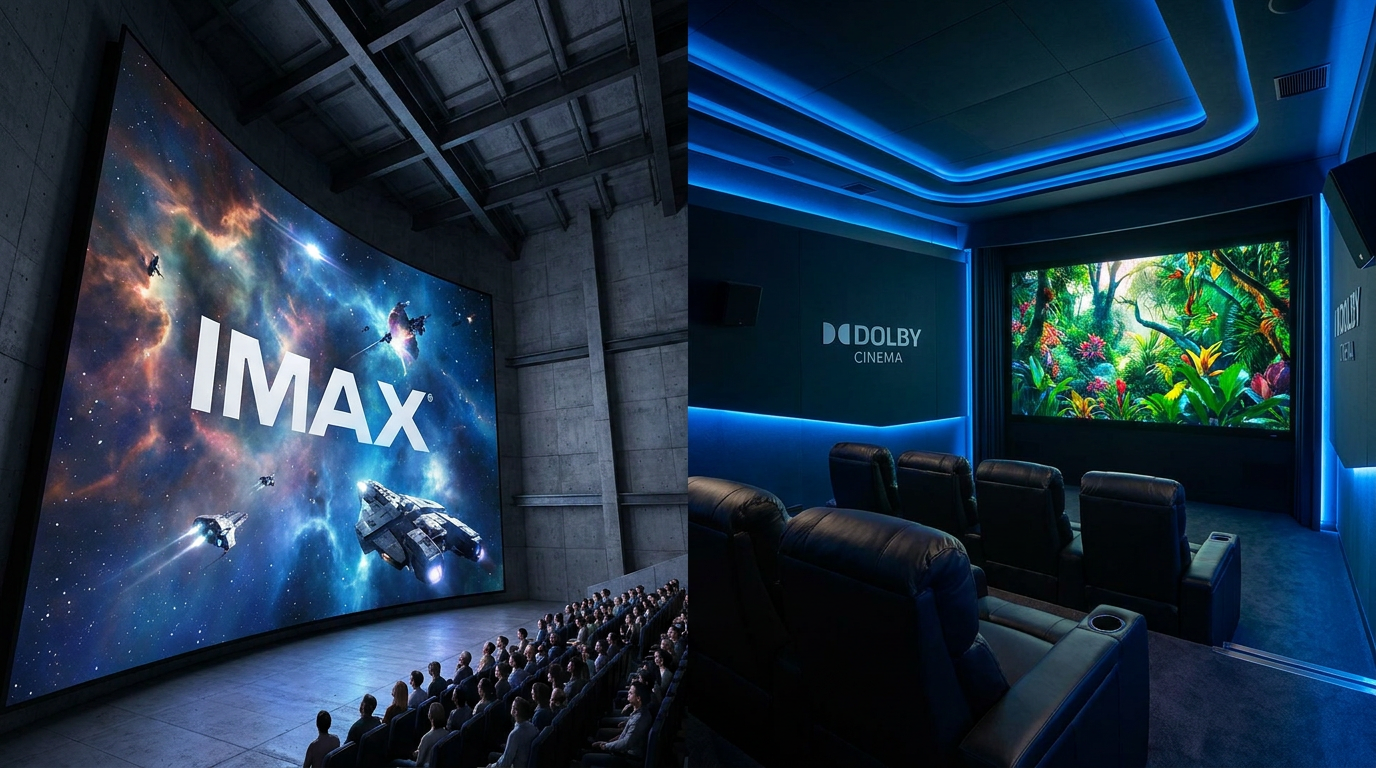
As the 2026 summer blockbuster season arrives with massive releases like "Project Hail Mary" and Christopher Nolan's "The Odyssey," moviegoers face an increasingly complex choice at the multiplex. The standard theatrical experience has been thoroughly eclipsed by premium large formats, leaving audiences to decide between the two reigning champions of exhibition: IMAX with Laser and Dolby Cinema. Both formats demand a premium ticket price, typically ranging from eighteen to twenty-two dollars, but they deliver fundamentally different philosophies of immersion. While casual viewers might assume all premium screens are identical, the underlying projection technologies, acoustic engineering, and auditorium designs cater to entirely different cinematic priorities. Choosing the wrong format can mean missing up to a quarter of the intended image or sacrificing the deepest visual contrast available in modern exhibition.[1][4]
When evaluating Dolby Cinema, the primary argument for the format rests on its unparalleled visual precision and color accuracy. The evidence for this superiority lies in its proprietary Dolby Vision high dynamic range technology, which utilizes dual 4K laser projectors to achieve a staggering 1,000,000:1 contrast ratio. In practical terms, this means the projectors can render true, inky blacks rather than the dark gray hues typical of standard digital projection. Colors appear vastly more vibrant, and the image retains exceptional sharpness regardless of the lighting conditions on screen. For cinephiles who prioritize exact color reproduction and the elimination of visual noise, Dolby Cinema provides an image that consistently pops off the screen with lifelike intensity.[2][3]
However, the primary argument against Dolby Cinema is its lack of sheer physical scale. While the screens are undeniably large—often reaching up to sixty feet across—they adhere to standard widescreen aspect ratios, typically 2.40:1 or 1.85:1. The auditoriums are specifically designed for intimacy and comfort rather than overwhelming size, meaning the screen does not stretch entirely from floor to ceiling or completely swallow the viewer's peripheral vision. For audiences seeking the sensation of being physically dwarfed by the cinematic world, Dolby Cinema can sometimes feel like a remarkably high-end home theater rather than a larger-than-life communal event. This more contained visual field means that sweeping, epic shots may lack the visceral, vertigo-inducing impact that other premium formats are specifically engineered to deliver.[4][5]

Conversely, the argument for IMAX with Laser is driven entirely by massive scale and expanded visual real estate. The evidence for IMAX's dominance is found in its specialized aspect ratios, specifically 1.90:1 and the towering 1.43:1 format available in Grand Theater locations. When a film is shot using IMAX-certified digital cameras or 70-millimeter film, the projection expands vertically to fill the entire screen, delivering up to 26 percent more visual information than a standard widescreen presentation. Dual 4K laser projectors ensure the image remains bright and sharp across screens that can exceed seventy-five feet in height, physically enveloping the audience and making sweeping landscapes or space vistas feel genuinely boundless.[6][7]
The argument against IMAX with Laser centers on its comparative lack of contrast and its utilitarian approach to comfort. Even with cutting-edge laser projection, IMAX cannot match the absolute black levels or the million-to-one contrast ratio of Dolby Vision, meaning darker scenes may lack the same three-dimensional depth. Furthermore, IMAX auditoriums prioritize steep stadium seating to ensure optimal sightlines for massive crowds, which means they almost never feature the plush, motorized recliners that have become standard in Dolby Cinema. For a three-hour epic, the trade-off between a towering screen and a comfortable seat becomes a genuine consideration for many moviegoers.[3][5]
The argument against IMAX with Laser centers on its comparative lack of contrast and its utilitarian approach to comfort.
The evidence regarding audio capabilities reveals another stark division in philosophy. Dolby Cinema utilizes Dolby Atmos, an object-based spatial audio system that can track up to 118 distinct sound objects across 128 channels, including overhead speakers. This allows for pinpoint acoustic precision, where the sound of a raindrop or a whispering voice can be isolated to a specific corner of the room. IMAX, by contrast, relies on a proprietary 12-channel uncompressed sound system that prioritizes raw, bone-rattling power. While IMAX audio is meticulously laser-aligned and incredibly immersive, it operates as a wall of sound designed to shake the seats, lacking the delicate, 360-degree spatial tracking that makes Dolby Atmos so uniquely precise.[2][6]

Ultimately, the decision often comes down to the specific production pipeline of the film itself. Directors increasingly shoot with a specific format in mind, utilizing customized camera rigs and digital workflows to optimize the final product. Filmmakers like Christopher Nolan and Denis Villeneuve frequently champion the IMAX format, framing their shots specifically for the towering 1.43:1 ratio. Other directors prefer the rich color palettes and deep shadows afforded by Dolby Vision, mixing their soundscapes explicitly for the Atmos spatial array. Understanding how a movie was actually filmed is the most reliable metric for choosing how it should be viewed.[2][7]
In terms of practical guidance, Dolby Cinema fits well when a film is dialogue-driven, heavily reliant on computer-generated imagery, or features significant dark sequences where high dynamic range is absolutely essential. It is also the undisputed winner for animated features, where color accuracy is paramount, and for any standard blockbuster that was not explicitly shot with IMAX cameras. If a movie is presented in a standard widescreen aspect ratio, Dolby Cinema will almost always provide the superior viewing experience, combining flawless picture quality with the physical comfort of premium reclining seats. For viewers who want to catch every subtle nuance of a film's sound design while sinking into a plush leather chair, Dolby remains the ultimate destination.[3][4]
Conversely, IMAX with Laser fits well when a movie is a large-scale spectacle, a sprawling science-fiction epic, or explicitly marketed as "Filmed for IMAX." It is the mandatory choice when a director utilizes the expanded 1.43:1 or 1.90:1 aspect ratios, as viewing these films in any other format results in the top and bottom of the image being aggressively cropped out. For audiences who want to feel entirely consumed by the visual scale of a blockbuster event, the towering screens and thunderous acoustic power of IMAX with Laser remain entirely unmatched in the theatrical landscape. When a film is designed to make the viewer feel small in the face of massive on-screen action, IMAX is the only format that truly delivers on that promise.[4][7]

There is no single winner without conditions in the premium large format war, as the ideal choice shifts depending on the specific visual and auditory demands of the film in question. Both IMAX with Laser and Dolby Cinema represent the absolute pinnacle of modern theatrical exhibition, offering immersive experiences that simply cannot be replicated in even the most advanced home theater setups. By taking a moment to understand how a movie was filmed and matching those technical specifications to the strengths of the projection technology, moviegoers can ensure that their premium ticket price translates into a genuinely unforgettable cinematic event. Ultimately, the golden age of theatrical exhibition is happening right now, provided you know which door to walk through at the multiplex.[1][5]
How we got here
2012
Dolby introduces Dolby Atmos, revolutionizing spatial audio in commercial theaters.
2014
IMAX launches its dual 4K laser projection system, significantly upgrading brightness and contrast over older Xenon digital projectors.
2015
The first Dolby Cinema locations open, combining Dolby Vision HDR projection with Atmos sound and premium seating.
2021
IMAX expands its single-laser projection systems, bringing 4K laser quality to smaller, retrofitted multiplex auditoriums.
2026
Major blockbusters increasingly market themselves based on specific camera formats, forcing audiences to choose the correct premium screen for the intended experience.
Viewpoints in depth
Scale and Immersion Purists
This camp argues that the sheer size of the screen and expanded aspect ratios are the defining characteristics of a premium theatrical experience.
For these moviegoers, the theater is about being physically overwhelmed by the image. They point to the 1.43:1 aspect ratio of IMAX Grand Theaters as the ultimate cinematic achievement, noting that it provides up to 26 percent more visual information than standard widescreen. To this camp, the lack of recliner seating or perfect black levels is a fair trade for a screen that completely fills the peripheral vision and a sound system designed for maximum visceral impact.
Fidelity and Comfort Advocates
This viewpoint prioritizes perfect black levels, high dynamic range, precise spatial audio, and plush recliners over raw screen size.
Advocates for this experience argue that a massive screen is useless if the image looks washed out or the audio lacks detail. They cite Dolby Cinema's 1,000,000:1 contrast ratio and the pinpoint accuracy of Dolby Atmos as the true markers of a premium format. For this camp, the ability to sit in a motorized recliner while experiencing flawless color reproduction and three-dimensional sound makes Dolby the superior choice for the vast majority of theatrical releases.
Format Agnostics
This camp believes the choice entirely depends on the specific camera equipment and production pipeline used by the director.
Rather than pledging loyalty to a specific brand, these viewers track how a movie was actually made. If a director like Christopher Nolan shoots on 70-millimeter film or IMAX-certified digital cameras, this camp insists on seeing it in IMAX to avoid cropped images. However, if a film is shot using standard digital workflows and mixed for Atmos, they will default to Dolby Cinema. They argue that forcing a standard movie onto an IMAX screen simply magnifies its flaws, while watching an IMAX-native film in Dolby robs the viewer of the director's intended scale.
What we don't know
- Whether theater chains will eventually standardize premium seating across both IMAX and Dolby auditoriums.
- How rapidly older, lower-resolution digital IMAX locations will be fully upgraded to modern laser systems.
- If future projection technologies will manage to combine IMAX's 1.43:1 scale with Dolby's 1,000,000:1 contrast ratio in a single format.
Key terms
- Aspect Ratio
- The proportional relationship between the width and height of an image; IMAX uses taller ratios (1.43:1 or 1.90:1) compared to standard widescreen (2.40:1).
- Contrast Ratio
- The difference in light intensity between the brightest white and the darkest black an image can produce; a higher ratio means deeper blacks and more vibrant colors.
- Dolby Vision
- A proprietary high dynamic range (HDR) format that uses dual laser projectors to deliver exceptional color accuracy and a 1,000,000:1 contrast ratio.
- Dolby Atmos
- An object-based spatial audio technology that allows sound designers to place and move specific sounds anywhere in a three-dimensional space, including overhead.
- High Dynamic Range (HDR)
- A video technology that provides a wider range of colors and brightness levels, making the image look more realistic and detailed in both shadows and highlights.
Frequently asked
Is Dolby Cinema more expensive than IMAX with Laser?
Ticket prices for both formats are generally comparable, typically ranging from $18 to $22 depending on the market, which is about $5 more than a standard ticket.
Does Dolby Cinema have a bigger screen than IMAX?
No. While Dolby Cinema screens are large (up to 60 feet), IMAX screens are significantly larger, often exceeding 75 feet in height and utilizing a taller aspect ratio.
What does 'Filmed for IMAX' mean?
It indicates that the movie was shot using IMAX-certified digital cameras or film, meaning the image will expand vertically to fill the taller IMAX screen, showing more of the scene.
Do IMAX theaters have reclining seats?
Most IMAX theaters use steep stadium seating to ensure optimal sightlines for the massive screen and do not feature the plush, motorized recliners found in Dolby Cinema.
Sources
Source coverage
7 outlets
3 viewpoints surfaced







[1]Factlen Editorial TeamFormat Agnostics
Synthesis by Factlen editorial team
Read on Factlen Editorial Team →[2]EngadgetScale and Immersion Purists
IMAX vs. Dolby Cinema: Which premium theater format is best?
Read on Engadget →[3]TrueSidesFidelity and Comfort Advocates
Dolby Cinema vs IMAX: What's the Real Difference?
Read on TrueSides →[4]AWOL VisionFidelity and Comfort Advocates
Dolby Cinema vs. IMAX — How to Choose Right Now
Read on AWOL Vision →[5]Reddit r/moviesFormat Agnostics
IMAX vs Dolby Cinema comparison
Read on Reddit r/movies →[6]GalaLite ScreensFidelity and Comfort Advocates
IMAX vs Dolby Cinema: Which is better?
Read on GalaLite Screens →[7]YouTube / Neelou GoodarziScale and Immersion Purists
IMAX Formats Explained: 70mm, Laser, and Dolby Cinema
Read on YouTube / Neelou Goodarzi →

Every angle. Every day.
Get entertainment stories with full source coverage and perspective breakdowns delivered to your inbox.