
The Science of Pilates: How Low-Impact Resistance Changes the Body
Clinical research reveals how Pilates targets deep stabilizing muscles to reduce back pain, improve dynamic balance, and support long-term joint health.
By Factlen Editorial Team
- Clinical Rehabilitation Specialists
- Value Pilates for its low-impact, deep-core stabilization that effectively treats chronic lower back pain and joint instability.
- Longevity & Aging Researchers
- Focus on the method's ability to improve dynamic balance, proprioception, and bone density to prevent falls and maintain independence in older adults.
- Athletic Performance Coaches
- Utilize Reformer Pilates to build explosive power, agility, and dynamic flexibility without adding unnecessary muscle bulk.
- Mind-Body Practitioners
- Emphasize the neuroplasticity, breath control, and stress-reduction benefits derived from the intense mind-muscle connection.
What's not represented
- · Cardiovascular health experts advocating for concurrent aerobic training
- · Budget-conscious consumers priced out of boutique Reformer studios
Why this matters
As the fitness industry shifts away from joint-punishing, high-intensity workouts, understanding the clinical mechanics of Pilates helps you choose a sustainable exercise routine that protects your spine and preserves mobility into old age.
Key points
- Pilates targets deep stabilizing muscles, retraining the brain to protect the spine before movement occurs.
- Clinical trials show a 90% reduction in chronic back pain among consistent practitioners after three months.
- Mat Pilates builds internal core control, while Reformer Pilates uses spring resistance to increase metabolic cost.
- For older adults, Pilates improves dynamic balance and Timed Up-and-Go scores by 18%, significantly reducing fall risk.
- Diaphragmatic breathing techniques used in Pilates lower cortisol levels and shift the nervous system into a restorative state.
For decades, Pilates was widely viewed as a niche conditioning method reserved for professional dancers and elite athletes recovering from injury. Today, it has evolved into a cornerstone of mainstream longevity and rehabilitation protocols. Developed in the early 20th century by Joseph Pilates under the name "Contrology," the practice has recently been the subject of rigorous clinical scrutiny. Modern electromyography (EMG) and biomechanical studies are finally revealing exactly why these slow, deliberate movements produce such profound changes in human physiology.[4][7]
At the heart of the scientific consensus is a redefinition of "core strength." While traditional fitness often focuses on superficial muscles—like the rectus abdominis, which creates a visible six-pack—Pilates targets the deep stabilizing architecture of the torso. This "powerhouse" includes the transverse abdominis, which wraps around the spine like a corset, the multifidus muscles connecting individual vertebrae, and the pelvic floor.[4]
Clinical researchers point to a mechanism known as "anticipatory stabilization." In a healthy body, deep core muscles activate milliseconds before the arms or legs move, bracing the spine against the impending load. Prolonged sitting, poor posture, or previous injuries often disrupt this neurological timing, leaving the lower back vulnerable to strain. EMG studies demonstrate that Pilates effectively retrains the brain-muscle connection, restoring this anticipatory firing sequence and thickening the transverse abdominis.[4][7]

The clinical outcomes of this deep-core retraining are striking. A systematic review published in PLOS One found that Pilates interventions significantly outperformed general exercise programs in reducing disability for individuals with chronic low back pain. In one controlled trial, participants experienced a 15% increase in core strength after just 12 sessions, while 90% of individuals reported a measurable reduction in back pain after three months of consistent practice.[2][5]
As the practice has grown, a central debate has emerged among practitioners: Mat Pilates versus Reformer Pilates. Both modalities adhere to the same foundational principles of breath, control, and precision, but they apply mechanical stress to the body in fundamentally different ways. Understanding these differences is crucial for matching the method to specific fitness or rehabilitation goals.[3][7]
Mat Pilates relies entirely on body weight and gravity. Because there is no external mechanical assistance, the practitioner must generate all the internal resistance required to control their limbs. This places a heavy demand on proprioception—the body's awareness of its position in space—and requires intense muscular endurance. Mat work is highly accessible, requires minimal equipment, and is frequently recommended by physical therapists for early-stage injury rehabilitation.[3][5]
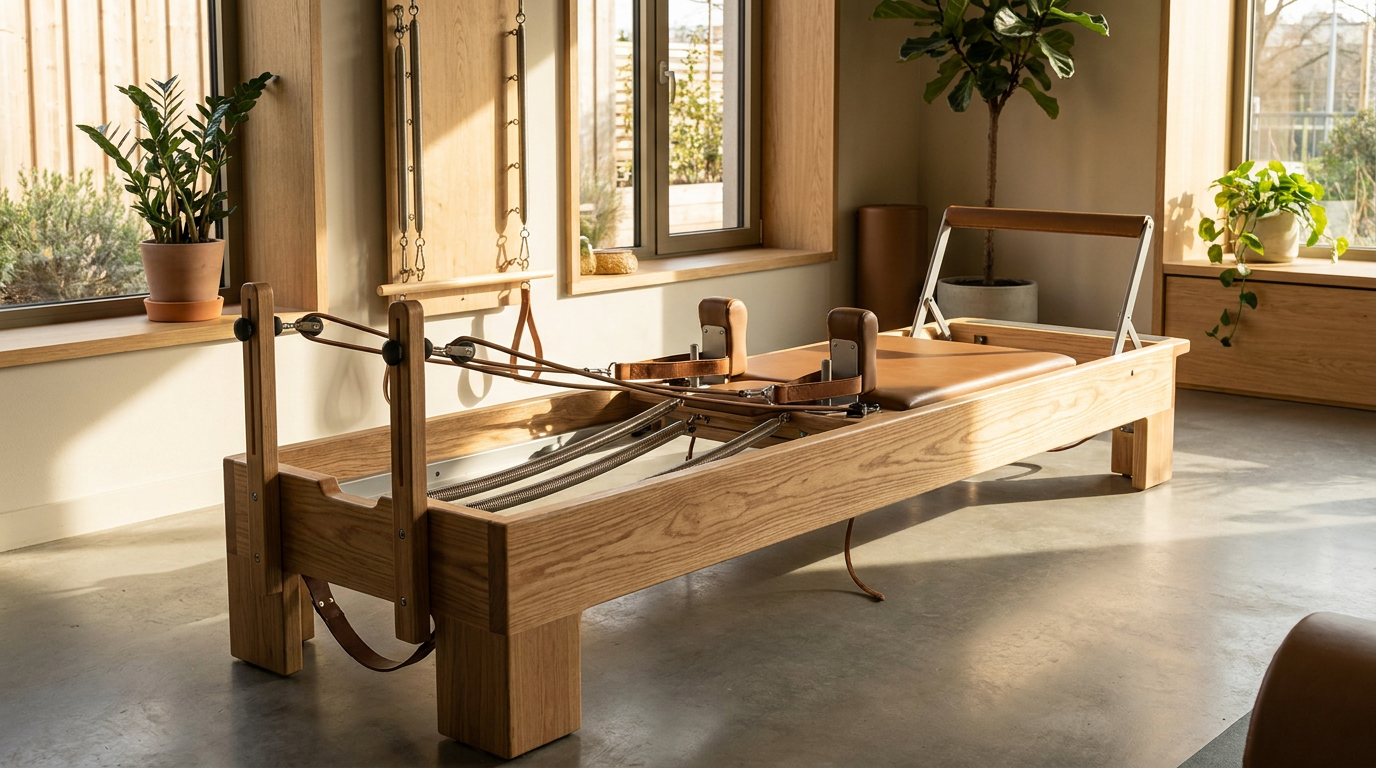
Reformer Pilates, by contrast, utilizes a specialized machine equipped with a sliding carriage, adjustable springs, straps, and pulleys. The springs provide dynamic, variable resistance that changes as the muscle lengthens and contracts. This unique mechanical environment allows for both assisted stretching—helping users achieve a greater range of motion safely—and increased load for strength building.[3][6]
Reformer Pilates, by contrast, utilizes a specialized machine equipped with a sliding carriage, adjustable springs, straps, and pulleys.
The metabolic and athletic impacts of the two methods also diverge. Data analytics from fitness studies indicate that a 60-minute Mat Pilates class burns approximately 175 calories, while a Reformer session can burn up to 250 calories due to the added mechanical resistance. Furthermore, a 2025 study on athletes found that Reformer Pilates was more effective at improving explosive power, agility, and short sprint times, making it increasingly popular in professional sports conditioning.[3][5]

Beyond athletic performance, the most significant public health implications of Pilates lie in the field of aging and longevity. As the human body ages, it naturally loses muscle mass (sarcopenia), bone density, and joint mobility. A sedentary lifestyle accelerates this decline, leading to a loss of independence. Low-impact, weight-bearing exercises are critical for halting this regression without causing joint shear.[1][6]
The National Institutes of Health has highlighted systematic reviews demonstrating that Pilates significantly improves dynamic balance and reduces fall risk in adults over 60. One meta-analysis of adults over 55 found that regular Pilates practice improved Timed Up-and-Go test scores by 18%, a critical clinical marker indicating an enhanced capacity for daily activities like rising from a chair or climbing stairs.[1][7]
Bone density preservation is another critical benefit. While Pilates is low-impact, the tension generated by the Reformer springs—or the bodyweight leverage used in advanced Mat exercises—places enough stress on the skeletal system to stimulate osteoblast activity. This helps combat the natural decline in bone mineral density, offering a protective effect against osteoporosis, particularly for post-menopausal women.[1][6]

The physiological benefits are deeply intertwined with the nervous system. Pilates is classified as a mind-body intervention, requiring intense concentration and specific breathing patterns. Instructors cue diaphragmatic breathing, which expands the lower rib cage laterally rather than lifting the shoulders. This breathing technique stimulates the vagus nerve, shifting the autonomic nervous system from a sympathetic "fight or flight" state to a parasympathetic "rest and digest" state.[4][6]
This neurological shift has measurable metabolic effects. Studies note that the stress-reducing properties of mindful breathing lower circulating cortisol levels, which indirectly supports metabolic health, reduces systemic inflammation, and improves sleep architecture. Practitioners frequently report reduced sleep latency and longer REM sleep durations compared to those who perform standard static stretching.[1][4]
Despite the overwhelming clinical support, researchers caution that Pilates is not a panacea. It is not a replacement for high-intensity cardiovascular exercise, which is still necessary for optimal heart health. Additionally, the lack of global standardization in instructor certification means that the quality of instruction—and therefore the safety and efficacy of the workout—can vary wildly from studio to studio.[3][7]
Ultimately, the science of Pilates validates what its creator claimed a century ago: physical fitness is the first requisite of happiness. By bridging the gap between clinical rehabilitation and dynamic strength training, Pilates offers a sustainable, evidence-based pathway to maintaining a resilient, pain-free body across a lifespan.[6][7]
Viewpoints in depth
Clinical Rehabilitation Specialists
Physical therapists view Pilates as a precise tool for correcting biomechanical dysfunction.
For clinical specialists, the value of Pilates lies not in calorie burning, but in neuromuscular re-education. By isolating and strengthening the transverse abdominis and multifidus, therapists use Pilates to treat the root cause of chronic lower back pain rather than just managing symptoms. They emphasize that the slow, controlled nature of the movements allows patients to rebuild anticipatory stabilization safely, making it a preferred modality for post-operative recovery and spinal disc rehabilitation.
Longevity & Aging Researchers
Aging experts focus on how Pilates preserves independence and prevents catastrophic falls.
Researchers studying healthy aging prioritize interventions that maintain functional capacity. They point to data showing that Pilates improves proprioception and dynamic balance, which are critical for preventing falls—a leading cause of morbidity in the elderly. Furthermore, the weight-bearing aspects of the practice stimulate bone density preservation, offering a vital, low-impact defense against osteopenia and osteoporosis without subjecting aging joints to the sheer forces of heavy weightlifting or running.
Athletic Performance Coaches
Sports conditioning experts use Reformer Pilates to build power and agility without adding bulk.
In the realm of elite sports, coaches integrate Reformer Pilates to enhance dynamic flexibility and explosive power. The spring resistance of the Reformer challenges athletes at the end ranges of their mobility, building strength in stretched positions—a key factor in injury prevention. Because Pilates focuses on eccentric muscle contractions and core integration rather than heavy progressive overload, athletes can improve their sprint times and rotational power without gaining unwanted muscle mass that could slow them down.
What we don't know
- Whether the long-term cardiovascular benefits of Pilates can match those of traditional aerobic exercise.
- How the wide variance in instructor certification standards affects the clinical outcomes for the average consumer.
- The exact threshold of spring resistance required to maximize bone density improvements in osteoporotic patients.
Key terms
- Transverse abdominis
- The deepest layer of abdominal muscle that wraps around the torso like a corset, crucial for spinal stability.
- Anticipatory stabilization
- The neurological process where deep core muscles automatically contract milliseconds before limb movement to protect the spine.
- Proprioception
- The body's subconscious ability to sense its position, movement, and balance in space.
- Reformer carriage
- The sliding platform on a Pilates Reformer machine that moves back and forth against spring resistance.
- Hypertrophy
- The enlargement of muscle tissue from heavy resistance training; Pilates typically avoids this in favor of lean endurance.
Frequently asked
Is Mat or Reformer Pilates better for beginners?
Both are suitable for beginners. Mat Pilates helps build foundational core control using body weight, while the Reformer can actually provide helpful assistance and support through its spring system while teaching proper alignment.
Can Pilates help with lower back pain?
Yes. Clinical studies show that Pilates is highly effective for chronic lower back pain because it strengthens the deep stabilizing muscles (like the transverse abdominis) that support the spine.
Does Pilates build muscle mass?
Pilates builds muscular endurance, strength, and tone, but because it relies on body weight and light spring resistance rather than heavy progressive overload, it does not typically cause significant muscle hypertrophy (bulk).
How often should I do Pilates to see results?
Most clinical studies and physical therapists recommend practicing Pilates 2 to 3 times per week to see measurable improvements in posture, core strength, and flexibility within 8 to 12 weeks.
Sources
Source coverage
7 outlets
4 viewpoints surfaced







[1]National Institutes of HealthLongevity & Aging Researchers
Systematic Review of Pilates Interventions for Healthy Aging
Read on National Institutes of Health →[2]PLOS OneClinical Rehabilitation Specialists
The effectiveness of Pilates exercise in people with chronic low back pain: a systematic review
Read on PLOS One →[3]HealthlineAthletic Performance Coaches
Reformer vs. Mat Pilates: Benefits, Differences, and Which is Right for You
Read on Healthline →[4]First Pilates PhysiotherapyClinical Rehabilitation Specialists
The Science Behind Pilates: Why It Actually Works
Read on First Pilates Physiotherapy →[5]BST Lagree AnalyticsAthletic Performance Coaches
Reformer vs Mat Pilates: Quantitative Data and Metabolic Costs
Read on BST Lagree Analytics →[6]MerrithewLongevity & Aging Researchers
The Lasting Benefits of Pilates for Wellness and Longevity
Read on Merrithew →[7]Factlen Editorial TeamMind-Body Practitioners
Synthesis by Factlen editorial team
Read on Factlen Editorial Team →
Every angle. Every day.
Get fitness stories with full source coverage and perspective breakdowns delivered to your inbox.