
Gas Stations in Space: How Orbital Refueling Will Unlock the Solar System
To reach the Moon and Mars, spacecraft must learn to transfer super-cooled propellants in microgravity. Here is how the aerospace industry is building the first off-Earth logistics network.
By Factlen Editorial Team
- Aerospace Engineers
- Focus on breaking the rocket equation and enabling heavy deep-space payloads.
- Commercial Space Industry
- Views orbital refueling as the foundation of a lucrative in-space logistics economy.
- Atmospheric Scientists
- Concerned about the emissions generated by launching dozens of tanker rockets for a single mission.
What's not represented
- · Space policy regulators managing orbital traffic
- · Taxpayers funding the Artemis infrastructure
Why this matters
For sixty years, space travel has been limited by the sheer weight of fuel. Mastering orbital refueling breaks that bottleneck, transforming space from a destination for one-off scientific stunts into a sustainable, multi-trillion-dollar logistics economy.
Key points
- Orbital refueling allows spacecraft to launch empty and fill up in space, enabling massive payloads to reach the Moon and Mars.
- Transferring super-cooled cryogenic fuels in microgravity requires precise pressure control and advanced thermal insulation.
- SpaceX plans to launch 8 to 16 Starship tankers to fill an orbital depot for NASA's Artemis 3 lunar mission.
- NASA's LOXSAT mission will launch in summer 2026 to test 11 different cryogenic fluid management technologies.
- Blue Origin is developing a reusable Cislunar Transporter to shuttle fuel from low Earth orbit to the Moon.
For sixty years, humanity’s reach into the cosmos has been constrained by a ruthless mathematical reality known as the rocket equation. Because fuel is heavy, a rocket must burn fuel just to lift its own fuel. To send a meaningful payload to the Moon or Mars, engineers must build exponentially larger rockets, resulting in towering leviathans that shed 99 percent of their mass just to escape Earth's gravity.[1]
The solution to this bottleneck is conceptually simple but technically agonizing: stop treating space travel like a single-use road trip with a single tank of gas. By launching a spacecraft empty, parking it in low Earth orbit, and sending up separate "tanker" rockets to fill it up, a ship can depart for deep space with a full tank and a massive payload.[1]
This concept, known as orbital refueling, is the foundational technology of the next era of spaceflight. It is the mandatory prerequisite for NASA’s Artemis program, the linchpin of SpaceX’s Mars ambitions, and the core of Blue Origin’s lunar architecture. After years of theoretical white-papers, 2026 marks the year the aerospace industry is finally attempting to build these gas stations in space.[1][2]

The engineering hurdle at the center of this effort is Cryogenic Fluid Management (CFM). Modern high-performance rockets do not run on room-temperature liquids; they rely on cryogenic propellants like liquid oxygen, liquid methane, and liquid hydrogen. These substances must be kept at hundreds of degrees below zero to remain in a liquid state.[2][3]
Handling these super-cooled fluids on Earth is difficult enough, but microgravity introduces bizarre fluid dynamics. Without gravity to pull liquid to the bottom of a tank, propellants float and slosh unpredictably, clinging to the walls or forming floating blobs. You cannot simply open a valve and let the fuel pour into a receiving ship.[1][7]
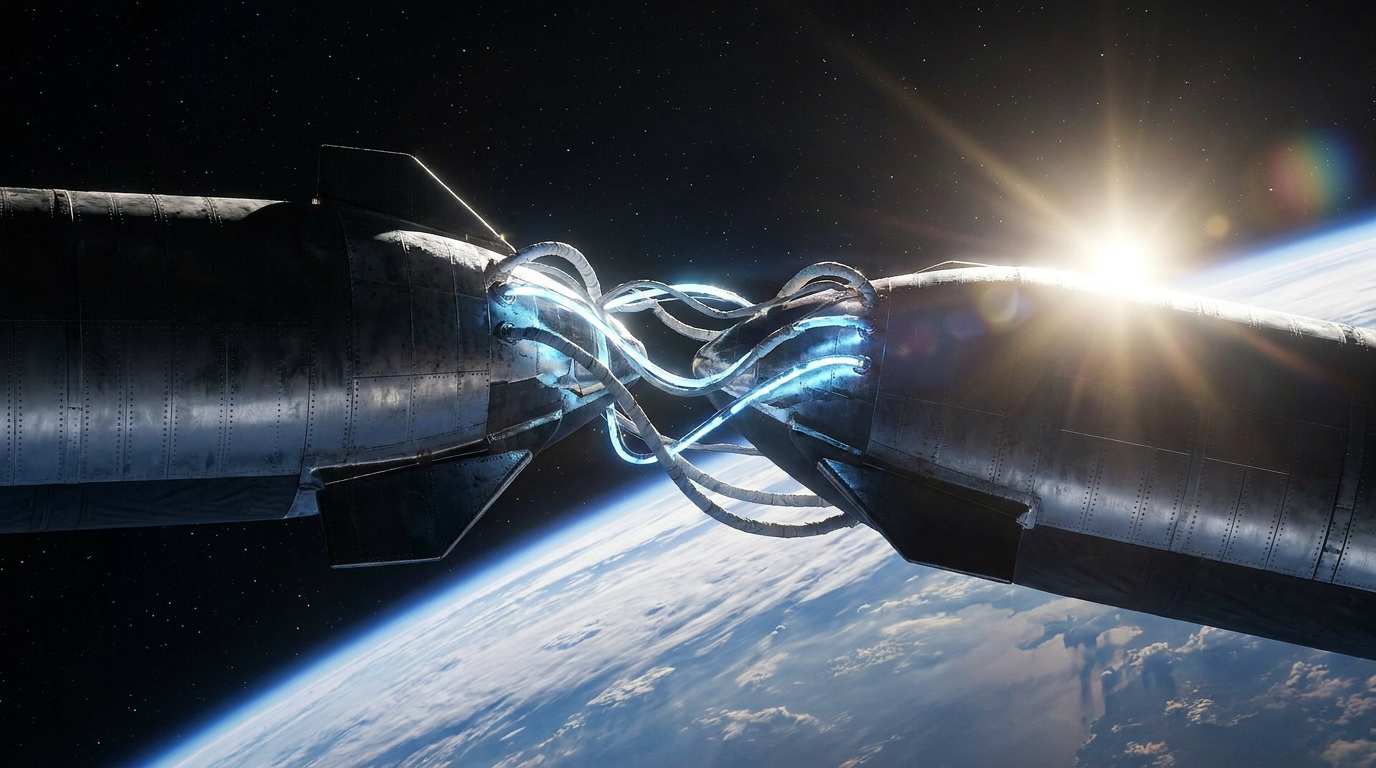
To transfer fuel in zero gravity, spacecraft must perform a delicate orbital ballet. First, they use small thrusters to provide "ullage"—a tiny amount of acceleration that gently settles the floating liquid against the bottom of the tank. Then, using precise pressure differentials and vacuum-jacketed plumbing, they force the cryogenic liquid through docking umbilicals into the receiving vehicle.[1][3]
The second major challenge is thermal management. In the vacuum of space, a spacecraft is simultaneously subjected to the searing heat of direct sunlight and the freezing cold of orbital shadow. If cryogenic propellants absorb too much heat, they undergo "boil-off," turning back into gas and venting out of the ship. Storing fuel in orbit for weeks or months requires unprecedented multi-layer insulation and active cooling systems.[1][7]

No company is pushing this technology harder, or at a larger scale, than SpaceX. The company’s Starship vehicle was selected by NASA to serve as the Human Landing System (HLS) for the Artemis 3 lunar mission. Because Starship is so massive, it will reach low Earth orbit with its tanks nearly empty.[2][4]
No company is pushing this technology harder, or at a larger scale, than SpaceX.
To get Starship to the Moon, SpaceX is developing a brute-force logistics chain. The company plans to launch a dedicated orbital fuel depot, followed by a rapid-fire succession of 8 to 16 Starship "tankers." Each tanker will carry 100 to 150 tons of liquid oxygen and liquid methane, docking with the depot to slowly fill its massive 1,200-ton reserves.[4]
Once the depot is full, the actual Starship lunar lander will launch, dock with the depot, take on the accumulated propellant, and ignite its engines for the Moon. SpaceX has already begun validating this architecture; during Starship's third test flight in March 2024, the company successfully transferred roughly 10 metric tons of liquid oxygen between two internal tanks while coasting in space.[3][4]
The next critical milestone is a full ship-to-ship transfer. SpaceX is preparing to launch two Starships into orbit weeks apart, have them rendezvous and dock, and transfer propellant between separate vehicles. This demonstration will prove whether the high-volume transfer mechanisms can survive the thermal and dynamic stresses of orbit.[1][4]
While SpaceX moves fast and breaks things, NASA is taking a methodical, science-first approach to the underlying physics. In the summer of 2026, the agency is launching the Liquid Oxygen Flight Demonstration (LOXSAT) mission. Built by Florida-based Eta Space and launching aboard a Rocket Lab Electron rocket, LOXSAT is a dedicated orbital laboratory for cryogenic fluids.[2][7]

Over the course of a nine-month mission, LOXSAT will rigorously test 11 different components of cryogenic fluid management. The satellite will experiment with reducing boil-off, maintaining tank pressure, and accurately measuring fuel levels in microgravity—a surprisingly difficult task when liquids refuse to sit flat. NASA views this data as open-source foundational knowledge that will benefit the entire commercial sector.[2][3][7]
Blue Origin is developing its own distinct architecture for orbital refueling. To support its Blue Moon lunar lander, the company is collaborating with Lockheed Martin to build the "Cislunar Transporter." Rather than relying on a massive depot in low Earth orbit, this vehicle acts as a highly efficient, reusable fuel shuttle.[1][5]
The Cislunar Transporter will be fueled in low Earth orbit by Blue Origin’s New Glenn rockets. Once loaded with liquid hydrogen and liquid oxygen, the transporter will travel all the way to lunar orbit. There, it will dock with the Blue Moon lander, transferring the fuel required for the lander to descend to the lunar surface and return.[1][5]
Blue Origin is also targeting the broader in-space logistics market with a platform called Blue Ring. Designed for medium Earth orbit and cislunar space, Blue Ring is a multi-mission spacecraft that provides data relay, payload hosting, and refueling services for smaller satellites. It represents a shift toward treating space as a serviced economy rather than a disposable frontier.[5][6]

Despite the rapid hardware development, significant uncertainties remain. The SpaceX architecture requires an unprecedented launch cadence; launching 15 tankers in a matter of weeks leaves zero margin for error. If a launch pad is damaged or a storm delays the schedule, the fuel already sitting in the orbital depot will slowly boil away, potentially jeopardizing the entire mission.[1][4]
Furthermore, atmospheric scientists are raising alarms about the environmental cost of this new paradigm. If a single lunar landing requires 16 super-heavy rocket launches, the resulting black carbon emissions and upper-atmosphere ozone depletion could be severe. The aerospace industry will have to prove that the scientific returns of deep space exploration justify the localized environmental impact of building the gas stations.[1][7]
Ultimately, mastering orbital refueling is the dividing line between the exploration age and the infrastructure age. Once spacecraft can reliably top off their tanks in the vacuum of space, the solar system shrinks. The Moon becomes a short commute, Mars becomes a viable destination, and the tyranny of the rocket equation is finally broken.[1][2]
How we got here
March 2024
SpaceX successfully transfers 10 metric tons of liquid oxygen between internal tanks during Starship's third flight.
July 2026
NASA's LOXSAT mission launches to test 11 cryogenic fluid management technologies in low Earth orbit.
Late 2026
SpaceX plans to conduct its first full ship-to-ship propellant transfer demonstration in orbit.
2028
Target window for the first crewed Artemis lunar landings, which rely entirely on orbital refueling architecture.
Viewpoints in depth
Aerospace Engineers
Focus on breaking the rocket equation and enabling heavy deep-space payloads.
For propulsion engineers and mission planners, orbital refueling is the only mathematically viable path to Mars. They argue that the "direct ascent" model used during the Apollo era simply does not scale to the massive habitats and life-support systems required for long-term planetary settlement. By mastering cryogenic fluid management, engineers can decouple the size of a spacecraft from the size of the rocket that launches it, fundamentally rewriting the rules of spacecraft design.
Commercial Space Industry
Views orbital refueling as the foundation of a lucrative in-space logistics economy.
Commercial space executives and investors see orbital depots not just as a NASA requirement, but as the birth of a multi-trillion-dollar logistics market. If satellites and spacecraft can be refueled, their operational lifespans can be extended indefinitely, ending the era of multi-million-dollar satellites becoming space junk simply because they ran out of maneuvering thruster gas. Companies like Blue Origin and Rocket Lab are positioning themselves to be the utility providers of this new cislunar economy.
Atmospheric Scientists
Concerned about the emissions generated by launching dozens of tanker rockets for a single mission.
While acknowledging the technological achievement, atmospheric researchers warn about the environmental cost of the "tanker" architecture. Launching 10 to 15 super-heavy rockets just to fuel a single lunar landing injects massive amounts of black carbon, water vapor, and nitrogen oxides directly into the stratosphere. These scientists argue that while orbital refueling solves a physics problem in space, it creates a compounding pollution problem in Earth's fragile upper atmosphere that regulators have not yet addressed.
What we don't know
- Whether SpaceX can sustain the unprecedented launch cadence required to launch 8 to 16 tankers in rapid succession without delays.
- How effectively multi-layer insulation can prevent cryogenic boil-off during long-duration storage in the harsh thermal environment of space.
- The long-term environmental impact of launching dozens of super-heavy rockets to fuel a single deep-space mission.
Key terms
- Cryogenic Fluid Management
- The technology and techniques used to store, transfer, and measure super-cooled liquid propellants in the extreme environment of space.
- Ullage
- The empty space in a fuel tank; in spaceflight, "ullage motors" are small thrusters fired to push floating liquid fuel to the bottom of the tank so it can be pumped.
- Boil-off
- The loss of cryogenic propellant when it absorbs heat and turns from a liquid into a gas, venting out of the spacecraft.
- The Rocket Equation
- The mathematical principle dictating that a rocket must carry exponentially more fuel to lift heavier payloads, creating a hard limit on deep-space travel.
Frequently asked
Why can't we just launch rockets with all the fuel they need?
The rocket equation dictates that adding fuel adds weight, which requires even more fuel to lift. Refueling in orbit bypasses this mathematical limit, allowing spacecraft to carry massive payloads instead of just fuel.
How do you pour liquid in zero gravity?
You cannot pour it. Spacecraft fire small thrusters to gently push the floating liquid to the bottom of the tank, then use pressurized gas to force the fluid through pipes into the receiving ship.
What is cryogenic boil-off?
Super-cooled fuels like liquid oxygen will boil into gas if exposed to heat. In space, the sun's radiation can rapidly boil away fuel unless the tanks are heavily insulated.
Sources
Source coverage
7 outlets
3 viewpoints surfaced







[1]Factlen Editorial TeamAerospace Engineers
Synthesis by Factlen editorial team
Read on Factlen Editorial Team →[2]NASAAerospace Engineers
SpaceX Starship Propellant Transfer Demonstration
Read on NASA →[3]Space.comCommercial Space Industry
NASA to test critical cryogenic fluid management technologies in space
Read on Space.com →[4]GizmodoCommercial Space Industry
SpaceX to Attempt Daring Orbital Refueling Test of Starship
Read on Gizmodo →[5]Blue OriginCommercial Space Industry
Blue Origin Unveils Multi-Mission, Multi-Orbit Space Mobility Platform
Read on Blue Origin →[6]Universe MagazineCommercial Space Industry
Space Transporter: Blue Origin to build an orbital platform
Read on Universe Magazine →[7]OkdiarioAtmospheric Scientists
NASA's LOXSAT mission is testing critical cryogenic fluid management technologies
Read on Okdiario →
Every angle. Every day.
Get transportation stories with full source coverage and perspective breakdowns delivered to your inbox.