
How Interior Design Physically Alters the Brain: The Science of Neuroaesthetics
Emerging research in cognitive neuroscience reveals that room shapes, lighting, and textures directly influence brain waves, stress hormones, and neuroinflammation.
By Factlen Editorial Team
- Cognitive Neuroscientists
- Argue that aesthetic experiences are grounded in universal neural mechanisms, using fMRI and EEG data to map how spatial geometries alter brain chemistry.
- Applied Interior Designers
- Focus on translating clinical data into actionable residential and commercial design choices to improve daily well-being and emotional regulation.
- Public Health Advocates
- View the built environment as a critical public health vector, arguing that better design serves as preventative mental healthcare against chronic stress.
What's not represented
- · Real estate developers balancing neuroaesthetic costs with profit margins
- · Individuals with neurodivergent sensory processing needs
Why this matters
Because humans spend roughly 90% of their lives indoors, the built environment is an invisible but constant driver of mental health. Understanding how spaces affect the nervous system allows us to design homes and workplaces that actively reduce chronic stress and enhance cognitive function.
Key points
- Neuroaesthetics is an emerging scientific field that measures how the brain physically responds to interior design and architecture.
- Using fMRI and EEG technology, researchers have proven that room shapes, lighting, and textures directly alter brain waves and heart rates.
- Biophilic design, which incorporates natural elements, has been shown to significantly reduce neuroinflammation and stress hormones.
- The brain evaluates architectural spaces based on three core dimensions: coherence, fascination, and hominess.
- Ceiling height influences cognitive function, with high ceilings promoting abstract creativity and low ceilings enhancing detailed focus.
- Interior designers are increasingly using this empirical data to create spaces optimized for emotional regulation and mental well-being.
You know the feeling. You walk into a room and your shoulders immediately drop. The air feels lighter, your breathing slows, and a subtle sense of calm washes over you. For decades, interior designers attributed this phenomenon to intuition, a "good eye," or the vague concept of spatial harmony.[2]
But a rapidly growing scientific discipline is proving that this feeling is not just a subjective mood—it is a measurable, physiological event. Welcome to neuroaesthetics, the intersection of cognitive neuroscience and interior design.[2][6]
By utilizing functional magnetic resonance imaging (fMRI), mobile electroencephalography (EEG), and biometric sensors, researchers are mapping exactly how the built environment alters our brain waves, heart rates, and even our immune responses. The findings suggest that beauty and spatial design are not mere luxuries; they are fundamental drivers of human health.[1][3][4]
To understand how a room changes the brain, one must look at the neural pathways of visual perception. When light bounces off a room's surfaces and hits the retina, electrical signals travel via the optic nerve directly to the visual cortex.[5]
But the brain does not simply process a room as a sterile box of dimensions. According to foundational models in neuroaesthetics, human-building interactions are mediated by three large-scale neural networks: the sensory-motor system, the knowledge-meaning system, and the emotion-valuation system.[3]

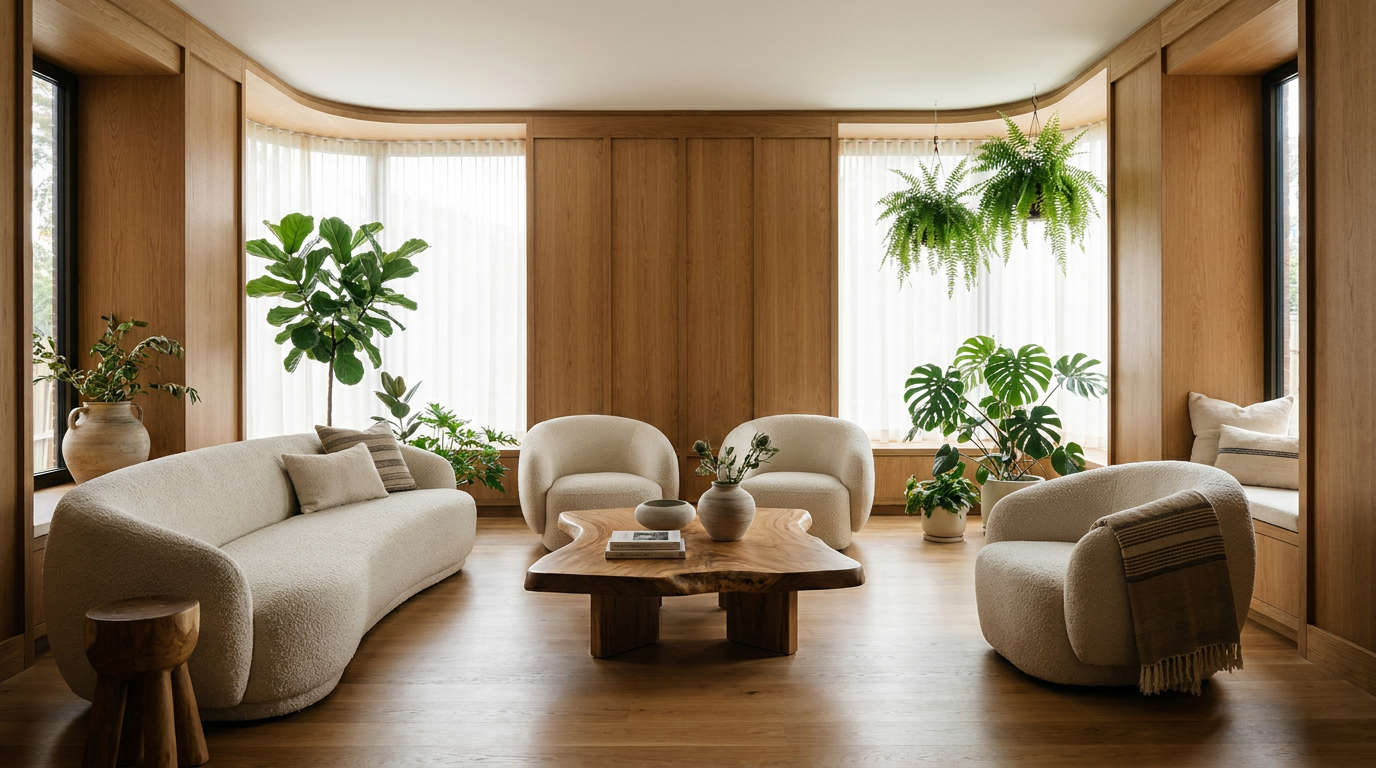
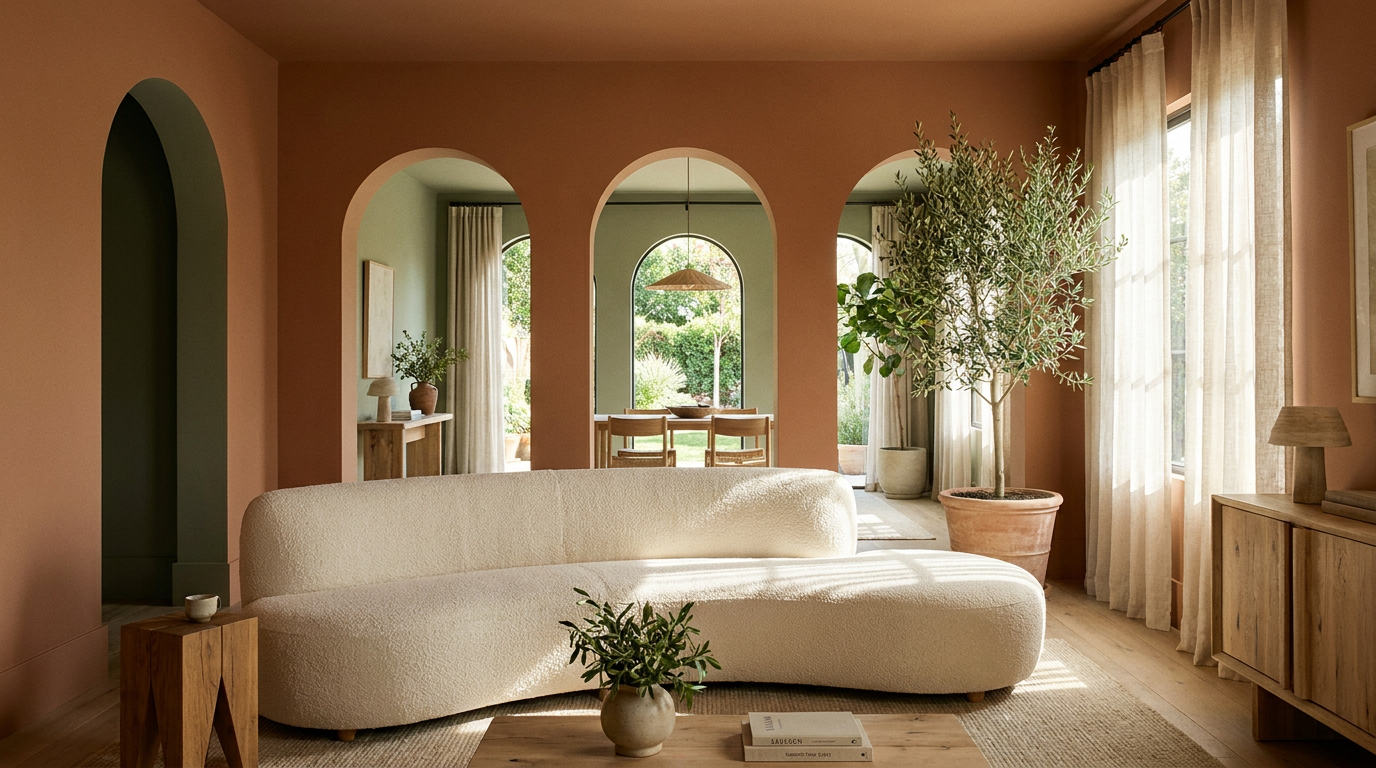
When a person enters a space with curvilinear furniture and arched doorways, for example, fMRI scans reveal heightened activity in the anterior cingulate cortex—a region deeply involved in processing emotion. The brain inherently reads sharp, jagged angles as potential threats, while smooth curves signal safety and comfort, triggering the release of neurotransmitters that soothe the nervous system.[3][4]
Researchers at the University of Pennsylvania's Center for Neuroaesthetics have further distilled our psychological responses to architectural interiors into three core dimensions: coherence, fascination, and hominess.[3]
"Coherence" refers to the brain's ease in organizing and comprehending a scene. When a room is cluttered or visually chaotic, the brain expends excessive metabolic energy trying to parse the environment, leading to cognitive fatigue. "Fascination" involves informational richness—the degree to which a space generates interest without overwhelming the senses.[3][6]
The third dimension, "hominess," is entirely unique to architectural interiors. In studies where participants viewed various rooms, feelings of hominess directly covaried with neural activity in the left cuneus, a brain region linked to approach-avoidance decisions. When a space feels "homey," the brain lowers its defensive guard.[3]

The third dimension, "hominess," is entirely unique to architectural interiors.
The stakes of these design choices extend far beyond momentary comfort. People in developed nations spend roughly 90 percent of their lives inside built environments. If those environments are poorly designed, they can induce what researchers call "allostatic overload"—the cumulatively overwhelming effects of chronic, low-grade environmental stress.[1][3]
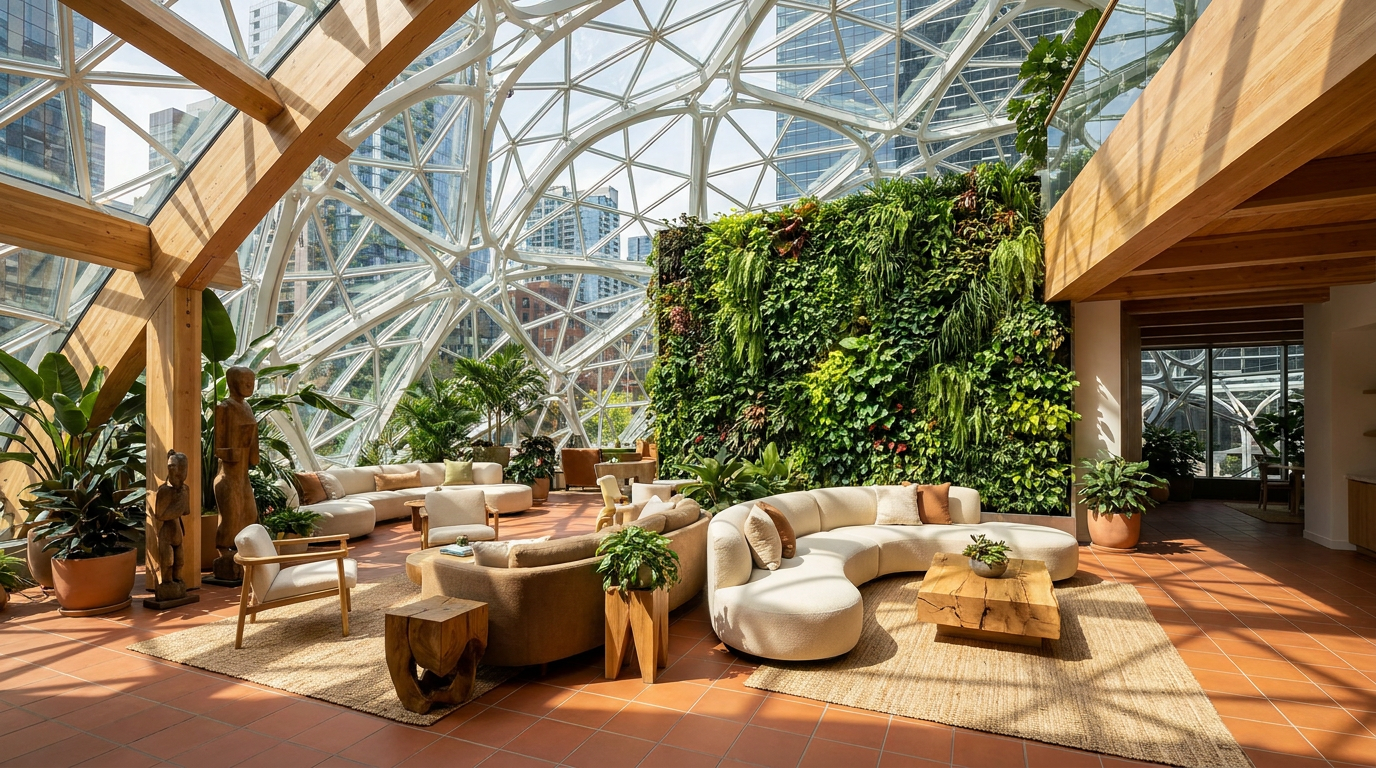
Recent studies from architectural neurophysiology researchers at Cambridge and Harvard have explored how "biophilic" design—incorporating natural light, organic textures, and greenery—can actively combat this stress.[1]
Using 32-channel quantitative electroencephalographs (qEEG), researchers measured subjects' brain responses to biophilic rooms versus sterile ones. The data revealed that nature-inspired designs significantly lowered neuroinflammation, a condition linked to severe psychiatric and neurodegenerative disorders. Furthermore, exposure to natural elements was shown to support hippocampal neurogenesis, the brain's process for regulating mood and forming new memories.[1]

Even the invisible volumes of a room dictate cognitive function. The height of a ceiling, for instance, fundamentally alters how a person thinks.[6]
Research pioneered by marketing and psychology scholars demonstrates that high ceilings promote "freedom-oriented processing." In these spaces, individuals are better at abstract thinking, creative problem-solving, and seeing the big picture. Conversely, lower ceilings trigger "confinement-oriented processing," which enhances focus, concrete thinking, and attention to minute details. An ideal home or office utilizes both, matching the ceiling height to the intended cognitive task of the room.[6]
Forward-thinking interior designers are already translating this clinical data into residential reality. Rather than starting with a visual motif or a trendy color palette, neuroaesthetic design begins with emotional mapping.[2]
"Neuroaesthetics invites us to decorate from the inside out, starting with what feels good," explains Suchi Reddy, founder of the neuroaesthetics-focused architecture firm Reddymade. The proportion of the space, the acoustic dampening of a rug, and the color temperature of the lighting are all calibrated to send specific signals to the nervous system.[2]

Color psychology, long a staple of design, now has neurological backing. Cooler hues like blues and greens activate the parasympathetic nervous system, slowing the heart rate and lowering blood pressure. Warmer hues stimulate the sympathetic nervous system, increasing alertness and vitality.[6]
Despite these breakthroughs, neuroarchitecture is still in its infancy. One of the primary challenges facing researchers is the inherent subjectivity of the "knowledge-meaning" network. A person's cultural background, personal memories, and prior experiences can dampen or enhance their baseline neurological response to a specific architectural feature. What feels like a cozy, enclosed refuge to one person might trigger claustrophobia in another.[3]
Looking ahead, the integration of smart-home technology and neuroaesthetics promises a new frontier of "adaptive spaces." Future environments may utilize subtle biofeedback—reading an occupant's heart rate or stress levels via wearable devices—to automatically adjust lighting, temperature, and acoustic masking in real-time.[4][6]
Ultimately, the rise of neuroaesthetics represents a profound shift in how we value our surroundings. Interior design is no longer just the art of making things look presentable; it is the science of preventative mental healthcare, proving that a well-designed room is one of the most powerful tools we have for healing the human brain.[1][2][6]
How we got here
1950s
Dr. Jonas Salk observes that the architectural environment influences scientific creativity, leading to the design of the Salk Institute.
1990s
Advancements in fMRI technology allow scientists to begin measuring real-time brain responses to visual beauty.
2013
Foundational studies reveal that curvilinear architectural spaces activate the brain's emotion-processing centers.
2024
Researchers publish quantitative EEG data proving biophilic design actively reduces neuroinflammation.
2026
Neuroaesthetics transitions from academic theory to mainstream interior design practice, focusing on measurable wellness outcomes.
Viewpoints in depth
Cognitive Neuroscientists
Argue that aesthetic experiences are not purely subjective but are grounded in universal neural mechanisms.
Researchers in this camp prioritize empirical measurement, utilizing fMRI and EEG data to map the neural correlates of spatial perception. They argue that specific spatial geometries, lighting conditions, and textures predictably alter brain chemistry and neuroinflammation. By quantifying these responses, they aim to transition architecture from an art form into an evidence-based science.
Applied Interior Designers
Focus on the practical translation of neurological science into everyday living spaces.
Designers argue that neuroaesthetics provides a much-needed empirical vocabulary to explain why certain rooms "feel right." Rather than relying solely on intuition or visual trends, they use this data to design intentionally for emotional regulation. This involves calibrating ceiling heights for specific cognitive tasks, using color psychology to manage heart rates, and integrating biophilic elements to create restorative environments.
Public Health Advocates
Emphasize the macro-level implications of neuroarchitecture on population health.
Because humans spend up to 90% of their time indoors, public health experts view the built environment as a critical vector for mental health. They argue that poorly designed, overstimulating spaces contribute to chronic stress and "allostatic overload." Consequently, they advocate for better architectural design as a form of preventative mental healthcare, capable of reducing societal levels of anxiety and neuroinflammation.
What we don't know
- How individual cultural backgrounds and personal memories alter baseline neurological responses to specific architectural features.
- The long-term, multi-decade neurological impacts of living exclusively in highly optimized, adaptive smart-home environments.
- How to perfectly standardize neuroaesthetic metrics across diverse populations with varying sensory processing sensitivities.
Key terms
- Neuroaesthetics
- The intersection of cognitive neuroscience and aesthetics, studying how the brain processes and responds to beauty and design.
- Biophilic Design
- An architectural approach that connects building occupants more closely to nature through natural lighting, organic forms, and greenery.
- Allostatic Overload
- The cumulative burden of chronic stress, which can be exacerbated by poorly designed, overstimulating environments.
- Hippocampal Neurogenesis
- The process by which the brain generates new neurons in the hippocampus, a region critical for learning, memory, and mood regulation.
- Anterior Cingulate Cortex
- A region of the brain involved in emotional regulation and decision-making, shown to activate when viewing curvilinear architectural spaces.
Frequently asked
What is neuroaesthetics?
Neuroaesthetics is the scientific study of how the brain responds to beauty, art, and spatial design, utilizing tools like fMRI and EEG to measure physiological reactions.
How does biophilic design affect the brain?
Exposure to natural light, organic textures, and greenery has been shown to lower neuroinflammation, reduce stress hormones, and support mood regulation.
Does ceiling height really matter?
Yes. Research shows high ceilings promote abstract, creative thinking, while lower ceilings enhance concrete, detail-oriented focus.
Can a room reduce stress?
Absolutely. Spaces with curvilinear forms, balanced proportions, and acoustic comfort can lower cortisol levels and heart rates by up to 15-20%.
Sources
Source coverage
6 outlets
3 viewpoints surfaced






[1]Popular MechanicsCognitive Neuroscientists
Scientists Think They Could Design Entire Cities That Heal Your Brain
Read on Popular Mechanics →[2]LivingetcApplied Interior Designers
Neuroaesthetics examines how the environments we live in affect us on a physical and emotional level
Read on Livingetc →[3]PubMed CentralCognitive Neuroscientists
Psychological responses to buildings and natural landscapes
Read on PubMed Central →[4]ArchDailyPublic Health Advocates
Neuroarchitecture: How Your Brain Responds to Different Spaces
Read on ArchDaily →[5]Sapien LabsCognitive Neuroscientists
Neuroarchitecture: The Brain in Space
Read on Sapien Labs →[6]Factlen Editorial TeamPublic Health Advocates
Synthesis by Factlen editorial team
Read on Factlen Editorial Team →
Every angle. Every day.
Get home stories with full source coverage and perspective breakdowns delivered to your inbox.