
South Korea's KSTAR Reactor Successfully Tests ITER Control System in Major Fusion Milestone
The KSTAR fusion facility has successfully operated using the control software designed for the international ITER project, marking a critical shift from theoretical physics to applied fusion engineering.
By Factlen Editorial Team
- Scientific Community
- Focused on validating the physics of magnetic confinement and plasma stability.
- Energy Security Advocates
- Viewing fusion as a strategic necessity to eliminate reliance on imported fossil fuels.
- Commercial Developers
- Racing to deploy fusion power rapidly using private capital and streamlined regulations.
What's not represented
- · Environmental groups concerned about the massive cost of fusion research detracting from immediate renewable energy deployment.
Why this matters
Mastering the control of superheated plasma removes one of the final engineering bottlenecks to commercial fusion power. For a global economy desperate to decarbonize, this milestone brings the promise of near-limitless, zero-emission energy significantly closer to reality.
Key points
- South Korea's KSTAR reactor successfully tested the plasma control system designed for the international ITER project.
- The March 2026 campaign achieved 'first plasma' and sustained reactions for over a second using the new software.
- KSTAR previously set records by holding 100-million-degree plasma for 48 seconds, aided by a new tungsten exhaust system.
- The facility is now targeting 300 seconds of high-temperature plasma confinement by the end of 2026.
- South Korea aims to build a fusion demonstration reactor (K-DEMO) by 2035 to reduce its 93% reliance on imported energy.
- Recent US regulatory changes will license fusion plants like particle accelerators, drastically cutting deployment timelines.
For decades, the pursuit of nuclear fusion has been defined by a single, blistering metric: heat. Scientists raced to build machines capable of recreating the conditions inside the sun, pushing temperatures past 100 million degrees Celsius to force atomic nuclei to fuse. But as the physics of generating star-like heat becomes increasingly understood, the frontier of fusion energy has quietly shifted. The new challenge is not just igniting the fire, but steering it. Controlling a superheated plasma so that it burns steadily without destroying its container is arguably the most complex engineering challenge in human history.[6]
In March 2026, that transition from pure physics to applied engineering took a monumental step forward in Daejeon, South Korea. Deep inside the Korea Institute of Fusion Energy, researchers handed over the controls of the KSTAR tokamak—often dubbed South Korea’s "artificial sun"—to a piece of software designed half a world away. The experiment was designed to test whether a standardized control architecture could successfully manage the chaotic, high-energy environment of a live fusion reactor, bridging the gap between theoretical computer models and physical reality.[1][6]
The software in question was the plasma control system for ITER, the massive international fusion reactor currently under construction in southern France. Over a two-week campaign comprising 38 experimental pulses, the ITER control system successfully initiated and managed the plasma inside the South Korean reactor. It marked the first time the international project’s "brain" had been tested on a fully operational, superconducting tokamak. The collaboration allowed engineers to evaluate the controller's timing performance and plant-system integration under real-world constraints that cannot be fully captured by simulation alone.[1]
The results were a resounding validation of years of theoretical design and international collaboration. The control system achieved "first plasma" on March 10, utilizing an electron-cyclotron heating-assisted startup scenario. It eventually drove peak plasma currents past 0.2 mega-amperes and sustained the reaction for over a second—exceeding the campaign's performance targets with significant margin. By proving the software works on KSTAR, the international fusion community has cleared a major hurdle, drastically reducing the technical risk for the $20 billion ITER project years before it officially powers on.[1]

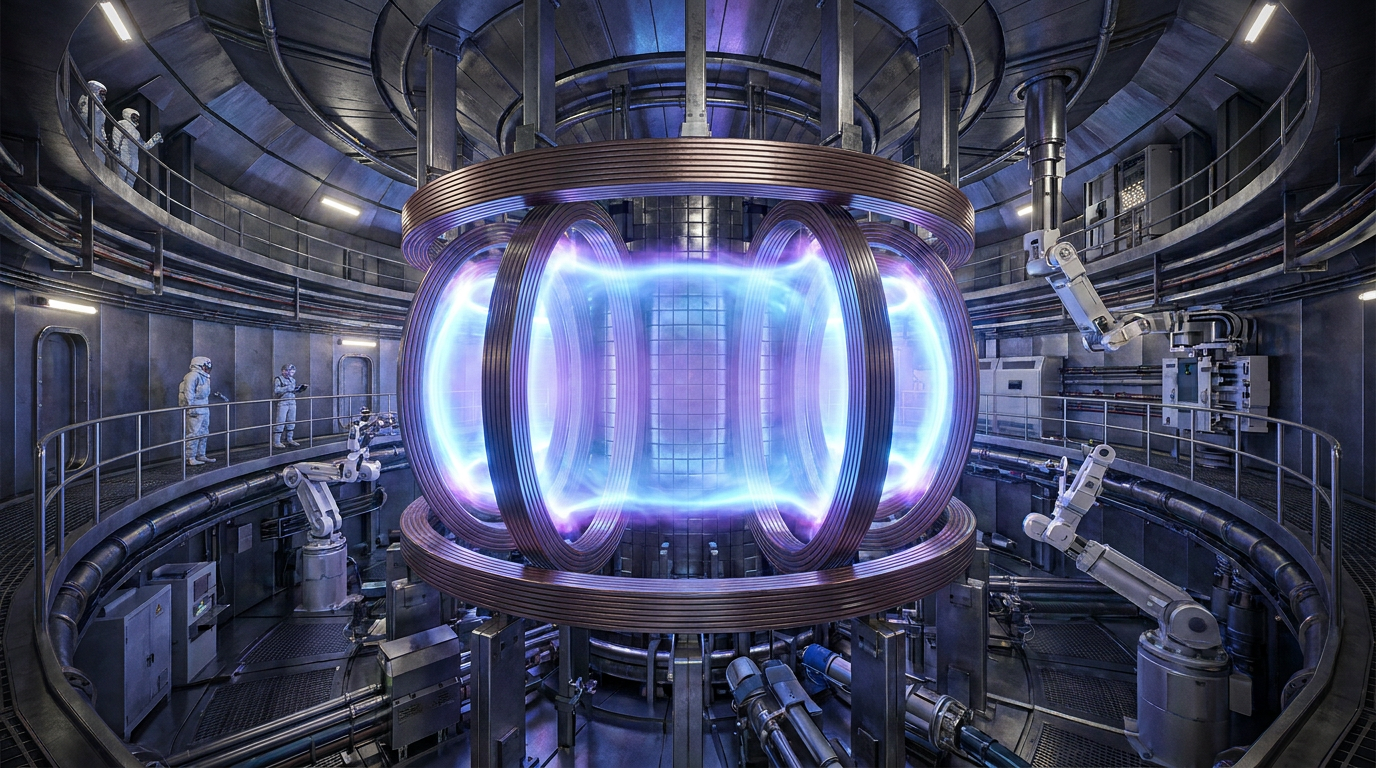
To understand why this software test is so critical, one must understand the volatile nature of a tokamak reactor. A tokamak is essentially a doughnut-shaped vacuum chamber wrapped in massive superconducting electromagnets. Inside this chamber, hydrogen isotopes are heated until they transition into a plasma—a superheated soup of positively charged ions and free electrons where fusion reactions can occur. Because no physical material on Earth can contain a 100-million-degree plasma without melting instantly, the magnetic fields act as an invisible, levitating cage.[6]
But plasma is notoriously unstable; it writhes, bulges, and constantly attempts to escape its magnetic confinement. The plasma control system must act as an ultra-fast conductor, reading thousands of diagnostic data points and adjusting the magnetic coils in milliseconds to keep the plasma perfectly suspended. If the plasma touches the reactor walls, it cools instantly, and the fusion reaction collapses. Mastering this delicate, high-speed feedback loop is the absolute prerequisite for any future power plant that hopes to keep the lights on.[1][6]
KSTAR itself is no stranger to pushing the boundaries of fusion science and holds several records of its own. In a landmark campaign spanning late 2023 to early 2024, the South Korean reactor sustained plasma at an astonishing 100 million degrees Celsius—roughly seven times hotter than the core of the sun—for 48 seconds. Furthermore, it maintained a highly efficient operating state known as "H-mode"—or high-confinement mode—for 102 seconds. These milestones demonstrated that the facility could handle the extreme thermal loads required for commercial-scale fusion generation, setting the stage for the recent software integration.[3][5]
KSTAR itself is no stranger to pushing the boundaries of fusion science and holds several records of its own.
These thermal records were made possible by a crucial, unglamorous hardware upgrade: replacing the reactor's carbon divertors with tungsten monoblocks. The divertor sits at the bottom of the tokamak and acts as the reactor's exhaust system, extracting intense heat and helium ash from the fusion reaction without disrupting the plasma. Tungsten, boasting the highest melting point of any pure metal, proved vastly superior to carbon. During the high-heat campaigns, the new tungsten surfaces showed only a 25 percent temperature increase compared to the older system, providing the thermal resilience needed for longer runs.[3]

Now, South Korea is eyeing an even more ambitious target to cement its leadership in the field. By the end of 2026, the KSTAR team aims to sustain high-temperature plasma for a full 300 seconds. In the realm of fusion physics, five minutes is a magic number. It approaches the timescale required to demonstrate "quasi-steady-state" operation, where the plasma reaches a self-sustaining equilibrium of heating, confinement, and exhaust, rather than merely persisting through a brief burst of stored energy. Achieving this would prove that a reactor can run continuously, a non-negotiable requirement for a commercial power plant.[2][3]
This relentless push is part of South Korea’s broader "K-Moonshot" initiative, a national strategy to secure next-generation technologies. Mission 4 of this initiative targets the design and construction of a Korean fusion demonstration reactor, known as K-DEMO, by 2035. The government has committed 1.5 trillion won to the effort, viewing fusion not just as a scientific curiosity, but as an existential necessity for the nation's future. The KSTAR facility serves as the primary testbed for the physics and engineering that will eventually scale up into K-DEMO.[2]
The urgency behind K-DEMO is driven by stark geopolitical realities. South Korea currently imports roughly 93 percent of its primary energy. For a highly industrialized, export-driven economy, this extreme dependence on foreign fossil fuels is a profound strategic vulnerability, exposing the nation to volatile global supply chains and price shocks. Fusion energy—which runs on deuterium extracted from seawater and tritium bred from lithium—offers the promise of near-limitless, zero-carbon domestic power, effectively rewriting the geopolitics of energy. For Seoul, mastering fusion is synonymous with achieving total energy sovereignty.[2][6]

The momentum in the public sector is increasingly being matched by private capital and sweeping regulatory breakthroughs. In late 2025, the United States Nuclear Regulatory Commission finalized a landmark framework that will regulate fusion devices more like particle accelerators than traditional fission power plants. Because fusion reactors cannot melt down and do not produce long-lived high-level radioactive waste, the NRC determined they do not require the same onerous oversight as uranium-based plants. This decision effectively compresses the regulatory timeline for commercial fusion from decades down to a few years.[4]
Capital markets have responded aggressively to these de-risking events. Private investment in the fusion sector topped $4.7 billion in 2025, with 2026 on pace to break that record. Companies are no longer just funding isolated lab experiments; they are signing the first commercial power purchase agreements and preparing for actual grid integration. The influx of private money is accelerating the development of alternative reactor designs, creating a robust ecosystem of innovation alongside massive government projects like ITER and KSTAR. Investors are betting that the engineering hurdles will be cleared within the decade.[4]
Yet, significant hurdles remain before fusion can power our homes. While control systems and magnetic confinement are advancing rapidly, the materials science required to withstand decades of high-energy neutron bombardment is still in its infancy. The inner walls of a commercial reactor will face conditions unlike anything currently found on Earth. Furthermore, the global supply of tritium fuel remains a bottleneck; future reactors will need to solve this by "breeding" their own fuel onsite using lithium blankets, a technology that has yet to be demonstrated at scale.[2][6]

Despite these formidable challenges, the successful integration of the ITER control system at KSTAR represents a profound psychological shift for the industry. The era of wondering whether fusion is physically possible is drawing to a close. The world has now entered the era of fusion engineering—where the ultimate prize of clean, limitless energy is no longer a question of "if," but "when." As researchers in Daejeon prepare for their 300-second run, the dream of capturing a star in a bottle has never looked more achievable.[6]
How we got here
Dec 2023 - Feb 2024
KSTAR sustains 100 million °C plasma for 48 seconds and H-mode for 102 seconds.
Late 2025
The US Nuclear Regulatory Commission finalizes a streamlined licensing framework for fusion devices.
Mar 2026
The ITER plasma control system successfully achieves first plasma on the KSTAR tokamak.
Late 2026
KSTAR's target deadline to achieve 300 seconds of high-temperature plasma confinement.
2035
Target date for the design and construction of South Korea's K-DEMO fusion demonstration reactor.
Viewpoints in depth
Fusion Physicists & Engineers
Focused on the technical validation of magnetic confinement and plasma stability.
For the scientific community, the KSTAR milestone is a triumph of applied mathematics and control theory. Physicists emphasize that generating heat is no longer the primary hurdle; the true challenge is maintaining the delicate equilibrium of the plasma. By proving that the ITER control system can successfully manage a live superconducting tokamak, researchers have validated decades of simulation work and significantly de-risked the upcoming operational phases of the international ITER project.
Energy Security Advocates
Viewing fusion as the ultimate solution to geopolitical energy vulnerabilities.
Proponents of national energy independence, particularly in import-heavy nations like South Korea, see fusion as an existential necessity. Because fusion relies on isotopes derived from seawater and lithium rather than geographically concentrated fossil fuels, it offers a pathway to total energy sovereignty. This camp argues that the massive upfront capital costs of projects like K-DEMO are easily justified when weighed against the long-term economic security of eliminating a 93 percent reliance on imported energy.
Commercial Fusion Developers
Racing to commercialize fusion power using private capital and new regulatory frameworks.
The private sector views these government-funded milestones as foundational, but believes commercialization will happen much faster through agile startups. Armed with nearly $5 billion in recent capital and a favorable new licensing framework from the US Nuclear Regulatory Commission, commercial developers are aggressively pursuing power purchase agreements. They argue that while massive international projects like ITER prove the physics, smaller, privately funded reactors will be the first to actually put fusion electricity on the grid.
What we don't know
- Whether the ITER control system will scale flawlessly to the much larger dimensions of the reactor currently being built in France.
- How quickly materials science can develop reactor walls capable of withstanding decades of high-energy neutron bombardment.
- Exactly when the first commercial fusion reactor will successfully connect to a civilian power grid.
Key terms
- Tokamak
- A doughnut-shaped machine that uses powerful magnetic fields to confine superheated plasma to achieve nuclear fusion.
- Plasma
- The fourth state of matter, consisting of a superheated gas of positively charged ions and free electrons.
- Divertor
- The exhaust system of a fusion reactor, designed to extract heat and ash from the plasma without disrupting the reaction.
- H-mode
- High-confinement mode, an advanced operating state in a tokamak where the plasma is highly stable and retains heat efficiently.
- ITER
- An international nuclear fusion research and engineering megaproject currently building the world's largest tokamak in France.
Frequently asked
What is the KSTAR reactor?
KSTAR is a superconducting fusion research device in South Korea, often called an 'artificial sun,' used to test the physics and engineering required for commercial fusion power.
Why is the ITER control system test important?
It proves that the software designed to run the massive international ITER reactor actually works on a live machine, significantly reducing the technical risks before ITER is turned on.
When will fusion power be available?
While experimental reactors are hitting major milestones now, commercial fusion power connected to the grid is still likely a decade or more away, with demonstration plants targeted for the mid-2030s.
Sources
Source coverage
6 outlets
3 viewpoints surfaced






[1]ITER OrganizationScientific Community
ITER plasma control system achieves first plasma on KSTAR
Read on ITER Organization →[2]K-MoonshotEnergy Security Advocates
Mission 4: Fusion Demonstration Reactor and KSTAR's 300-Second Target
Read on K-Moonshot →[3]Voz PopuliScientific Community
South Korea's 'artificial sun' marks new fusion milestones
Read on Voz Populi →[4]Next Waves InsightCommercial Developers
Nuclear fusion 2026 milestones and commercial timelines
Read on Next Waves Insight →[5]Srishti IASScientific Community
South Korea's KSTAR fusion reactor marks major breakthrough
Read on Srishti IAS →[6]Factlen Editorial TeamEnergy Security Advocates
Synthesis by Factlen editorial team
Read on Factlen Editorial Team →
Every angle. Every day.
Get world stories with full source coverage and perspective breakdowns delivered to your inbox.