
U.S. Envoy Heads to Switzerland for Iran Nuclear Talks as Vance Rebukes Israeli Criticism
The U.S. and Iran have opened a 60-day diplomatic window to negotiate a permanent nuclear treaty, overcoming delays caused by fighting in Lebanon. Meanwhile, Vice President JD Vance sharply criticized Israeli hardliners opposing the deal, arguing military force cannot solve every security crisis.
By Factlen Editorial Team
- U.S. Administration
- Believes the military campaign successfully neutralized Iran's immediate nuclear threat, creating the necessary leverage to secure a permanent diplomatic settlement.
- Israeli Security Establishment
- Fears the 60-day memorandum provides Iran with premature economic relief without guaranteeing the permanent destruction of its proxy networks.
- Iranian Leadership
- Frames the negotiations as a necessary step to lift crippling economic sanctions, though hardliners remain deeply skeptical of U.S. commitments.
- Regional Proxies
- Groups like Hezbollah tie any broader U.S.-Iran diplomatic progress directly to a complete cessation of Israeli military operations in their territories.
What's not represented
- · Lebanese Civilians
- · European Union Negotiators
Why this matters
This 60-day negotiation window represents the most significant attempt to permanently dismantle Iran's nuclear program and end a devastating regional war. The outcome will dictate global energy prices, the security architecture of the Middle East, and the future of the U.S.-Israel alliance.
Key points
- U.S. Envoy Steve Witkoff is traveling to Switzerland to open a 60-day negotiation window with Iran over its nuclear program.
- The talks were briefly delayed by fighting in Lebanon, but a fragile ceasefire between Israel and Hezbollah has been renewed.
- Vice President JD Vance sharply criticized Israeli hardliners opposing the deal, stating 'you can't just kill your way out' of security problems.
- Iran has waived transit fees in the Strait of Hormuz, and the U.S. has lifted its naval blockade of Iranian ports as gestures of compliance.
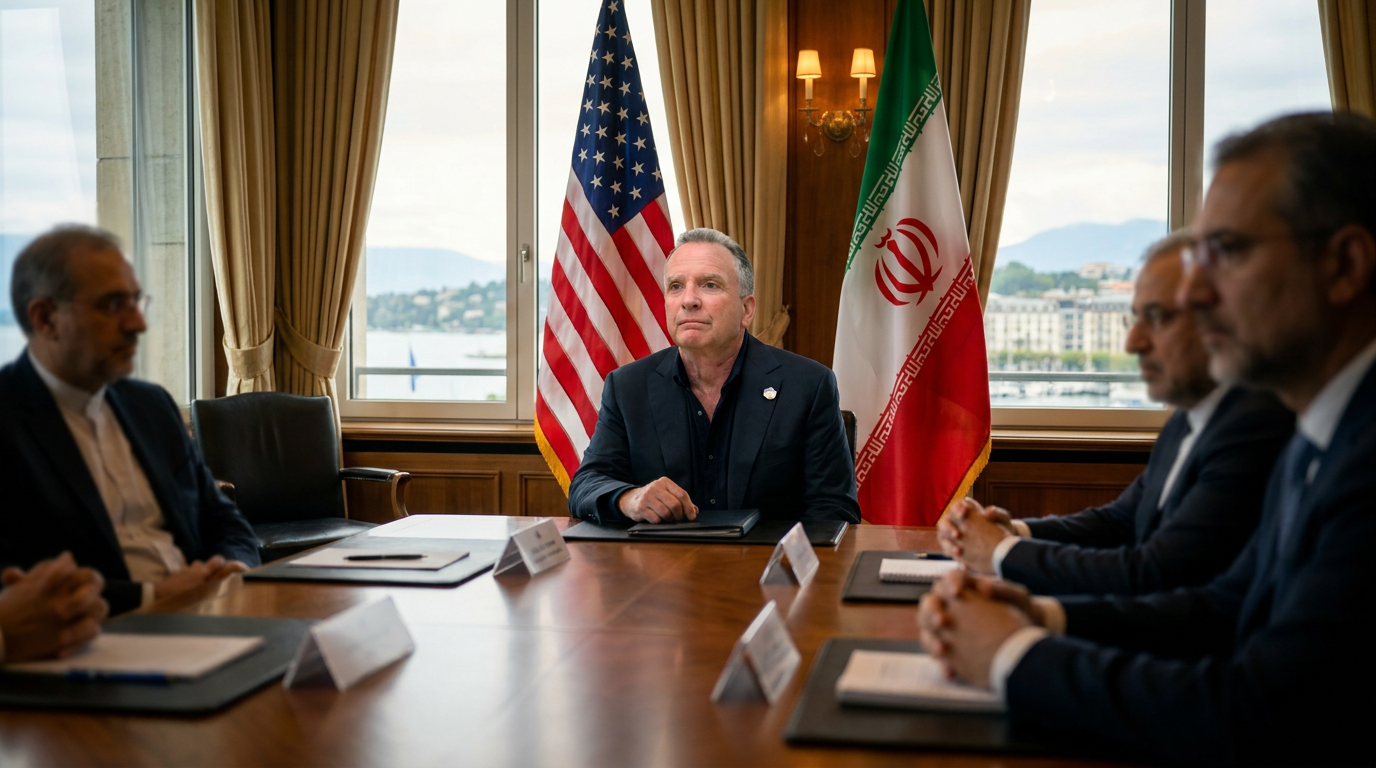
The United States and Iran are officially entering a critical 60-day diplomatic window aimed at ending months of regional warfare and permanently dismantling Tehran's nuclear program. White House envoy Steve Witkoff is en route to Switzerland to open the first round of direct negotiations with Iranian officials. The talks mark the implementation phase of a landmark memorandum of understanding (MoU) signed digitally earlier this week by U.S. President Donald Trump and Iranian President Masoud Pezeshkian.[1][2]
The stakes for the Switzerland summit are immense. The MoU outlines a framework to halt hostilities across the Middle East, restore global energy traffic, and negotiate a comprehensive nuclear treaty. If successful, the agreement would unfreeze tens of billions of dollars in Iranian assets and lift crippling U.S. sanctions. In exchange, Washington demands verifiable proof that Iran's nuclear enrichment capabilities—which U.S. and Israeli forces heavily degraded in military strikes earlier this year—are permanently dismantled.[2][3][7]
The diplomatic push represents a stark pivot for the Trump administration, transitioning from a campaign of intense military pressure to high-stakes dealmaking. U.S. officials argue that the military phase achieved its primary objective by destroying Iran's conventional military capacity and nuclear facilities, creating the leverage necessary to force Tehran to the negotiating table. Now, the administration is betting that economic incentives can secure a lasting peace that military force alone could not guarantee.[6][7]
The mechanics of the 60-day MoU are already reshaping regional dynamics. As a gesture of compliance, Iran's Persian Gulf Strait Authority announced it will waive planned transit fees for ships navigating the Strait of Hormuz during the negotiation period. Vessels must submit transit requests 48 hours in advance to coordinate safe routes through areas previously affected by naval mines. Concurrently, the U.S. military has lifted its naval blockade of Iranian ports, allowing commercial shipping to resume while maintaining a warship presence in the broader region.[3][4]

However, the path to the negotiating table in Switzerland has already faced severe stress tests. The talks were briefly delayed on Friday after a violent flare-up between Israel and the Iran-backed militant group Hezbollah in southern Lebanon. The MoU explicitly calls for an end to hostilities on all fronts, including Lebanon, though neither Israel nor Hezbollah are direct signatories to the U.S.-Iran document.[2][3]
The fighting threatened to derail the fragile diplomatic process before it began. Hezbollah lawmakers stated that Iran had informed them that talks with the U.S. could not proceed without a comprehensive ceasefire in Lebanon. Iranian Deputy Foreign Minister Saeed Khatibzadeh reiterated that while Tehran is "ready to move forward" on diplomacy, the United States bears the responsibility to ensure Israel halts its military operations.[4][5]
By late Friday, diplomatic pressure appeared to salvage the timeline. U.S. officials confirmed that Israel and Hezbollah had agreed to renew a fragile ceasefire, allowing the Switzerland talks to proceed. French diplomats also intervened, publicly urging Washington to exert maximum pressure on the Israeli government to respect the cessation of hostilities outlined in the MoU.[2][3]
By late Friday, diplomatic pressure appeared to salvage the timeline.
Despite the renewed truce, the U.S.-Iran agreement has triggered a political firestorm in Israel. Israeli officials across the political spectrum have fiercely criticized the deal, arguing it provides Tehran with a financial lifeline without adequately addressing Iran's ballistic missile program or its funding of regional proxy militias. Hardline cabinet members, including National Security Minister Itamar Ben-Gvir and Finance Minister Bezalel Smotrich, have publicly attacked the framework as a dangerous concession.[7]

The Israeli security establishment fears that the 60-day window will allow Iran to rebuild its economy while Hezbollah regroups across the northern border. Israel has maintained a security buffer zone in southern Lebanon, with officials stating that Israeli forces will remain until Hezbollah's infrastructure is entirely dismantled. This fundamental disagreement over the definition of a "ceasefire" remains the most volatile threat to the broader U.S.-Iran negotiations.[2][3]
The Trump administration has responded to Israeli criticism with unprecedented bluntness. In an interview with The New York Times, U.S. Vice President JD Vance lashed out at what he described as a "weird panic" and "freakout" within the Israeli political system. Vance argued that the Israeli reaction stems from misplaced mistrust and a failure to recognize the strategic victories already achieved by the U.S. military campaign.[6][7]
Vance directly challenged the Israeli hardliners opposing the deal. "What is your exact proposal? You're a country of nine million people. You can't just kill your way out of solving every single national security problem that you have," Vance stated. He emphasized that the U.S. has been an "incredible partner" to Israel and urged the Netanyahu government to give the United States credit for orchestrating a diplomatic off-ramp.[6][7]
The Vice President also sought to clarify the mechanics of the sanctions relief, pushing back against claims that Iran would receive immediate, unconditional payouts. Vance noted that the U.S. would not remove sanctions if Iran continued to fund terrorist organizations like Hezbollah. "There is this weird panic almost in the Israeli system... where they assume that everything that is contemplated that is good for Iran will happen—but that will happen without the Iranians changing any behavior," Vance said, adding, "That's not how the deal is written."[6][7]

Within Iran, the MoU has exposed its own domestic fractures. While President Pezeshkian and chief negotiator Mohammad Bagher Ghalibaf have championed the agreement as a necessary step to relieve economic suffering, hardline clerics and media outlets view it as a capitulation to Washington. The Islamic Revolutionary Guard Corps (IRGC) has publicly framed the negotiations as a victory forced by Iranian military resilience, attempting to sell the diplomatic compromise to a skeptical conservative base.[4]
The ultimate success of the Switzerland talks hinges on verifiable compliance. U.S. negotiators, led by Witkoff, are demanding that Iran present a comprehensive plan proving it has blocked every pathway to a nuclear weapon. While Iran's nuclear facilities were heavily damaged in recent strikes, U.S. intelligence estimates suggest Tehran could theoretically enrich its remaining uranium stockpiles to weapons-grade levels within weeks if it managed to rebuild its centrifuge infrastructure.[1][3]

As the 60-day clock ticks down, the international community is watching closely. The agreement represents one of the most ambitious and high-risk diplomatic gambles of the decade. If Witkoff and his Iranian counterparts can translate the broad strokes of the MoU into a binding, verifiable treaty, it could fundamentally realign the security architecture of the Middle East. If the talks collapse—either due to violations at the negotiating table or renewed warfare in Lebanon—the region risks plunging back into a devastating, multi-front conflict.[2][3][7]
How we got here
Early 2026
U.S. and Israeli military strikes heavily degrade Iran's nuclear facilities and conventional military infrastructure.
June 14, 2026
President Trump and Iranian President Pezeshkian digitally sign a Memorandum of Understanding to end hostilities.
June 18, 2026
Vice President JD Vance publicly rebukes Israeli criticism of the deal in a New York Times interview.
June 19, 2026
A fragile ceasefire between Israel and Hezbollah is renewed in Lebanon, allowing U.S.-Iran talks to proceed.
June 20, 2026
U.S. Envoy Steve Witkoff travels to Switzerland to open the first round of direct nuclear negotiations.
Viewpoints in depth
U.S. Administration's view
Believes the military campaign successfully neutralized Iran's immediate nuclear threat, creating the necessary leverage to secure a permanent diplomatic settlement.
The Trump administration argues that the intense military strikes earlier in the year achieved their primary objective: destroying Iran's conventional military capacity and nuclear facilities. With that leverage secured, U.S. officials believe that economic incentives—such as unfreezing assets and lifting sanctions—are now required to ensure long-term compliance. The administration is increasingly frustrated by Israeli resistance to the peace framework, viewing it as a failure to recognize a strategic victory.
Israeli Security Establishment's view
Warns that the 60-day memorandum provides Iran with premature economic relief without guaranteeing the permanent destruction of its proxy networks.
Israeli officials across the political spectrum fear that halting military operations now allows groups like Hezbollah to regroup and rearm, posing an unacceptable long-term threat to Israel's northern border. They argue that the U.S.-Iran deal focuses too heavily on the nuclear portfolio while ignoring Iran's ballistic missile program and its funding of regional militias. Consequently, Israel insists on maintaining a security buffer zone in southern Lebanon until Hezbollah's infrastructure is entirely dismantled.
Iranian Leadership's view
Frames the negotiations as a necessary step to lift crippling economic sanctions and stabilize the country, though internal divisions remain.
While the reformist government led by President Pezeshkian pushes for diplomatic engagement to relieve severe economic suffering, hardline factions and the Islamic Revolutionary Guard Corps (IRGC) remain deeply skeptical of U.S. commitments. They view the memorandum as a victory forced by Iranian military resilience rather than a concession. Furthermore, Tehran demands that Washington actively restrain Israeli military actions in Lebanon and Gaza as a strict precondition for continued nuclear diplomacy.
What we don't know
- Whether Iran will agree to the comprehensive, verifiable nuclear dismantling demanded by U.S. negotiators.
- How long the fragile ceasefire between Israel and Hezbollah in southern Lebanon will hold.
- Whether the U.S. Congress will attempt to block the unfreezing of Iranian assets if a final treaty is reached.
Key terms
- Memorandum of Understanding (MoU)
- A formal, non-binding agreement outlining the broad terms of a negotiated settlement before a final treaty is drafted.
- Strait of Hormuz
- A critical maritime chokepoint between the Persian Gulf and the Gulf of Oman, through which nearly 20% of the world's oil supply passes.
- Security Buffer Zone
- A demilitarized or heavily monitored area established to separate hostile forces and prevent cross-border attacks.
- Weapons-Grade Uranium
- Uranium that has been highly enriched (typically above 90%) to be used as the fissile core of a nuclear weapon.
Frequently asked
Why are the U.S. and Iran meeting in Switzerland?
U.S. Envoy Steve Witkoff is meeting Iranian officials to begin a 60-day negotiation period aimed at finalizing a permanent nuclear treaty and ending regional hostilities.
What did JD Vance say about Israel's reaction to the deal?
Vice President Vance criticized Israeli hardliners for a "weird panic," stating that military force cannot solve every security problem and defending the deal's safeguards.
How does the agreement affect global shipping?
As part of the memorandum, Iran has waived transit fees for ships passing through the Strait of Hormuz, and the U.S. has lifted its naval blockade of Iranian ports.
Is Hezbollah part of the U.S.-Iran agreement?
While not a direct signatory, the U.S.-Iran memorandum demands an end to hostilities on all fronts, including Lebanon, tying the broader peace deal to a local ceasefire.
Sources
Source coverage
7 outlets
4 viewpoints surfaced







[1]AxiosU.S. Administration
Trump envoy Witkoff heads to Switzerland ahead of potential Iran talks
Read on Axios →[2]CBS NewsRegional Proxies
Israel and Hezbollah reach Lebanon ceasefire agreement after fighting delayed U.S.-Iran deal
Read on CBS News →[3]The Guardian
US-Iran meeting in Switzerland delayed over clashes in southern Lebanon
Read on The Guardian →[4]Iran InternationalRegional Proxies
Iran waives Strait of Hormuz fees; Hezbollah ties talks to ceasefire
Read on Iran International →[5]Al JazeeraRegional Proxies
Iran war live: Tehran says US must ensure Israel ends attacks on Lebanon
Read on Al Jazeera →[6]Fox NewsIsraeli Security Establishment
JD Vance tells Israeli critics 'you can't kill your way' out of national security problems
Read on Fox News →[7]The Times of IsraelIsraeli Security Establishment
Vance slams Israeli 'freakout' over Iran deal: 'You can't just kill your way out of solving' every security problem
Read on The Times of Israel →
More in news politics
See all 6 stories →Media Literacy
Evidence Pack: Do State Media Literacy Laws Actually Work?
8 sources

Right to Repair
Fact Check: Are New 'Right to Repair' Laws Actually Saving Consumers Money?
8 sources

US-Iran Deal
US Envoys Head to Switzerland for Iran Talks as Vance Clashes with Israel Over Ceasefire
8 sources
Iran Diplomacy
US Envoy Heads to Switzerland for Iran Talks Amid Regional Escalation
7 sources
Every angle. Every day.
Get news politics stories with full source coverage and perspective breakdowns delivered to your inbox.