
Bank of Japan Raises Interest Rates to 1%, Hitting a 31-Year High Amid Inflation Fears
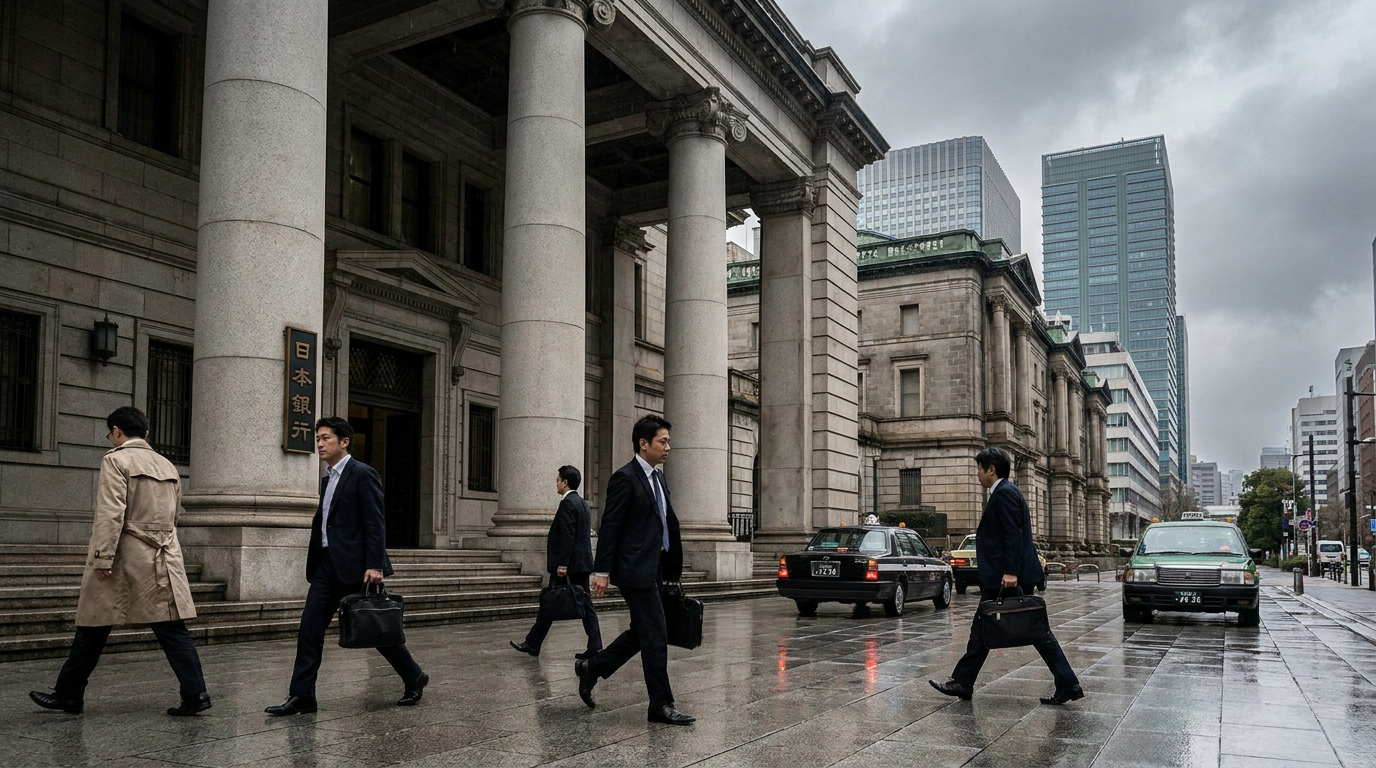
The Bank of Japan has increased its benchmark interest rate to 1% for the first time since 1995, pivoting away from decades of ultra-loose monetary policy to combat a weak yen and rising energy costs.
By Factlen Editorial Team
- Inflation Hawks & Policy Normalizers
- Argue that rising energy costs and a weak yen necessitate tightening to prevent inflation from overshooting the 2% target.
- Global Currency & Market Strategists
- Analyze the global ripple effects, specifically the yen carry trade unwinding and capital flows.
- Economic Growth Defenders
- Highlight the fragility of Japan's economic recovery and the risks of premature tightening on production and employment.
What's not represented
- · Japanese small business owners facing higher borrowing costs
- · Average Japanese consumers dealing with simultaneous inflation and rising mortgage rates
- · Export-heavy Japanese corporations that benefit from a weak yen
Why this matters
For decades, Japan has served as the world's anchor for ultra-cheap money, allowing global investors to borrow yen for nearly nothing to fund investments elsewhere. By raising rates to a 31-year high, the Bank of Japan is fundamentally altering the math of global finance, which could trigger volatility in international markets while increasing borrowing costs for Japanese households and businesses.
Key points
- The Bank of Japan raised its benchmark interest rate to 1%, the highest level since 1995.
- The 7-1 decision was driven by a weak yen and imported inflation from Middle East energy shocks.
- BOJ Governor Kazuo Ueda missed the historic meeting due to hospitalization for a hepatic cyst infection.
- The central bank will pause the tapering of its government bond purchases starting in April 2027.
- The rate hike threatens to disrupt the 'yen carry trade,' a major source of global market liquidity.
The Bank of Japan has officially closed the book on an era of effectively free money, raising its benchmark interest rate to 1% for the first time since 1995. The quarter-point hike, executed during a highly unusual June policy meeting, marks a watershed moment for the world's fourth-largest economy. For decades, Japan stood as the global anchor of ultra-loose monetary policy, maintaining near-zero or negative rates to combat chronic deflation. Now, driven by a weak yen and imported inflation stemming from Middle East energy shocks, the central bank has forcefully pivoted.[1][2][3]
The decision was approved by a 7-1 vote of the monetary policy board, underscoring a broad consensus that the risks of entrenched inflation now outweigh the dangers of economic stagnation. The move pushes Japan's borrowing costs to a 31-year high, a level unseen since the aftermath of the country's historic asset bubble collapse. While a 1% policy rate remains exceptionally low by the standards of the US Federal Reserve or the European Central Bank, the directional shift is profound, signaling to global markets that the yen will no longer serve as a limitless source of cheap funding.[4][5][8]
The optics of the historic decision were complicated by a sudden leadership vacuum. Bank of Japan Governor Kazuo Ueda, the architect of the country's recent monetary normalization, was absent from the meeting after being hospitalized with a hepatic cyst infection. It marked the first time in modern history that a BOJ governor missed a policy-setting gathering. In his stead, Deputy Governor Ryozo Himino chaired the session, while Deputy Governor Shinichi Uchida—who recently returned from his own medical leave for leukemia treatment—delivered the post-meeting press conference.[4][5][8]

Despite the absence of its chief, the central bank's messaging remained resolute. Uchida emphasized that while the risk of a sharp economic deterioration had diminished, price increases were broadening across the economy. The central bank warned that companies are passing on rising oil costs to consumers at a relatively fast pace, creating a tangible risk that underlying inflation could deviate upward from the BOJ's 2% target.[2][6]
The primary catalyst for this inflationary pressure is the geopolitical turmoil in the Middle East. Japan imports approximately 95% of its crude oil from the region, leaving its economy highly vulnerable to energy shocks. The recent conflict involving Iran sent global oil prices soaring, which rapidly filtered down into Japan's corporate goods price index. Wholesale inflation spiked to a three-year high of 6.3% in May, forcing policymakers to act before those costs fully embedded themselves in consumer prices.[3][6][8]
Compounding the energy shock is the historic weakness of the Japanese yen. Prior to the rate decision, the currency had plummeted to roughly 160 per US dollar, a level that significantly inflates the cost of imported goods. The Japanese government has already spent an estimated 11.7 trillion yen—roughly $73 billion—in currency interventions since late April to arrest the yen's slide. By raising domestic interest rates, the BOJ aims to narrow the yawning yield gap between Japan and the United States, theoretically reducing the downward pressure on the currency.[4][5]

Compounding the energy shock is the historic weakness of the Japanese yen.
The mechanics of the BOJ's intervention extend beyond the headline rate. The central bank also clarified its stance on quantitative tightening, announcing that it will pause the tapering of its Japanese Government Bond purchases starting in April 2027. While the BOJ has been gradually reducing its market footprint, it committed to maintaining purchases at around 2 trillion yen per month from that point forward. This dual approach—raising short-term rates while maintaining a floor under long-term bond purchases—reflects a delicate balancing act to prevent a disorderly spike in borrowing costs.[1][7][8]
Not everyone on the policy board agreed with the aggressive posture. Toichiro Asada, a recently appointed board member, cast the lone dissenting vote against the rate hike. Asada argued that the downside risks to domestic production and employment, exacerbated by the very same Middle East tensions, are currently greater than the upside risks to prices. His dissent highlights the fragility of Japan's economic recovery, which relies heavily on domestic consumption that could be stifled by higher mortgage and corporate borrowing rates.[1][5][8]
The global financial system is watching the BOJ's moves with intense scrutiny, primarily due to the mechanics of the "yen carry trade." For years, international investors have borrowed yen at rock-bottom interest rates, converted the funds, and invested in higher-yielding assets abroad, from US Treasuries to emerging market equities and even cryptocurrencies. As the BOJ raises rates, the cost of servicing those yen-denominated loans increases, threatening to trigger a massive unwinding of these positions.[8]

If a rapid unwinding occurs, it could force investors to liquidate global assets to repay their yen debts, potentially sparking volatility across international stock and bond markets. However, the immediate market reaction to the 1% hike was relatively muted. The yen briefly strengthened before settling back near the 160-per-dollar mark, while the Nikkei 225 index briefly touched a record 70,000 before paring gains. This suggests that financial markets had largely priced in the BOJ's move, avoiding the kind of shock that triggers a disorderly sell-off.[1][5]
The path forward remains clouded by geopolitical developments. Recent reports indicate that the US and Iran have reached an interim peace agreement to reopen the Strait of Hormuz, which has already begun to cool global oil prices. If energy costs recede significantly, the imported inflation that justified the BOJ's June hike could dissipate, potentially altering the trajectory of future rate increases.[2][5][8]

Nevertheless, a clear majority of economists anticipate that the BOJ is not yet finished. Surveys indicate that market watchers expect another rate hike by the end of 2026, potentially pushing the benchmark to 1.25% or 1.5%. The central bank has explicitly stated that it will continue to adjust the degree of monetary accommodation if economic and price developments align with its projections, signaling that the era of Japanese monetary exceptionalism is definitively over.[1][6]
The ultimate success of this transition will depend on whether Japan can achieve a virtuous cycle of rising wages and sustainable domestic demand, rather than merely reacting to external cost-push shocks. For now, the BOJ has drawn a line in the sand, demonstrating its willingness to defend its currency and its inflation target, even as it navigates uncharted economic waters and unprecedented internal leadership challenges.[4][7]
How we got here
1995
The Bank of Japan last holds its benchmark interest rate at or above 1%.
March 2024
The BOJ ends its negative interest rate policy, raising rates for the first time in 17 years.
Late April 2026
The Japanese government spends an estimated 11.7 trillion yen to prop up the rapidly depreciating currency.
May 2026
Japan's wholesale inflation hits a three-year high of 6.3%, driven by energy costs.
June 10, 2026
BOJ Governor Kazuo Ueda is hospitalized with a hepatic cyst infection.
June 16, 2026
The BOJ officially raises its benchmark rate to 1% in a 7-1 vote.
Viewpoints in depth
Inflation Hawks & Policy Normalizers
Argue that the era of ultra-loose monetary policy has outlived its usefulness and is now actively harming the Japanese economy by destroying the yen's purchasing power.
This camp points to the 6.3% wholesale inflation rate as proof that external energy shocks are bleeding into the domestic economy, necessitating a return to orthodox central banking to protect consumers from runaway costs. They argue that keeping rates near zero while the rest of the developed world tightened policy created an unsustainable yield gap, which directly caused the yen's historic collapse to 160 per dollar. For these analysts, the 1% hike is a necessary, albeit delayed, step to restore the currency's credibility and prevent imported inflation from eroding household wealth.
Economic Growth Defenders
Caution that Japan's underlying economic recovery remains highly fragile and heavily dependent on government subsidies.
This perspective, echoed by dissenting board member Toichiro Asada, argues that the inflation Japan is experiencing is 'cost-push' (driven by external supply shocks like Middle East oil prices) rather than 'demand-pull' (driven by strong domestic consumption). Raising borrowing costs, they warn, could choke off business investment and household spending just as the economy is trying to escape decades of stagnation. They fear that higher mortgage rates and corporate loan costs will disproportionately harm small and midsize enterprises, potentially tipping the country back into a deflationary mindset.
Global Market Strategists
Focus on the systemic risks posed by the unwinding of the yen carry trade and the broader implications for global liquidity.
These analysts emphasize that for decades, the Bank of Japan has served as the world's provider of cheap liquidity. By raising rates to 1%, the BOJ alters the fundamental math of global finance. They warn that as the cost of borrowing yen increases, international investors may be forced to liquidate trillions of dollars in foreign assets—ranging from US Treasuries to emerging market equities—to cover their increasingly expensive yen-denominated debts. While the immediate market reaction was muted, they caution that sustained rate hikes could trigger significant volatility across international borders.
What we don't know
- Whether the recent US-Iran interim peace agreement will lower oil prices enough to cool Japanese inflation.
- How high the BOJ is willing to push rates if the yen continues to hover near the 160-per-dollar mark.
- The extent to which higher borrowing costs will stifle Japan's fragile domestic consumption and corporate investment.
Key terms
- Policy Interest Rate
- The benchmark interest rate set by a central bank, which influences the cost of borrowing for commercial banks and, ultimately, consumers and businesses.
- Yen Carry Trade
- A financial strategy where investors borrow money in a currency with low interest rates (like the yen) to invest in assets denominated in a currency with higher interest rates.
- Wholesale Inflation
- The rate of price increases for goods sold between businesses, before they reach the consumer market. It often serves as an early indicator of consumer inflation.
- Quantitative Tightening
- A monetary policy tool used by central banks to decrease the amount of liquidity in the economy, often by reducing their purchases of government bonds.
- Hepatic Cyst
- A fluid-filled sac that occurs on the liver. While usually benign, an infection can require long-term hospital care.
Frequently asked
Why did the Bank of Japan raise interest rates?
The BOJ raised rates to combat rising inflation driven by high Middle East energy costs and a historically weak yen, which makes imported goods more expensive.
Why was BOJ Governor Kazuo Ueda absent?
Governor Ueda was hospitalized with a hepatic cyst infection, marking the first time in modern history a BOJ governor missed a policy-setting meeting.
What is the yen carry trade?
It is an investment strategy where investors borrow Japanese yen at low interest rates to buy higher-yielding assets globally. Rising Japanese rates threaten to disrupt this trade.
Will Japanese interest rates keep going up?
Most economists expect the BOJ to continue gradually raising rates, potentially reaching 1.25% or 1.5% by the end of 2026, depending on inflation trends.
Sources
Source coverage
8 outlets
3 viewpoints surfaced








[1]BloombergInflation Hawks & Policy Normalizers
Bank of Japan raises rate to 31-year high and signals more to come
Read on Bloomberg →[2]The GuardianInflation Hawks & Policy Normalizers
Bank of Japan raises interest rates to 31-year high … of 1%
Read on The Guardian →[3]Al JazeeraGlobal Currency & Market Strategists
Japan's central bank raises interest rates to highest level since 1995
Read on Al Jazeera →[4]AP NewsInflation Hawks & Policy Normalizers
Bank of Japan raises its key interest rate to a three-decade high of 1%, citing inflation
Read on AP News →[5]The Japan TimesEconomic Growth Defenders
Bank of Japan takes rates to 1%, the highest level since 1995
Read on The Japan Times →[6]ReutersGlobal Currency & Market Strategists
Bank of Japan raises interest rates to 31-year high
Read on Reuters →[7]Central BankingEconomic Growth Defenders
BoJ tightens to 1% and plans end to JGB purchase reductions
Read on Central Banking →[8]BabypipsGlobal Currency & Market Strategists
Bank of Japan Raises Rates to 1% — Highest Since 1995
Read on Babypips →



Every angle. Every day.
Get business stories with full source coverage and perspective breakdowns delivered to your inbox.