
How Women's Wrestling Became the NCAA's 91st Championship Sport
Driven by explosive grassroots growth, women's wrestling has officially graduated from an emerging sport to a fully sanctioned NCAA championship.
By Factlen Editorial Team
- Collegiate Athletes and Coaches
- Focuses on the validation, scholarship opportunities, and Title IX equity this milestone provides.
- Grassroots and Olympic Advocates
- Emphasizes the structural pipeline from high school mats to the Olympic podium.
- Athletic Administrators
- Focuses on the logistical, financial, and compliance realities of adding a new varsity sport.
- Sports Analysts
- Analyzes the broader cultural and structural shifts in collegiate athletics.
What's not represented
- · High school athletic directors managing the rapid logistical scaling of new girls' wrestling programs.
Why this matters
The elevation of women's wrestling to full NCAA championship status provides thousands of young female athletes with new pathways to college scholarships and degrees. It also establishes a permanent, fully funded developmental pipeline that will shape the future of American Olympic success.
Key points
- The NCAA held its first-ever National Collegiate Women's Wrestling Championship in March 2026.
- McKendree University captured the inaugural team title, narrowly defeating the University of Iowa.
- The milestone was driven by explosive grassroots growth, with high school participation jumping from 11,000 to over 74,000 in a decade.
- Women's wrestling achieved championship status by successfully navigating the NCAA's Emerging Sports for Women pipeline.
- The current unified format allows athletes from Divisions I, II, and III to compete in a single 180-wrestler bracket.
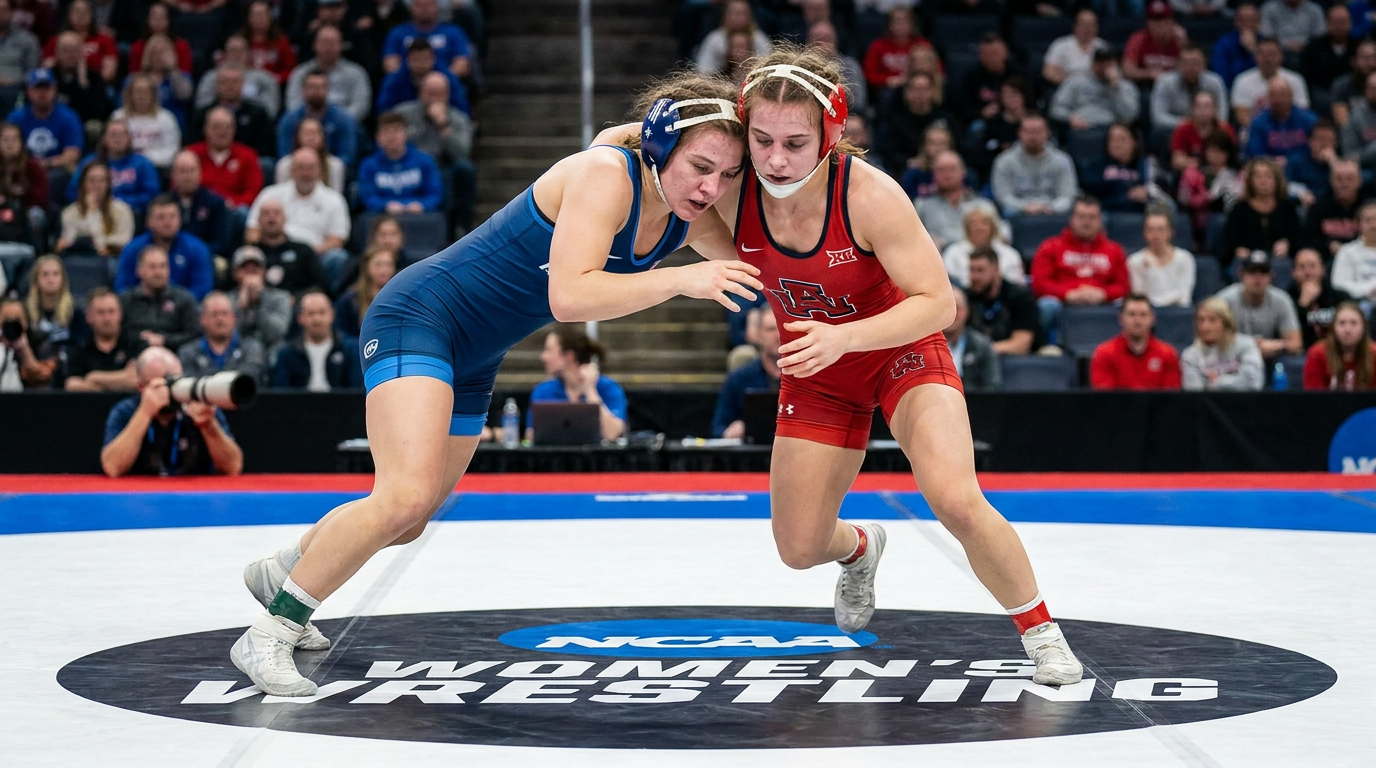
The atmosphere inside Xtream Arena in Coralville, Iowa, was electric as the final whistle blew in March 2026. For the athletes on the mat, the sweat and exhaustion were familiar, but the stakes were entirely unprecedented. This was the first-ever NCAA National Collegiate Women's Wrestling Championship.[1][5]
When the dust settled, McKendree University hoisted the inaugural team trophy, narrowly edging out the University of Iowa in a fiercely contested team race. Individual champions like Yu Sakamoto and Bella Mir cemented their names in collegiate history, winning titles in front of a roaring, sold-out crowd.[1][5]
But this was not just another collegiate tournament; it was the culmination of a decades-long fight for institutional recognition. With the crowning of these champions, women's wrestling officially took its place as the 91st NCAA championship sport.[1][2]
The arrival of this championship represents a massive structural shift in American collegiate athletics. It is a testament to what happens when institutional barriers are removed, driven entirely by an unprecedented grassroots explosion at the high school level.[6]
Just a decade ago, girls' wrestling was a statistical anomaly in the United States. In 2014, roughly 11,000 girls wrestled in high school, and the vast majority of them had no choice but to compete against boys on men's teams.[3]
By the 2024–2025 school year, that narrative had completely rewritten itself. The number of female high school wrestlers skyrocketed to over 74,000, according to data from the National Federation of State High School Associations (NFHS).[3]

This surge made girls' wrestling the fastest-growing high school sport in the country. Today, 40 states hold officially sanctioned girls' state wrestling championships, creating a massive talent pool hungry for the next level of competition.[3][4]
However, high school growth alone does not automatically guarantee a college championship. To reach the NCAA stage, the sport had to carefully navigate the complex bureaucracy of the NCAA's "Emerging Sports for Women" pipeline.[6]
Established in 1994, the Emerging Sports program was designed to help universities meet Title IX gender-equity requirements by incubating new women's sports and providing them with a structured path to official recognition.[1]
To graduate from an "emerging" sport to an official NCAA championship, a sport must hit a specific, rigorous metric: at least 40 member schools must sponsor it at the fully funded varsity level.[1][4]

A dedicated coalition of advocates—including USA Wrestling, Wrestle Like a Girl, and the National Wrestling Coaches Association—worked tirelessly to convince athletic directors across the country to launch and fund new programs.[4]
Their strategic efforts paid off. During the 2022–2023 academic year, women's wrestling officially crossed the 40-program threshold, triggering the formal legislative process required to establish a national championship.[1][4]
The final hurdle was cleared in January 2025. At the NCAA Convention in Nashville, delegates from all three NCAA divisions voted overwhelmingly to elevate women's wrestling to full championship status, greenlighting the 2026 tournament.[2]
The inaugural 2026 championship utilized a "National Collegiate" format. Because the sport is still in its early growth phase, athletes from Divisions I, II, and III competed together in a single, unified 180-wrestler bracket.[1]

This unified format created unique, compelling David-versus-Goliath matchups, where scrappy Division III athletes had the rare opportunity to test their skills against fully funded Division I powerhouses on a national stage.[5][6]
The collegiate boom is also reshaping the demographic landscape of the sport. The NCAA reports that 45 percent of female collegiate wrestlers come from diverse or international backgrounds, highlighting the sport's broad accessibility.[2]
Furthermore, the NCAA championship solidifies the United States' Olympic pipeline. College wrestling has long been the primary developmental engine for Team USA's men, and now American women finally have the same elite infrastructure.[1][4]
Looking ahead, the sport faces a new set of logistical challenges. As the number of sponsoring schools rapidly approaches 100, the NCAA will eventually need to decide when to split the unified tournament into separate divisional championships.[1][6]

For now, the focus within the wrestling community remains on celebration and continued expansion. The success of the 2026 championship proved that when the platform is built, female athletes will eagerly fill the mats.[6]
The establishment of the NCAA Women's Wrestling Championship ensures that the thousands of young girls lacing up their shoes in high school gyms today have a clear, fully sanctioned path to collegiate glory.[6]
How we got here
1994
The NCAA establishes the Emerging Sports for Women program to incubate new female athletics.
2020
Women's wrestling is officially added to the Emerging Sports program.
2023
The sport crosses the required threshold of 40 sponsoring varsity programs.
Jan 2025
All three NCAA divisions vote to elevate women's wrestling to full championship status.
Mar 2026
The first-ever NCAA National Collegiate Women's Wrestling Championship is held in Iowa.
Viewpoints in depth
Collegiate Athletes and Coaches
Focuses on the validation, scholarship opportunities, and Title IX equity this milestone provides.
For the athletes and coaches on the mat, the NCAA sanctioning represents long-overdue institutional validation. Beyond the prestige of competing for an official national title, championship status forces athletic departments to fully fund programs, hire full-time coaching staffs, and offer dedicated athletic scholarships. Coaches view this as a critical Title IX victory that finally rewards the intense physical dedication of female wrestlers with the same educational benefits long afforded to their male counterparts.
Grassroots and Olympic Advocates
Emphasizes the structural pipeline from high school mats to the Olympic podium.
Organizations like USA Wrestling and Wrestle Like a Girl view the NCAA championship as the missing link in the American developmental pipeline. Historically, female wrestlers had to rely on club teams or international tours to prepare for the Olympics, while male athletes honed their skills in the grueling NCAA system. Advocates argue that a fully funded collegiate ecosystem will exponentially raise the technical level of American women, ensuring long-term dominance for Team USA on the global stage.
Athletic Administrators
Focuses on the logistical, financial, and compliance realities of adding a new varsity sport.
For university athletic directors and NCAA regulators, women's wrestling represents a highly efficient way to boost female athletic participation and maintain Title IX compliance. Because wrestling requires relatively minimal infrastructure—primarily mats and a practice room—it is more cost-effective to launch than equipment-heavy sports like ice hockey or rowing. However, administrators must now navigate the complexities of recruiting qualified coaching staffs and managing the eventual split of the unified championship into separate divisions.
What we don't know
- When the unified National Collegiate Championship will generate enough participating schools to split into separate Division I, II, and III tournaments.
- How the influx of fully funded Division I programs will impact the competitive dominance of early-adopter Division II and III schools.
Key terms
- Emerging Sports for Women
- An NCAA program created to recognize and incubate new women's sports, providing a pathway to official championship status.
- National Collegiate Championship
- A unified NCAA championship format where athletes from Divisions I, II, and III compete against each other, typically used for newer or smaller sports.
- Title IX
- A federal civil rights law in the United States that prohibits sex-based discrimination in any school or education program that receives federal funding.
- Varsity Status
- The highest level of collegiate athletic competition, meaning a program is fully funded and sponsored by the university's athletic department rather than operating as a club.
Frequently asked
What is an NCAA Emerging Sport?
It is a pipeline created in 1994 to help grow women's athletics and assist universities in meeting Title IX gender-equity requirements by incubating new sports.
Why did Divisions I, II, and III compete together?
Because the sport is newly sanctioned, it uses a unified 'National Collegiate' format until enough schools sponsor it to warrant separate divisional tournaments.
Who won the first NCAA women's wrestling team title?
McKendree University won the inaugural 2026 team championship, narrowly defeating the University of Iowa.
How many girls wrestle in high school?
As of the 2024-25 school year, over 74,000 girls participate in high school wrestling nationwide, making it the fastest-growing high school sport.
Sources
Source coverage
6 outlets
4 viewpoints surfaced





[1]NCAA.comAthletic Administrators
NCAA's first women's wrestling championships: What to know
Read on NCAA.com →[2]AP NewsAthletic Administrators
NCAA adds women's wrestling as its 91st and latest championship sport
Read on AP News →[3]NFHSGrassroots and Olympic Advocates
Wrestling Participation Surpasses 370,000 Fueled by Record Growth in Girls Wrestling
Read on NFHS →[4]USA WrestlingGrassroots and Olympic Advocates
NCAA approves women's wrestling as championship sport
Read on USA Wrestling →[5]FloWrestlingCollegiate Athletes and Coaches
The Dawn of a New Era: Inside the First NCAA Women's Wrestling Championship
Read on FloWrestling →[6]Factlen Editorial TeamSports Analysts
Synthesis by Factlen editorial team
Read on Factlen Editorial Team →

More in sports
See all 11 stories →PWHL Business Model
How the PWHL's Unique Business Model Secured the Future of Women's Hockey
7 sources

Injury
SailGP Fleet Reunited in Halifax as Injured Sailors and Rebuilt Catamarans Make Triumphant Return
6 sources

Standings
Australia Extends SailGP Lead as League Hits Major Ownership Milestone Ahead of Halifax Grand Prix
6 sources

Injury
Olympic Champions Find a 'New Lease of Life' in Triumphant Returns at World Rowing Cup I
6 sources

Every angle. Every day.
Get sports stories with full source coverage and perspective breakdowns delivered to your inbox.