
Smart vs. Traditional Bassinets: Weighing the Trade-offs for Infant Sleep
High-tech smart bassinets promise exhausted parents more sleep through automated soothing, but their steep price tags and heavy footprints present stark trade-offs against affordable, portable traditional models.
By Factlen Editorial Team
- Tech-Forward Parents
- View automated bassinets as a necessary investment in parental sleep and mental health during the grueling newborn phase.
- Pediatric Safety Advocates
- Focus strictly on AAP compliance, emphasizing that a firm, flat, and empty sleep surface is the only non-negotiable requirement.
- Budget-Conscious Minimalists
- Argue that expensive smart gear is unnecessary for a six-month window, preferring affordable, portable traditional bassinets.
What's not represented
- · Parents of multiples (twins/triplets) who face compounded sleep deprivation
- · Second-hand market buyers navigating warranty and hygiene risks
Why this matters
A bassinet is one of the most critical and heavily used purchases for a newborn. Choosing between a traditional and smart model dictates not only a family's budget, but how much sleep parents will get during the grueling first six months of a child's life.
Key points
- Traditional bassinets cost between $100 and $300, offering a lightweight, portable, and AAP-compliant safe sleep surface.
- Smart bassinets, ranging from $300 to $2,000, act as virtual night nurses by automatically soothing fussing babies with motion and white noise.
- The Happiest Baby Snoo holds FDA authorization for keeping infants on their backs, but is outgrown by six months of age.
- Convertible models like the Cradlewise justify higher upfront costs by transitioning into a mini-crib that lasts up to 24 months.
- Parents must weigh the financial cost and heavy footprint of smart gear against the physical toll of manual nighttime soothing.
The arrival of a newborn brings a universal and immediate challenge: severe sleep deprivation. For decades, the standard solution for the first few months of a baby's life was a simple, traditional bassinet placed securely next to the parents' bed. Today, however, the baby gear market has been transformed by Silicon Valley, offering a high-tech alternative: the smart bassinet. With prices ranging from a modest $100 for a basic, manually operated model to upwards of $2,000 for a robotic, Wi-Fi-enabled sleep assistant, parents are forced to weigh the trade-offs between traditional manual parenting and automated soothing. This decision is rarely just about furniture; it is a complex calculation involving family budgets, nursery space, and the desperate pursuit of a good night's rest.[7]
At its core, a traditional bassinet is exactly what it appears to be—a safe, flat, enclosed sleeping surface designed for a newborn's first few months. Models like the Maxi-Cosi Iora, which Consumer Reports recently scored as the top overall bassinet in its 2026 testing, cost around $270 and offer simple height adjustments alongside breathable mesh sides. The primary advantage of the traditional route is accessibility and portability. They are lightweight, easy to move from the bedroom to the living room for daytime naps, and require no power outlets, software updates, or Wi-Fi connections. For families prioritizing simplicity, a traditional bassinet provides everything an infant strictly needs for safe sleep without any digital overhead.[4]
The trade-off for that simplicity, however, is entirely manual labor. When a baby wakes at 2:00 a.m., the parents are the engine. They must physically rock, shush, and soothe the infant back to sleep. For families blessed with a naturally good sleeper, this manual intervention is a minor, manageable hurdle. But for parents facing severe sleep deprivation, colic, or the demands of caring for multiple children, the physical toll of leaning over a stationary bed night after night can become overwhelming. This exhaustion is the primary driver behind the booming demand for automated alternatives that promise to shoulder some of the nocturnal burden.[7]
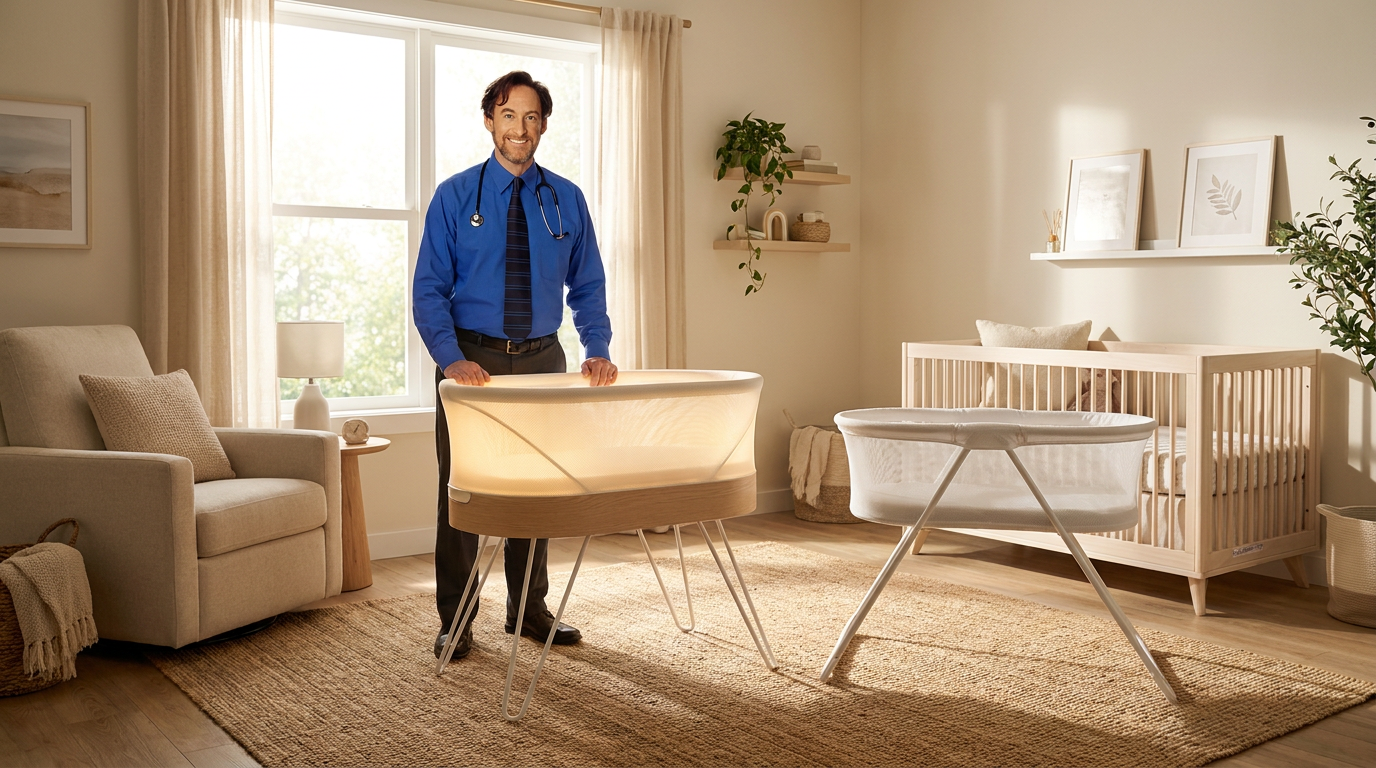
Enter the smart bassinet, a category pioneered by the Happiest Baby Snoo and recently expanded by sophisticated competitors like Cradlewise and Graco. These devices are engineered to act as a virtual night nurse. Using built-in microphones, cameras, and motion sensors, they detect when a baby begins to fuss or wake up. Before the infant can escalate to a full cry, the bassinet automatically responds with escalating levels of white noise and physical motion—ranging from a gentle, rhythmic sway to a more vigorous bounce designed to mimic the sensation of being in the womb.[1]

The evidence supporting these high-tech sleepers is largely found in the extra hours of rest they afford exhausted parents. Reviews from parenting platforms like Babylist and Poppylist consistently highlight that smart bassinets can successfully connect a baby's sleep cycles. By intervening at the first sign of stirring, the machine often soothes the baby back to deep sleep before a parent even needs to get out of bed. For many families, purchasing a smart bassinet is viewed less as buying a piece of nursery furniture and more as a critical investment in parental mental health and daytime functioning.[1][2]
However, that investment comes with a steep financial barrier that fundamentally alters the nursery budget. The Happiest Baby Snoo retails for $1,695, while the Cradlewise Convertible Smart Crib costs $1,999. Even mid-tier automated options, like the Graco SmartSense, hover around the $300 to $400 mark. Against the backdrop of inflation and the already high costs of diapers, formula, and childcare, these premium price tags force families to calculate the exact dollar value of a few extra hours of sleep, weighing the convenience of automation against significant financial strain.[1][2]
Beyond cost, safety remains the ultimate, non-negotiable metric for any infant sleep space. The American Academy of Pediatrics (AAP) updated its safe sleep guidelines in 2025, reinforcing the lifesaving 'ABC' rule: babies should sleep Alone, on their Back, in a Crib or bassinet with a firm, flat mattress. The AAP strictly advises against loose bedding, pillows, weighted swaddles, or inclined sleepers. Furthermore, the academy strongly recommends room-sharing—keeping the baby's sleep space in the parents' bedroom—for at least the first six months to significantly reduce the risk of Sudden Infant Death Syndrome (SIDS).[5]
Beyond cost, safety remains the ultimate, non-negotiable metric for any infant sleep space.
Both traditional and smart bassinets can meet these strict AAP criteria, provided they are used correctly by caregivers. The Snoo, for instance, requires a specialized sleep sack that clips directly into the sides of the bassinet, physically preventing the infant from rolling onto their stomach during the night. This unique safety feature earned the Snoo a De Novo authorization from the FDA, classifying it as a medical device intended to facilitate a supine sleep position—a major selling point for parents battling severe nighttime anxiety.[1][6]

Yet, the integration of complex technology into infant sleep is not without regulatory friction. In June 2026, the FDA issued a warning letter to Happiest Baby regarding the marketing of its 'Snoo Hospital Bundle' for clinical settings without proper clearance. The agency also cited quality control issues, noting complaints of mold and bodily fluids in units processed by the company's third-party refurbisher. This regulatory scrutiny highlights the inherent complexities of treating consumer electronics as medical devices, and serves as a stark reminder to parents that smart features require rigorous cleaning and maintenance.[6]
Another critical factor in the smart versus traditional debate is the product's usable longevity. A standard bassinet—whether it is a $100 traditional mesh model or the $1,695 Snoo—has a strict developmental expiration date. Once a baby can roll over or push up on their hands and knees, which usually occurs around five to six months of age, they must be transitioned to a full-size, stationary crib for safety. Spending nearly two thousand dollars for a maximum of six months of use is a difficult equation for many budgets, which has prompted a robust, secondary rental market for smart sleepers.[2][3]
Cradlewise attempts to solve this exact longevity problem by bridging the gap between a newborn bassinet and a toddler bed. Its unit features a height-adjustable mattress that allows it to function as a bassinet for newborns and then lower into a mini-crib for toddlers up to 24 months or 33 pounds. While the upfront cost is the highest on the market, the extended two-year lifespan—combined with a built-in video monitor and white noise machine—changes the value proposition for parents willing to commit to a single, multi-functional piece of furniture.[1][3]

The reliance on technology also introduces a philosophical debate among parents and pediatric sleep consultants. Critics argue that automated bassinets can create powerful sleep associations that are incredibly difficult to break once the baby inevitably transitions to a stationary crib. If an infant learns to rely exclusively on robotic rocking to fall asleep, the eventual move to a still mattress can trigger a grueling sleep regression. Proponents counter that premium smart bassinets feature built-in 'weaning modes' that gradually reduce motion over several weeks, gently easing the baby's transition to independent sleep.[7]
Furthermore, the physical footprint and aesthetic impact of these devices vary wildly. Traditional bassinets are often foldable, easily stowed in a closet, or wheeled effortlessly into a living room or kitchen for daytime supervision. Smart bassinets, laden with heavy motors, sensors, and solid wooden bases, are essentially stationary pieces of heavy furniture. They require a dedicated power outlet and are not easily moved from room to room, limiting their utility for families in multi-story homes who want to keep the baby nearby throughout the day.[3][7]
Ultimately, the decision requires a clear-eyed assessment of a family's specific needs, budget, and living situation. The traditional bassinet fits well when parents are on a strict budget, value portability, have limited space, or simply prefer a low-tech approach to newborn care. It is the proven, reliable baseline that has safely housed infants for generations, provided parents are fully prepared to take on the manual labor of nighttime soothing and rocking.[7]

Conversely, the smart bassinet fits well when families have the disposable income to prioritize parental sleep, are managing the exhausting demands of multiple children, or are returning to work quickly and cannot afford the cognitive toll of severe sleep deprivation. It does not fit well when parents are prone to tech anxiety—constantly checking sleep tracking apps and camera feeds—or when the sheer size, weight, and power requirements of the unit clash with a small, transient, or multi-story living space.[7]
How we got here
1990s
The AAP launches the 'Back to Sleep' campaign, drastically reducing SIDS rates by advising parents to place infants on their backs.
2016
Happiest Baby launches the Snoo, pioneering the luxury smart bassinet category with automated motion and white noise.
2022
The AAP updates its safe sleep guidelines, strongly emphasizing that sleep surfaces must be flat and free of all loose bedding or inclined products.
2024
Cradlewise gains popularity as a convertible smart crib that extends the lifespan of automated soothing up to 24 months.
2025
The AAP reaffirms its strict 'bare is best' guidelines, continuing to advise room-sharing for the first six months.
June 2026
The FDA issues a warning letter to Happiest Baby regarding marketing practices and quality control of refurbished Snoo units.
Viewpoints in depth
Tech-Forward Parents
This camp views the high cost of smart bassinets not as a luxury, but as a necessary utility for surviving the grueling newborn phase.
Proponents point to data showing that automated soothing can connect infant sleep cycles, preventing full wake-ups and granting parents crucial hours of rest. For dual-income households returning to work quickly, the 'virtual night nurse' aspect is considered invaluable, often justifying the $1,500+ price tag or the cost of a monthly rental. They argue that a well-rested parent is a safer, more attentive parent during the day.
Pediatric Safety Advocates
Medical professionals maintain a laser focus on the physical sleep environment rather than the technology.
Their primary concern is strict adherence to the AAP's 'bare is best' guidelines—ensuring the mattress is firm, flat, and completely devoid of loose blankets or toys. While they acknowledge that devices like the Snoo can keep babies safely on their backs, they caution against over-reliance on technology and stress that no device can replace active parental supervision and foundational safe sleep practices.
Budget-Conscious Minimalists
This perspective argues that the baby gear industry preys on the anxieties of new parents, upselling them on expensive gadgets with incredibly short lifespans.
They advocate for traditional bassinets, noting that a $150 mesh sleeper provides the exact same safety benefits as a $2,000 smart crib. They emphasize that manual soothing—rocking, shushing, and holding—is a temporary but natural part of early parenthood that doesn't require a Wi-Fi connection, a motorized base, or a subscription app.
What we don't know
- Whether long-term reliance on automated motion during infancy affects a child's independent sleep habits in their toddler years.
- How upcoming FDA regulations might further impact the marketing and secondary resale market of smart bassinets classified as medical devices.
Key terms
- Smart Bassinet
- An infant bed equipped with sensors, microphones, and motors to automatically detect crying and soothe the baby with motion and sound.
- AAP Safe Sleep Guidelines
- Evidence-based recommendations from the American Academy of Pediatrics designed to reduce the risk of sleep-related infant deaths.
- Weaning Mode
- A setting on smart bassinets that gradually reduces automated motion and sound to prepare an infant for transitioning to a stationary crib.
- Supine Position
- Lying horizontally with the face and torso facing up; the only AAP-recommended sleep position for infants.
Frequently asked
Are smart bassinets safe for newborns?
Yes, provided they meet AAP guidelines for a firm, flat, and empty sleep surface. The Snoo even holds FDA authorization for keeping babies on their backs, though parents must strictly follow all manufacturer instructions.
How long can a baby use a bassinet?
Most traditional bassinets and the Snoo are outgrown when a baby can roll over or push up, typically around 5 to 6 months. Convertible models like the Cradlewise can last up to 24 months.
Do smart bassinets cause sleep associations?
They can. Babies may become accustomed to motion to fall asleep. However, most premium smart bassinets include a 'weaning mode' that gradually reduces movement to help transition the baby to a stationary crib.
What is the AAP's 'ABC' rule for infant sleep?
The American Academy of Pediatrics recommends that babies sleep Alone, on their Back, in a Crib (or bassinet) with a firm, flat mattress and absolutely no loose bedding.
Sources
Source coverage
7 outlets
3 viewpoints surfaced







[1]BabylistTech-Forward Parents
Cradlewise vs. Snoo: Which Smart Crib is Right for You?
Read on Babylist →[2]PoppylistTech-Forward Parents
Snoo vs. Cradlewise: A Parent's Honest Review
Read on Poppylist →[3]ReviewedTech-Forward Parents
Is the Cradlewise Smart Crib Worth It?
Read on Reviewed →[4]QuartzBudget-Conscious Minimalists
Consumer Reports: The Best Bassinets of 2026
Read on Quartz →[5]American Academy of PediatricsPediatric Safety Advocates
Sleep-Related Infant Deaths: Updated Recommendations for Reducing Infant Deaths in the Sleep Environment
Read on American Academy of Pediatrics →[6]U.S. Food and Drug AdministrationPediatric Safety Advocates
Warning Letter: Happiest Baby, Inc.
Read on U.S. Food and Drug Administration →[7]Factlen Editorial TeamBudget-Conscious Minimalists
Synthesis by Factlen editorial team
Read on Factlen Editorial Team →
More in shopping
See all 5 stories →Sun Protection
Mineral vs. Chemical Sunscreen: What the Evidence Says as the FDA Approves a Historic New Filter
7 sources

Summer Sales
Summer Sales Shift to June as Amazon, Target, and Walmart Launch Competing Deal Events
6 sources

Appliance Tech
Induction vs. Gas Cooktops in 2026: The Complete Efficiency and Health Comparison
7 sources
Every angle. Every day.
Get shopping stories with full source coverage and perspective breakdowns delivered to your inbox.