
Fusion Startups Surpass $13 Billion in Private Funding as AI Energy Demands Surge
Private investment in nuclear fusion has crossed $13 billion, with 17 startups now holding over $100 million in funding. Driven by the massive energy demands of AI data centers, companies are racing to deliver the first commercial fusion power plant, though significant scientific hurdles remain.
By Factlen Editorial Team
- Commercial Optimists
- Tech investors and hyperscalers who believe immense capital and AI can brute-force the remaining engineering hurdles.
- Scientific Realists
- Physicists and industry analysts who acknowledge the progress but caution that grid-scale engineering breakeven is still years away.
- Geopolitical Strategists
- Observers focusing on the international race for energy independence and the strategic implications of fusion leadership.
What's not represented
- · Traditional Utility Operators
- · Renewable Energy Advocates
- · Local Communities Hosting Prototype Plants
Why this matters
If these startups succeed, they will unlock a virtually limitless, zero-carbon source of baseload electricity, fundamentally solving the energy constraints of the AI boom and accelerating global decarbonization.
Key points
- Private investment in nuclear fusion has surpassed $13 billion globally.
- 17 different fusion startups have now raised more than $100 million each.
- Commonwealth Fusion Systems leads with nearly $3 billion in total funding.
- Helion Energy recently raised $465 million, achieving a $15.5 billion valuation.
- Tech giants like Google and Microsoft have already signed power purchase agreements.
- No private company has yet demonstrated commercial net energy gain.
The artificial intelligence boom has created an insatiable appetite for electricity, forcing technology giants to look far beyond traditional renewable sources. While wind and solar continue to expand rapidly, their inherent intermittency leaves utilities and hyperscalers searching for reliable, zero-carbon baseload power capable of running gigawatt-scale data centers around the clock. This mounting desperation for clean, continuous energy has dramatically accelerated the timeline for what was once considered a distant science-fiction dream: commercial nuclear fusion. Tech companies are no longer waiting for government laboratories to solve the physics; they are actively funding private startups to build the infrastructure today.[1][2]
In June 2026, the private fusion sector crossed a historic and highly anticipated threshold. Cumulative private investment in fusion energy officially surpassed $13 billion globally, with 17 different startups having now raised more than $100 million each. The influx of capital marks a definitive shift for the industry, transitioning fusion from government-funded academic research into boardroom negotiations, venture capital portfolios, and industrial manufacturing. Reaching the $100 million mark is widely considered the moment a fusion company transitions from experimental ambition to industrial seriousness, allowing them to build the massive hardware required for commercial deployment.[1][2]
At its core, nuclear fusion is the exact physical process that powers the sun and the stars. It involves smashing two light atomic nuclei—typically isotopes of hydrogen known as deuterium and tritium—together under extreme heat and immense pressure. When these atoms fuse into a heavier helium element, they release a massive, disproportionate amount of energy. Unlike traditional nuclear fission reactors, which generate power by splitting heavy uranium atoms and leaving behind long-lived radioactive waste, fusion produces absolutely no carbon emissions and no high-level nuclear waste. Furthermore, a fusion reaction cannot melt down; if the precise conditions are lost, the plasma simply cools and the reaction stops instantly.[3]

For decades, the running joke in the energy sector was that commercial fusion was always 'thirty years away.' But that timeline has compressed rapidly in recent years due to two major, converging technological breakthroughs: the commercial availability of high-temperature superconducting (HTS) tape, and the use of artificial intelligence to model complex plasma physics. HTS magnets allow startups to build significantly smaller, more powerful magnetic fields to contain the superheated plasma. By drastically shrinking the size of the required reactor, companies can iterate faster and reduce the capital cost of building a prototype from tens of billions of dollars down to hundreds of millions.[4]
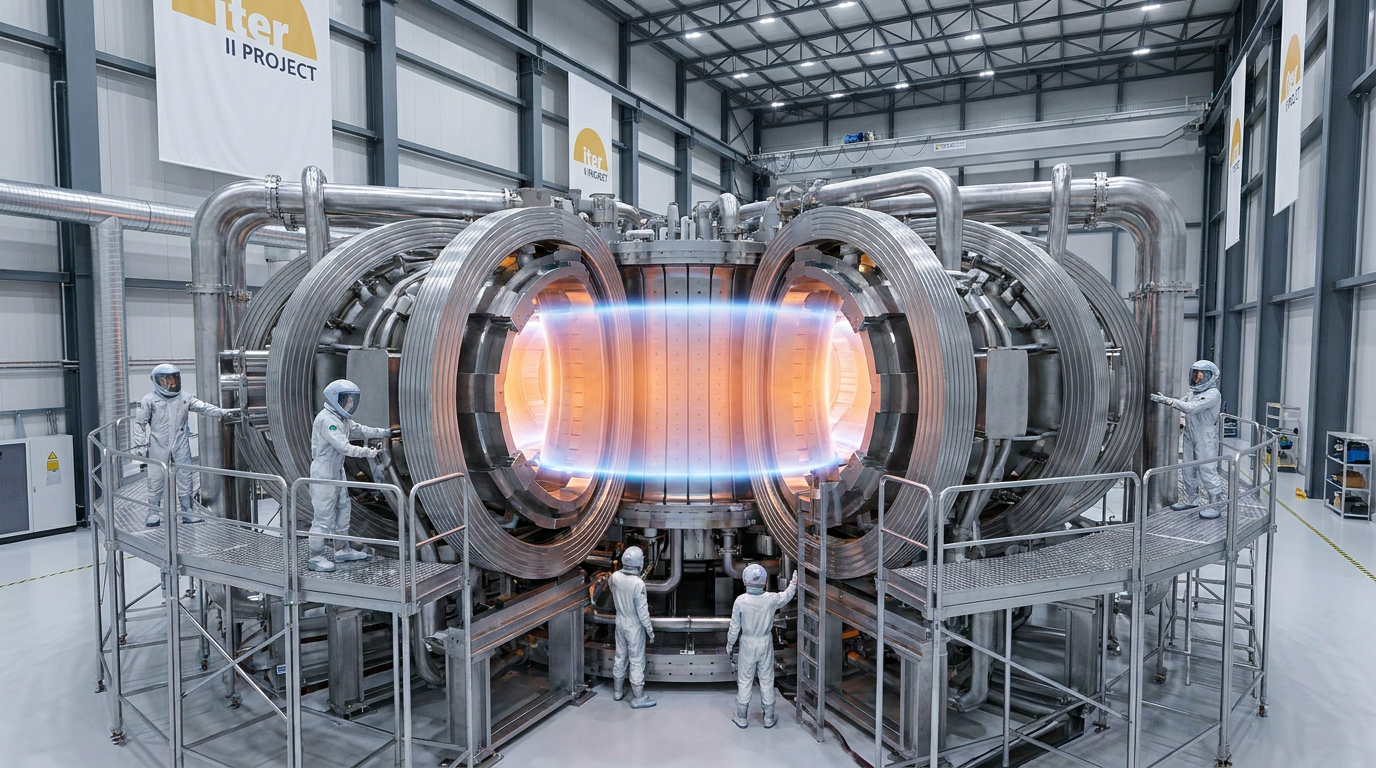
Leading the global pack is Massachusetts-based Commonwealth Fusion Systems (CFS), an MIT spinout that has raised roughly $3 billion to date. Following a massive $863 million Series B2 funding round, CFS is currently finalizing the construction of SPARC, a demonstration tokamak reactor located in Devens, Massachusetts. A tokamak is a donut-shaped device that uses powerful external magnets to trap plasma in a continuous, superheated loop. CFS has leveraged its deep academic roots and massive war chest to become the undisputed heavyweight of the magnetic confinement approach, attracting investments from Bill Gates, Jeff Bezos, and major sovereign wealth funds.[4][7]
CFS is targeting late 2026 or early 2027 to achieve a 'burning plasma' in its SPARC reactor, a critical scientific milestone where the fusion reaction becomes entirely self-sustaining without needing continuous external heating. If successful, the company plans to immediately pivot to building its first commercial-scale power plant, known as ARC, in Virginia by the early 2030s. The commercial demand for this unbuilt plant is already locked in: Google has signed a binding agreement to purchase half of the power generated by the ARC facility to feed its expanding data center footprint.[2][4][7]
Operating on an even more aggressive timeline is Helion Energy, based in Everett, Washington. In early June 2026, Helion closed a massive $465 million Series G funding round led by Thrive Capital, valuing the startup at an astonishing $15.5 billion post-money. This makes Helion the most highly valued private fusion company in the world, backed heavily by prominent tech figures including OpenAI CEO Sam Altman, who views fusion as the necessary bedrock for artificial general intelligence. The new capital is earmarked for expanding their manufacturing capacity and accelerating the deployment of their commercial systems.[3]
Operating on an even more aggressive timeline is Helion Energy, based in Everett, Washington.
Helion eschews the traditional, donut-shaped tokamak design in favor of a pulsed magnetic system known as a Field-Reversed Configuration. Its seventh-generation prototype, Polaris, recently became the first privately funded machine to operate with actual deuterium-tritium fuel, reaching internal plasma temperatures exceeding 150 million degrees Celsius—roughly ten times hotter than the core of the sun. Instead of using the fusion heat to boil water and spin a traditional steam turbine, Helion’s system is uniquely designed to directly recover electrical energy from the expanding magnetic fields, a process that could dramatically increase the efficiency of the power plant.[3]

Helion’s commercial ambitions are unmatched in their speed and audacity. The company is currently constructing its eighth-generation plant, dubbed Orion, in Malaga, Washington. Under the world’s first-ever fusion power purchase agreement, Helion is legally contracted to deliver 50 megawatts of electricity to a nearby Microsoft data center by 2028. Delivering on that timeline would represent an unprecedented leap in energy infrastructure, effectively beating the rest of the industry to the grid by nearly a full decade, though many physicists remain highly skeptical of the aggressive schedule.[3]
While tokamaks and pulsed systems dominate the mainstream headlines, a third architectural approach is gaining serious financial traction: the stellarator. In May 2026, New Jersey-based Thea Energy raised $100 million in Series B funding to advance its software-controlled stellarator systems. Stellarators use a highly complex, twisted magnetic field to contain the plasma. Because the magnetic field is entirely generated by external coils rather than relying on a current running through the plasma itself, stellarators theoretically allow for much more stable, continuous operation than a tokamak, making them ideal for baseload power.[5]
Historically, stellarators were considered far too difficult to manufacture because of their intricate, asymmetrical magnetic coils, which required millimeter-perfect precision. However, Thea Energy and European competitors like Munich-based Proxima Fusion are using advanced digital modeling, AI-driven optimization, and simplified architectures to overcome these historical engineering hurdles. Investors are increasingly betting that while stellarators might be harder to design on a computer, their inherent stability could offer the most reliable and commercially viable path to steady-state baseload power once constructed.[2][5]
The race to commercialize fusion is by no means confined to the United States. Europe is aggressively funding its own fusion ecosystem, driven by a strategic imperative for long-term energy independence and climate goals. Germany’s Focused Energy recently raised $240 million, combining private venture capital with significant government grants. Meanwhile, the UK’s Tokamak Energy and First Light Fusion have raised hundreds of millions of dollars to advance their respective designs, ensuring that the European continent remains highly competitive in the race to patent and deploy the first working reactors.[2]
Meanwhile, China has officially designated nuclear fusion as a top 'frontier technology' and a critical strategic priority in its 15th Five-Year Plan, aiming for net-gain power generation by 2030. In June 2026, Shanghai-based SunUp Fusion raised $100 million to develop compact, high-magnetic-field reactors, joining other heavily funded Chinese startups like Energy Singularity and NovaFusion. The Chinese nuclear fusion market is rapidly transitioning from a purely government-led research endeavor into a commercial, venture-backed industry, heavily supported by state capital and aggressive policy tailwinds.[6]

Despite the billions of dollars flowing into the sector and the highly confident timelines published by startup CEOs, a fundamental scientific hurdle remains entirely unsolved: no private fusion company has yet demonstrated 'net energy gain' at a commercial scale. Net energy gain, often referred to as engineering breakeven, means producing more usable electricity from the fusion reaction than the total electrical energy required to run the entire facility, including the massive cooling systems, superconducting magnets, and complex diagnostic equipment.[2]
The U.S. National Ignition Facility (NIF) achieved a form of scientific breakeven in late 2022, proving that a fusion reaction could yield more energy than the lasers directly deposited into the fuel target. However, that measurement did not account for the massive inefficiencies of the facility itself; the NIF lasers consumed roughly 100 times more energy from the grid than the fusion reaction ultimately produced. Startups must bridge this massive efficiency gap, translating a momentary scientific proof-of-concept into a continuously operating, commercially viable power plant.[2]
Beyond the core physics, the industry faces daunting supply chain and infrastructure challenges that venture capital alone cannot instantly solve. Commercial fusion will require vast quantities of highly specialized materials, from high-temperature superconductors to tritium fuel, which is currently in extremely short supply globally. Because the existing supply chain is so nascent, companies are frequently having to build their own manufacturing facilities and vertically integrate just to ensure they have the bespoke parts needed to construct their prototypes, adding years of necessary groundwork before a reactor can even be turned on.[4][7]

Ultimately, the $13 billion poured into fusion startups represents a calculated, high-stakes gamble by the world's deepest pockets. The venture capitalists and tech billionaires backing Commonwealth Fusion Systems, Helion, and others are fully aware that some of these companies will inevitably fail, and that the aggressive 2028 and 2030 timelines will likely slip. But the ultimate prize—a virtually limitless, clean energy source capable of powering the AI era and permanently decarbonizing the global economy—is simply too large, and too important, to ignore.[2][3]
How we got here
Dec 2022
The U.S. National Ignition Facility achieves scientific breakeven, proving fusion can yield more energy than the lasers used to ignite it.
Aug 2025
Commonwealth Fusion Systems raises an $863 million Series B2 round, bringing its total funding to nearly $3 billion.
May 2026
Thea Energy raises $100 million to advance software-controlled stellarator technology.
Jun 2026
Helion Energy closes a $465 million Series G round, achieving a $15.5 billion valuation.
2028
Helion Energy's target date to begin delivering 50 megawatts of commercial fusion power to a Microsoft data center.
Viewpoints in depth
Hyperscalers and Tech Investors
Tech giants view fusion as the ultimate solution to the AI energy bottleneck.
For hyperscalers like Microsoft and Google, fusion is not just a science experiment; it is a necessary infrastructure investment. The exponential growth of AI data centers requires gigawatts of continuous, zero-carbon baseload power that wind and solar cannot reliably provide. By signing early power purchase agreements and pouring billions into startups like Helion and CFS, tech investors are attempting to brute-force the commercialization of fusion to ensure their future compute capabilities are not throttled by grid limitations.
Pragmatic Physicists
The scientific community emphasizes the massive engineering hurdles that remain.
While physicists celebrate the influx of capital, many remain deeply skeptical of the aggressive 2028 and 2030 commercial timelines. Researchers point out that achieving a momentary 'burning plasma' is vastly different from engineering a power plant that can run continuously for years. Challenges surrounding neutron degradation of reactor walls, the global shortage of tritium fuel, and the unprecedented efficiency required for engineering breakeven lead many experts to believe that grid-scale fusion is still at least a decade away.
National Strategists
Governments view fusion leadership as a critical geopolitical and economic race.
Beyond corporate interests, nations are treating fusion as a strategic imperative. The U.S., Europe, and China are all aggressively subsidizing their domestic fusion ecosystems to avoid being left behind in the next major energy transition. China's inclusion of fusion in its 15th Five-Year Plan and Europe's heavy backing of companies like Focused Energy highlight a global consensus: the country that patents and commercializes fusion first will hold a massive geopolitical advantage in the 21st century.
What we don't know
- Whether any of the current startup designs can actually achieve engineering breakeven at scale.
- How quickly the global supply chain can scale to produce enough tritium and superconducting magnets.
- Which architectural approach—tokamaks, stellarators, or pulsed systems—will ultimately prove most commercially viable.
Key terms
- Tokamak
- A donut-shaped device that uses powerful external magnetic fields to confine superheated plasma in a continuous loop.
- Stellarator
- A fusion reactor that uses a highly complex, twisted magnetic field generated by external coils to contain plasma, offering high stability.
- Net Energy Gain
- The point at which a fusion reactor produces more usable electrical energy than it consumes to operate.
- High-Temperature Superconducting (HTS) Magnets
- Advanced electromagnets that can operate at higher temperatures than traditional superconductors, allowing for smaller and more powerful fusion reactors.
- Plasma
- The fourth state of matter, consisting of superheated, ionized gas where electrons are separated from their nuclei, required for fusion to occur.
Frequently asked
Has any company achieved commercial fusion yet?
No. While several companies have achieved extreme plasma temperatures, no private startup has yet demonstrated 'net energy gain'—producing more electricity than the reactor consumes.
When will fusion power be available on the grid?
Timelines vary wildly. Helion Energy aims to deliver power to Microsoft by 2028, while Commonwealth Fusion Systems targets the early 2030s. Many physicists believe commercial deployment is still a decade or more away.
Is fusion energy safe compared to traditional nuclear plants?
Yes. Fusion does not use heavy radioactive elements like uranium, produces no long-lived high-level nuclear waste, and cannot melt down. If the reaction loses stability, the plasma simply cools and stops.
Why are AI companies investing heavily in fusion?
AI data centers require massive amounts of continuous, zero-carbon electricity. Tech giants like Microsoft and Google are investing in fusion to secure reliable baseload power that intermittent renewables like wind and solar cannot guarantee.
Sources
Source coverage
7 outlets
3 viewpoints surfaced







[1]TechCrunchCommercial Optimists
Every fusion startup that has raised over $100M
Read on TechCrunch →[2]The Next WebScientific Realists
Private fusion funding has crossed $13B with 17 startups raising $100M+
Read on The Next Web →[3]GeekWireCommercial Optimists
Helion Energy raises $465M Series G funding round
Read on GeekWire →[4]Canary MediaGeopolitical Strategists
Commonwealth Fusion Systems tops up its Series B with $863 million
Read on Canary Media →[5]Tech Funding NewsCommercial Optimists
Thea Energy has raised $100M in Series B funding
Read on Tech Funding News →[6]DealStreetAsiaGeopolitical Strategists
SunUp Fusion raises $100M led by Qiming Venture Partners
Read on DealStreetAsia →[7]Latitude MediaScientific Realists
Commonwealth Fusion Systems tops up its Series B with $863 million
Read on Latitude Media →


Every angle. Every day.
Get technology stories with full source coverage and perspective breakdowns delivered to your inbox.