
Induction vs. Gas Cooktops in 2026: The Complete Efficiency and Health Comparison
As induction technology reaches price parity with traditional gas ranges, households face a critical choice between electromagnetic efficiency and open-flame cooking. We break down the health data, energy costs, and practical trade-offs to help you decide.
By Factlen Editorial Team
- Public Health & Environmental Advocates
- Prioritizes indoor air quality, asthma reduction, and decarbonization of home appliances.
- Culinary Traditionalists
- Values the tactile feedback, visual control, and cookware versatility of open-flame cooking.
- Home Infrastructure Analysts
- Focuses on the practical installation costs, electrical grid capacity, and upfront economics of retrofitting.
What's not represented
- · Professional restaurant chefs managing commercial kitchen transitions
- · Natural gas industry representatives
Why this matters
Choosing between induction and gas impacts more than just how fast your water boils—it directly affects your home's indoor air quality, your long-term energy bills, and the safety of your kitchen environment.
Key points
- Induction cooktops are 85-90% energy efficient, while gas stoves waste more than half their heat.
- Gas stoves emit nitrogen dioxide and benzene, increasing childhood asthma risks by 42%.
- Induction boils water significantly faster and offers ultra-precise temperature control.
- Switching to induction often requires a dedicated 240-volt electrical circuit, which can be costly to install.
- Induction requires ferromagnetic cookware like cast iron or magnetic stainless steel.
- Gas remains popular for its visual flame feedback and compatibility with all cookware types.
As induction technology reaches price parity with traditional gas ranges, households face a critical choice between electromagnetic efficiency and open-flame cooking. The debate has shifted from purely culinary preference to a comprehensive evaluation of public health, energy efficiency, and home infrastructure. For decades, gas was considered the gold standard for serious home cooks, while electric resistance coils were viewed as a sluggish compromise. Today, induction has matured into a thermodynamically superior cooking method that is reshaping the modern kitchen.[1][7]
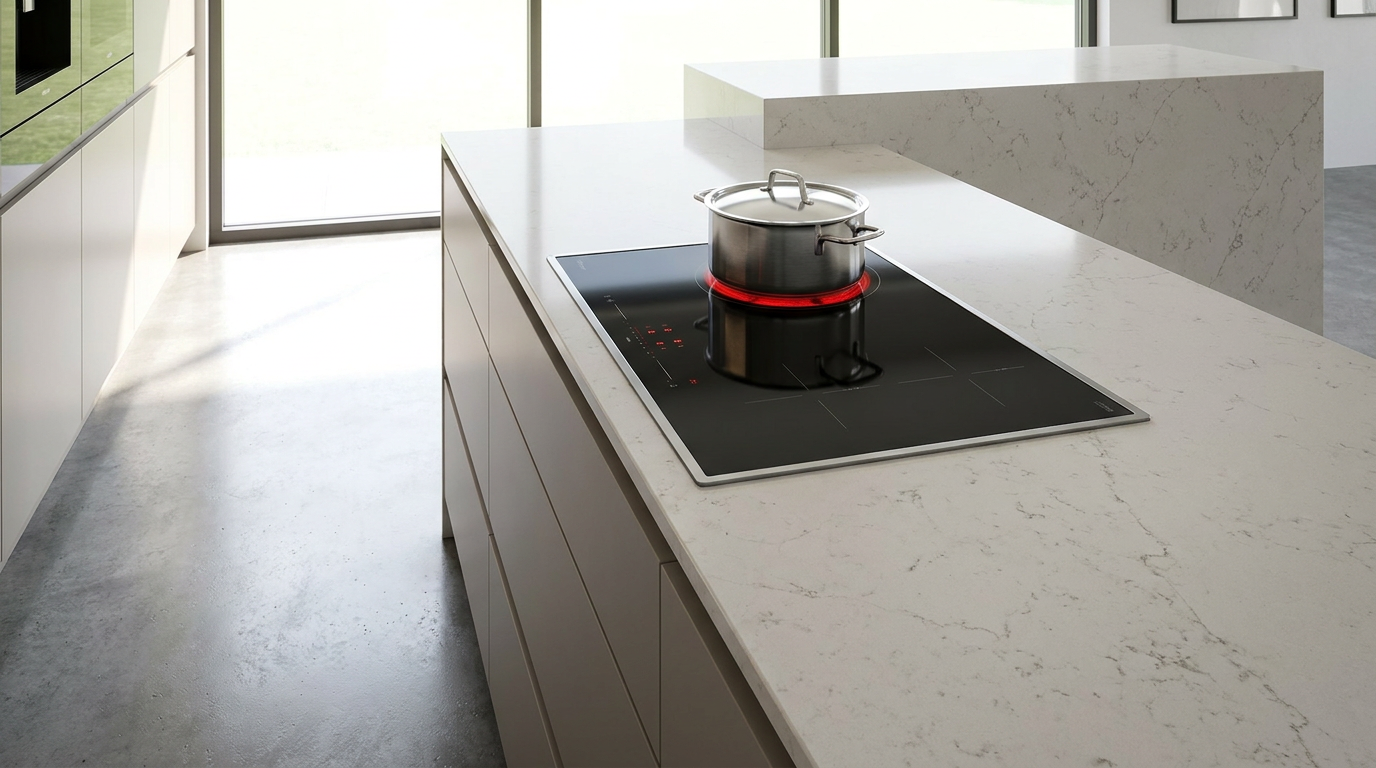
To understand the trade-offs, it helps to look at the underlying mechanisms. Gas cooktops rely on combustion to create an open flame, which heats the air around the pan and indirectly warms the food. Induction, by contrast, uses an oscillating electromagnetic field to excite the iron atoms inside the cookware itself. By turning the pan into the heat source, the glass surface of the stove remains relatively cool, fundamentally changing how energy is transferred during the cooking process.[2][6]
The evidence for induction's energy efficiency is overwhelming. Because it heats the pan directly, induction achieves 85% to 90% energy efficiency, meaning almost all the power drawn from the grid goes directly into your food. Gas ranges, however, operate at just 32% to 40% efficiency, losing more than half of their generated heat to the surrounding ambient air. In practical terms, a high-output induction burner can boil a gallon of water in about three minutes, whereas a standard high-output gas burner takes roughly 14 minutes to accomplish the same task.[1][6]

Beyond speed and efficiency, the most significant shift in the 2026 appliance conversation revolves around indoor air quality. Peer-reviewed research indicates that gas stoves emit nitrogen dioxide, carbon monoxide, and benzene—even when the appliance is turned off. These combustion byproducts can accumulate in poorly ventilated kitchens, creating localized air quality that frequently exceeds outdoor safety standards set by environmental regulators.[3][5]
The health data provides a compelling argument against indoor combustion. A landmark meta-analysis of 41 studies found that children living in homes with gas stoves face a 42% increased risk of developing asthma. Furthermore, researchers at Columbia University demonstrated that swapping a gas stove for an induction model reduces indoor nitrogen dioxide concentrations by 56%. During their controlled trials, participants reported high satisfaction with the switch and cited reduced anxiety about gas leaks and accidental fires.[1][3]

However, the case against induction largely centers on upfront installation costs and infrastructure hurdles. While induction offers long-term operating savings—costing roughly $90 per year to run compared to $600 for gas in some markets—the initial transition can be steep. An induction range typically requires a dedicated 240-volt, 50-amp electrical circuit. If a home's electrical panel is already at maximum capacity, upgrading the service can add hundreds or even thousands of dollars to the total project cost.[1][6]
However, the case against induction largely centers on upfront installation costs and infrastructure hurdles.
For homeowners already plumbed with a natural gas line, replacing an old gas stove with a new one is often the path of least resistance and lowest immediate cost. Yet, this dynamic is slowly shifting as more than 100 jurisdictions across the United States have implemented building codes that restrict or prohibit new natural gas hookups in residential construction, pushing the market inevitably toward electrification.[1][7]
Another practical consideration is cookware compatibility. Because induction relies on magnetic fields, it requires ferromagnetic pots and pans. If a magnet sticks firmly to the bottom of a pan, it will work on an induction stove. This means cast iron, enameled Dutch ovens, and most high-quality stainless steel are perfectly compatible, while pure aluminum, copper, and glass cookware will not function and must be replaced.[2][4]
For culinary enthusiasts, the cooking experience presents distinct trade-offs. The argument for induction highlights its ultra-precise temperature control; it can hold a delicate, unwavering simmer for melting chocolate without a double boiler, and it responds instantaneously to temperature adjustments. Conversely, the argument for gas is rooted in tactile tradition. Many cooks prefer the immediate visual feedback of a flame and the ability to char peppers directly on heavy cast-iron grates, or to use traditional round-bottomed woks that require ambient heat.[4][6]

Safety is an area where induction holds a clear, quantifiable advantage. Because the glass surface only absorbs residual heat from the pan, it remains much cooler to the touch than electric coils or heavy gas grates. The cooktop will not generate heat if it is accidentally turned on without a magnetic pan present, drastically reducing the risk of severe burns—a major selling point for households with young children or elderly family members.[2][6]
Cleanup and daily maintenance further separate the two technologies. The flat, smooth glass surface of an induction cooktop is famously easy to maintain; because the surface doesn't get blazing hot, spills and splatters are far less likely to bake onto the glass. A simple wipe-down with a damp cloth is usually sufficient. Gas cooktops, with their heavy grates, burner caps, and intricate crevices, require regular soaking and scrubbing to remove polymerized grease and food debris.[4][6]
Ultimately, an induction cooktop fits well when you prioritize energy efficiency, rapid heating, and effortless cleanup. It is the definitive choice for households concerned about indoor air quality, families with young children who want a safer cooking surface, and homeowners looking to decarbonize their footprint by moving away from fossil fuels. If your home already has the necessary 240-volt electrical infrastructure, the transition is seamless and highly rewarding.[1][7]
Conversely, an induction cooktop does not fit well when your home lacks the electrical capacity for a high-voltage circuit upgrade and you are on a strict renovation budget. Gas remains a practical choice if you rely heavily on non-magnetic specialty cookware, if you experience frequent power outages without a backup generator, or if you strongly prefer the traditional, tactile experience of cooking over an open flame.[6][7]
How we got here
2014
Early efficiency studies confirm induction transfers up to 90% of heat to food, compared to roughly 40% for gas.
2022
A landmark meta-analysis attributes 12.7% of current U.S. childhood asthma cases to gas stove use.
2023
The U.S. Department of Energy highlights induction's efficiency, noting it can boil water 20-40% faster than gas.
2024
Columbia University publishes findings showing a 56% reduction in indoor NO2 pollution when households switch from gas to induction.
2026
Induction cooktops reach broader price parity with mid-tier gas ranges, accelerating adoption in residential remodels.
Viewpoints in depth
Public Health & Environmental Advocates
Focuses on the urgent need to eliminate indoor combustion and reduce childhood asthma risks.
This camp, supported by organizations like the EPA and academic researchers, views the transition away from gas stoves as a critical public health intervention. They point to meta-analyses showing a 42% increase in childhood asthma risk associated with gas cooking. For environmental advocates, induction is also a key pillar of home electrification, allowing households to run their kitchens on increasingly renewable grid energy rather than fossil fuels.
Culinary Traditionalists
Values the tactile feedback, visual control, and versatility of open-flame cooking.
Many professional chefs and enthusiastic home cooks remain loyal to gas because of the intuitive visual feedback of a flame. This perspective emphasizes the ability to use any type of cookware—including copper and aluminum—and the necessity of open flames for specific techniques like charring vegetables, flambéing, or using traditional round-bottom woks. They often argue that proper range hood ventilation can mitigate the indoor air quality concerns.
Home Infrastructure Analysts
Highlights the practical and financial hurdles of retrofitting older homes for high-voltage appliances.
Contractors and energy economists point out that while induction is cheaper to operate, the upfront barrier is significant. Upgrading an older home's electrical panel to support a 50-amp dedicated circuit can cost thousands of dollars. This camp advocates for a pragmatic approach, suggesting that while induction is perfect for new builds, gas may still be the most economically viable choice for homes already plumbed for it, provided they have adequate ventilation.
What we don't know
- How quickly local electrical grids will upgrade to support the mass electrification of residential appliances.
- Whether future induction models will find ways to accommodate non-magnetic cookware like copper and aluminum.
Key terms
- Electromagnetic Induction
- A process where an oscillating magnetic field generates an electric current inside a magnetic object, creating heat directly within the cookware.
- Ferromagnetic Cookware
- Pots and pans containing iron, such as cast iron or magnetic stainless steel, which are required for an induction cooktop to work.
- Nitrogen Dioxide (NO2)
- A gaseous air pollutant produced by combustion (like burning natural gas) that can irritate airways and exacerbate respiratory diseases.
- Primary Energy
- The total raw energy required to power an appliance, including the energy lost during electricity generation and transmission.
Frequently asked
Do I need to buy all new pots and pans for induction?
Not necessarily. If a magnet sticks firmly to the bottom of your current cookware (like cast iron or most stainless steel), it will work on an induction stove. Aluminum, copper, and glass will not work.
Are induction cooktops safe for people with pacemakers?
Individuals with pacemakers or implantable cardioverter defibrillators (ICDs) should consult their doctor. General guidance suggests keeping the device at least 2 feet (60 cm) away from an active induction cooktop to avoid electromagnetic interference.
Will an induction cooktop heat up my kitchen in the summer?
No. Because induction transfers heat directly to the pan rather than the surrounding air, it produces almost no ambient heat, keeping your kitchen significantly cooler than a gas stove would.
Is it expensive to switch from gas to induction?
The cooktop itself is comparable in price to a gas range, but installation can be costly. You will likely need an electrician to install a dedicated 240V, 50-amp circuit, which can cost anywhere from a few hundred to a few thousand dollars depending on your electrical panel's capacity.
Sources
Source coverage
7 outlets
3 viewpoints surfaced






[1]Energy SolutionsPublic Health & Environmental Advocates
Induction vs Gas Cooktops: The Definitive Health, Efficiency & Economic Analysis (2026)
Read on Energy Solutions →[2]Department of EnergyHome Infrastructure Analysts
The numbers are in: Americans are seeing the benefits of induction appliances
Read on Department of Energy →[3]Columbia UniversityPublic Health & Environmental Advocates
Switching from a gas stove to an electric induction stove can reduce indoor nitrogen dioxide air pollution
Read on Columbia University →[4]Consumer ReportsCulinary Traditionalists
Induction Cooktops vs. Gas
Read on Consumer Reports →[5]The Washington PostPublic Health & Environmental Advocates
The health impact of kitchen choices: Gas vs. induction cooking
Read on The Washington Post →[6]Yale ApplianceCulinary Traditionalists
Induction Has Changed Fast: Here's What You Need to Know
Read on Yale Appliance →[7]Factlen Editorial TeamHome Infrastructure Analysts
Synthesis by Factlen editorial team
Read on Factlen Editorial Team →
Every angle. Every day.
Get shopping stories with full source coverage and perspective breakdowns delivered to your inbox.