
The Science of Saving Britain's Rarest Native Tree
Armed with DNA testing and clone banks, a coalition of conservationists is working to rescue the native black poplar from the brink of extinction.
By Factlen Editorial Team
- Conservation Geneticists
- Focuses on the critical need to map DNA and preserve the remaining genetic diversity of the species.
- Landscape Ecologists
- Emphasizes the tree's role as a keystone species within broader wetland and riparian ecosystems.
- Civic Conservationists
- Views the revival as a community-driven effort to reclaim a lost piece of cultural and natural heritage.
What's not represented
- · Commercial timber industry
- · Agricultural landowners managing drained floodplains
Why this matters
The black poplar is a keystone species of Europe's vanishing floodplain ecosystems; its successful revival provides a blueprint for using genetic mapping to save other critically endangered flora.
Key points
- The native black poplar is Britain's rarest timber tree, with only about 7,000 remaining and a severe shortage of females.
- Historical floodplain drainage and a preference for planting male cuttings halted the species' ability to reproduce naturally.
- Conservationists are using DNA testing to distinguish true native trees from commercial hybrids and to map genetic diversity.
- Regional clone banks and targeted planting programs are successfully reintroducing thousands of verified saplings to river catchments.
The native black poplar (Populus nigra subsp. betulifolia) was once a defining feature of the British and Irish countryside, a towering wetland giant that inspired landscape painters and anchored floodplain ecosystems. Today, it holds the precarious title of Britain’s rarest native timber tree. A sweeping new revival project, highlighted by recent BBC reporting, is attempting to reverse centuries of decline through a coordinated campaign of genetic testing, clone banks, and strategic replanting. The effort represents a shift from passive preservation to active, scientifically managed ecological resurrection.[1][7]
The empirical evidence of the tree's decline is stark. National surveys indicate that only about 7,000 native black poplars remain across the United Kingdom and the Republic of Ireland. More critically, the gender imbalance is severe: researchers estimate that a mere 600 of these surviving trees are female. Because the species is dioecious—meaning individual trees are either strictly male or female—this spatial and numerical separation has effectively halted natural reproduction in the wild.[1][2]

Historical and ecological data point to human land-use changes as the primary driver of this collapse. For centuries, agricultural expansion led to the systematic drainage of the damp, river-valley floodplains where black poplar seeds require bare, wet mud to germinate. Simultaneously, landowners historically favored planting male cuttings because female trees produce vast quantities of fluffy, cotton-like seeds that were considered a nuisance to agriculture and early industry.[2][3]
This historical preference for male cuttings created a severe genetic bottleneck. Evidence gathered by regional conservation groups reveals that many seemingly distinct trees are actually genetic duplicates. In Sussex, for example, genetic profiling of the county's 38 remaining mature black poplars revealed they comprised just five distinct genetic clones—three males and two females. This lack of genetic diversity makes the remaining population highly vulnerable to disease and environmental stress.[6][7]
To combat this, modern conservationists have turned to rigorous DNA testing. Organizations like The Otter Trust in Norfolk are systematically sampling the DNA of existing heritage trees to confirm their native status. This genetic verification is crucial because the native population has been heavily diluted by faster-growing hybrid poplars, introduced for commercial timber, which easily cross-pollinate with the native species.[4][7]
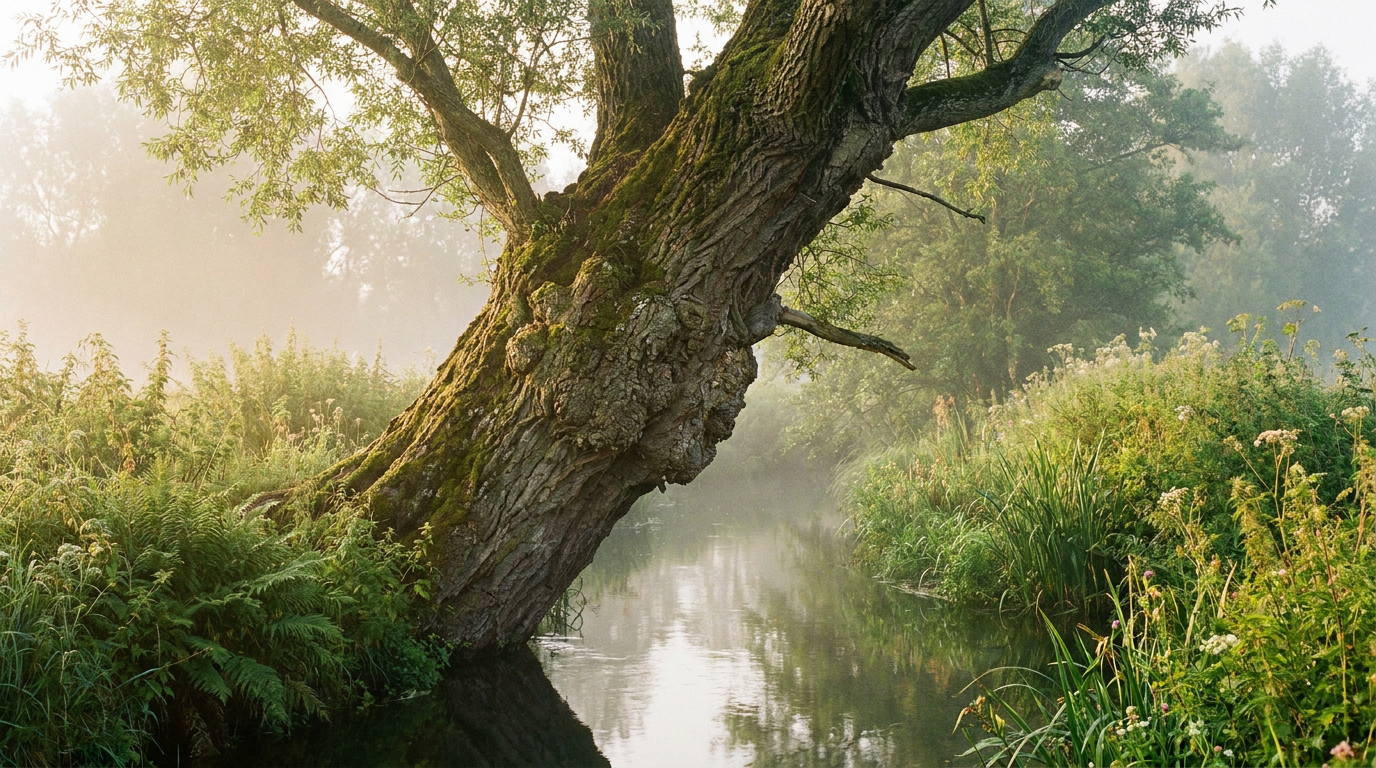
The morphological evidence used to identify true native trees includes deeply fissured bark, knobbly "bosses" on the trunk, and a distinctive leaning posture. However, because hybrids can mimic these physical traits, genetic sequencing has become the gold standard for conservationists. Only trees confirmed as pure Populus nigra subsp. betulifolia are selected for the new national clone banks, ensuring that the true native lineage is preserved.[2][4]
Because natural seed germination is currently unviable in the wild, the revival strategy relies heavily on vegetative propagation. Conservationists take cuttings—often large branches known as "truncheons"—from verified native trees and root them in specialized nurseries. This method exploits the willow family's natural ability to clone itself from broken branches that wash downstream, allowing nurseries to rapidly produce robust saplings.[3][7]

Because natural seed germination is currently unviable in the wild, the revival strategy relies heavily on vegetative propagation.
The deployment of these saplings is highly strategic. At Quarry Bank in Cheshire, the National Trust has initiated a targeted planting program within the River Bollin catchment. By planting verified male and female trees in close proximity—specifically in pairs—conservationists are engineering the spatial conditions necessary for future wind pollination. The long-term goal is to re-establish a self-sustaining population that can eventually reproduce via seed.[3]
Regional data highlights areas where the crisis is particularly acute. In Wales, a collaborative mapping project led by the Bannau Brycheiniog National Park Authority estimates that only 200 black poplars remain, with only a handful being female. The park has launched a public appeal, asking citizens to photograph and map potential sightings to help locate undiscovered genetic variants before they are lost to old age or disease.[5]

Despite the grim baseline numbers, longitudinal evidence from early intervention sites provides strong proof of concept for the revival strategy. The Sussex Black Poplar Partnership, a collaboration between the Sussex Wildlife Trust and Kew's Wakehurst, has been operating for over 25 years. Through their dedicated nursery, they have successfully cultivated and planted over 6,000 young black poplars across local river catchments, dramatically increasing the local population.[6]
The ecological benefits of these plantings extend beyond the species itself. Black poplars are a keystone species in wet woodland habitats, supporting a specific web of biodiversity. Their deeply fissured bark provides microhabitats for rare insects, and they are the primary food source for the caterpillars of several specialized moth species. Restoring the trees is a foundational step in rehabilitating the broader riparian ecosystem.[2][7]
Furthermore, the revival project intersects with modern climate adaptation strategies. In Norfolk, The Otter Trust is distributing free, DNA-tested black poplar saplings to riparian landowners. The evidence suggests that planting these thirsty, deep-rooted trees along rivers and ditches can significantly improve soil stability and absorb excess water, providing a natural mechanism for mitigating the increased flood risks associated with climate change.[4]
While the immediate survival of the species is being secured through cloning and cuttings, the scientific community acknowledges transparent uncertainty regarding the long-term climate resilience of such a genetically narrow population. Cloned populations lack the adaptive capacity generated by sexual reproduction, leaving them potentially exposed to novel pathogens or rapidly shifting climate envelopes.[7]
Consequently, the next frontier of this conservation effort is moving from clones back to seeds. Researchers at Forest Research and the Millennium Seed Bank are actively investigating methods to assist the black poplar in reproducing naturally from seed in controlled environments. If successful, this would introduce new genetic combinations into the population, bolstering the species' evolutionary resilience.[6][7]

The black poplar's story is also deeply intertwined with human cultural heritage. These imposing trees were once central landmarks in rural communities, serving as boundary markers and gathering places, and were immortalized in the iconic landscape paintings of John Constable. The effort to save them is driven by a recognition that losing the black poplar would impoverish both the ecological network and the historical landscape of Britain.[3][7]
Ultimately, the black poplar revival project serves as a compelling model for modern conservation. By combining advanced genetic sequencing with localized, community-driven planting efforts, scientists and volunteers are successfully pulling a keystone species back from the brink. The data so far suggests that with sustained intervention, Britain’s rarest native tree will once again thrive along its waterways.[1][7]
How we got here
1700s-1800s
Black poplars are a common feature of the British landscape, famously painted by John Constable.
Mid-1900s
Widespread drainage of floodplains and a preference for male cuttings cause populations to plummet.
2002
National surveys estimate only 7,000 native trees remain, prompting the creation of early clone banks.
2023-2026
Regional groups launch coordinated DNA-testing and replanting efforts to restore genetic diversity.
Viewpoints in depth
Conservation Geneticists
Focuses on the critical need to map DNA and preserve the remaining genetic diversity of the species.
This camp argues that simply planting more trees is insufficient if they are all identical clones or unrecognized hybrids. By utilizing advanced DNA sequencing, they aim to catalog every remaining true native tree and build secure clone banks. Their primary concern is the evolutionary bottleneck; without sufficient genetic variation, the restored population remains highly susceptible to future diseases and climate shifts.
Landscape Ecologists
Emphasizes the tree's role as a keystone species within broader wetland and riparian ecosystems.
For ecologists, the black poplar is a means to an end: the restoration of Britain's degraded floodplains. They highlight how the tree's deeply fissured bark and sprawling root systems support specialized insects, moths, and soil stability. This perspective advocates for planting the trees not in isolation, but as part of holistic river catchment restoration projects that re-wet the land and mitigate flood risks.
Civic Conservationists
Views the revival as a community-driven effort to reclaim a lost piece of cultural and natural heritage.
This viewpoint leans heavily on the cultural resonance of the black poplar, noting its historical presence as a village landmark and its immortalization in classical landscape art. By organizing public mapping initiatives and distributing free saplings to local landowners, they argue that the species' survival depends on grassroots engagement and public affection just as much as it does on laboratory science.
What we don't know
- Whether the genetically narrow cloned populations will possess enough resilience to survive novel pathogens or rapid climate shifts.
- How long it will take for newly planted male and female pairs to successfully reproduce via seed in the wild.
Key terms
- Dioecious
- A botanical term meaning a species has distinct male and female individual plants.
- Truncheon
- A large hardwood cutting, often a thick branch, used to propagate trees like poplars and willows.
- Clone bank
- A living collection of genetically verified plants maintained to preserve genetic diversity and provide material for propagation.
- Riparian
- Relating to or situated on the banks of a river or other body of water.
- Wet woodland
- A type of forest habitat that is frequently or seasonally waterlogged, supporting specialized flora and fauna.
Frequently asked
Why are there so few female black poplar trees?
Historically, landowners preferred planting male cuttings because female trees produce large amounts of fluffy seed that was considered a nuisance to agriculture.
How do conservationists know if a tree is a true native?
While physical traits like knobbly bark help, conservationists now rely on DNA testing to distinguish true native black poplars from faster-growing commercial hybrids.
Can black poplars reproduce naturally in the UK?
Currently, natural reproduction is extremely rare because male and female trees are located too far apart, and the wet, muddy floodplains required for seed germination have largely been drained.
Sources
Source coverage
7 outlets
3 viewpoints surfaced






[1]BBCCivic Conservationists
Revival project for endangered native trees
Read on BBC →[2]Woodland TrustLandscape Ecologists
Black poplar (Populus nigra subsp. betulifolia)
Read on Woodland Trust →[3]National TrustLandscape Ecologists
Our work to save black poplars
Read on National Trust →[4]The Otter TrustConservation Geneticists
Black Poplar Trees Norfolk
Read on The Otter Trust →[5]Bannau Brycheiniog National ParkCivic Conservationists
Saving Britain's most endangered native tree
Read on Bannau Brycheiniog National Park →[6]Sussex Wildlife TrustConservation Geneticists
Sussex Black Poplar Partnership
Read on Sussex Wildlife Trust →[7]Factlen Editorial TeamConservation Geneticists
Synthesis by Factlen editorial team
Read on Factlen Editorial Team →
Every angle. Every day.
Get science stories with full source coverage and perspective breakdowns delivered to your inbox.