
How On-Device AI and Local LLMs Actually Work in 2026
The era of sending every prompt to the cloud is ending. Thanks to dedicated NPUs, advanced quantization, and tools like Ollama, powerful AI models now run entirely on consumer hardware—offering complete privacy, zero API costs, and offline capabilities.
By Factlen Editorial Team
- Privacy & Compliance Advocates
- Argues that local AI is the only viable path for handling sensitive corporate and personal data.
- Hardware Manufacturers
- Focuses on the transition to NPU-equipped silicon and unified memory architectures.
- Open-Source Developers
- Champions the democratization of AI through open-weight models and accessible tooling.
What's not represented
- · Cloud API Providers
- · Data Center Operators
Why this matters
Running AI locally means your sensitive data—whether it's corporate code, medical records, or personal journals—never leaves your computer. It also eliminates monthly subscription fees and allows you to use powerful reasoning tools on an airplane or in areas with no internet connection.
Key points
- AI models can now run entirely on consumer laptops and phones, ensuring complete data privacy.
- Dedicated Neural Processing Units (NPUs) allow devices to run AI efficiently without draining the battery.
- Quantization compresses massive AI models from 28GB down to 4GB so they fit in standard RAM.
- Tools like Ollama and LM Studio have made installing a local AI as easy as downloading a web browser.
- Local AI eliminates monthly API subscription fees and works completely offline.
For the past three years, using artificial intelligence meant renting a brain housed in a distant data center. Every prompt, question, and line of code was sent over the internet, processed on massive server farms, and beamed back. But in 2026, the paradigm has fundamentally shifted.[1][8]
The era of "on-device AI" has arrived, allowing powerful Large Language Models (LLMs) to run entirely on your own laptop, smartphone, or desktop. By downloading the model directly to your hardware, you gain complete privacy, zero API subscription costs, and the ability to work entirely offline.[1][2][3]
This transition is being driven by a hardware revolution, specifically the rise of the Neural Processing Unit (NPU). While CPUs handle general logic and GPUs excel at parallel graphics rendering, NPUs are purpose-built silicon designed exclusively for the matrix math required by AI inference.[3][6]

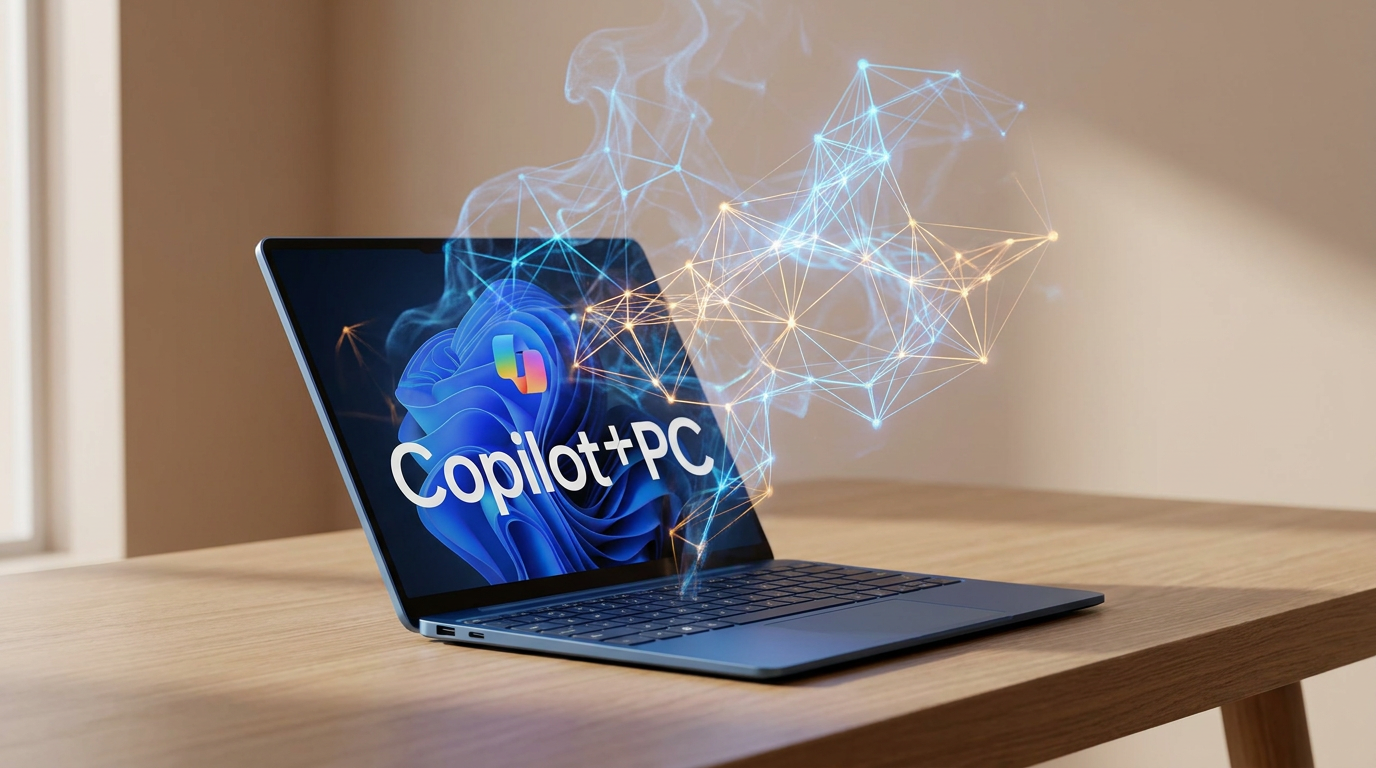
In 2026, the industry standard for a true "AI PC"—such as those meeting Microsoft's Copilot+ certification—requires an NPU capable of at least 40 Trillion Operations Per Second (TOPS). This dedicated chip allows the computer to run AI tasks continuously in the background without draining the battery or causing the system fans to sound like a jet engine.[3][6]
Apple has made on-device processing the cornerstone of its Apple Intelligence suite. By leveraging the Neural Engine built into Apple Silicon, iPhones and Macs process everyday requests locally, ensuring the device is aware of your personal context without actually collecting or transmitting your data.[5]
For requests that exceed local hardware limits, Apple utilizes "Private Cloud Compute." This system routes complex queries to Apple-designed servers that process the data statelessly—meaning the information is used solely to fulfill the request and is never stored or made accessible to Apple.[5]
Beyond proprietary ecosystems, the open-source community has democratized access to raw AI models. Tech giants and researchers are releasing "open-weight" models like Meta's Llama 3 and 4, Mistral, and Qwen. Anyone can download the "brain files" of these models for free.[1][7]
Beyond proprietary ecosystems, the open-source community has democratized access to raw AI models.
The magic that makes these massive models fit onto consumer laptops is a mathematical compression technique called quantization. AI models are typically trained using 32-bit floating-point numbers, resulting in massive file sizes. Quantization compresses these weights down to 8-bit or even 4-bit formats.[1][2]

This compression shrinks a 7-billion-parameter model from an unwieldy 28 gigabytes down to roughly 4 or 5 gigabytes. Remarkably, this drastic reduction in file size results in almost no noticeable loss in the model's reasoning or conversational quality, allowing it to run smoothly on standard consumer hardware.[1][2]
Software tools have evolved rapidly to make running these models as easy as installing a web browser. Applications like Ollama and LM Studio act as a "Docker for AI," abstracting away the complex command-line setups of the past. Users can simply browse a catalog, click download, and start chatting with a local model in minutes.[2][7]
For developers and enterprises, this local capability solves a massive headache: data sovereignty. Regulated industries dealing with HIPAA, GDPR, or proprietary corporate code can now utilize AI without violating compliance rules, because the data never leaves the local network.[2][7]
However, the shift to local AI has introduced a new hardware reality known as the "RAM Tax." Because AI models must be loaded entirely into system memory to function efficiently, the old baseline of 8GB of RAM is no longer sufficient.[6]

In 2026, 16GB of RAM is considered the absolute minimum for an AI PC, while 32GB is the sweet spot for professionals running multiple local agents or larger models. Systems with unified memory architectures, like Apple's M-series chips or AMD's high-end Strix Halo processors, have a distinct advantage, as they can dedicate massive pools of memory directly to the AI model.[4][6]
High-end hardware is pushing the boundaries even further. Advanced AMD laptop chips equipped with up to 128GB of unified memory can now run massive 120-billion-parameter models locally—a feat that required a server rack just a few years ago.[4]
Despite these advancements, local AI is not meant to completely replace the cloud. The future is a hybrid approach. Your local NPU will handle everyday tasks—drafting emails, summarizing local documents, and real-time coding assistance—while the cloud will be reserved for massive, heavy-lifting reasoning tasks.[3]

Ultimately, the rise of local LLMs represents a shift in power back to the user. It transforms AI from a metered, surveilled utility into a private, owned tool—one that works on an airplane, costs nothing per query, and keeps your most sensitive thoughts exactly where they belong: on your own machine.[1][8]
How we got here
2023
Cloud-based LLMs dominate, requiring constant internet access and subscription fees.
Early 2024
Open-weight models like Llama 3 are released, sparking interest in local deployment.
Late 2024
Tools like Ollama and LM Studio abstract away command-line complexity for everyday users.
2025
The 'AI PC' category emerges, standardizing NPUs across Windows laptops.
2026
40+ TOPS NPUs and 16GB RAM become the baseline, making local AI a mainstream reality.
Viewpoints in depth
Privacy & Compliance Advocates
Argues that local AI is the only viable path for handling sensitive corporate and personal data.
For regulated industries dealing with HIPAA, GDPR, or proprietary corporate code, sending data to a third-party cloud provider is a massive liability. This camp views local LLMs not just as a convenience, but as a mandatory security measure. By keeping all inference on-premise, organizations eliminate the risk of data leaks, telemetry tracking, and unauthorized model training by cloud vendors.
Hardware Manufacturers
Focuses on the transition to NPU-equipped silicon and unified memory architectures.
Chipmakers like Apple, AMD, and Intel view the shift to local AI as a massive hardware upgrade cycle. They emphasize the necessity of Neural Processing Units (NPUs) capable of 40+ TOPS and unified memory systems that allow massive models to run efficiently. For this camp, the bottleneck is no longer software, but getting enough high-bandwidth RAM and dedicated AI silicon into consumer devices.
Open-Source Developers
Champions the democratization of AI through open-weight models and accessible tooling.
This community believes AI should be a fundamental, freely available utility rather than a metered corporate service. They focus on optimizing quantization techniques to squeeze massive models onto budget hardware and building tools like Ollama to lower the barrier to entry. Their goal is to ensure that anyone, regardless of internet access or budget, can leverage state-of-the-art reasoning engines.
What we don't know
- Whether local NPUs will eventually be powerful enough to handle on-device training, rather than just inference.
- How cloud providers will adjust their pricing models as more users shift to free, local alternatives.
Key terms
- NPU
- Neural Processing Unit, a dedicated chip for efficient AI processing.
- Local LLM
- A Large Language Model that runs entirely on your own hardware rather than a remote cloud server.
- Quantization
- A technique that compresses AI model weights to reduce file size and memory usage with minimal loss in quality.
- Private Cloud Compute
- Apple's system for processing complex AI requests on secure, stateless servers when on-device power is insufficient.
- TOPS
- Trillion Operations Per Second, a metric used to measure the performance of an NPU.
Frequently asked
What is an NPU?
A Neural Processing Unit is a specialized computer chip designed specifically to handle the complex matrix math required by AI models, doing so much more efficiently than a standard CPU.
Can a local LLM access my private files?
No, the model itself is just a static file. However, the software running it (like LM Studio) can be granted permission to read specific files you provide, but nothing is sent to the internet.
Do I need an internet connection to use a local LLM?
Only to download the model file initially. Once the model is saved to your hard drive, all processing happens locally, meaning it works perfectly offline.
What is quantization?
It is a mathematical compression technique that shrinks the file size of an AI model (often from 32-bit to 4-bit) so it can fit into the memory of a standard consumer laptop.
Sources
Source coverage
8 outlets
3 viewpoints surfaced








[1]MediumOpen-Source Developers
Your Private AI Era Starts Now
Read on Medium →[2]Prompt QuorumPrivacy & Compliance Advocates
Best Local LLMs June 2026: Ollama, LM Studio, Hardware & VRAM Guide
Read on Prompt Quorum →[3]Nasr TechOpen-Source Developers
On-device AI explained for 2026
Read on Nasr Tech →[4]AMDHardware Manufacturers
James Governor sits down with Anush Elangovan, VP of AI at AMD
Read on AMD →[5]AppleHardware Manufacturers
Apple Intelligence and privacy on iPhone
Read on Apple →[6]HPHardware Manufacturers
Key Components of the AI PC Ecosystem
Read on HP →[7]CohortePrivacy & Compliance Advocates
Run LLMs Locally with Ollama: Privacy-First AI for Developers in 2025
Read on Cohorte →[8]Factlen Editorial Team
Synthesis by Factlen editorial team
Read on Factlen Editorial Team →

More in ai
See all 7 stories →AI Science
AI Disproves 80-Year-Old Math Conjecture, Marking a New Era of Machine Discovery
8 sources

AI Act Enforcement
EU Delays Core 'High-Risk' AI Rules to 2027, But Locks In Strict Deepfake and Watermarking Mandates
7 sources
Agentic AI
How Autonomous AI Agents Work: Moving from Chatbots to Action-Takers
6 sources

Molecular AI
New AI Model Accelerates Molecular Simulations 10,000-Fold, Promising Faster Drug Discovery
7 sources

Every angle. Every day.
Get ai stories with full source coverage and perspective breakdowns delivered to your inbox.