
SpaceX Acquires AI Coding Startup Cursor for $60 Billion Amid Record-Breaking Options Debut
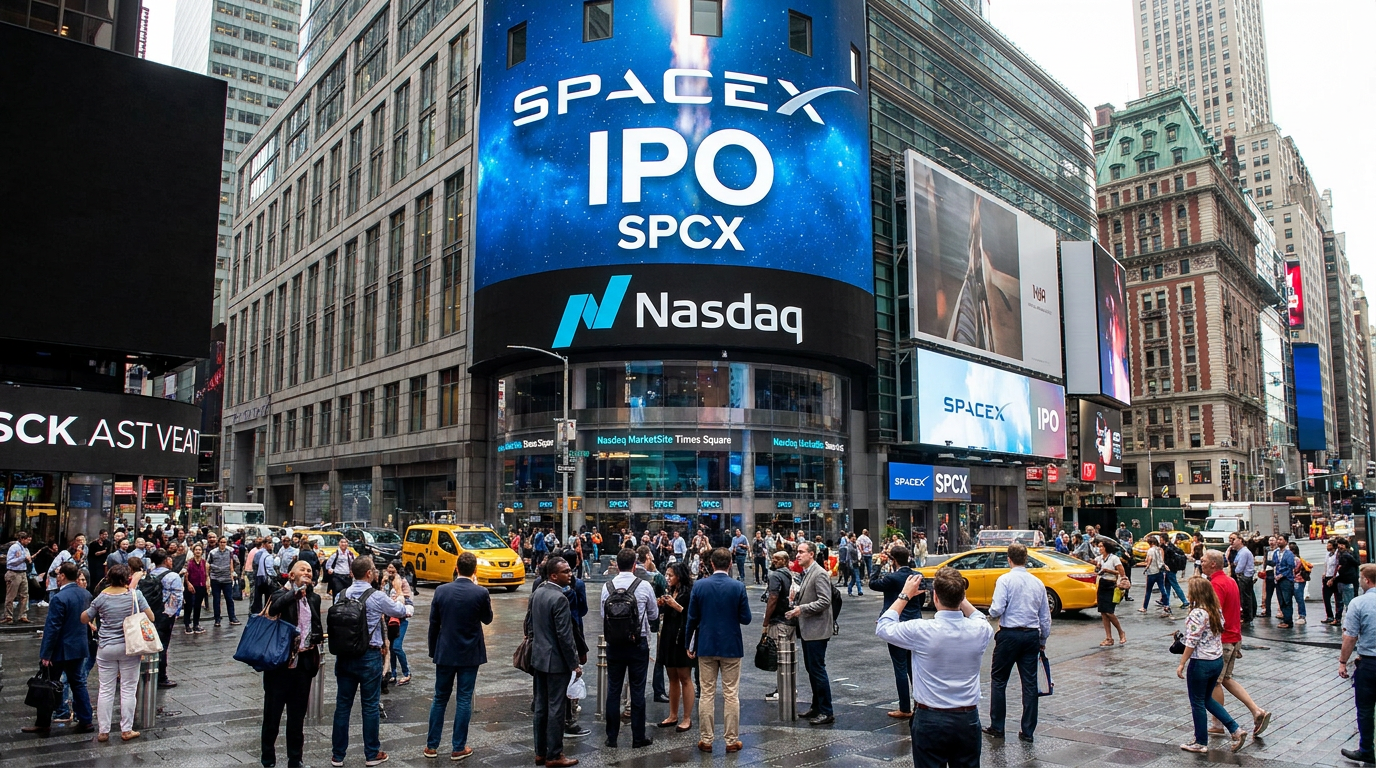
Days after its historic $1.5 trillion IPO, SpaceX has agreed to buy AI coding assistant Cursor in an all-stock deal. The acquisition merges Cursor's $4 billion revenue engine with SpaceX's massive supercomputing infrastructure.
By Factlen Editorial Team
- Tech Founders & Investors
- Celebrates the massive valuation and the validation of AI-assisted coding as a highly lucrative enterprise sector.
- Market Analysts & Traders
- Focuses on the unprecedented retail and institutional frenzy surrounding SpaceX's newly listed stock and options.
- AI Industry Competitors
- Views the merger as a formidable strategic threat that combines raw computing power with a dominant developer interface.
What's not represented
- · Open-source developers
- · Regulatory antitrust bodies
Why this matters
This $60 billion acquisition signals a massive shift in the tech landscape, combining SpaceX's raw computing power with the software industry's most popular AI coding tool. For investors, the unprecedented volume in SpaceX's newly launched options market highlights a historic retail and institutional frenzy that is reshaping the broader stock market.
Key points
- SpaceX is acquiring AI coding startup Cursor for $60 billion in an all-stock transaction.
- Cursor's annualized revenue run rate hit $4 billion in June, fending off competition from Anthropic.
- The deal will utilize SpaceX's 'Colossus' supercomputer to train new models for Cursor and xAI.
- SpaceX's newly launched options market saw a record 1.6 million contracts traded on its first day.
Just days after executing the largest initial public offering in market history, SpaceX has made its first massive move as a public company. The aerospace and artificial intelligence conglomerate announced Tuesday it is acquiring AI coding startup Cursor in an all-stock deal valued at $60 billion. The acquisition merges the world's most valuable space enterprise with one of Silicon Valley's fastest-growing software tools.[2][4]
The blockbuster deal marks a stunning victory for Cursor, a company that many industry observers had prematurely written off. Earlier this year, when AI heavyweight Anthropic launched its rival Claude Code product, social media pundits declared Cursor dead in the water. Instead of folding, the startup shifted into what its leadership described as "war time" mode, aggressively shipping new features and capturing enterprise market share.[1][3]
That aggressive pivot yielded historic financial results. By early June, Cursor's annualized revenue run rate had skyrocketed to $4 billion—a staggering leap from the $2 billion it reported just months prior in February. The company successfully fended off stiff competition from both Anthropic and OpenAI, proving that developers were willing to pay a premium for a dedicated, AI-native coding environment rather than relying on generic chatbots.[3][6]

For Cursor's four co-founders—Michael Truell, Aman Sanger, Sualeh Asif, and Arvid Lunnemark, all in their mid-twenties—the acquisition is a life-changing windfall. The all-stock transaction will instantly elevate their individual net worths to an estimated $2.7 billion each. Early venture backers, including Andreessen Horowitz and Thrive Capital, are also positioned to reap massive returns from the $60 billion valuation.[3]
But the acquisition is about much more than a financial exit; it represents a critical strategic puzzle piece for Elon Musk's broader AI ambitions. Earlier in 2026, SpaceX formally acquired xAI, bringing the Grok large language model under its corporate umbrella. However, xAI had reportedly struggled to match the coding and reasoning capabilities of its top-tier rivals, relying heavily on social media data rather than structured programming logic.[3][6]
Cursor solves that exact bottleneck. By bringing Cursor's deep expertise in programming data and software-hardware integration in-house, SpaceX aims to supercharge xAI's capabilities. The two companies had already been collaborating since April under a preliminary agreement, jointly training a new AI model designed to power both Cursor's interface and future iterations of Grok.[2][6]
By bringing Cursor's deep expertise in programming data and software-hardware integration in-house, SpaceX aims to supercharge xAI's capabilities.
The engine behind this joint effort is SpaceX's "Colossus," a massive supercomputer cluster located in Memphis, Tennessee. Cursor's leadership recognized that to build the next generation of AI coding tools, they needed access to unprecedented computing power—something SpaceX possesses in abundance. The merger effectively trades Cursor's software dominance for SpaceX's raw hardware scale.[2][3]
Wall Street's reaction to the acquisition has been completely eclipsed by the sheer frenzy surrounding SpaceX's newly minted stock. Trading under the ticker SPCX, the company raised $85 billion in its June 12 IPO, valuing the enterprise at roughly $1.5 trillion. By Tuesday, shares had surged to push the company's market capitalization past $2.7 trillion, making it more valuable than Amazon.[2][8]
The launch of SpaceX options trading on Tuesday added rocket fuel to the market dynamics. In a staggering display of retail and institutional demand, more than 1.6 million options contracts changed hands on the first day. This volume completely shattered the previous first-day record of 364,000 contracts, which was set by Meta during its 2012 public debut.[5][7]

Options market makers reported unprecedented implied volatility, with premiums pricing in massive price swings of up to 25% over the next month. Retail traders, reminiscent of the post-COVID trading boom, flooded into out-of-the-money call options, betting heavily on the stock continuing its parabolic ascent.[5][8]
Analysts point out that the massive demand for SpaceX shares is being compounded by forced mechanical buying. Index trackers for the Nasdaq-100 and Russell indices are expected to purchase between $22 billion and $27 billion worth of SPCX stock in the coming weeks to rebalance their portfolios, creating a structural tailwind for the share price.[7]
Despite the astronomical valuation, SpaceX remains uniquely positioned as the only publicly traded company worth over $1 trillion that is not yet generating a net profit. The company posted a net loss of $4.28 billion in the first quarter of 2026. Yet, investors appear entirely unbothered, pricing the stock based on its total addressable market across space exploration, satellite internet, and now, enterprise artificial intelligence.[7]

The integration of Cursor into SpaceX sets the stage for a brutal new phase in the AI arms race. With Microsoft backing OpenAI, Google leveraging DeepMind, and Amazon partnering with Anthropic, SpaceX has now firmly established its own vertically integrated AI stack. By owning the compute, the foundational models, and the developer interface, the company is betting it can outpace the incumbent tech giants.[4][6]
For the millions of software developers who rely on Cursor daily, the acquisition promises a massive acceleration in product capabilities. As the startup transitions from a scrappy underdog to a fully funded subsidiary of a $2.7 trillion behemoth, the era of AI-assisted "vibe coding" is officially graduating from a niche trend to the foundational infrastructure of the modern software industry.[1][2]
How we got here
2022
Cursor is founded by four MIT alumni to build an AI-native coding environment.
Feb 2026
SpaceX formally acquires Elon Musk's artificial intelligence startup, xAI.
Apr 2026
Cursor and SpaceX enter a preliminary agreement to jointly train new AI models.
Jun 12, 2026
SpaceX executes the largest IPO in market history, raising $85 billion.
Jun 16, 2026
SpaceX announces the $60 billion acquisition of Cursor as its options market shatters trading records.
Viewpoints in depth
Tech Founders & Investors
Celebrates the massive valuation and the validation of AI-assisted coding.
For Silicon Valley's venture capital ecosystem, the $60 billion acquisition is a resounding validation of the AI application layer. Investors point to Cursor's ability to scale its revenue to a $4 billion run rate while fending off giants like Anthropic as proof that specialized, AI-native workflows can command massive premiums. The deal is viewed as a triumph of 'war time' execution by a young founding team.
Market Analysts & Traders
Focuses on the unprecedented retail and institutional frenzy surrounding SpaceX's newly listed stock.
Wall Street is captivated by the sheer mechanics of the SpaceX public debut. Analysts emphasize that the 1.6 million options contracts traded on day one represents a historic level of market participation, dwarfing the Gamestop and post-COVID retail booms. Traders are closely watching the extreme implied volatility, noting that forced mechanical buying from index trackers will likely add further fuel to the stock's parabolic ascent.
AI Industry Competitors
Views the merger as a formidable strategic threat to incumbent tech giants.
Rival artificial intelligence firms see the SpaceX-Cursor merger as a major escalation in the AI arms race. By combining Cursor's massive developer user base with the raw computing power of SpaceX's 'Colossus' supercomputer in Memphis, Elon Musk's conglomerate has vertically integrated its AI stack. Competitors acknowledge that this hardware-software synergy directly challenges the dominance of Microsoft's GitHub Copilot and Anthropic's Claude.
What we don't know
- How regulatory bodies will scrutinize a $60 billion acquisition by a newly public $2.7 trillion conglomerate.
- Whether the extreme implied volatility in SpaceX options will lead to a broader market squeeze.
- How quickly Cursor's interface will fully integrate with xAI's Grok models.
Key terms
- Implied Volatility
- A metric used in options trading that reflects the market's forecast of a likely movement in a security's price.
- Run Rate
- A method of forecasting future financial performance based on current data, often used to project annualized revenue.
- xAI
- An artificial intelligence company founded by Elon Musk, now a subsidiary of SpaceX, known for developing the Grok language model.
- Options Contract
- A financial derivative that gives an investor the right, but not the obligation, to buy or sell a stock at an agreed-upon price and date.
Frequently asked
Why did SpaceX buy Cursor?
SpaceX acquired Cursor to integrate its popular AI coding interface with xAI's massive supercomputing power, aiming to build the world's most capable AI for programming.
How much is Cursor worth?
SpaceX is acquiring Cursor in an all-stock deal valued at $60 billion.
What is happening with SpaceX stock?
Following its historic $85 billion IPO, SpaceX (SPCX) shares have surged, and its newly launched options market shattered records with 1.6 million contracts traded on the first day.
Who are the founders of Cursor?
Cursor was founded by four 25- and 26-year-old MIT alumni—Michael Truell, Aman Sanger, Sualeh Asif, and Arvid Lunnemark—who will each be worth an estimated $2.7 billion after the deal.
Sources
Source coverage
8 outlets
3 viewpoints surfaced








[1]MarketWatchTech Founders & Investors
Social media declared Cursor dead. Then SpaceX handed the AI startup a $60 billion lifeline.
Read on MarketWatch →[2]CBS NewsAI Industry Competitors
SpaceX to buy AI coding startup Cursor for $60 billion
Read on CBS News →[3]ForbesTech Founders & Investors
SpaceX To Acquire AI Coding Startup Cursor For $60 Billion, Minting Four New Billionaires
Read on Forbes →[4]CNBCAI Industry Competitors
SpaceX agrees to acquire Cursor for $60 billion in stock
Read on CNBC →[5]Business InsiderMarket Analysts & Traders
Record Volume in SpaceX Options Shows Stock Casino Open for Business
Read on Business Insider →[6]TradingKeyAI Industry Competitors
SpaceX to Acquire AI Startup Cursor for $60 Billion to Bolster xAI
Read on TradingKey →[7]BenzingaMarket Analysts & Traders
SpaceX Options Begin Trading With Record Volume
Read on Benzinga →[8]PurePowerPicksMarket Analysts & Traders
SpaceX (SPCX) Options Are Now Live: What's Available
Read on PurePowerPicks →


Every angle. Every day.
Get finance stories with full source coverage and perspective breakdowns delivered to your inbox.