
Aquascaping: The Art and Science of Underwater Gardening
Far beyond traditional fish tanks, aquascaping combines landscape architecture and biology to create lush, self-sustaining underwater ecosystems. The rapidly growing hobby offers measurable psychological benefits while challenging enthusiasts to master the delicate balance of light, carbon dioxide, and nutrients.
By Factlen Editorial Team
- Nature Aquarium Traditionalists
- Focus on Takashi Amano's wabi-sabi philosophy, emotional resonance, and natural balance.
- High-Tech Horticulturalists
- Focus on CO2 injection, intense lighting, and pushing the boundaries of aquatic plant growth.
- Therapeutic & Wellness Advocates
- Focus on the psychological and physiological health benefits of keeping and viewing aquariums.
- Accessible Hobbyists
- Focus on low-tech, budget-friendly setups that bring nature to beginners without complex equipment.
What's not represented
- · Marine and reef aquarists who focus on saltwater ecosystems rather than freshwater planted tanks.
- · Commercial aquatic plant farmers who supply the global aquascaping market.
Why this matters
In an increasingly fast-paced and urbanized world, aquascaping offers a scientifically backed method for reducing stress and lowering blood pressure. By bringing a thriving slice of nature indoors, the hobby provides an accessible form of daily mindfulness and passive therapy.
Key points
- Aquascaping is the craft of designing and maintaining lush, self-sustaining underwater gardens.
- The modern hobby was revolutionized in the 1990s by Takashi Amano, who introduced the nature-focused Japanese aesthetic of wabi-sabi.
- Clinical studies demonstrate that observing aquariums can significantly lower heart rates, reduce blood pressure, and decrease anxiety.
- Enthusiasts must carefully balance light, carbon dioxide, and nutrients to allow aquatic plants to outcompete algae.
- Setups range from low-tech tanks with hardy plants to high-tech systems utilizing pressurized CO2 for explosive growth.
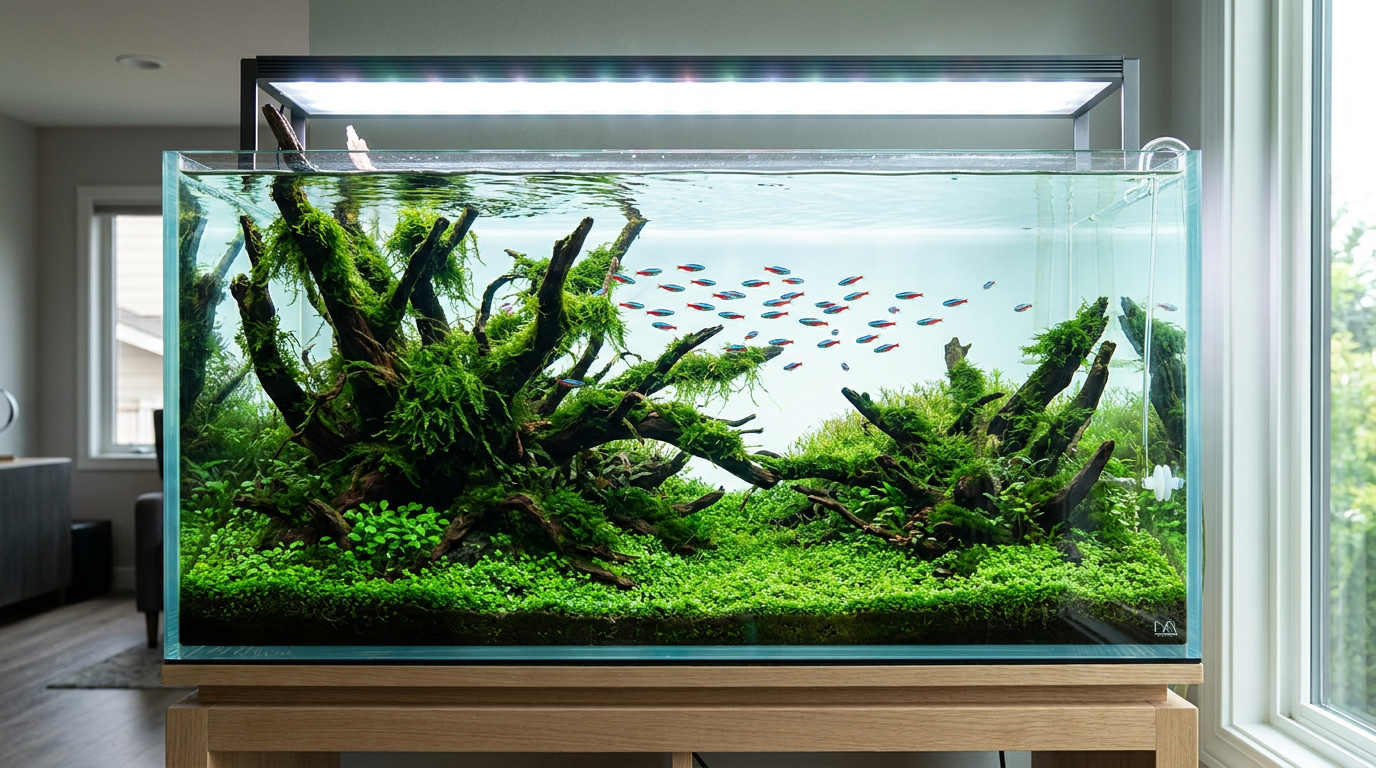
For decades, the home aquarium was defined by neon gravel, bubbling treasure chests, and plastic castles. It was a static cage for fish, where the water was merely a medium for keeping pets alive. But over the last thirty years, a quiet revolution has transformed the glass box into a canvas for living art. This is the world of aquascaping—the meticulous craft of designing, planting, and maintaining underwater landscapes that rival the beauty of terrestrial gardens.[8]
At its core, aquascaping is a synthesis of landscape architecture, horticulture, and biology. Practitioners use natural materials like stone, driftwood, and specialized aquatic soil to build a structural foundation known as the hardscape. From there, they cultivate a diverse array of submerged flora, carefully balancing light, nutrients, and carbon dioxide to create a thriving ecosystem. The goal is not merely to decorate a fish tank, but to engineer a self-sustaining slice of nature where the plants are the primary focus, and the fish serve as complementary inhabitants.[2][6]
The explosive growth of this hobby is driven by more than just aesthetics; it is deeply rooted in human psychology. Biologist Edward O. Wilson’s "biophilia hypothesis" suggests that humans possess an innate tendency to seek connections with nature and other forms of life. In increasingly dense urban environments where green space is a luxury, an aquascape provides a concentrated, accessible dose of the natural world. The gentle movement of water, the vibrant greens of aquatic foliage, and the rhythmic swimming of fish tap directly into neurological pathways associated with safety and comfort.[3][7]
The mental and physical health benefits of these underwater gardens are not merely anecdotal—they are measurable. A landmark 2015 study published in the journal Environment & Behavior demonstrated that observing a well-stocked aquarium yields significant physiological improvements. Researchers recorded drops in heart rates by up to 7 percent and reductions in blood pressure by 4 percent among participants who spent time watching aquatic environments. The more biodiverse the tank, the more pronounced the calming effect became.[3][7]

Beyond cardiovascular metrics, aquariums have been shown to actively reduce cortisol, the body's primary stress hormone. In high-pressure environments—from corporate offices to dental waiting rooms—the presence of an aquascape acts as a form of passive therapy. Participants in various studies reported an average 12 percent decrease in anxiety levels after observing aquatic life. The act of maintaining the tank—trimming plants, testing water, and cleaning glass—also serves as a grounding mindfulness practice, forcing the aquarist to slow down and engage with a living system.[3][5]
While the modern iteration of the hobby feels cutting-edge, its roots stretch back nearly a century. The practice first gained traction in the 1930s in the Netherlands. The "Dutch style" of aquascaping emerged alongside the mass production of glass aquariums, focusing heavily on dense, geometric arrangements of colorful stem plants. Dutch aquascapes resemble manicured terrestrial flowerbeds, relying on strict rules of contrast, color, and texture, often entirely omitting rocks or driftwood to let the flora dominate the visual space.[6]
However, the hobby was fundamentally revolutionized in the early 1990s by Takashi Amano, a Japanese nature photographer and aquarist. Amano introduced the "Nature Aquarium" style, shifting the global focus away from rigid flowerbeds and toward the recreation of wild, atmospheric landscapes. Drawing on his experiences photographing rainforests in the Amazon and Borneo, Amano treated the aquarium as a living photograph. He founded Aqua Design Amano (ADA) in 1982 and published the seminal book Nature Aquarium World in 1992, which stunned the global community with its vision of underwater ecosystems that looked as though they had existed for centuries.[1][4]
Amano’s approach was deeply influenced by the Japanese aesthetic philosophy of wabi-sabi—the appreciation of beauty that is imperfect, impermanent, and incomplete. Rather than forcing plants into sterile, symmetrical rows, the Nature Aquarium embraces natural chaos. Driftwood is placed to look like fallen forest timber, and plants are allowed to overgrow their boundaries slightly. Amano taught that an aquascape should not just look like nature; it should evoke the emotional resonance of standing beside a pristine mountain stream or deep within an ancient forest.[4]
Amano’s approach was deeply influenced by the Japanese aesthetic philosophy of wabi-sabi—the appreciation of beauty that is imperfect, impermanent, and incomplete.
From Amano’s foundational philosophy, several distinct sub-styles have flourished. The most minimalist and challenging of these is the Iwagumi style. Translating roughly to "rock formation," Iwagumi relies almost entirely on stone and low-growing carpet plants. Following strict rules derived from Japanese rock gardening, an Iwagumi layout typically features a primary "Father stone" flanked by smaller supporting stones, arranged according to the rule of thirds. The resulting landscape resembles a sweeping, wind-blown grassy meadow, demanding absolute perfection in plant health since there is nowhere to hide algae or stunted growth.[2]

In recent years, the "Diorama" style has also surged in popularity, particularly in international competitions. Diorama aquascapes push the boundaries of hyper-realism, using forced perspective to recreate specific terrestrial scenes—such as a winding canyon, a dense pine forest, or a cascading waterfall (often simulated using falling white sand). These layouts rely heavily on complex, glued hardscapes and tiny plant species to maintain a massive sense of scale within a relatively small glass box.[6]
Regardless of the chosen aesthetic, every aquascape is bound by the strict laws of biology and chemistry. An aquarium is a closed ecosystem, meaning the aquarist must artificially manage the nitrogen cycle—the process by which beneficial bacteria convert toxic fish waste (ammonia) into relatively harmless nitrates. The plants play a crucial role in this cycle, absorbing nitrates as fertilizer. However, to achieve the dense, vibrant growth seen in professional aquascapes, hobbyists must carefully balance three critical pillars: light, carbon dioxide, and nutrients.[2][5]
This balancing act divides the hobby into two primary methodologies: "high-tech" and "low-tech" setups. The distinction does not refer to the presence of a filter or a heater, but specifically to the use of pressurized carbon dioxide (CO2) injection. Because CO2 is naturally scarce underwater, it acts as the primary bottleneck for plant growth. The choice between high-tech and low-tech dictates the types of plants that can be grown, the speed of their growth, and the overall maintenance required.[5]
A high-tech aquascape utilizes a pressurized cylinder, a regulator, and a diffuser to inject a steady mist of CO2 directly into the water column. When combined with high-intensity LED lighting and a strict regimen of liquid fertilizers, the results are explosive. Plants grow at an accelerated rate, allowing aquascapers to cultivate demanding species, achieve dense carpets of foreground grass, and coax out brilliant red and orange pigments that would otherwise remain dull green.[1][5]

The hallmark of a successful high-tech tank is a phenomenon known as "pearling." When aquatic plants photosynthesize at a rapid rate, they produce oxygen faster than it can dissolve into the surrounding water. This results in thousands of tiny, diamond-like oxygen bubbles forming on the leaves and floating to the surface. While visually spectacular, high-tech tanks require meticulous daily maintenance, frequent trimming, and precise chemical dosing to prevent the system from crashing.[1][5]
Conversely, low-tech aquascapes embrace a slower, more forgiving pace. By omitting CO2 injection and using moderate lighting, the metabolic rate of the entire tank is reduced. Aquarists rely on hardy, slow-growing species like Anubias, Java Fern, and various mosses—often epiphytes that attach directly to wood and stone rather than rooting in soil. While a low-tech tank may take months to fill in, it offers immense stability. With fewer variables to manage, the risk of sudden algae outbreaks is drastically reduced, making it an ideal entry point for beginners.[5]
In both methodologies, the hardscape serves as the enduring skeleton of the design. While fast-growing stem plants may be trimmed, uprooted, or replaced over the lifespan of the tank, the wood and stone remain constant. A well-designed hardscape anchors the visual flow of the aquarium, providing depth and shadow. Aquascapers often spend weeks arranging their hardscape in an empty tank, adjusting angles by mere millimeters before a single drop of water is added.[1][4]

The ultimate test of an aquascaper’s skill is the battle against algae. Algae spores are omnipresent in water, waiting for an imbalance to exploit. If an aquarist provides too much light without enough CO2, or adds too many nutrients without enough plant mass to absorb them, algae will rapidly smother the tank. Success in aquascaping is not about eradicating algae, but about outcompeting it. By providing the perfect conditions for higher-order plants to thrive, the plants naturally starve the algae of resources.[2][6]
Today, aquascaping is a thriving global community. Millions of hobbyists share knowledge on forums, trade rare plant clippings, and compete in massive events like the International Aquatic Plants Layout Contest (IAPLC), which draws thousands of entries from around the world. Yet, beneath the competitive edge and the complex chemistry, the core appeal remains deeply personal. Aquascaping offers a quiet rebellion against the digital age—a daily invitation to step away from screens, plunge one's hands into the water, and tend to a living, breathing piece of the natural world.[2][8]
How we got here
1930s
The 'Dutch style' of aquascaping emerges in the Netherlands, focusing on dense, geometric arrangements of colorful plants.
1982
Takashi Amano founds Aqua Design Amano (ADA), introducing specialized equipment for planted tanks.
1992
Amano publishes 'Nature Aquarium World,' revolutionizing the hobby with his photography and naturalistic philosophy.
2001
The first International Aquatic Plants Layout Contest (IAPLC) is held, globalizing the competitive aquascaping scene.
2015
A landmark study in Environment & Behavior quantifies the physiological health benefits of viewing aquariums.
Viewpoints in depth
Nature Aquarium Traditionalists
Advocates for the emotional resonance and natural balance pioneered by Takashi Amano.
This camp views aquascaping primarily as an art form rooted in the Japanese philosophy of wabi-sabi. They argue that an aquarium should not strive for sterile perfection, but rather capture the feeling and atmosphere of a wild landscape. For traditionalists, the goal is to create a layout that feels discovered rather than designed, allowing plants to grow naturally and embracing the transience of the ecosystem over time.
High-Tech Horticulturalists
Enthusiasts focused on pushing the biological limits of aquatic plant growth through technology.
High-tech aquascapers approach the hobby as a science of optimization. By utilizing pressurized CO2 injection, high-output LED lighting, and precise liquid fertilization, they aim to cultivate the most demanding and vibrant plant species available. This camp values rapid growth, dense carpeting plants, and the striking visual contrast of deep red foliage, accepting the rigorous daily maintenance required to keep such a highly-tuned system from crashing into an algae bloom.
Therapeutic & Wellness Advocates
Researchers and hobbyists focused on the psychological and physiological benefits of aquariums.
Drawing on the biophilia hypothesis, this perspective emphasizes the measurable health benefits of keeping an aquascape. Advocates point to clinical studies showing that observing aquatic life lowers blood pressure, reduces heart rates, and decreases cortisol levels. For this group, the primary value of an aquascape is its function as accessible, passive therapy—a vital tool for stress relief and mindfulness in increasingly disconnected urban environments.
What we don't know
- While the short-term physiological benefits of viewing aquariums are well-documented, long-term longitudinal studies on the mental health impacts of active aquascaping maintenance are still limited.
- The exact threshold of biodiversity required to maximize the psychological benefits of an aquascape remains a subject of ongoing environmental psychology research.
Key terms
- Hardscape
- The non-living structural elements of an aquascape, such as rocks, stones, and driftwood, which form the foundation of the design.
- Wabi-sabi
- A Japanese aesthetic philosophy embracing the beauty of natural imperfection, transience, and asymmetry.
- Pearling
- The visual phenomenon where aquatic plants produce visible oxygen bubbles on their leaves during intense photosynthesis.
- Epiphyte
- A plant that grows attached to another object, like wood or rock, rather than rooting in soil.
- Nitrogen Cycle
- The biological process in an aquarium where beneficial bacteria convert toxic fish waste into nitrates, which plants then absorb as fertilizer.
Frequently asked
What is the difference between aquascaping and a regular fish tank?
A regular fish tank focuses primarily on keeping fish alive, often using artificial decorations. Aquascaping focuses on cultivating live aquatic plants and natural hardscapes to create a balanced, living underwater ecosystem.
Do I need CO2 injection to grow aquatic plants?
No. While pressurized CO2 is required for 'high-tech' setups with demanding carpeting plants, many hardy species like Java Fern and Anubias thrive in 'low-tech' environments without supplemental carbon dioxide.
What is the Iwagumi style?
Iwagumi is a minimalist Japanese aquascaping style that uses only stone formations and low-growing carpet plants to mimic sweeping, wind-blown terrestrial landscapes.
How does an aquascape control algae?
Aquascapers control algae by balancing light, CO2, and nutrients. When these elements are perfectly tuned, the higher-order aquatic plants outcompete the algae for resources, naturally starving it out.
Sources
Source coverage
8 outlets
4 viewpoints surfaced








[1]TFH MagazineNature Aquarium Traditionalists
Takashi Amano and the Nature Aquarium
Read on TFH Magazine →[2]BluvivaHigh-Tech Horticulturalists
Aquascaping: The Art of Underwater Gardening
Read on Bluviva →[3]Buce PlantTherapeutic & Wellness Advocates
Health Benefits of Home Aquariums
Read on Buce Plant →[4]Aquatic DepthsNature Aquarium Traditionalists
Beauty in Nature, Under Glass
Read on Aquatic Depths →[5]Gensou AquascapingHigh-Tech Horticulturalists
High Tech vs Low Tech Planted Tanks
Read on Gensou Aquascaping →[6]WikipediaAccessible Hobbyists
Aquascaping
Read on Wikipedia →[7]Environment and BehaviorTherapeutic & Wellness Advocates
Marine Biota and Psychological Well-Being
Read on Environment and Behavior →[8]Factlen Editorial TeamAccessible Hobbyists
Synthesis by Factlen editorial team
Read on Factlen Editorial Team →
Every angle. Every day.
Get lifestyle stories with full source coverage and perspective breakdowns delivered to your inbox.