
How Heat Pump Water Heaters Work: The Appliance Quietly Cutting Energy Bills
Heat pump water heaters use up to 75% less energy than standard models by moving heat rather than generating it. With federal tax credits covering up to $2,000 of the installation cost, the technology is rapidly becoming the standard for home energy efficiency.
By Factlen Editorial Team
- Financial & Consumer Analysts
- Analyze the appliance through the lens of return on investment, rebates, and long-term utility savings.
- Energy Efficiency Advocates
- Focus on the massive reduction in residential carbon emissions and grid strain.
- Building Science Experts
- Evaluate the technical performance, installation constraints, and indoor air quality impacts.
What's not represented
- · Traditional Gas Utility Companies
- · Renters unable to upgrade appliances
Why this matters
Water heating is the second-largest energy expense in most homes. Upgrading to a heat pump model not only slashes monthly utility bills by up to 75% but also unlocks thousands of dollars in federal tax credits, making it one of the highest-ROI home improvements available today.
Key points
- Heat pump water heaters use up to 75% less energy than traditional electric resistance models.
- The technology works by moving ambient heat from the air into the water tank, rather than generating heat from scratch.
- Homeowners can claim a federal tax credit of up to $2,000 to offset the higher upfront installation costs.
- The appliances actively cool and dehumidify the surrounding space, making them ideal for garages and basements.
- New federal efficiency rules will require most new electric water heaters over 35 gallons to use heat pump technology by 2029.
Water heating is the unsung heavyweight of household energy consumption. For the average family, keeping showers hot and laundry warm accounts for roughly 20 percent of their total utility bill, making it the second-largest energy expense after heating and cooling the home itself.[6]
For decades, the technology behind this daily luxury remained largely stagnant. Most basements and utility closets house either a gas burner or an electric resistance tank—appliances that generate heat through combustion or by running electricity through metal coils, much like a giant toaster.[2]
But a quiet revolution is taking place in home improvement. Heat pump water heaters, often referred to as hybrid water heaters, are rapidly emerging as the most cost-effective and environmentally friendly way to generate domestic hot water.[3]
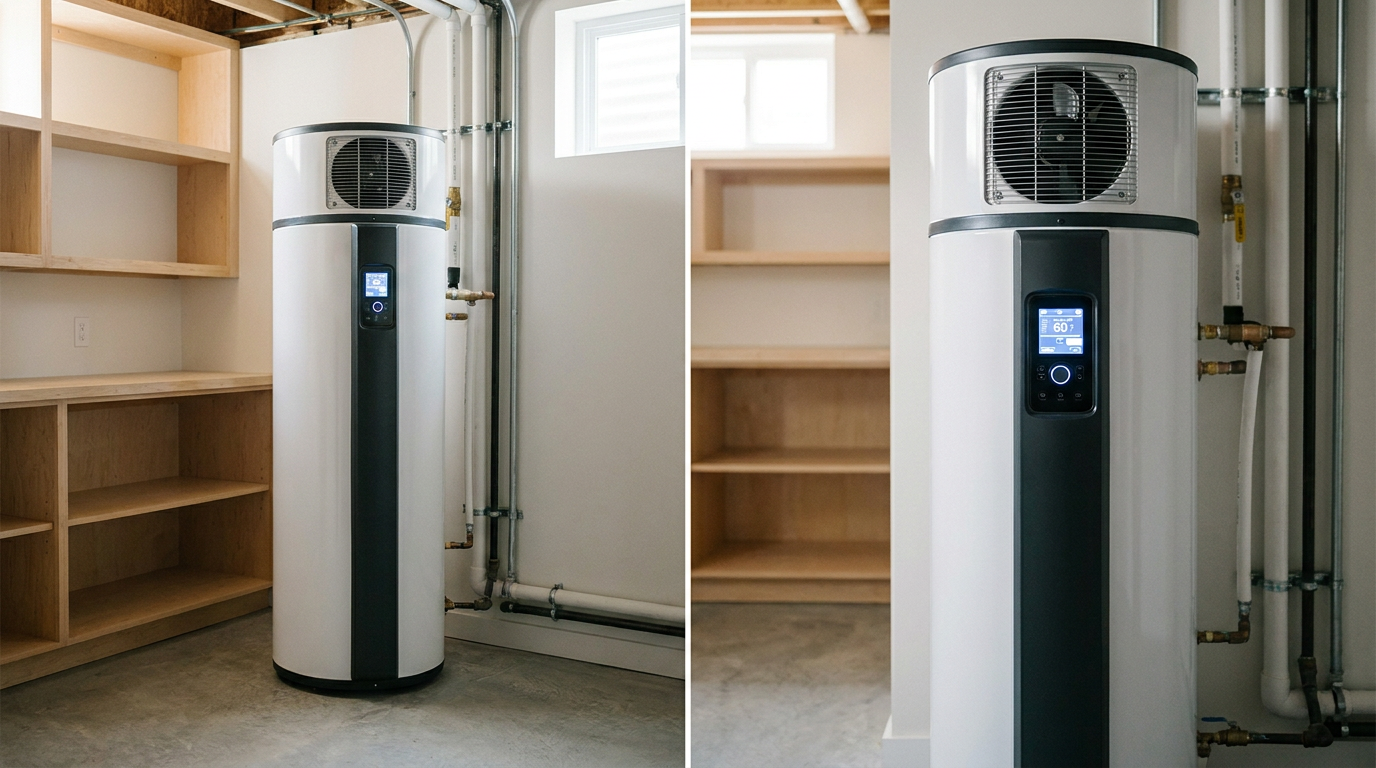
Rather than generating heat from scratch, a heat pump water heater operates like a refrigerator running in reverse. It uses a fan to pull ambient air from the surrounding room, extracts the latent heat using a chemical refrigerant, and compresses that refrigerant to amplify the temperature.[3][6]

That concentrated heat is then transferred into the water tank via condenser coils. Because the system is merely moving existing heat from one place to another rather than creating it, the process is remarkably efficient.[1][5]
The standard metric for this performance is the Uniform Energy Factor (UEF). While a traditional electric resistance water heater typically maxes out at a UEF of 0.93, modern heat pump models boast UEF ratings between 3.5 and 4.0.[3][4]
In practical terms, this means a heat pump water heater is three to four times more efficient than standard electric tanks. They use up to 75 percent less electricity, which translates to massive reductions in monthly utility bills.[3][5]
Depending on local electricity rates, homeowners can expect to save between $200 and $550 every single year just by making the switch. Over the appliance's typical 10-to-15-year lifespan, those savings compound to anywhere from $2,000 to over $6,000.[2][4]

Despite the overwhelming math in their favor, heat pump water heaters currently account for only 2 to 3 percent of the United States market. The primary barrier to adoption has historically been the upfront sticker price.[2]
Despite the overwhelming math in their favor, heat pump water heaters currently account for only 2 to 3 percent of the United States market.
A standard electric tank might cost $500 to $800 at a big-box hardware store, while a heat pump model ranges from $1,700 to $3,500, not including the cost of professional installation.[4]
However, recent federal legislation has fundamentally altered the financial calculus. Under the Inflation Reduction Act, homeowners can claim the 25C tax credit, which covers 30 percent of the project cost—up to a maximum of $2,000 annually—for qualifying heat pump water heaters.[1][3]
For low- and moderate-income households, the High-Efficiency Electric Home Rebate Act (HEEHRA) provides even more aggressive incentives, offering point-of-sale rebates up to $1,750. When stacked with local utility incentives, some families are getting these advanced systems installed for less than the cost of a standard replacement.[3][4]
Beyond the financial benefits, the technology offers unique secondary perks. Because the unit pulls heat and humidity from the surrounding air, it actively cools and dehumidifies the space it occupies.[2]
This "free air conditioning" effect makes heat pump water heaters incredibly popular for hot, muggy garages or damp basements, though it requires homeowners in colder climates to be strategic about placement so they do not inadvertently freeze a finished living space.[2][6]

The systems do come with specific installation requirements. Because they need a steady supply of ambient air to harvest heat, they cannot be locked inside a tiny, airtight utility closet without louvered doors or dedicated ducting.[6]
They also produce a gentle humming noise—similar to a dehumidifier or a modern refrigerator—and require a condensate drain to safely route away the moisture pulled from the air during operation.[3]
To ensure nobody runs out of hot water during periods of high demand, most units operate in a "hybrid" mode. If the household takes three consecutive showers and the heat pump cannot recover the temperature fast enough, the system temporarily engages a standard electric resistance element to bridge the gap.[4]
From an environmental standpoint, the shift away from gas-fired water heaters eliminates a major source of residential greenhouse gas emissions and removes the indoor air quality risks associated with burning fossil fuels inside the home.[2][5]

The transition is not just a consumer trend; it is becoming a regulatory certainty. By 2029, new federal efficiency rules will mandate that all new electric water heaters over 35 gallons sold in the United States must utilize heat pump technology.[2]
How we got here
Aug 2022
The Inflation Reduction Act is signed, establishing the 25C tax credit for heat pumps.
Jan 2023
The $2,000 annual federal tax credit for heat pump water heaters officially takes effect.
Apr 2026
Market data shows heat pump water heaters still account for only 2-3% of the U.S. market, despite massive incentives.
2029
Upcoming federal efficiency rules will require most new electric water heaters over 35 gallons to use heat pump technology.
Viewpoints in depth
Energy Efficiency Advocates
View heat pump water heaters as a critical tool for decarbonizing residential buildings.
Environmental organizations and energy efficiency advocates point to heat pump water heaters as a silver bullet for residential emissions. Because water heating accounts for roughly 20% of a home's energy use, transitioning away from fossil-fuel combustion and inefficient electric resistance heating drastically lowers a household's carbon footprint. They emphasize that as the electrical grid becomes greener with more wind and solar power, the environmental benefits of these appliances will only compound.
Home Service Contractors
Focus on the practical installation requirements and upfront sticker shock.
Plumbers and HVAC professionals acknowledge the massive operational savings but caution homeowners about the installation realities. Heat pump models require sufficient ambient air to draw heat from, meaning they cannot be stuffed into a tiny utility closet without louvered doors or ducting. Additionally, contractors note that the units are taller and heavier than standard tanks, and they require a condensate drain to handle the moisture pulled from the air. They often advise clients to plan the upgrade proactively, as emergency replacements leave little time to navigate the necessary electrical or spatial modifications.
Frugal Homeowners
Prioritize the return on investment and utility bill reduction.
For budget-conscious consumers, the appeal of a heat pump water heater lies entirely in the math. While the initial quote can induce sticker shock, the combination of federal tax credits, state rebates, and immediate utility bill reductions transforms the appliance into an investment rather than a sunk cost. Many homeowners report that the system pays for its premium within two to three years, after which it generates hundreds of dollars in pure annual savings for the remainder of its 10-to-15-year lifespan.
What we don't know
- Whether supply chains and local contractor availability can scale fast enough to meet the impending 2029 federal efficiency mandates.
- How quickly the remaining states will roll out their specific implementations of the HEEHRA rebate program for low-income households.
Key terms
- Uniform Energy Factor (UEF)
- The standard measure of water heater efficiency; higher numbers indicate greater energy efficiency.
- Hybrid Mode
- An operating setting that primarily uses the heat pump but engages standard electric resistance heating during periods of high hot water demand.
- Electric Resistance Heating
- The traditional method of heating water by passing electricity through a metal element, similar to a toaster.
- Condensate Drain
- A tube required to safely route away the liquid water that a heat pump extracts from the air during operation.
Frequently asked
Do heat pump water heaters work in cold climates?
Yes. While they draw heat from the surrounding air, most models can operate efficiently in ambient temperatures down to 37°F (3°C). In colder environments, they are typically installed in basements and rely on their hybrid electric resistance mode during extreme temperature drops.
How loud is a heat pump water heater?
They produce a humming sound similar to a modern refrigerator or a dehumidifier, typically around 45 to 55 decibels. Because of this, they are best installed in garages, basements, or utility rooms rather than near bedrooms.
Can I claim the tax credit if I install it myself?
The federal 25C tax credit applies to both the equipment and labor costs. If you install it yourself, you can still claim the credit for the cost of the unit, but professional installation is highly recommended due to electrical and plumbing requirements.
Sources
Source coverage
6 outlets
3 viewpoints surfaced






[1]ENERGY STAREnergy Efficiency Advocates
Federal Income Tax Credits and Incentives for Energy Efficiency
Read on ENERGY STAR →[2]The Washington PostFinancial & Consumer Analysts
What I learned about what to buy, how to save and what to avoid before plugging in a heat pump water heater
Read on The Washington Post →[3]EcoHomeBuilding Science Experts
Heat Pump Water Heaters: Complete Buyer's Guide 2026
Read on EcoHome →[4]NuWatt EnergyFinancial & Consumer Analysts
Heat Pump Water Heaters: Complete Buyer's Guide 2026
Read on NuWatt Energy →[5]CleanPowerSFEnergy Efficiency Advocates
Upgrade Your Appliance: Heat Pump Water Heaters
Read on CleanPowerSF →[6]Factlen Editorial TeamFinancial & Consumer Analysts
Synthesis by Factlen editorial team
Read on Factlen Editorial Team →

Every angle. Every day.
Get home stories with full source coverage and perspective breakdowns delivered to your inbox.