
The Science of Pilates: How Low-Impact Core Training Reshapes the Body
Peer-reviewed research reveals how the century-old practice of Pilates alters human physiology, improving deep core stability, dynamic balance, and functional mobility.
By Factlen Editorial Team
- Clinical Rehabilitation Specialists
- Medical professionals who utilize Pilates as a targeted tool for injury recovery and joint stabilization.
- General Fitness Practitioners
- Instructors and everyday practitioners who value the holistic, mind-body benefits of the method.
- Sports Science Researchers
- Academics who evaluate the physiological limits and empirical outcomes of Pilates training.
What's not represented
- · Traditional Weightlifters
- · Cardiovascular Endurance Athletes
Why this matters
Understanding the biomechanics of Pilates allows individuals to make evidence-based decisions about their fitness routines, utilizing the practice to prevent injuries, rehabilitate joints, and build a resilient foundation for long-term physical health.
Key points
- Pilates targets deep anticipatory stabilizers, including the transverse abdominis and multifidus, to protect the spine.
- Clinical evidence strongly supports the method's ability to improve dynamic balance, flexibility, and core endurance.
- Mat Pilates builds foundational strength using body weight, while Reformer Pilates uses springs for eccentric strengthening.
- Studies show Pilates can improve functional mobility and reduce the risk of falls in older adults.
- While effective for body composition and posture, Pilates does not replace cardiovascular exercise or heavy resistance training for muscle hypertrophy.
The century-old exercise system developed by Joseph Pilates is experiencing an unprecedented modern boom, evolving from a niche practice for dancers into a cornerstone of mainstream fitness. But beyond the aesthetic appeal and celebrity endorsements, a growing body of peer-reviewed research is decoding exactly how this low-impact system alters human physiology. Unlike high-intensity interval training or heavy powerlifting, Pilates operates on the principle of precision, focusing on controlled movements that integrate the entire body. As sports scientists and rehabilitation specialists increasingly subject the method to clinical scrutiny, the data reveals a sophisticated biomechanical framework that fundamentally changes how the body supports itself, moves through space, and protects its joints from injury.[1][6]
At the heart of this scientific inquiry is a redefined concept of the "core." In the context of Pilates, the core is not merely the superficial "six-pack" rectus abdominis that traditional crunches target. Instead, it is a complex, three-dimensional cylinder of deep stabilizing muscles. This powerhouse includes the transverse abdominis, which wraps around the torso like a muscular corset; the multifidus, a series of small muscles stabilizing the individual vertebrae along the spine; the pelvic floor, which supports the internal organs; and the diaphragm, the primary muscle of respiration.[1][6]
Clinical studies utilizing electromyography (EMG) have demonstrated that Pilates exercises activate these deep stabilizing muscles far more effectively than conventional abdominal workouts. These specific muscles function as "anticipatory stabilizers" within the human body's complex kinetic chain. Neurologically, they are programmed to fire milliseconds before the arms or legs move, bracing the spine and pelvis to safely absorb the upcoming mechanical load. When this anticipatory timing is perfectly calibrated, the body moves with fluid efficiency, ensuring that the skeletal structure remains protected during both athletic endeavors and everyday activities.[1][6]
However, when these stabilizing muscles are weak or their activation is delayed—a condition frequently caused by prolonged sedentary behavior, poor posture, or previous injuries—the spine is left highly vulnerable. Without that crucial millisecond of bracing, the body relies on superficial muscles to do the job of deep stabilizers, leading to compensatory movement patterns, muscle spasms, and chronic lower back pain. By deliberately retraining the timing and increasing the thickness of the transverse abdominis, Pilates effectively restores this natural protective mechanism, acting as a neurological reset for the body's central support system.[1][6]

Beyond core activation, a major area of scientific consensus surrounds the method's impact on flexibility and dynamic balance. A comprehensive systematic review published in the Archives of Physical Medicine and Rehabilitation evaluated numerous randomized controlled trials to separate fitness marketing from physiological facts. The researchers found strong, rigorous evidence that Pilates significantly improves both flexibility and dynamic balance when compared to inactivity or even habitual, generalized exercise routines. This makes the practice particularly valuable for individuals looking to enhance their functional range of motion without subjecting their joints to the aggressive stretching protocols often found in competitive gymnastics or martial arts.[2]
This enhanced flexibility is not achieved through passive, static stretching, where a practitioner simply holds a position and waits for the muscle to yield. Instead, Pilates relies on "active mobility." By strictly stabilizing the pelvis and the spine, practitioners can safely extend their limbs through a much greater range of motion. This technique effectively lengthens muscles, such as the notoriously tight hamstrings, while they are actively engaged and under tension. The result is a functional, usable flexibility that translates directly into better athletic performance and a reduced likelihood of muscle tears.[2][6]
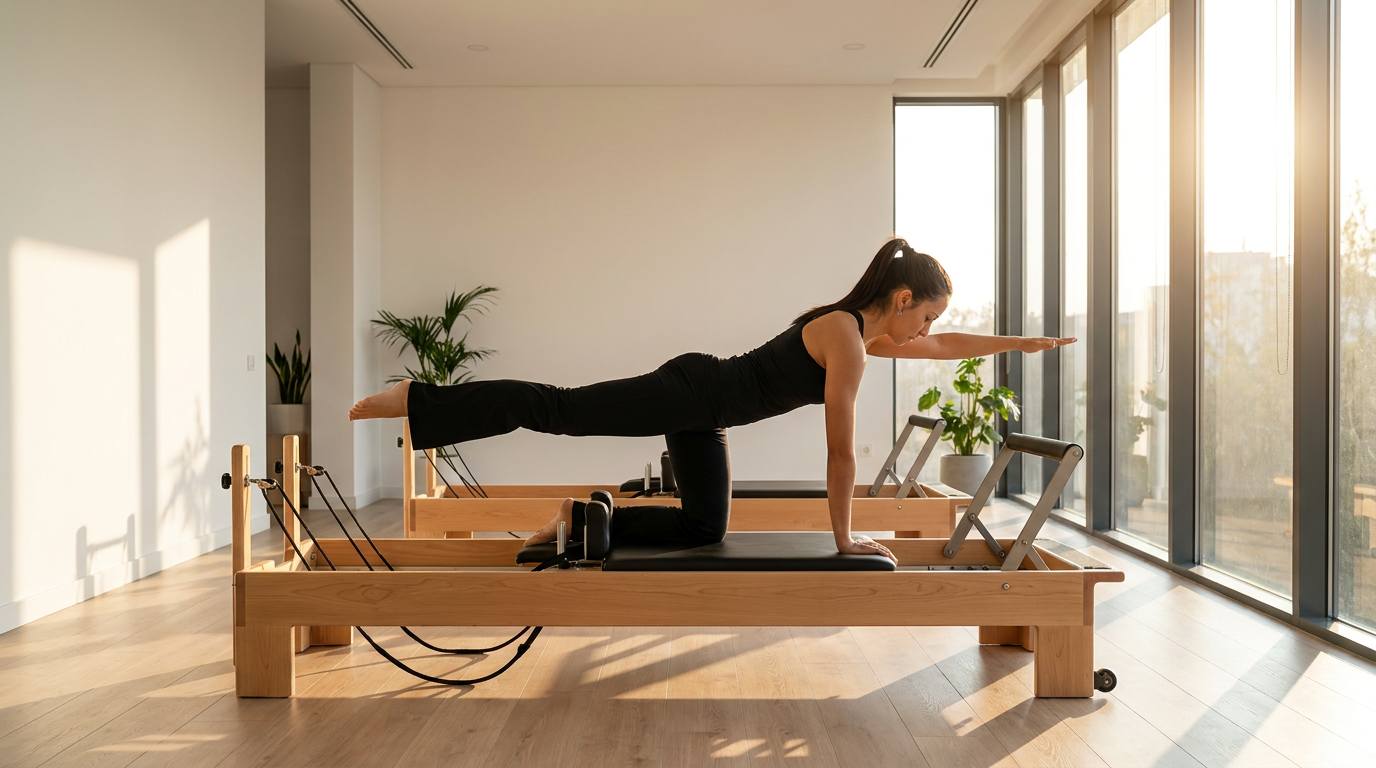
The Pilates method is broadly divided into two primary modalities, each with distinct biomechanical advantages: Mat Pilates and Reformer Pilates. Mat Pilates relies entirely on gravity and the practitioner's own body weight to provide resistance. Because there is no external apparatus to assist with alignment, the deep stabilizing muscles are forced to work continuously to maintain the body's position in space. This lack of external support makes Mat Pilates highly effective for developing foundational core strength, improving postural endurance, and teaching the nervous system how to control the body independently.[7][8]
The Pilates method is broadly divided into two primary modalities, each with distinct biomechanical advantages: Mat Pilates and Reformer Pilates.
Reformer Pilates, conversely, utilizes a specialized, bed-like machine equipped with a sliding carriage, a system of pulleys, and adjustable color-coded springs. This apparatus provides a unique environment that offers both supportive assistance and variable resistance. A 2026 review of current sports science literature highlighted that the Reformer's spring system is particularly adept at facilitating eccentric muscle contractions—the process of lengthening a muscle while it is actively under load. Eccentric training is widely recognized by exercise physiologists as a potent catalyst for building strength and rehabilitating damaged tendons.[4][7]

The ongoing debate over which modality is superior often centers on the goal of muscle hypertrophy, or the physical growth of muscle tissue. The 2026 research review noted that while Mat Pilates generally demonstrates minimal effects on overall lean muscle mass accretion, Reformer Pilates is mechanistically much better positioned to promote hypertrophy. The ability to incrementally increase the spring tension allows for progressive external loading, a fundamental requirement for stimulating muscle fibers to grow larger and stronger over time.[4]
Despite the Reformer's mechanical advantages, researchers caution that neither form of Pilates is optimized for massive muscle accretion. The empirical support for robust, bodybuilder-style hypertrophy resulting from Pilates remains highly heterogeneous and generally limited across clinical trials. Sports scientists emphasize that while the practice builds dense, efficient, and highly coordinated muscles, it lacks the extreme mechanical overload required for maximum growth. Individuals seeking significant gains in sheer muscle size, or athletes requiring maximum explosive power, are still strongly advised to incorporate traditional heavy resistance training with barbells and dumbbells into their broader fitness regimens.[4][8]
Where Pilates undeniably excels, however, is in improving functional body composition and overall metabolic health. A systematic review published in the journal MDPI analyzed dozens of studies over a five-year period, tracking the physical changes in practitioners across various demographics. The aggregated data revealed a marked, consistent trend indicating that regular Pilates practice effectively reduces overall body fat percentage, decreases waist and hip circumference, and lowers the body mass index (BMI). These improvements were particularly pronounced within female populations who maintained a consistent practice schedule of two to three sessions per week over a period of several months.[3]
Beyond aesthetic and compositional changes, Pilates serves as a potent, evidence-based tool for injury rehabilitation and long-term prevention. Physical therapists and orthopedic specialists frequently integrate Pilates principles into their clinical practices to correct deep-seated muscular imbalances. By ensuring that opposing muscle groups—such as the chest and the upper back, or the quadriceps and the hamstrings—are neither too rigid nor too weak, the practice stabilizes vulnerable joints. This balanced tension acts as a shock absorber, significantly reducing the risk of acute sports-related injuries and chronic wear-and-tear.[6][7]

These protective benefits extend significantly to older populations, making Pilates a critical intervention for healthy aging. Research published in the Journal of Bodywork and Movement Therapies observed adults with a mean age of 70 who participated in a structured six-week mat Pilates program. The participants demonstrated statistically significant improvements in functional mobility, walking gait speed, and static balance. These physiological adaptations led study authors to conclude that the practice is a highly effective, low-risk intervention for reducing the incidence of dangerous falls among senior citizens.[5]
Another critical, yet often difficult to quantify, component of the practice is the "mind-muscle connection." Pilates is not a passive workout; it requires intense mental concentration, precise control over micro-movements, and coordinated diaphragmatic breathing. This deep neurological engagement actively improves proprioception—the brain's subconscious awareness of the body's exact position and movement in three-dimensional space. By constantly challenging the nervous system to track and control the limbs, practitioners develop a heightened physical intuition that carries over into daily life.[1][6]
Emerging studies suggest that this highly mindful approach to movement yields profound psychological benefits alongside the physical adaptations. The strict requirement to focus entirely on the present moment, combined with deliberate, rhythmic breathing patterns, actively stimulates the parasympathetic nervous system—the body's "rest and digest" network. This neurological shift helps to lower circulating stress hormones like cortisol, significantly reduce symptoms of clinical depression, and improve overall sleep architecture. By demanding total cognitive presence, Pilates effectively bridges the gap between physical exertion and mental health therapy, offering a moving meditation that calms an overactive nervous system.[3][6]
Despite the overwhelming array of scientifically validated positives, sports medicine professionals are careful to emphasize that Pilates is not a complete, all-encompassing fitness panacea. Because the movements are highly controlled and generally performed at a deliberate, methodical pace, the practice typically lacks the sustained cardiovascular intensity required to maximize long-term heart health. Even in advanced Reformer classes, the workout rarely elevates the heart rate sufficiently to significantly boost VO2 max or provide the rigorous aerobic conditioning that can be achieved through dedicated endurance sports like running, swimming, or cycling.[1][8]
Consequently, health professionals and exercise physiologists recommend viewing Pilates as a vital, foundational pillar of physical fitness rather than a standalone, single-source solution. It provides the essential structural integrity, joint mobility, and deep core endurance necessary to perform other demanding physical activities safely and effectively. When strategically paired with regular cardiovascular exercise for heart health and targeted progressive overload training for maximum muscle growth, Pilates serves as the ultimate stabilizing force. Together, this comprehensive approach helps create a highly resilient, biomechanically efficient, and holistically balanced human body capable of thriving well into old age.[6][8]

How we got here
1920s
Joseph Pilates develops 'Contrology,' initially using it to rehabilitate bedridden patients and later training dancers in New York.
2011
A landmark review in the Archives of Physical Medicine and Rehabilitation confirms strong evidence for Pilates improving flexibility and balance.
2022
Research demonstrates that just six weeks of Mat Pilates significantly reduces fall risks and improves gait in adults over 70.
2026
Modern sports science continues to validate the method, distinguishing the specific biomechanical benefits of Reformer versus Mat training.
Viewpoints in depth
Clinical Rehabilitation Specialists
Medical professionals who utilize Pilates as a targeted tool for injury recovery and joint stabilization.
For physical therapists and rehabilitation specialists, Pilates is less about aesthetics and entirely about biomechanics. They focus heavily on the method's ability to activate the deep anticipatory stabilizers—like the transverse abdominis and multifidus—which are often dormant in patients with chronic lower back pain. By using the Reformer's spring system, clinicians can isolate specific muscle groups and guide patients through controlled, eccentric movements that rebuild strength without overloading vulnerable joints.
Sports Science Researchers
Academics who evaluate the physiological limits and empirical outcomes of Pilates training.
Sports scientists approach Pilates with a critical eye toward measurable outcomes like muscle hypertrophy, VO2 max, and athletic power. While they acknowledge the robust data supporting Pilates for flexibility, balance, and core endurance, they frequently caution against overstating its benefits. Researchers emphasize that Pilates does not provide the progressive mechanical overload required for massive muscle growth, nor does it elevate the heart rate sufficiently to replace dedicated cardiovascular training, positioning it as a supplementary rather than comprehensive fitness protocol.
General Fitness Practitioners
Instructors and everyday practitioners who value the holistic, mind-body benefits of the method.
Within the broader fitness community, the appeal of Pilates lies in its accessibility and its profound impact on daily quality of life. Practitioners highlight the 'mind-muscle connection,' noting that the intense focus required for proper alignment and breathing serves as a form of active meditation. For this camp, the primary victories are found in improved posture, reduced daily stiffness, and the mental clarity that comes from a low-impact practice that energizes rather than depletes the nervous system.
What we don't know
- The exact threshold of spring resistance on a Reformer required to trigger significant muscle hypertrophy remains under-researched.
- Long-term comparative data measuring Pilates against other mind-body practices like yoga for cognitive decline prevention is still emerging.
- Standardization across Pilates studies is inconsistent, making it difficult to isolate the effects of specific exercise sequences.
Key terms
- Transverse abdominis
- The deepest layer of abdominal muscles that wraps around the torso like a corset, crucial for spinal stability.
- Multifidus
- A series of small, deep muscles attached to the spinal column that help stabilize the individual vertebrae.
- Eccentric contraction
- The lengthening of a muscle while it is under tension or load, commonly experienced when resisting the springs on a Pilates Reformer.
- Proprioception
- The body's subconscious ability to sense its movement, action, and location in three-dimensional space.
- Hypertrophy
- The increase in the size of skeletal muscle fibers, typically achieved through progressive resistance training.
Frequently asked
Can Pilates help you lose weight?
While Pilates can improve body composition and reduce body fat percentage, it is not a high-calorie-burning cardiovascular workout. It is most effective for weight management when combined with a balanced diet and aerobic exercise.
Is Reformer Pilates better than Mat Pilates?
Neither is strictly better; they serve different purposes. Mat Pilates is excellent for foundational core strength and postural control, while Reformer Pilates offers adjustable spring resistance that can better facilitate muscle strengthening and injury rehabilitation.
How often should you do Pilates to see results?
Most clinical studies showing significant improvements in flexibility, balance, and core endurance involve participants practicing Pilates two to three times per week for at least six to twelve weeks.
Does Pilates build muscle mass?
Pilates improves muscle tone, endurance, and strength, but it does not consistently elicit the robust muscle hypertrophy (size increase) seen with traditional heavy weightlifting.
Sources
Source coverage
8 outlets
3 viewpoints surfaced








[1]Factlen Editorial TeamSports Science Researchers
Synthesis by Factlen editorial team
Read on Factlen Editorial Team →[2]Archives of Physical Medicine and RehabilitationClinical Rehabilitation Specialists
Pilates for Improvement of Muscle Endurance, Flexibility, Balance, and Posture
Read on Archives of Physical Medicine and Rehabilitation →[3]MDPISports Science Researchers
Influence of the Pilates Method on Functional Body Composition: A Systematic Review
Read on MDPI →[4]ResearchGateSports Science Researchers
Reformer Pilates vs Mat Pilates and Muscle Mass: Current State of Knowledge
Read on ResearchGate →[5]Journal of Bodywork and Movement TherapiesClinical Rehabilitation Specialists
Pilates benefits for older adults: functional mobility and balance
Read on Journal of Bodywork and Movement Therapies →[6]HealthlineGeneral Fitness Practitioners
19 Benefits of Pilates, According to Science
Read on Healthline →[7]Medical News TodayClinical Rehabilitation Specialists
Reformer vs. mat Pilates: What is the difference?
Read on Medical News Today →[8]Women's HealthGeneral Fitness Practitioners
Mat Vs. Reformer Pilates: Which Is Better For Your Goals?
Read on Women's Health →
More in fitness
See all 6 stories →Zone 2 Cardio
Why Zone 2 Cardio Is the Foundation of Longevity and Metabolic Health
8 sources

Micro-Dosing Fitness
The Science of 'Movement Snacks': Why Micro-Dosing Mobility is Replacing the 60-Minute Workout
7 sources

Sports Nutrition
Creatine's New Frontier: Why Endurance Athletes and Biohackers Are Embracing the Gym-Bro Staple
8 sources

Hypertrophy
The Science of Muscle Hypertrophy: How Resistance Training Actually Builds Muscle
7 sources
Every angle. Every day.
Get fitness stories with full source coverage and perspective breakdowns delivered to your inbox.