
The Evidence for Synthetic Data: How Artificial Datasets Are Solving AI's Privacy Bottleneck
As privacy laws and data scarcity throttle machine learning, researchers are turning to 'synthetic data'—artificially generated datasets that perfectly mirror real-world statistics without compromising individual identities. A review of the evidence shows this methodology is accelerating healthcare trials and AI training, though risks of bias and 'model collapse' remain.
By Factlen Editorial Team
- AI Developers & Data Scientists
- View synthetic data as the solution to data scarcity and the high cost of manual labeling.
- Privacy Advocates & Regulators
- Focus on the mathematical guarantees of privacy and the prevention of re-identification.
- Clinical Researchers
- Optimistic about accelerating trials but demand rigorous validation against real-world biological outcomes.
What's not represented
- · Patients and consumers whose original data is used to train the generative models.
- · Legal scholars debating the copyright and ownership of synthetically generated datasets.
Why this matters
Data privacy regulations and the exhaustion of public data have created a severe bottleneck for AI development and medical research. Synthetic data offers a mathematically proven way to train life-saving algorithms and test new drugs without ever exposing real human information.
Key points
- Synthetic data is artificially generated information that mirrors the statistical properties of real data without containing actual personal records.
- Unlike traditional anonymization, synthetic data breaks the one-to-one link between a data point and a real human, mathematically reducing privacy risks.
- The methodology allows AI developers to intentionally generate 'edge cases'—rare scenarios that are difficult to capture in the real world.
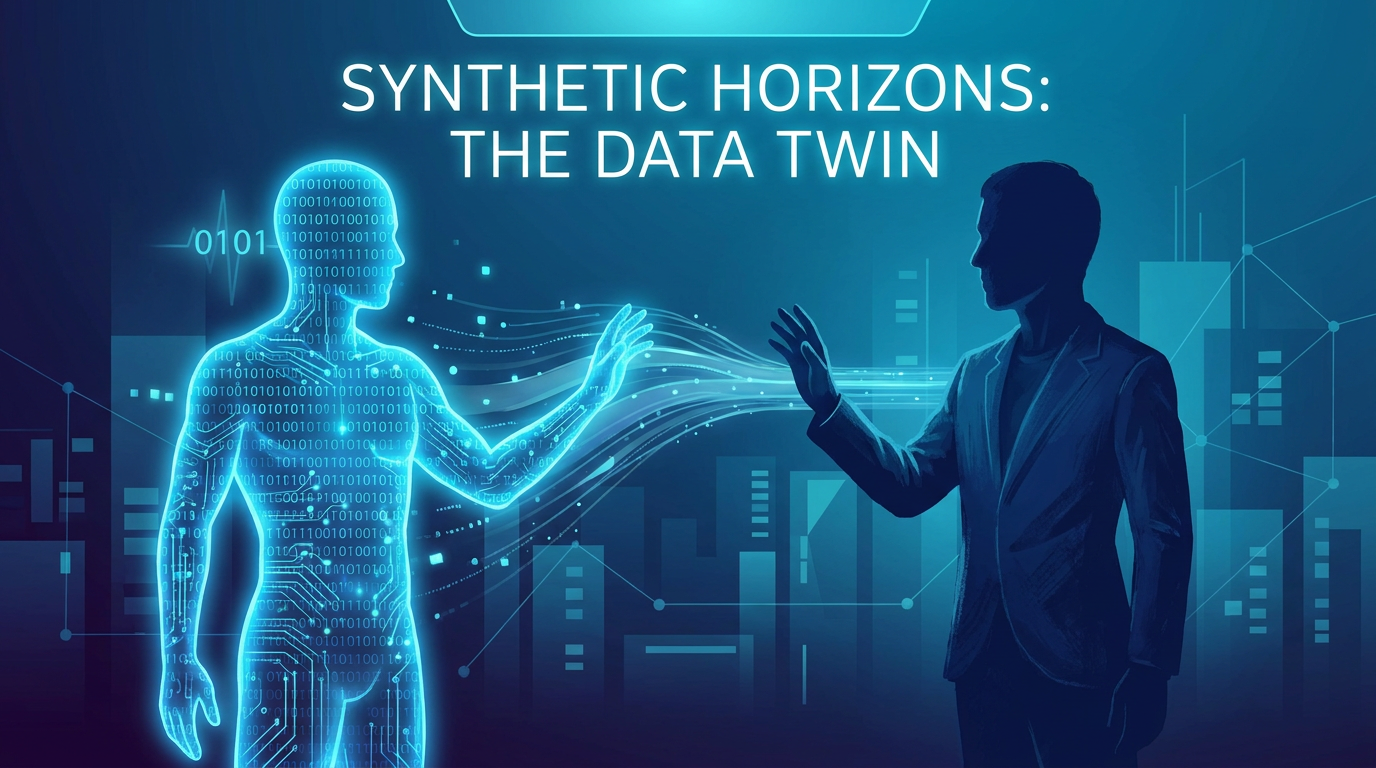
- Clinical researchers are using synthetic 'digital twins' to simulate drug trials, potentially shaving years off the development cycle.
- Experts warn that synthetic data can still amplify existing biases if the original real-world dataset lacks diverse representation.
Artificial intelligence has an insatiable appetite for data, but the technology is rapidly colliding with a hard limit: the privacy of the human beings generating it. For years, the standard practice in data science was "anonymization"—stripping names and social security numbers from datasets before feeding them into machine learning models. But as algorithms grew more sophisticated, researchers proved that anonymized data could easily be reverse-engineered to re-identify individuals. This created a profound bottleneck in fields like healthcare and finance, where data is abundant but legally and ethically locked away. Today, a methodological breakthrough is solving this impasse. It is called synthetic data, and it is fundamentally changing how evidence is generated and algorithms are trained.[7]
Unlike traditional de-identification, which merely masks existing records, synthetic data generation creates entirely artificial datasets from scratch. Using advanced generative models—such as Generative Adversarial Networks (GANs) and Variational Autoencoders (VAEs)—researchers analyze a real-world dataset to understand its underlying statistical distributions, correlations, and patterns. The models then generate a brand-new population of "fake" individuals who exhibit the exact same statistical behaviors as the real population, but who do not actually exist. Because there is no one-to-one mapping between a synthetic record and a real human, the privacy risk is mathematically severed.[1][3]
The evidence supporting the utility of this approach is mounting rapidly, particularly in the public sector. The UK's Office for National Statistics (ONS) has actively explored synthetic data as a method for statistical disclosure control, allowing researchers to analyze highly sensitive census and demographic microdata without ever touching the confidential originals. When researchers run regression models on the synthetic datasets, they yield the same group means, cell counts, and correlation coefficients as the original data. This allows data scientists to write and test their code on synthetic replicas in open environments before deploying it securely on the real data.[4]

Beyond privacy, synthetic data solves a critical problem in machine learning: data scarcity and the "edge case" dilemma. Real-world data is naturally skewed toward routine, business-as-usual scenarios. An autonomous vehicle, for example, will record thousands of hours of driving on sunny highways, but very little data on pedestrians jaywalking in a blizzard. Models trained exclusively on this routine data fail to generalize when confronted with rare, high-consequence events. Synthetic data allows engineers to intentionally oversample these low-probability edge cases, injecting them into the training pipeline to produce vastly more robust and resilient AI systems.[1][7]
The most profound impacts of this methodology are currently unfolding in healthcare. A narrative review published in the British Medical Journal (BMJ) highlights that obtaining real-world health data is notoriously slow due to ethical and regulatory barriers like HIPAA. By utilizing computationally derived synthetic healthcare data, hospitals and pharmaceutical companies can model disease progression and test treatment hypotheses in a fraction of the time. The BMJ review found that machine learning models trained on synthetic patient records are equally valid against real-world populations as those trained on the original data.[2]
The most profound impacts of this methodology are currently unfolding in healthcare.
This capability is accelerating the pace of clinical trials and drug discovery. By generating "digital twins"—virtual representations of patient populations based on the statistical properties of real electronic health records—researchers can simulate how a new molecule might perform across millions of synthetic patients. According to industry analyses, synthetic data-enabled target identification can reduce the time required for preclinical studies by up to 30%, shaving years off the traditional drug development cycle while entirely bypassing the risks associated with handling Protected Health Information (PHI).[7]

However, the evidence pack for synthetic data is not without transparent uncertainties and limitations. The Royal Society cautions that generating synthetic data is not inherently private by default. If a generative model is overfitted to the original data, it can memorize and regurgitate real training inputs—a phenomenon that completely undermines the privacy guarantee. To combat this, researchers must apply rigorous mathematical frameworks like Differential Privacy, which injects a controlled level of statistical noise into the generation process to ensure that no single individual's data can significantly influence the final synthetic output.[1][3]
Furthermore, there is strong evidence that synthetic data can perpetuate and even amplify existing biases. The National Institutes of Health (NIH) warns that if the original real-world dataset lacks representation from minority populations, the synthetic data will faithfully replicate that exclusion. Because synthetic data aims to capture aggregate distributions, it often struggles to accurately represent the nuances of rare comorbidities or intersectional identities. Consequently, the NIH recommends that synthetic datasets be cautiously supplemented with external data and rigorously validated by domain experts to ensure equitable representation.[5]

There is also the looming epistemic threat of "model collapse." As synthetic data becomes ubiquitous on the internet, future AI models will inevitably ingest data generated by previous AI models. Early studies indicate that without fresh infusions of real-world human data, models trained on their own synthetic exhaust gradually lose their ability to generate diverse outputs, converging into a narrow, degraded state. Synthetic data is a powerful supplement to human data, but it cannot permanently replace the messy, unpredictable reality of human behavior.[7]
Despite these challenges, the trajectory of the methodology is clear. Technology research firm Gartner predicts that by 2026, 75% of all data used to train AI models will be synthetically generated, up from roughly 30% in 2024. As the market for synthetic data generation surges toward a projected $50 billion by 2030, it is transitioning from a niche privacy tool into foundational infrastructure. By breaking the zero-sum trade-off between data utility and individual privacy, synthetic data is proving that sometimes, the best way to understand the real world is to simulate it.[6]
How we got here
Early 2000s
Researchers demonstrate that traditional data anonymization techniques can be easily reverse-engineered to identify individuals.
2014
Generative Adversarial Networks (GANs) are introduced, providing the foundational architecture for highly realistic synthetic data generation.
2023
The UK's Office for National Statistics begins actively testing synthetic data for public microdata releases.
2024
Synthetic data adoption accelerates in healthcare to bypass HIPAA bottlenecks in medical AI research.
2026
Gartner projects that synthetic data will account for 75% of all data used to train AI models globally.
Viewpoints in depth
Privacy Advocates & Regulators
Focus on the mathematical guarantees of privacy and the prevention of re-identification.
This camp views synthetic data as a necessary evolution in data sharing, particularly for compliance with GDPR and HIPAA. However, they emphasize that synthetic data is not a silver bullet; without rigorous frameworks like Differential Privacy, generative models can still memorize and leak sensitive training data. They advocate for strict auditing of synthetic datasets before public release.
AI Developers & Data Scientists
View synthetic data as the solution to data scarcity and the high cost of manual labeling.
For engineers building autonomous systems and large language models, the real world does not provide enough 'edge cases'—rare events like extreme weather or unusual system failures. This camp values synthetic data for its ability to intentionally oversample these rare scenarios, making models more robust. They also see it as a massive cost-saving measure that bypasses the need for expensive human data labeling.
Clinical Researchers
Optimistic about accelerating trials but demand rigorous validation against real-world biological outcomes.
Medical researchers see immense potential in using synthetic 'digital twins' to model disease progression and simulate clinical trials without risking patient privacy. However, they caution that synthetic data must not completely replace real-world evidence in final regulatory approvals. Their primary concern is that synthetic datasets might fail to capture the complex, intersectional realities of rare diseases and underrepresented populations.
What we don't know
- Whether AI models trained predominantly on synthetic data will eventually suffer from 'model collapse' and degrade in quality over time.
- How regulatory bodies like the FDA will ultimately standardize the use of synthetic data in final drug approvals.
- The exact threshold of statistical noise required to guarantee differential privacy without destroying the utility of the dataset.
Key terms
- Synthetic Data
- Artificially generated information that mimics the statistical properties of real-world data without containing any actual individual's information.
- Generative Adversarial Networks (GANs)
- A machine learning framework where two neural networks contest with each other to generate highly realistic artificial data.
- Differential Privacy
- A mathematical framework that adds controlled noise to a dataset to guarantee that an individual's data cannot be re-identified.
- Model Collapse
- A phenomenon where AI models trained on too much of their own synthetic data gradually degrade in quality and diversity.
- Digital Twin
- A virtual representation of a patient population based on the statistical properties of real health records, used to simulate clinical trials.
Frequently asked
What is the difference between synthetic data and anonymized data?
Anonymized data takes real records and masks identifying details, which can often be reverse-engineered. Synthetic data generates entirely new, fake records that share the statistical patterns of the real data, breaking the link to any real person.
Can synthetic data introduce bias into AI models?
Yes. If the original real-world dataset used to train the synthetic generator is biased or lacks representation, the resulting synthetic data will faithfully replicate and potentially amplify those biases.
Why do AI models need synthetic data if we have so much real data?
Real data is often locked behind privacy regulations, expensive to label, and lacks sufficient examples of rare 'edge cases' (like extreme weather in autonomous driving) that AI models need to learn from.
Sources
Source coverage
7 outlets
3 viewpoints surfaced




[1]arXivAI Developers & Data Scientists
Machine Learning for Synthetic Data Generation: a Review
Read on arXiv →[2]BMJ Health & Care InformaticsClinical Researchers
Synthetic data in healthcare: a narrative review
Read on BMJ Health & Care Informatics →[3]The Royal SocietyPrivacy Advocates & Regulators
Privacy-preserving synthetic data
Read on The Royal Society →[4]Office for National StatisticsPrivacy Advocates & Regulators
Synthetic data at ONS
Read on Office for National Statistics →[5]National Institutes of HealthClinical Researchers
The promise and perils of synthetic data in healthcare
Read on National Institutes of Health →[6]GartnerAI Developers & Data Scientists
Gartner Predicts 75% of AI Training Data Will Be Synthetic by 2026
Read on Gartner →[7]Factlen Editorial TeamAI Developers & Data Scientists
Synthesis by Factlen editorial team
Read on Factlen Editorial Team →
Every angle. Every day.
Get data analysis stories with full source coverage and perspective breakdowns delivered to your inbox.