
How AI is Compressing Centuries of Materials Science into Months
Generative AI and autonomous robotic laboratories are discovering hundreds of thousands of stable new materials, accelerating the development of next-generation batteries and green technologies.
By Factlen Editorial Team
- Computational AI Researchers
- Focus on the sheer scale of digital discovery and the power of graph neural networks to map chemical possibilities.
- Experimental Materials Scientists
- Emphasize that digital predictions are only hypotheses until physically synthesized and validated in a laboratory.
- Industrial Manufacturing Analysts
- Highlight the gap between a stable crystal and a commercially viable product, focusing on cost and scalability.
What's not represented
- · Environmental Toxicologists
- · Mining and Extraction Industries
Why this matters
Everything from the range of electric vehicles to the efficiency of solar panels is limited by current materials. By using AI to discover new compounds in months rather than decades, scientists are rapidly accelerating the timeline for critical climate and energy technologies.
Key points
- Generative AI and graph neural networks are compressing the materials discovery timeline from decades to months.
- Google DeepMind's GNoME model predicted over 380,000 new thermodynamically stable crystalline materials.
- Microsoft and PNNL used AI to screen 32 million candidates, discovering a new battery material in just nine months.
- Autonomous robotic laboratories are now synthesizing these AI-predicted recipes 24/7 to validate their physical properties.
- Significant hurdles remain in translating thermodynamically stable digital models into cost-effective, mass-manufacturable industrial products.
The physical world is bottlenecked by chemistry. From the energy density of electric vehicle batteries to the heat tolerance of fusion reactors, human progress is strictly limited by the materials we can dig out of the ground or synthesize in a laboratory.[7]
For centuries, materials science has relied on a painstaking process of trial and error. A researcher formulates a hypothesis, mixes elements, bakes them, and tests the result. This iterative cycle typically takes 10 to 20 years to move a single new material from a conceptual whiteboard to commercialization.[7]
That timeline is now collapsing. A convergence of generative artificial intelligence, graph neural networks, and autonomous robotics is fundamentally rewriting the rules of chemical discovery, shifting the field from physical guesswork to digital prediction.[7]

The primary evidence for this shift comes from Google DeepMind’s Graph Networks for Materials Exploration, known as GNoME. By training neural networks on decades of existing crystallographic data, GNoME learned the underlying quantum physics of how atoms bond, allowing it to predict entirely new molecular combinations.[1]
The scale of these predictions is unprecedented. DeepMind announced the discovery of over 380,000 thermodynamically stable crystalline materials. This single computational run expanded the catalog of known stable materials by nearly a factor of ten, generating what researchers estimate would be 800 years' worth of knowledge using traditional experimental methods.[1][7]
While GNoME mapped the broad landscape of what is chemically possible, other researchers are proving that generative AI can be directed to solve specific engineering bottlenecks, such as the global lithium shortage.[2][3]

Microsoft’s Azure Quantum Elements demonstrated this targeted approach in a partnership with the Pacific Northwest National Laboratory (PNNL). Microsoft tasked its AI with finding a new solid-state battery electrolyte that could maintain high energy density while drastically reducing reliance on lithium.[4]
Microsoft’s Azure Quantum Elements demonstrated this targeted approach in a partnership with the Pacific Northwest National Laboratory (PNNL).
The computational system screened over 32 million potential inorganic materials. AI models rapidly filtered these candidates for stability and reactivity, narrowing the massive list to a few dozen promising options in less than a week—a filtering process that would have taken human researchers lifetimes.[2][4]
Within nine months, PNNL scientists synthesized the top candidate and built a working battery prototype. The new material utilizes a mix of lithium and sodium, successfully reducing the required lithium content by up to 70% while maintaining viability.[3][4]
However, a digital recipe is useless if it cannot be synthesized in the physical world. To bridge the gap between digital prediction and physical reality, institutions like the Lawrence Berkeley National Laboratory have developed "A-Labs."[5]

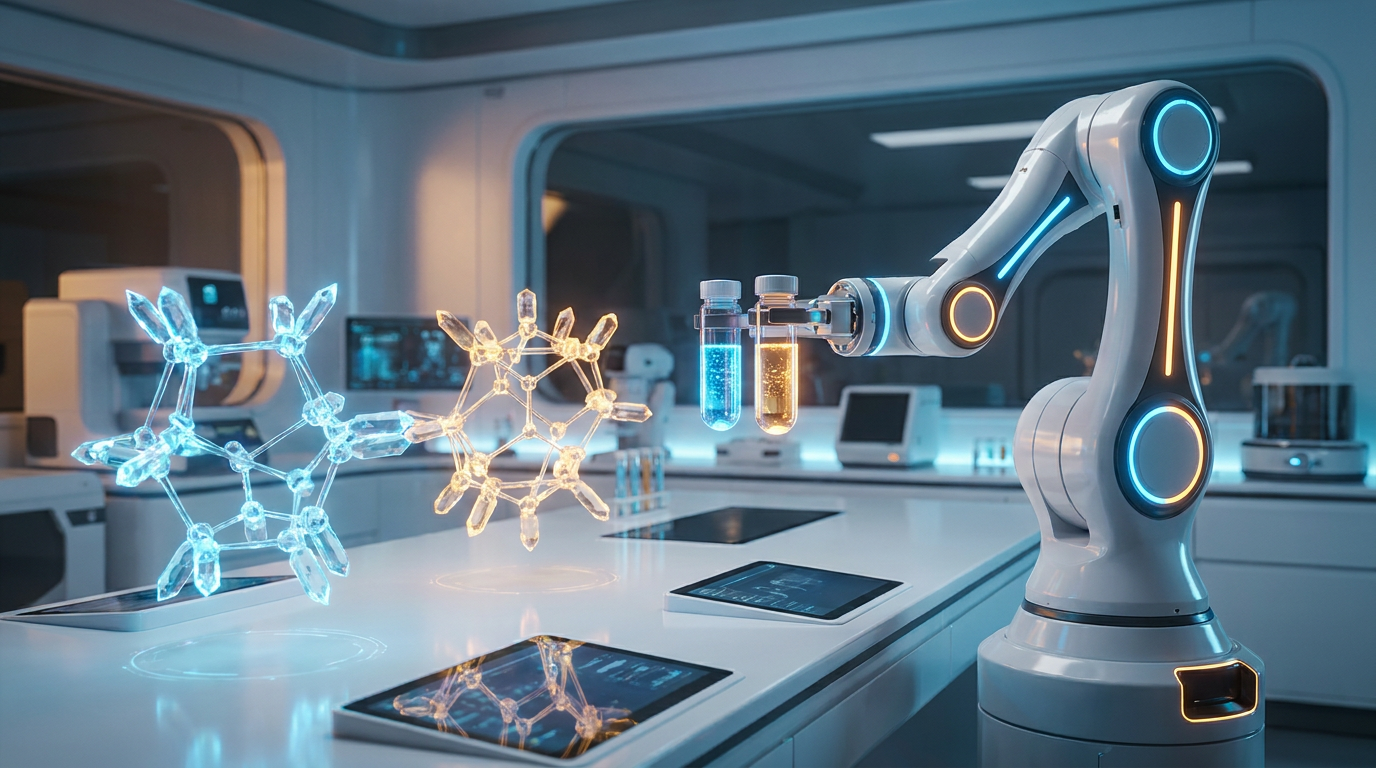
These closed-loop autonomous laboratories use AI to direct robotic arms to mix, heat, and analyze compounds 24 hours a day without human intervention. The robots adjust their own synthesis recipes on the fly based on real-time experimental feedback.[5]
These robotic systems are already proving the AI's math. Independent researchers and autonomous labs have successfully synthesized over 736 of the novel materials predicted by GNoME, confirming that the digital models accurately reflect physical reality.[1][5]
Despite the euphoria surrounding these breakthroughs, transparent uncertainty remains regarding industrial viability. Significant evidentiary gaps still exist between laboratory synthesis and mass manufacturing.[6]
Academic critiques of the AI datasets point out that while a material might be thermodynamically stable, the models do not currently account for strict industrial constraints. A predicted super-material might require rare, toxic elements, or demand synthesis temperatures that make commercial production economically impossible.[6]

Furthermore, the physical properties of amorphous materials—those without neat crystalline structures, like certain polymers and glasses—remain notoriously difficult for current AI models to predict accurately.[6][7]
Nevertheless, the paradigm has irreversibly shifted. The bottleneck in green technology is no longer the human imagination, but the speed at which robotic laboratories can physically bake the recipes that artificial intelligence has already written.[7]
How we got here
2011
The Materials Project launches to compute and database the properties of known inorganic materials.
Nov 2023
Google DeepMind publishes the GNoME project, releasing predictions for over 380,000 new stable materials.
Nov 2023
Berkeley Lab publishes results from the A-Lab, demonstrating autonomous robotic synthesis of AI-predicted materials.
Jan 2024
Microsoft and PNNL announce the physical synthesis of a new solid-state battery material discovered via AI screening.
Viewpoints in depth
Computational AI Researchers
Focus on the sheer scale of digital discovery and the power of graph neural networks.
For AI researchers at institutions like DeepMind and Microsoft, the materials bottleneck is fundamentally a data and compute problem. By training graph neural networks on decades of quantum mechanical calculations, they argue that AI has successfully mapped the 'convex hull' of stable materials. From this perspective, the digital discovery phase is largely solved; the AI can now reliably predict the exact atomic arrangements that will remain stable, effectively compressing centuries of theoretical chemistry into a few months of compute time.
Experimental Materials Scientists
Emphasize that digital predictions are only hypotheses until physically synthesized.
Experimentalists at national laboratories view AI as a powerful compass, but not a replacement for physical chemistry. They point out that a digital model cannot account for every real-world variable, such as impurities in raw materials or unexpected kinetic reactions during heating. This camp advocates for massive investments in 'closed-loop' autonomous laboratories, arguing that the true bottleneck has simply shifted from predicting materials to physically synthesizing and validating them.
Industrial Manufacturing Analysts
Highlight the gap between a stable crystal and a commercially viable product.
Industry analysts and applied engineers caution against premature euphoria. They note that thermodynamic stability is only the first of many hurdles. A material must also be non-toxic, rely on elements that are abundant and ethical to mine, and be manufacturable at a massive scale without requiring prohibitively expensive conditions (like extreme vacuums or temperatures). From the industrial viewpoint, until AI models can co-optimize for supply chain economics and manufacturability, many of these 'miracle materials' will remain confined to the laboratory.
What we don't know
- Whether the majority of AI-predicted materials can be synthesized using cost-effective, scalable industrial processes.
- How accurately current AI models can predict the properties of complex amorphous materials, such as polymers and glasses.
- The exact timeline for when these newly discovered materials will reach consumer products like electric vehicles or solar panels.
Key terms
- Thermodynamic Stability
- A state where a chemical compound is at its lowest energy level, meaning it will not spontaneously decompose and can theoretically exist in the real world.
- Solid-State Electrolyte
- A solid material that conducts ions between a battery's anode and cathode, offering higher energy density and safety compared to traditional liquid electrolytes.
- Inverse Design
- A computational process where scientists specify the desired properties of a material first, and the AI works backward to generate a molecular structure that meets those criteria.
- Convex Hull
- In materials science, a mathematical boundary representing the lowest-energy (most stable) states of material compositions; compounds outside this boundary are unstable.
Frequently asked
What is a graph neural network?
It is an AI architecture that represents atoms as nodes and chemical bonds as edges, allowing the model to learn and predict how different elements will interact and stabilize.
Why do we need new materials?
Next-generation technologies, such as solid-state EV batteries, highly efficient solar panels, and fusion reactors, require materials with properties that do not exist in currently known compounds.
Did the AI physically build a battery?
No. The AI predicted the chemical recipe and simulated its properties. Human scientists at national laboratories then physically synthesized the material and built the working battery prototype.
Sources
Source coverage
7 outlets
3 viewpoints surfaced







[1]NatureComputational AI Researchers
Scaling deep learning for materials discovery
Read on Nature →[2]MicrosoftComputational AI Researchers
How AI and HPC are speeding up scientific discovery
Read on Microsoft →[3]ForbesIndustrial Manufacturing Analysts
Microsoft Azure Quantum Elements Accelerates Materials Discovery
Read on Forbes →[4]Utility DiveExperimental Materials Scientists
PNNL, Microsoft use AI to discover new battery material in weeks
Read on Utility Dive →[5]Berkeley LabExperimental Materials Scientists
An Autonomous Laboratory Powered by AI
Read on Berkeley Lab →[6]arXivIndustrial Manufacturing Analysts
Critical Analysis of AI-Generated Materials Databases
Read on arXiv →[7]Factlen Editorial TeamIndustrial Manufacturing Analysts
Synthesis by Factlen editorial team
Read on Factlen Editorial Team →

Every angle. Every day.
Get ai stories with full source coverage and perspective breakdowns delivered to your inbox.