
The Rise of Small Language Models: How AI Moved from the Cloud to Your Pocket
Massive cloud-based AI models are no longer the only option. Small Language Models (SLMs) are bringing powerful, private, and offline artificial intelligence directly to smartphones and laptops.
By Factlen Editorial Team

- Edge AI Developers
- Argue that local execution is the only way to guarantee privacy and zero-latency performance.
- Open-Source Community
- Focus on the democratization of AI, ensuring powerful models are freely available to run on consumer hardware.
- Cloud AI Researchers
- Maintain that while SLMs are useful for basic tasks, true reasoning breakthroughs still require massive cloud infrastructure.
What's not represented
- · Hardware manufacturers producing legacy chips
- · Cloud infrastructure providers losing inference volume
Why this matters
By running AI locally on your device rather than in the cloud, SLMs guarantee absolute data privacy, eliminate subscription fees, and work flawlessly without an internet connection.
Key points
- Small Language Models (SLMs) run entirely on local hardware, requiring no internet connection.
- On-device processing guarantees absolute data privacy, as prompts never reach a server.
- Modern smartphone NPUs can process AI tasks faster than human reading speed.
- SLMs excel at summarization and drafting but cannot match the complex reasoning of massive cloud models.
- The future of mobile AI relies on a hybrid approach, routing simple tasks locally and complex tasks to the cloud.
For the past four years, the artificial intelligence industry has been locked in a race to build the biggest brain possible. Tech giants poured billions of dollars into massive server farms, training Large Language Models (LLMs) with trillions of parameters. These behemoths can write code, draft legal briefs, and pass medical exams, but they come with a fundamental tether: they require a constant, high-speed internet connection to beam your prompts to a distant data center and wait for a response.[5]
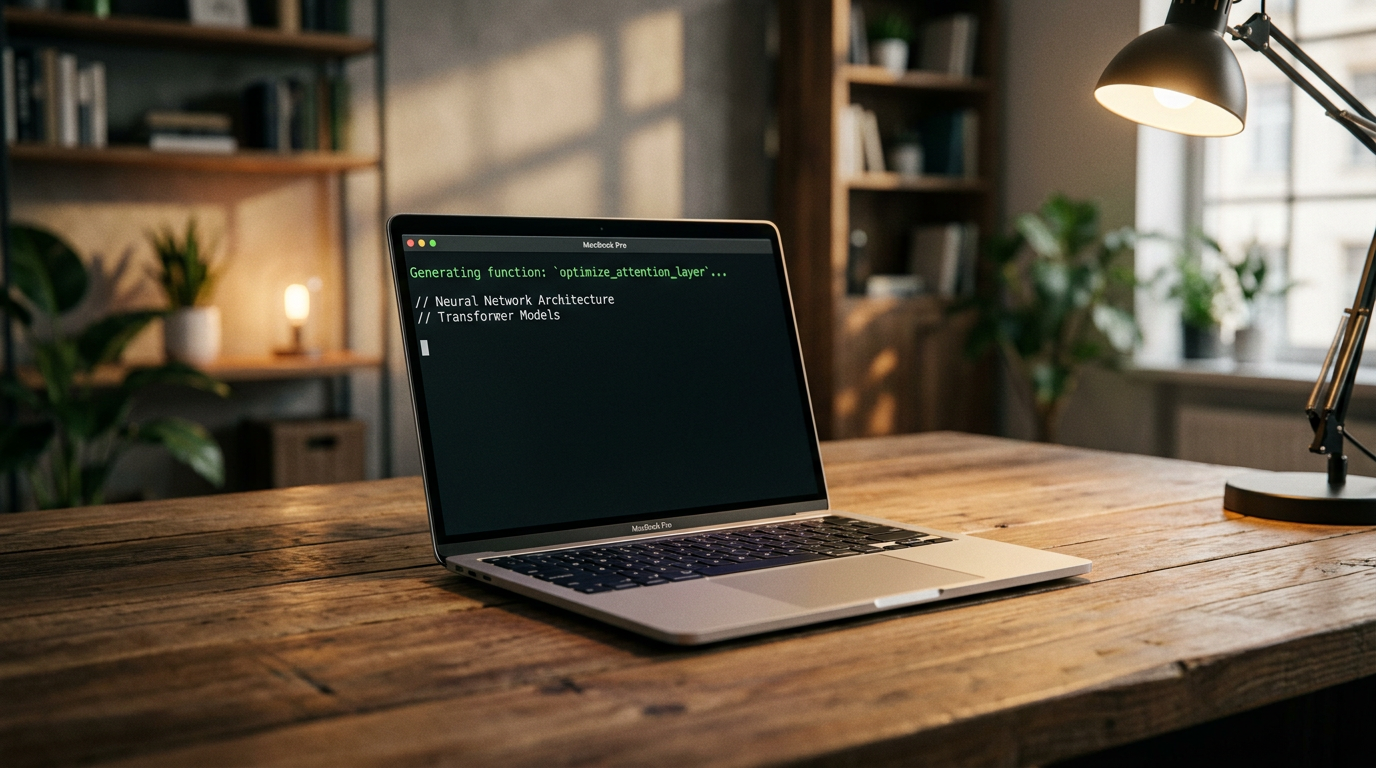
In 2026, that paradigm is fracturing. A quiet revolution has taken hold at the opposite end of the spectrum, driven by a new class of algorithms known as Small Language Models (SLMs). Rather than relying on the cloud, these compact AI systems are designed to run entirely locally—directly on the silicon of the smartphone in your pocket or the laptop on your desk.[4]
The shift from cloud to edge computing represents one of the most significant democratizations of technology in the modern era. By severing the cord to the server, on-device AI solves three of the most stubborn bottlenecks in the industry: absolute data privacy, zero-latency responsiveness, and guaranteed offline availability.[5]
To understand how this works, it helps to understand what makes an AI "small." A language model's size is measured in parameters—the internal neural weights and biases it uses to process information. While frontier cloud models like GPT-4 operate on over a trillion parameters, modern SLMs typically range from 1 billion to 14 billion parameters.[3]

Shrinking a model by a factor of one hundred without losing its core intelligence requires aggressive optimization. Engineers use a technique called quantization, which reduces the mathematical precision of the model's weights—compressing high-resolution data into smaller, low-bit formats. Combined with "pruning" (removing redundant neural pathways) and training on highly curated, textbook-quality data, developers have managed to pack startling reasoning capabilities into files as small as two gigabytes.[3][4]
But software optimization is only half the equation; the hardware had to catch up. The unsung hero of the local AI revolution is the Neural Processing Unit (NPU). Unlike standard central processors, NPUs are purpose-built to handle the massive parallel matrix math required by neural networks.[1]
In 2026, mobile silicon has crossed a critical threshold. Flagship devices equipped with chips like the Snapdragon 8 Elite Gen 5 and Apple's A19 Pro now boast NPUs capable of 40 to 50 Trillion Operations Per Second (TOPS). This hardware acceleration allows a smartphone to generate text at 30 tokens per second—faster than most humans can read—without ever waking up the cloud.[1][2]
Flagship devices equipped with chips like the Snapdragon 8 Elite Gen 5 and Apple's A19 Pro now boast NPUs capable of 40 to 50 Trillion Operations Per Second (TOPS).
The major operating systems have aggressively integrated these capabilities. Apple's Foundation Models framework, built deeply into iOS and macOS, allows third-party developers to tap into Apple's heavily optimized 3-billion-parameter on-device model. Similarly, Google's AI Core and ML Kit surface the Gemini Nano model to Android developers, providing a standardized way to run AI tasks locally on Pixel and Galaxy devices.[1][2]
Beyond the proprietary ecosystems, an explosion of open-weight models has fueled a vibrant developer community. Models like Microsoft's Phi-4 Mini, Google's Gemma 3, and Meta's Llama 3.2 are freely available for anyone to download. Independent apps now allow users to browse repositories like Hugging Face, download a model directly to their phone, and chat with it completely offline.[3][4]
The most profound implication of this architecture is privacy. When you use a cloud-based AI, every intimate question, proprietary business document, or rough draft you submit is transmitted to a corporate server. With on-device SLMs, the data boundary ends at the glass of your screen.[5]

This absolute privacy guarantee is unlocking use cases that were previously impossible due to compliance or security risks. Healthcare workers can use local AI to summarize patient notes without violating HIPAA regulations. Enterprise executives can analyze confidential financial data on airplanes. Journalists can transcribe and translate sensitive interviews in remote areas without fear of interception.[5]
Offline capability also transforms reliability. A local model works in a subway tunnel, during a cell network outage, or in the backcountry. It eliminates the frustrating "network error" timeouts that plague cloud assistants, providing a resilient tool that is always available, regardless of infrastructure.[2]
However, the laws of physics still apply, and local AI comes with distinct trade-offs. Running billions of calculations per second generates significant heat and consumes battery power. Extended inference sessions can cause a smartphone to throttle its performance to prevent overheating, slowing down response times.[1]
Furthermore, SLMs cannot match the sheer encyclopedic knowledge or complex, multi-step logical reasoning of trillion-parameter cloud models. They excel at targeted tasks—summarizing an email, rewriting a paragraph, or extracting action items from a transcript—but they will hallucinate or fail if asked to write a complex software application from scratch.[3][5]

Because of these limitations, the immediate future of AI is hybrid. Operating systems are increasingly acting as intelligent routers. When a user asks a simple question or requests a summary of a local document, the OS routes the task to the on-device SLM for a fast, private response.[1][2]
Only when a prompt requires heavy logical lifting or broad world knowledge does the system—with explicit user permission—escalate the request to a massive cloud model. This hybrid approach offers the best of both worlds: the privacy and speed of the edge, backed by the raw power of the cloud.[1][5]
Ultimately, the rise of Small Language Models represents a shift in ownership. For the first time, highly capable artificial intelligence is not just a service you rent from a tech giant; it is a tool you physically possess. As models continue to shrink and silicon continues to accelerate, the most important AI you use won't be in a data center—it will be the one in your pocket.[4][5]
How we got here
2020–2022
The AI industry focuses almost exclusively on massive, cloud-dependent Large Language Models like GPT-3.
Early 2023
Open-source models like LLaMA prove that smaller, highly optimized models can punch above their weight class.
2024–2025
Apple and Google introduce native OS frameworks (Apple Intelligence and AI Core) to support on-device inference.
Mid-2026
Flagship smartphones ship with 50-TOPS NPUs, making local execution of 3B-parameter models seamless and instantaneous.
Viewpoints in depth
Edge Computing Advocates
Developers and engineers who believe AI must run locally to be truly useful.
This camp argues that the cloud-first era of AI was a temporary stepping stone. They point out that relying on data centers introduces unacceptable latency, recurring subscription costs, and single points of failure. By moving inference to the edge, they believe AI becomes a reliable utility—like a calculator or a camera—that works instantly and universally, regardless of cellular coverage.
Enterprise Security Teams
Corporate IT leaders focused on data sovereignty and compliance.
For heavily regulated industries like healthcare, finance, and law, cloud-based AI has been a non-starter due to the risk of data leakage. This perspective views SLMs as the ultimate compromise: employees gain the productivity benefits of generative AI without violating strict data-handling policies. Because the data never leaves the physical device, the attack surface is dramatically reduced.
Frontier AI Researchers
Scientists focused on pushing the absolute boundaries of machine intelligence.
While acknowledging the utility of SLMs, this camp warns against overestimating their capabilities. They emphasize that true breakthroughs in reasoning, scientific discovery, and autonomous agent behavior require the massive parameter counts and compute clusters that only the cloud can provide. They view SLMs as useful "front-end" filters, but maintain that the heavy lifting of the future will still happen in data centers.
What we don't know
- How quickly battery technology will evolve to support continuous on-device AI inference without rapid degradation.
- Whether the performance gap between SLMs and frontier cloud models will eventually close, or remain a permanent hardware limitation.
Key terms
- Small Language Model (SLM)
- A compact AI model, typically between 1 and 14 billion parameters, designed to run efficiently on consumer hardware.
- Quantization
- A compression technique that reduces the mathematical precision of an AI model's weights, allowing it to fit into mobile memory.
- Neural Processing Unit (NPU)
- A specialized hardware chip designed specifically to accelerate the complex math required by artificial intelligence.
- Inference
- The process of an AI model generating a response or prediction based on a user's prompt.
Frequently asked
Can I run a Small Language Model on my current phone?
Yes, if you have a recent flagship device. Phones released in 2024 or later with dedicated NPUs (like the iPhone 15 Pro or Pixel 9) can run these models smoothly.
Does running AI locally drain my battery?
It can. Generating long responses requires significant computational power, which consumes battery and generates heat during extended use.
Are SLMs as smart as cloud models like ChatGPT?
No. While they are excellent at summarization, drafting, and basic reasoning, they lack the vast encyclopedic knowledge and complex logic of trillion-parameter cloud models.
Do I need an internet connection to use them?
Only to download the model initially. Once the model file is saved to your device, all text generation happens completely offline.
Sources
Source coverage
5 outlets
3 viewpoints surfaced





[1]Apple DeveloperEdge AI Developers
Apple Intelligence Foundation Models and On-Device Architecture
Read on Apple Developer →[2]Android DevelopersEdge AI Developers
Gemini Nano and Google AI Core for Mobile
Read on Android Developers →[3]Microsoft ResearchCloud AI Researchers
Phi-3 and Phi-4: Highly Capable Small Language Models
Read on Microsoft Research →[4]Hugging FaceOpen-Source Community
The State of Open-Weight Small Language Models in 2026
Read on Hugging Face →[5]Factlen Editorial TeamOpen-Source Community
Synthesis by Factlen editorial team
Read on Factlen Editorial Team →


Every angle. Every day.
Get ai stories with full source coverage and perspective breakdowns delivered to your inbox.