
Trade-offs Between the 2026 Rivian R2 and Tesla Model Y
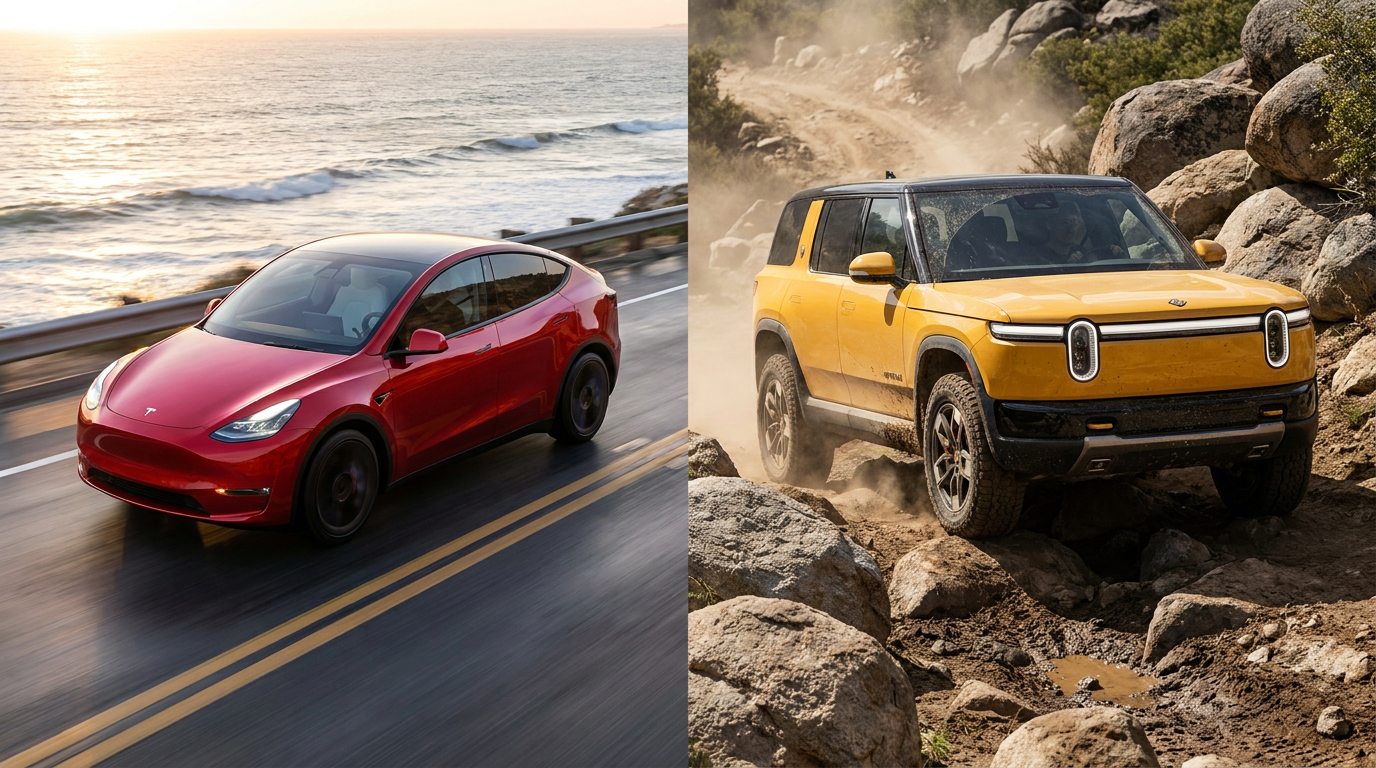
The 2026 Rivian R2 arrives to challenge the best-selling Tesla Model Y, offering a rugged, off-road-focused alternative to Tesla's sleek crossover. While the Model Y retains a significant pricing advantage, the R2 matches its efficiency while delivering superior cargo space and outdoor utility.
By Factlen Editorial Team
- Utility & Off-Road Enthusiasts
- Prioritizes maximum cargo space, ground clearance, and rugged capability over pure on-road dynamics.
- Efficiency & Value Pragmatists
- Focuses on lower entry prices, proven charging curves, and aerodynamic efficiency for daily commuting.
- Tech & Design Reviewers
- Evaluates the user interface, screen layouts, and the aesthetic divergence between boxy and sleek designs.
What's not represented
- · Legacy Automakers
- · Dealership Networks
Why this matters
For consumers looking to transition to an electric vehicle in 2026, the midsize SUV segment is the most critical and highly contested market. Understanding the stark trade-offs between Tesla's proven on-road efficiency and Rivian's rugged utility ensures buyers make a $40,000 to $60,000 decision that actually fits their daily lifestyle.
Key points
- The 2026 Rivian R2 Performance matches the Tesla Model Y Performance in EPA efficiency despite weighing 800 pounds more.
- Tesla maintains a significant pricing advantage in 2026, with the base Model Y starting under $40,000 while the R2 launches near $60,000.
- The Rivian R2 offers superior utility, featuring 90.1 cubic feet of cargo space, fold-flat seats, and 9.6 inches of ground clearance.
- Both vehicles utilize native NACS charging ports, granting adapter-free access to the Tesla Supercharger network.
- The Model Y remains the better choice for on-road agility and budget buyers, while the R2 caters to outdoor enthusiasts needing rugged capability.
The electric SUV market has a new heavyweight matchup for 2026. For years, the Tesla Model Y has dominated global sales, offering a blend of aerodynamic efficiency, software integration, and access to the Supercharger network. Now, the Rivian R2 arrives as a formidable challenger, targeting the exact same demographic but with a radically different philosophy. Where Tesla leans into sleek, egg-like curves and sedan-like handling, Rivian brings a rugged, boxy aesthetic that prioritizes outdoor utility and off-road capability.[1][7][8]
When evaluating the Tesla Model Y, the argument for the vehicle centers on its unmatched value at the entry level and its proven on-road dynamics. The evidence is clear in the pricing: buyers can secure a rear-wheel-drive Model Y for just under $40,000 today, while the cheapest Rivian R2 available at launch is the $59,485 Performance trim, with more affordable variants delayed until 2027. Against the Model Y is its aging fundamental design and a minimalist interior that forces drivers to rely entirely on a single central screen, omitting a dedicated instrument cluster.[5][7]
Conversely, the case for the Rivian R2 is built on sheer versatility and a premium, nature-inspired cabin. The evidence lies in its physical dimensions: the R2 boasts a massive 9.6 inches of ground clearance compared to the Model Y's 6.6 inches, and it features a 12.3-inch digital gauge cluster directly in front of the driver. Against the R2 is its heavier curb weight—tipping the scales at roughly 5,250 pounds—and a slightly slower peak charging rate of 210 kW, which trails the industry's fastest architectures.[1][3][6]

The most surprising data point in this comparison is the quantified efficiency battle, which defies conventional automotive physics. Traditionally, a boxy, 5,250-pound SUV with an upright windshield would suffer a massive aerodynamic penalty against a sleek, teardrop-shaped crossover. Yet, final Environmental Protection Agency ratings confirm that the Rivian R2 Performance matches the Tesla Model Y Performance exactly. Both vehicles achieve 105 MPGe combined and consume 32 kilowatt-hours per 100 miles when equipped with standard 21-inch all-season tires. For Rivian to match Tesla—long considered the global benchmark for electric vehicle efficiency—with a vehicle that prioritizes off-road capability and interior volume is a significant engineering achievement.[3]
Because the Rivian utilizes a slightly larger 87.9-kilowatt-hour battery pack compared to Tesla's 84-kilowatt-hour unit, it actually edges out the Model Y in total range. The R2 Performance delivers an EPA-estimated 330 miles on a full charge, a 24-mile advantage over the Model Y Performance's 306 miles. However, equipping the Rivian with its optional 20-inch all-terrain tires drops that range to 307 miles, illustrating the exact efficiency penalty of knobby off-road rubber.[2][3][6]
Because the Rivian utilizes a slightly larger 87.9-kilowatt-hour battery pack compared to Tesla's 84-kilowatt-hour unit, it actually edges out the Model Y in total range.
In terms of straight-line acceleration and driving dynamics, the two vehicles cater to different tastes. The Rivian R2 Performance generates a staggering 656 horsepower and 609 pound-feet of torque from its dual-motor setup. Despite this power advantage, the lighter Tesla Model Y is quicker to highway speeds, hitting 60 miles per hour in 3.3 seconds compared to the Rivian's 3.6 seconds. Reviewers note that the Tesla handles more like a sports sedan on twisty roads, while the Rivian offers a softer, more relaxed ride that absorbs bumps effortlessly.[5][6][7][8]

Cargo capacity and interior flexibility represent another stark divergence. The Rivian R2 is explicitly designed to transform into a gear-hauling workhorse. Both the front and rear seats fold completely flat, creating 90.1 cubic feet of total storage space, significantly outpacing the Model Y's 76 cubic feet. Furthermore, the R2 features a 5.2-cubic-foot front trunk, providing an extra cubic foot of space over the Tesla for muddy gear or groceries.[2][4][8]
The charging infrastructure debate, once a decisive victory for Tesla, has effectively been neutralized. The 2026 Rivian R2 features a native North American Charging Standard (NACS) port built directly into the vehicle. This grants Rivian owners seamless, adapter-free access to the vast Tesla Supercharger network. While the Model Y still charges slightly faster—completing a 10-to-80 percent fast charge in roughly 24 minutes compared to the Rivian's 29 minutes—the convenience gap has closed entirely.[6][7]

Ultimately, the Tesla Model Y fits well when a buyer prioritizes immediate affordability, maximum on-road agility, and the absolute fastest charging curve. It remains the sensible, highly efficient choice for urban commuters who want a sports-sedan feel packaged within a crossover body. Because the 2026 Juniper refresh addressed older complaints regarding cabin insulation and ride harshness, the Model Y is more refined than ever. Furthermore, its sub-$40,000 entry point for the rear-wheel-drive trim makes it the only viable option for budget-conscious shoppers who cannot wait until 2027 for Rivian's cheaper variants to arrive. It does not fit when a driver needs genuine ground clearance or plans to frequently haul oversized outdoor gear.[5][7]
Conversely, the Rivian R2 fits well when a buyer demands genuine off-road capability, maximum cargo volume, and a more traditional, rugged SUV aesthetic. It stands as the superior choice for outdoor enthusiasts who will actively utilize the 9.6 inches of ground clearance, the rally and soft-sand drive modes, and the fold-flat seating designed specifically for car camping. While buyers must be willing to pay the nearly $60,000 premium for the initial Performance Launch Edition in 2026, the R2 delivers a characterful, highly versatile alternative that successfully challenges Tesla's long-standing dominance in the electric crossover segment. It does not fit when a buyer is strictly bound to a $40,000 budget or prioritizes sports-sedan agility over rugged utility.[1][2][7]
How we got here
2020
Tesla begins deliveries of the Model Y, which quickly becomes the world's best-selling electric vehicle.
March 2024
Rivian officially unveils the R2 SUV, promising a smaller, more affordable alternative to its flagship R1S.
May 2026
The EPA publishes official range and efficiency ratings for the R2, confirming it matches the Model Y Performance.
June 2026
Rivian begins initial customer deliveries of the R2 Performance Launch Edition.
Viewpoints in depth
Utility & Off-Road Enthusiasts
Prioritizes maximum cargo space, ground clearance, and rugged capability over pure on-road dynamics.
For drivers who frequently venture off the pavement, the Rivian R2 is viewed as the first true electric SUV in its class. This camp emphasizes that the Model Y is essentially a lifted hatchback, lacking the physical geometry—such as the R2's 9.6 inches of clearance and 32-inch tires—required for rough terrain. They point to Rivian's dedicated rally and sand modes, alongside the fold-flat seats that turn the cabin into a camper, as evidence that the R2 is built for actual outdoor utility rather than just suburban commuting.
Efficiency & Value Pragmatists
Focuses on lower entry prices, proven charging curves, and aerodynamic efficiency for daily commuting.
This perspective argues that for 95 percent of buyers, the Tesla Model Y remains the undisputed logical choice. Pragmatists highlight the massive price disparity at the entry level, noting that a base Model Y can be purchased today for under $40,000, while the cheapest available R2 approaches $60,000. Furthermore, they emphasize Tesla's slight edge in fast-charging speeds and the Model Y's superior on-road agility, arguing that the Rivian's off-road hardware introduces unnecessary weight and cost for drivers who rarely leave paved roads.
What we don't know
- How quickly Rivian can scale production at its Illinois facility to meet the massive backlog of R2 reservations.
- The exact range and efficiency figures for the cheaper, smaller-battery R2 variants arriving in 2027.
- Whether Tesla will introduce further price cuts or hardware updates to the Model Y to aggressively defend its market share against the R2.
Key terms
- NACS (North American Charging Standard)
- The charging plug design originally developed by Tesla, which has now been adopted by most major automakers, including Rivian, for seamless network access.
- MPGe (Miles Per Gallon Equivalent)
- A metric used by the EPA to compare the energy efficiency of electric vehicles to traditional gas-powered cars.
- Torque Vectoring
- A technology that controls the amount of power sent to each individual wheel, improving grip and handling on slippery or uneven terrain.
Frequently asked
Does the Rivian R2 have access to Tesla Superchargers?
Yes. The 2026 Rivian R2 features a native NACS port, allowing it to plug directly into Tesla Superchargers without requiring an adapter.
Which vehicle has more cargo space?
The Rivian R2 offers significantly more room, with 90.1 cubic feet of total storage when the seats are folded flat, compared to the Model Y's 76 cubic feet.
Is the Rivian R2 more expensive than the Tesla Model Y?
At launch in 2026, yes. The R2 is only available in its $59,485 Performance trim, while the Model Y starts around $39,990. Cheaper R2 variants will not arrive until 2027.
Which electric SUV is faster?
The Tesla Model Y Performance is quicker in a straight line, reaching 60 mph in 3.3 seconds, while the heavier Rivian R2 Performance takes 3.6 seconds.
Sources
Source coverage
8 outlets
3 viewpoints surfaced








[1]CarConfectionsTech & Design Reviewers
2027 Rivian R2 vs. 2026 Tesla Model Y faceoff
Read on CarConfections →[2]CarBuzzUtility & Off-Road Enthusiasts
Rivian Has Built The Superior Off-Roader
Read on CarBuzz →[3]ElectrekTech & Design Reviewers
The Rivian R2 Performance's final EPA ratings
Read on Electrek →[4]AutoblogUtility & Off-Road Enthusiasts
Interior, Cargo, and Features
Read on Autoblog →[5]CarwowTech & Design Reviewers
Rivian R2 vs Tesla Model Y batteries, range and driving
Read on Carwow →[6]EdmundsEfficiency & Value Pragmatists
The Rivian R2 hits the heart of the EV market
Read on Edmunds →[7]Road EthosEfficiency & Value Pragmatists
Rivian R2 Vs. Tesla Model Y: An Honest Comparison For 2026 Buyers
Read on Road Ethos →[8]AutoNocionUtility & Off-Road Enthusiasts
Tesla Model Y vs. Rivian R2: Range and driving experience
Read on AutoNocion →
Every angle. Every day.
Get automotive stories with full source coverage and perspective breakdowns delivered to your inbox.