
Stem Cell Transplant Induces 15-Year Remission in Severe Autoimmune Disease
Two patients with a devastating neurological autoimmune disorder have remained completely symptom-free for over 15 years after an experimental donor stem-cell transplant replaced their immune systems.
By Factlen Editorial Team
- Clinical Researchers
- Focus on the curative potential of completely replacing a defective immune system rather than just suppressing it.
- Patient Advocates
- Emphasize the life-changing benefits of achieving long-term remission without the burden of expensive, lifelong medications.
- Medical Skeptics
- Warn that the severe risks of allogeneic transplants, including secondary cancers and fatal infections, limit this therapy to only the most extreme cases.
What's not represented
- · Health Insurance Providers
- · Patients ineligible for transplants
Why this matters
Autoimmune diseases typically require a lifetime of expensive, immune-suppressing medications that only manage symptoms. This 15-year breakthrough proves that completely replacing a defective immune system with donor stem cells can offer a permanent, functional cure, fundamentally changing how medicine approaches severe autoimmune disorders.
Key points
- Two patients with severe neuromyelitis optica (NMOSD) have achieved 15 years of remission after an experimental stem-cell transplant.
- The procedure used allogeneic (donor) stem cells to completely replace the patients' malfunctioning immune systems.
- Biomarker tests confirm the specific antibodies that cause the disease have entirely disappeared from their blood.
- While highly effective, the procedure carries severe risks, including graft-versus-host disease and secondary cancers.
- Researchers are calling for larger clinical trials to determine if the treatment can be safely scaled for other severe autoimmune cases.
For patients diagnosed with severe autoimmune diseases, the prognosis is often a lifetime of symptom management, expensive medications, and the constant fear of the next relapse. But a groundbreaking long-term study has demonstrated that a functional cure may be possible. Two patients suffering from a devastating neurological condition have achieved more than 15 years of complete remission following an experimental stem-cell transplant. The procedure did not just suppress their symptoms; it completely replaced their malfunctioning immune systems.[1][2]
The patients were diagnosed with neuromyelitis optica spectrum disorder (NMOSD), a rare and debilitating autoimmune disease. In NMOSD, the body's immune system mistakenly identifies healthy tissue as a threat, launching targeted attacks against the spinal cord and the optic nerve, which connects the eye to the brain. These inflammatory attacks cause recurring episodes of severe eye pain, vomiting, profound weakness, and vision loss.[3][4]
The stakes for NMOSD patients are exceptionally high. Unlike more common autoimmune conditions, the progression of NMOSD can be swift and catastrophic. Without effective intervention, approximately half of all patients lose their sight and their ability to walk within five years of their initial diagnosis. The disease relentlessly strips away independence, leaving patients reliant on intensive medical care.[6][7]
The current standard of care relies on powerful immunosuppressive drugs and monoclonal antibodies. While these therapies are highly effective at reducing the frequency of relapses, they come with a heavy burden. They require lifelong administration, suppress the patient's overall immune defenses, and can cost up to $500,000 annually. Furthermore, they were entirely ineffective for the two patients involved in this long-term study, leaving them with rapidly deteriorating health.[3][6]

Facing a dire prognosis, researchers opted for a radical and highly experimental intervention: an allogeneic hematopoietic stem-cell transplant. While stem cell transplants are commonly used to treat blood cancers like leukemia, using them for autoimmune diseases is a relatively new frontier. "Allogeneic" means the stem cells were harvested from a healthy donor—in one case, the male patient's sister, and in the other, an unrelated donor for the female patient.[2][3]
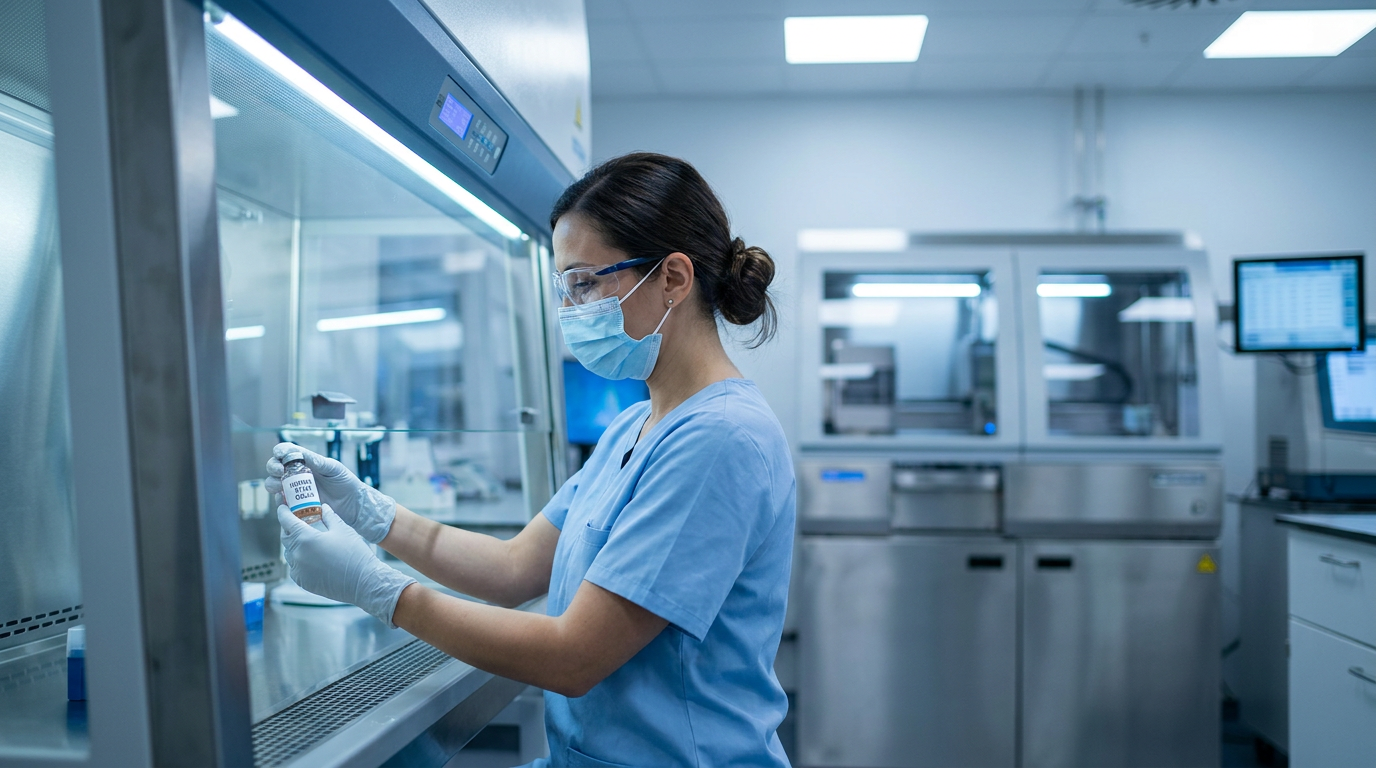
The mechanism behind the treatment is both elegant and brutal. Before the new stem cells could be introduced, doctors had to eliminate the source of the autoimmune attacks. They administered a harsh regimen of chemotherapy drugs, including fludarabine and treosulfan, alongside B-cell depleting antibodies. This aggressive "conditioning" phase effectively wiped out the patients' existing, malfunctioning immune systems, leaving them temporarily without natural defenses.[1][3]
Once the defective immune cells were eradicated, the healthy donor stem cells were infused into the patients' bloodstreams. These stem cells migrated to the bone marrow, where they began the slow process of engraftment. Over time, they generated a brand-new immune system from scratch—one derived from the healthy donor's genetics, free from the specific defect that caused the body to attack its own nervous system.[2][3]

Once the defective immune cells were eradicated, the healthy donor stem cells were infused into the patients' bloodstreams.
The long-term results, published in the journal Med and highlighted by Nature, are unprecedented. More than 15 years after their single infusions, neither patient has experienced a single relapse. Their disease activity has completely halted, and they have remained entirely free from the need for any immunosuppressive medications. For a disease characterized by relentless progression, a decade and a half of unmedicated silence is a monumental achievement.[1][2][4]
The clinical success is backed by definitive biomarker evidence. Unlike many autoimmune diseases, NMOSD has a specific, measurable culprit: an autoantibody known as AQP4-IgG, which targets the aquaporin-4 water channels in the central nervous system. Following the transplants, researchers found that the AQP4 antibodies had completely vanished from both patients' bloodstreams and never returned, confirming that the biological root of the disease had been eradicated.[5][6][7]
The real-world impact on the patients' lives has been transformative. The male patient, whose neurological condition was severe prior to the transplant, recovered sufficiently to resume a normal life, return to work, and start a family. The female patient regained significant mobility and use of her arms. By resetting their immune systems, the therapy gave them back the futures that NMOSD had threatened to steal.[3][4]
However, the medical community is careful to transparently communicate the profound uncertainties and risks associated with this procedure. An allogeneic stem-cell transplant is not a casual treatment; it carries a significant risk of mortality. The conditioning phase leaves patients highly vulnerable to severe, potentially fatal infections before the new immune system takes hold.[3][6]

Furthermore, introducing foreign immune cells into a patient's body carries the constant threat of graft-versus-host disease (GVHD), a severe complication where the new donor cells recognize the recipient's tissues as foreign and attack them. To mitigate this, patients require additional medications during the recovery phase. The two patients in the study did experience adverse effects, including swollen lymph nodes, prolonged antibody deficiencies requiring medical care, and in one case, the development of bladder cancer.[3]
Because of these severe risks, most prior research into stem cell therapy for autoimmune diseases has focused on autologous transplants, which use the patient's own stem cells. A landmark 2019 study published in Neurology demonstrated that autologous transplants could reverse NMOSD disability, with most patients remaining relapse-free after five years. Autologous transplants are much safer because there is no risk of GVHD.[5][6][7]
Yet, autologous transplants have a critical limitation: because the stem cells come from the patient, they carry the same genetic predispositions that caused the autoimmune disease in the first place. While the immune system is "rebooted," the underlying flaw remains, leaving a higher risk of eventual relapse. The allogeneic approach, by contrast, completely replaces the genetic source of the immune system, offering the tantalizing possibility of a permanent, lifelong cure.[2][5]
The success of these two patients provides a vital proof-of-concept that severe, refractory autoimmune diseases can be halted in their tracks. While the extreme risks mean allogeneic transplants will likely be reserved for the most severe, treatment-resistant cases, researchers are now calling for larger clinical trials. As conditioning regimens become safer and GVHD management improves, this radical immune reset could eventually offer a permanent escape for patients trapped by their own biology.[1][4]
How we got here
2009
The first patient, a man with severe NMOSD, receives an allogeneic stem-cell transplant from his sister.
2010
A female patient with the same condition undergoes the procedure using stem cells from an unrelated donor.
2019
A separate study demonstrates that autologous transplants (using patients' own cells) can reverse NMOSD disability for up to five years.
June 2026
Researchers publish 15-year follow-up data confirming both allogeneic transplant patients remain completely disease-free.
Viewpoints in depth
Clinical Researchers
Focusing on the biological triumph of eradicating the disease.
For immunologists and neurologists, the complete disappearance of the AQP4 autoantibody is the most significant finding. It proves that autoimmune diseases are not necessarily permanent states of being. By completely replacing the hematopoietic stem cells, doctors can effectively swap out a defective immune system for a healthy one. Researchers argue this justifies the extreme risks for patients who fail to respond to standard therapies, as it shifts the medical paradigm from lifelong symptom management to a potential functional cure.
Patient Advocates
Highlighting the dramatic improvement in quality of life.
Advocacy groups emphasize the crushing physical and financial burden of living with NMOSD. Standard treatments can cost up to $500,000 annually and require constant medical supervision, yet they only delay the disease's progression. For patients, the prospect of a one-time procedure that allows them to return to work, start families, and live free of daily medication is life-altering. They view the 15-year remission milestone as a beacon of hope for those trapped by severe autoimmune conditions.
Medical Skeptics
Warning that the severe mortality risks limit the procedure's scalability.
Bioethicists and cautious medical professionals point out that an allogeneic stem-cell transplant is one of the most punishing procedures in modern medicine. The conditioning phase leaves patients entirely without an immune system, vulnerable to fatal infections. Furthermore, the risk of graft-versus-host disease (GVHD) and secondary complications—such as the bladder cancer observed in one of the study's patients—means this therapy cannot be scaled to the broader autoimmune population. They argue it must remain a strictly last-resort option.
What we don't know
- Whether the 15-year remission observed in these two patients will hold true for a larger population in broader clinical trials.
- How to reliably minimize the severe risks of graft-versus-host disease (GVHD) and secondary cancers associated with allogeneic transplants.
- Whether less aggressive conditioning regimens could achieve the same immune-resetting results with lower mortality risks.
Key terms
- Neuromyelitis optica spectrum disorder (NMOSD)
- A rare autoimmune disease that targets the central nervous system, specifically causing inflammation in the optic nerves and spinal cord.
- Allogeneic transplant
- A medical procedure where a patient receives stem cells from a genetically matched donor, rather than using their own cells.
- Autologous transplant
- A procedure that uses the patient's own stem cells, safely avoiding tissue rejection but retaining the patient's original genetics.
- AQP4-IgG
- The specific autoantibody that mistakenly attacks healthy water channels in the nervous system of most NMOSD patients.
- Graft-versus-host disease (GVHD)
- A severe and potentially fatal complication of allogeneic transplants where the newly donated immune cells attack the recipient's body.
- Conditioning regimen
- The aggressive chemotherapy and antibody treatment used to intentionally destroy a patient's existing immune system before a transplant.
Frequently asked
What is Neuromyelitis Optica Spectrum Disorder (NMOSD)?
NMOSD is a rare, severe autoimmune disease where the immune system mistakenly attacks the optic nerves and the spinal cord, leading to vision loss, paralysis, and severe pain.
How does a stem cell transplant treat an autoimmune disease?
Doctors use chemotherapy to wipe out the patient's malfunctioning immune system. They then infuse healthy stem cells, which grow into a brand-new, defect-free immune system.
What is the difference between allogeneic and autologous transplants?
An autologous transplant uses the patient's own stem cells, which is safer but carries the original genetic defects. An allogeneic transplant uses a donor's stem cells, completely replacing the genetic source of the immune system.
Is this a permanent cure for NMOSD?
While doctors are cautious about using the word 'cure,' the two patients in this study have remained completely free of symptoms and disease-causing antibodies for over 15 years without medication.
Sources
Source coverage
7 outlets
3 viewpoints surfaced







[1]NatureClinical Researchers
Stem cells banish severe autoimmune disease for 15 years
Read on Nature →[2]MedClinical Researchers
Long-term remission of neuromyelitis optica with allogeneic hematopoietic stem cell transplant
Read on Med →[3]QazinformPatient Advocates
Rare autoimmune disease halted for 15 years after stem-cell transplant
Read on Qazinform →[4]Positron TodayPatient Advocates
Stem cells banish severe autoimmune disease for 15 years
Read on Positron Today →[5]NeurologyClinical Researchers
Autologous hematopoietic stem cell transplantation for neuromyelitis optica
Read on Neurology →[6]Pharmacy TimesMedical Skeptics
Study: Stem Cell Transplant Reverses Neuromyelitis Optica
Read on Pharmacy Times →[7]Neuroscience NewsMedical Skeptics
Stem cell transplant reverses disabling MS-like disease
Read on Neuroscience News →


Every angle. Every day.
Get science stories with full source coverage and perspective breakdowns delivered to your inbox.