
End-to-End AI: How Humanoid Robots Are Finally Learning to Move Like Us
A new generation of humanoid robots is abandoning traditional hand-coded programming in favor of "end-to-end" neural networks. By learning through trial, error, and simulation, these machines are acquiring human-like dexterity and adaptability for the real world.
By Factlen Editorial Team
- Robotics Engineers
- Argue that end-to-end neural networks are the only viable path to generalized physical intelligence, as the real world is too complex to hard-code.
- Manufacturing Executives
- Value the technology for its potential to provide flexible, scalable automation that can adapt to different tasks without expensive reprogramming.
- AI Safety Researchers
- Caution that the uninterpretable nature of end-to-end models makes it difficult to guarantee fail-safe behavior when robots interact closely with humans.
What's not represented
- · Factory floor workers whose daily routines will be altered by working alongside autonomous humanoids.
- · Labor union representatives negotiating the integration of general-purpose robots into the workforce.
Why this matters
For decades, robots were confined to highly structured factories because they couldn't adapt to unexpected changes. End-to-end AI gives them the physical intuition to operate safely in messy human environments, paving the way for general-purpose machines that can assist in warehouses, hospitals, and eventually homes.
Key points
- Humanoid robots are shifting from hand-coded software to end-to-end neural networks.
- A single AI model can now translate camera pixels directly into complex motor movements.
- Robots learn tasks by watching human demonstrations via VR teleoperation.
- Virtual simulations allow AI to practice tasks millions of times before physical deployment.
- Major automakers are preparing to deploy AI-driven humanoids in factories by 2028.
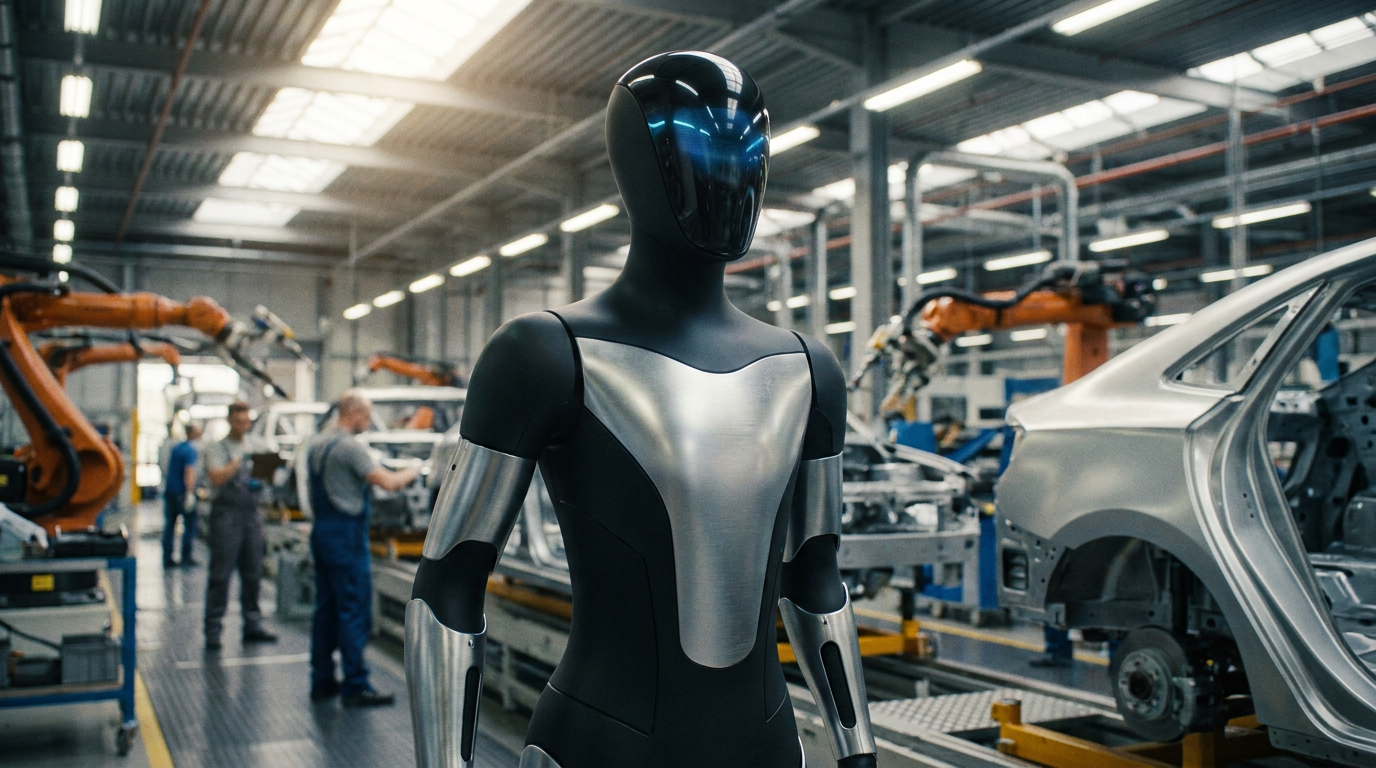
For decades, the defining characteristic of a robot was its rigidity. Industrial arms in automotive plants moved with terrifying precision, but only because human engineers had meticulously coded every millimeter of their trajectory. If a part was shifted by an inch, the robot would blindly grasp at empty air. This brittle paradigm meant that bringing robots out of highly controlled factories and into messy, unpredictable human environments was a nearly impossible engineering hurdle.[7]
In 2026, that paradigm is being dismantled. The robotics industry is undergoing a fundamental architectural shift toward "end-to-end AI"—a breakthrough that is transforming humanoid robots from scripted machines into adaptable, learning agents. By abandoning traditional programming in favor of neural networks, robots are finally acquiring the physical intuition necessary to navigate the real world.[6][7]
To understand the magnitude of this shift, one must look at how robots were traditionally built. Historically, robotic software was divided into isolated modules: a vision system to identify objects, a planning module to calculate the path, and a control system to execute the motor commands. Each handoff between these modules required complex, hand-written logic. End-to-end AI collapses this entire pipeline. A single neural network takes in raw sensory data—pixels from cameras, torque feedback from joints—and directly outputs the precise electrical currents needed to move the robot's motors.[1][7]
The practical impact of this consolidation is staggering. Figure AI, a leading humanoid developer, recently demonstrated this with its Helix 02 model. By transitioning to an end-to-end neural system, the company replaced over 100,000 lines of hand-engineered C++ code with a single learned "neural prior." This unified network controls the robot's walking, balancing, and manipulation simultaneously, allowing it to perform continuous, multi-minute tasks like unloading a dishwasher without human intervention.[1]

Boston Dynamics, long famous for its acrobatic, hydraulically powered robots, has also embraced this new era. The company's next-generation, fully electric Atlas robot is now driven by Large Behavior Models (LBMs). Unlike large language models that generate text, LBMs generate physical actions. When the new Atlas encounters a surprise—like a bin lid closing unexpectedly—it does not crash or freeze. It relies on its learned experiences to adapt and recover in real-time.[2]
But how exactly does a robot learn to move without being explicitly programmed? The process begins with human imitation. Engineers step into virtual reality rigs, wearing headsets and motion-tracking gloves, to physically guide the robot through a task. As the human operator sorts parts or folds a shirt, the robot's cameras record the visual data while its sensors record the corresponding joint movements.[4]
This teleoperation creates a dataset of human expertise. As CBS News observed inside Boston Dynamics' AI lab, this data is fed into the robot's neural network, allowing it to build a mathematical "muscle memory." By watching and feeling how a human solves a physical problem, the AI learns to map visual inputs to the correct motor outputs, eventually enabling the robot to perform the task autonomously.[4]

However, collecting human demonstrations is slow and labor-intensive. To achieve true general-purpose capability, robots need to experience millions of scenarios. The solution is a technique known as "Sim2Real"—training in simulation and transferring the knowledge to reality.[3][7]
However, collecting human demonstrations is slow and labor-intensive.
Companies rely on hyper-realistic virtual physics engines, such as NVIDIA's Isaac framework, to generate massive amounts of synthetic training data. Inside these digital twins of the real world, thousands of virtual robots can practice tasks simultaneously, operating at speeds far faster than real time.[3]
Within these simulations, the AI utilizes reinforcement learning. The virtual robot is given a goal—such as picking up a fragile object—and is left to figure out the mechanics through trial and error. It receives a mathematical "reward" for success and a "penalty" for failure or applying too much force. Over millions of iterations, the neural network discovers the optimal way to move, learning nuances of physics that would be impossible to hard-code.[3][7]
Once the AI has mastered the task in the virtual world, the neural network weights are downloaded into the physical robot. Because the simulation accurately modeled real-world gravity, friction, and actuator dynamics, the physical robot can immediately execute the skill it learned digitally.[3]
This rapid acceleration in learning is moving humanoids out of the research lab and onto the factory floor. Hyundai Motor Group, which owns a majority stake in Boston Dynamics, is currently building an "end-to-end AI Robotics Value Chain." The automaker plans to deploy fleets of the electric Atlas robot in its manufacturing plants by 2028, aiming to eventually produce 30,000 humanoid units annually.[5]

The broader industry is following suit. At the CES 2026 technology showcase, analysts from ABI Research noted a definitive pivot toward "Physical AI." The exhibition floors were dominated by humanoid robots from global vendors demonstrating autonomous, dexterous manipulation that required no real-time human teleoperation, signaling that the technology is ready for commercial scale.[6]
Despite the rapid progress, the transition to neural-network-driven robotics introduces new challenges. End-to-end AI models are inherently "black boxes." When a traditional robot fails, engineers can review the code to find the exact line that caused the error. When a neural network makes an unexpected movement, diagnosing the root cause is vastly more complex, raising critical questions about safety certification for robots operating near humans.[7]
Nevertheless, the trajectory is clear. By replacing rigid code with fluid, experience-based learning, the robotics industry has solved the bottleneck of physical adaptability. Humanoid robots are no longer just machines executing a script; they are intelligent agents learning to navigate the world on our terms.[7]
How we got here
2023
Early humanoid prototypes rely heavily on scripted movements and modular software stacks.
Late 2024
Figure AI and OpenAI demonstrate early speech-to-speech reasoning and vision-language integration in humanoids.
2025
Boston Dynamics retires its hydraulic Atlas, introducing a fully electric version designed for AI-driven learning.
Early 2026
Figure AI unveils Helix 02, replacing over 100,000 lines of code with a single neural network for full-body control.
Viewpoints in depth
Robotics Engineers
Argue that end-to-end neural networks are the only viable path to generalized physical intelligence.
For decades, roboticists attempted to solve real-world navigation by writing increasingly complex code to account for every possible edge case. Engineers now argue this approach is a dead end. The real world is simply too messy and unpredictable to be captured in "if-then" statements. By shifting to end-to-end neural networks, engineers believe they have unlocked the ability for robots to develop genuine physical intuition, allowing them to react to dropped objects, slippery floors, and moving obstacles just as a human would—through learned experience rather than explicit instruction.
Manufacturing Executives
Value the technology for its potential to provide flexible, scalable automation.
Industrial leaders view end-to-end AI as the key to unlocking flexible manufacturing. Traditional factory robots are highly efficient but incredibly rigid; reprogramming an assembly line arm for a new car model can take weeks of engineering time. A humanoid robot powered by a Large Behavior Model can theoretically learn a new task simply by watching a human do it a few times. This promises to drastically lower the cost of automation and allow factories to adapt to changing production needs almost instantly.
AI Safety Researchers
Caution that the uninterpretable nature of end-to-end models makes it difficult to guarantee fail-safe behavior.
While the capabilities of neural-network-driven robots are expanding rapidly, safety experts warn about the "black box" problem. When a robot's movements are generated by billions of mathematical weights rather than readable code, it becomes nearly impossible to prove mathematically that the robot will never make a dangerous movement. Researchers argue that before these heavy, powerful machines are deployed in homes or crowded public spaces, the industry must develop new methods for interpreting AI decision-making and establishing hard-coded safety guardrails that the neural network cannot override.
What we don't know
- How regulatory bodies will certify "black box" neural networks for safety in human-dense environments.
- Whether the cost of humanoid hardware can drop fast enough to make consumer home deployment viable this decade.
- How well Sim2Real training will hold up against highly unpredictable edge cases not captured in virtual environments.
Key terms
- End-to-End AI
- A machine learning approach where a single neural network processes raw inputs (like camera pixels) directly into final outputs (like motor commands), bypassing intermediate programmed steps.
- Sim2Real
- The process of training an AI model in a virtual simulation and successfully transferring those learned skills to a physical robot in the real world.
- Reinforcement Learning
- A training method where an AI learns by trial and error, receiving virtual rewards for correct actions and penalties for mistakes.
- Teleoperation
- Controlling a robot remotely, often using VR and motion capture, to demonstrate a task so the AI can learn from human movement.
- Large Behavior Model (LBM)
- An AI model designed specifically to generate physical actions and behaviors, rather than text or images.
Frequently asked
Why couldn't robots do this before?
Traditional robots relied on rigid, hand-written code that couldn't adapt to unexpected changes. If an object was slightly out of place, the robot would fail.
Are these robots controlled by humans?
Humans control them initially via VR to demonstrate tasks, but the goal is for the AI to learn the pattern and perform the task fully autonomously.
When will these robots be in homes?
While companies are testing them in factories now, consumer home deployment is likely still years away due to the need for rigorous safety testing and cost reductions.
Sources
Source coverage
7 outlets
3 viewpoints surfaced







[1]Figure AIRobotics Engineers
Helix 02: Autonomous Long-Horizon Loco-Manipulation
Read on Figure AI →[2]Boston DynamicsRobotics Engineers
Electric Atlas and Large Behavior Models
Read on Boston Dynamics →[3]NVIDIARobotics Engineers
Imitation Learning and Reinforcement Learning for Robots
Read on NVIDIA →[4]CBS News
Inside the AI Lab: Teaching Atlas to Work
Read on CBS News →[5]AI MagazineManufacturing Executives
Hyundai's End-to-End AI Robotics Value Chain
Read on AI Magazine →[6]ABI ResearchManufacturing Executives
CES 2026: Robotics Pushes Forward with Physical AI
Read on ABI Research →[7]Factlen Editorial TeamAI Safety Researchers
Synthesis by Factlen editorial team
Read on Factlen Editorial Team →
Every angle. Every day.
Get ai stories with full source coverage and perspective breakdowns delivered to your inbox.