
OLED vs. Mini-LED in 2026: The Definitive Display Technology Comparison
As Mini-LEDs reach 10,000 nits of brightness and OLEDs deploy tandem architectures, the 2026 display market offers two flawless but fundamentally different technologies. Choosing the right screen now requires a strict trade-off analysis based on room lighting, burn-in risk, and daily workflow.
By Factlen Editorial Team
- Home Theater Purists
- Advocates for absolute picture perfection, prioritizing pixel-level contrast over raw brightness.
- Bright-Room & Productivity Users
- Values sustained full-screen brightness, text clarity, and zero burn-in risk for all-day use.
- Competitive Gamers
- Focuses strictly on motion clarity, input lag, and response times for fast-paced gameplay.
What's not represented
- · Budget consumers priced out of both flagship OLED and premium Mini-LED markets
- · Commercial digital signage operators requiring 24/7 runtime in outdoor environments
Why this matters
Choosing between OLED and Mini-LED in 2026 is no longer a simple budget decision; it dictates how your display will survive sunlit rooms, handle 10-hour workdays, and render next-generation gaming. Making the wrong choice can lead to frustrating screen dimming, permanent burn-in, or washed-out images in bright environments.
Key points
- OLED technology relies on organic pixels that offer perfect black levels and 0.03ms response times, ideal for dark rooms and gaming.
- Mini-LED uses inorganic Gallium Nitride, allowing it to sustain up to 10,000 nits of brightness without any risk of permanent burn-in.
- Modern OLEDs have improved brightness via Tandem architectures but still use Auto Brightness Limiters (ABL) that dim full-screen white images.
- Mini-LEDs now feature up to 20,000 local dimming zones, drastically reducing the 'blooming' halo effect around bright objects.
- OLED remains the premium choice for dedicated home theaters, while Mini-LED dominates in sunlit living rooms and productivity setups.
The 2026 display market has dismantled the old hierarchy of television and monitor technology. For years, consumers were taught a simple rule: spend more for OLED if you want the best picture, or settle for LED if you are on a budget. Today, that conventional wisdom is entirely obsolete. The industry is now defined by a fierce, parallel engineering rivalry between OLED and Mini-LED, two fundamentally different technologies that have both reached extraordinary levels of performance. Choosing between them is no longer a question of which is objectively superior, but rather a strict trade-off analysis based on room lighting, daily workflow, and viewing habits.[6]
At the core of this rivalry is a difference in chemistry and physics. OLED (Organic Light-Emitting Diode) panels rely on carbon-based organic compounds that illuminate individually when an electrical current is applied. Because each of the 8.2 million pixels in a 4K display generates its own light, they can turn off completely to create perfect, zero-nit black levels. Conversely, Mini-LED technology utilizes inorganic Gallium Nitride (GaN) semiconductors. These microscopic diodes do not create the image themselves; instead, they act as a massively powerful backlight sitting behind an LCD color filter. This inorganic structure allows Mini-LEDs to withstand immense thermal loads and electrical currents without degrading.[2][6]
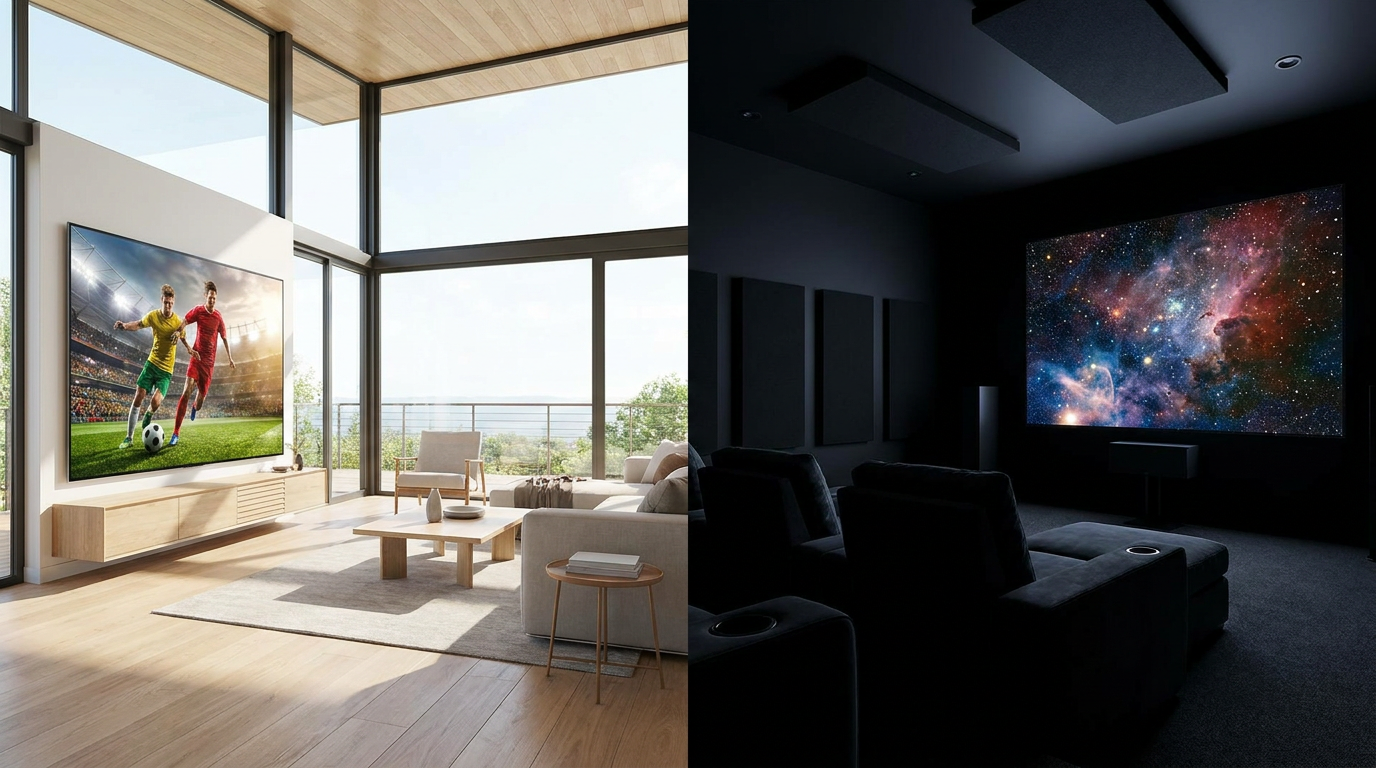
When evaluating the case for Mini-LED, the primary argument centers on sustained, retina-searing brightness. The evidence is quantified in raw luminance: flagship 2026 Mini-LED panels now routinely sustain peak highlights between 5,000 and 10,000 nits. More importantly, because the inorganic diodes are immune to heat degradation, a Mini-LED display can hold a full-screen white image—such as a sunlit hockey rink or a massive spreadsheet—indefinitely without dimming. This brute-force light output allows the display to punch through direct sunlight in living rooms with massive windows, maintaining color volume and HDR impact where older televisions would look entirely washed out.[2][5]
The primary argument against Mini-LED has historically been "blooming"—a visual artifact where light bleeds from a bright object into the surrounding dark areas, creating a hazy halo. The evidence against the technology points to the mathematical reality of local dimming. Even with 2026 models deploying up to 20,000 independent dimming zones, a single zone still controls hundreds of pixels. If a bright white cursor moves across a pitch-black background, the backlight must illuminate an area larger than the cursor itself. While modern algorithms have drastically minimized this effect, blooming remains slightly visible when viewing the screen off-angle or when watching complex scenes like a starry night sky.[2][5]

Conversely, the case for OLED is built entirely on infinite contrast and pixel-level precision. The evidence supporting OLED is its ability to place a 2,000-nit specular highlight—like a flashlight beam or a laser—directly adjacent to a perfectly black pixel with zero light bleed. This creates a sense of three-dimensional depth and cinematic realism that no backlit LCD can replicate. With the introduction of Tandem OLED architectures and Micro Lens Arrays (MLA) in 2026, these panels have overcome their historical dimness, now delivering peak HDR highlights that rival premium Mini-LEDs in small, concentrated areas of the screen.[1][5]
However, the case against OLED reveals its structural limitations in bright environments. The evidence lies in the Auto Brightness Limiter (ABL), a mandatory software mechanism designed to protect the organic pixels from overheating. While an OLED can hit 3,000 nits in a tiny window, if the entire screen fills with bright content—such as a daytime sports broadcast or a maximized web browser—the ABL aggressively dims the panel. In rooms exceeding 300 lux of ambient light, this constant shifting of full-screen brightness can become highly distracting, making the display feel significantly less impactful than its peak specifications suggest.[2][4]
In the realm of competitive gaming, the case for OLED is nearly unassailable. The evidence is found in the panel's response time, which measures how fast a pixel can change from one color to another. Modern OLEDs boast a near-instantaneous response time of 0.03 milliseconds. This translates to absolute motion clarity; fast-moving objects, camera pans, and crosshairs remain razor-sharp with zero ghosting or smearing behind them. For esports professionals and enthusiasts playing at 240Hz or higher, this lack of motion blur provides a tangible competitive advantage that LCD-based panels simply cannot match.[2][3]
In the realm of competitive gaming, the case for OLED is nearly unassailable.
Yet, the case against OLED for heavy productivity and specific gaming genres remains tethered to the reality of burn-in. While 2026 models utilize deuterium-stabilized pixels and aggressive pixel-shifting software to mitigate the risk, organic materials still degrade over time. The evidence gathered from professional environments shows that displaying static elements—such as a video editing timeline, a Windows taskbar, or a persistent gaming health bar—for thousands of hours can still result in permanent image retention. For users who work eight-hour shifts on the same software interface, this lingering anxiety is a significant deterrent.[3][4]

This brings us to the case for Mini-LED in productivity and mixed-use scenarios. The evidence supporting its dominance here is its 30,000-hour inorganic lifespan and complete immunity to burn-in. A professional can leave a light-mode spreadsheet or a stock trading terminal open all day at maximum brightness without a second thought. Furthermore, Mini-LEDs avoid the text-fringing issues that still plague certain OLED subpixel layouts, delivering crisp, traditional text rendering that reduces eye strain during long reading sessions.[3][4]
The case against Mini-LED in productivity arises only for users who strictly prefer dark-mode interfaces in dimly lit rooms. The evidence against it in this specific scenario is the return of the blooming effect. When coding in a dark-mode Integrated Development Environment (IDE), the bright text against the dark background can trigger the local dimming zones to create subtle halos around the code blocks. While not a dealbreaker for most, purists who work exclusively in dark environments often find OLED's pixel-perfect text rendering to be vastly superior.[3][4]
Environmental and power consumption metrics also present a stark contrast between the two technologies. The evidence shows that OLED is remarkably energy-efficient when displaying dark, cinematic content, often drawing between 80 and 150 watts because black pixels consume zero power. Mini-LED, by contrast, must power its massive backlight array continuously. When pushing 5,000 nits of brightness in a sunlit room, a flagship Mini-LED can draw significantly more peak wattage, requiring robust internal heat sinks to manage the thermal output of the Gallium Nitride diodes.[5]
Finally, the economic evidence heavily influences the decision at larger screen sizes. While 55-inch and 65-inch models see OLED and Mini-LED competing at similar price points, the cost curve diverges violently at 85 inches and above. Manufacturing massive, defect-free organic panels remains exponentially expensive. Mini-LED, leveraging mature LCD fabrication processes, offers 85-inch and 98-inch displays at a fraction of the cost of a comparable OLED. For buyers looking to fill a massive wall on a reasonable budget, Mini-LED provides an unbeatable return on investment.[1][3]

Ultimately, the 2026 landscape requires buyers to abandon the search for the objective "best" display and instead focus on the best display for their specific reality. The synthesis of these trade-offs reveals that both technologies have achieved a level of maturity where their strengths are spectacular, and their weaknesses are highly situational. The decision matrix relies entirely on matching the engineering to the environment.[6]
OLED fits well when the display is placed in a light-controlled room or a dedicated home theater. It is the definitive choice for cinephiles who demand perfect shadow detail, competitive gamers who require flawless motion clarity, and professionals who work exclusively in dark-mode applications. If the primary goal is immersive, pixel-perfect accuracy in a dim environment, OLED remains the undisputed champion.[1][6]
However, OLED does not fit when the display faces a massive, sunlit window, or when the user intends to watch bright daytime sports with the blinds open. It is equally ill-suited for users who plan to use the screen as a primary workstation for light-mode office applications, or for gamers who play a single UI-heavy title for thousands of hours, as the protective dimming and burn-in risks will actively hinder the experience.[4][6]

Conversely, Mini-LED fits well when the environment is inherently bright and unpredictable. It is the perfect solution for open-concept living rooms, sports fans who leave the television running all day, and hybrid workers who need a monitor that can handle eight hours of static spreadsheets followed by evening HDR gaming. It is also the only logical choice for buyers seeking massive, 85-inch-plus screens without spending a premium.[1][6]
Mini-LED does not fit when the viewer is a home theater purist who watches movies in pitch-black darkness and cannot tolerate even the slightest halo effect around subtitles or starfields. It is also less ideal for extreme off-angle viewing, as the LCD panel structure inherently degrades color accuracy and exacerbates blooming when viewed from the far sides of a wide seating arrangement.[2][6]
How we got here
2013
First commercially viable large-screen OLED TVs enter the consumer market, establishing a new benchmark for perfect black levels.
2021
Mini-LED technology goes mainstream, replacing traditional LED backlights with thousands of microscopic diodes for vastly improved contrast.
2024
OLED manufacturers introduce Micro Lens Array (MLA) and QD-OLED technologies, pushing peak brightness past 1,500 nits for the first time.
2026
Mini-LEDs reach 20,000 local dimming zones and 10,000 nits, while Tandem OLEDs cross the 3,000-nit threshold, creating the tightest performance gap in display history.
Viewpoints in depth
Home Theater Purists
Advocates for absolute picture perfection, prioritizing pixel-level contrast over raw brightness.
For cinematic enthusiasts, the argument begins and ends with infinite contrast. Because OLED pixels emit their own light and can turn off completely, they produce a true zero-nit black. This camp argues that no amount of local dimming zones can replicate the precision of 8.2 million individually controlled pixels. To them, the slight blooming seen on Mini-LEDs around subtitles or starfields breaks immersion, making OLED the only acceptable choice for a dedicated, light-controlled viewing room.
Bright-Room & Productivity Users
Values sustained full-screen brightness, text clarity, and zero burn-in risk for all-day use.
This perspective focuses on the reality of mixed-use spaces. In a living room with massive windows, or a home office where a monitor displays spreadsheets for eight hours a day, OLED's protective dimming (ABL) and burn-in risks become liabilities. This camp champions Mini-LED for its inorganic durability and ability to sustain retina-searing brightness indefinitely. They argue that a display must perform flawlessly in the environment it actually lives in, rather than a pitch-black testing laboratory.
Competitive Gamers
Focuses strictly on motion clarity, input lag, and response times for fast-paced gameplay.
Gamers are uniquely split by the 2026 display market, but the competitive esports camp leans heavily toward OLED. Their primary metric is motion clarity, driven by OLED's near-instantaneous 0.03-millisecond response time, which eliminates the ghosting and smearing found on even the fastest LCD panels. However, a vocal sub-faction of MMO and UI-heavy gamers prefers Mini-LED, willing to trade a fraction of a millisecond in response time for the peace of mind that their static health bars will never permanently burn into the screen.
What we don't know
- How the long-term degradation curve of 2026's ultra-bright Tandem OLEDs will compare to older generations after 10,000 hours of use.
- Whether future micro-LED technology will become affordable enough to render both OLED and Mini-LED obsolete before the end of the decade.
Key terms
- Auto Brightness Limiter (ABL)
- A protective software mechanism in OLED displays that automatically dims the screen when a large portion of the image becomes too bright, preventing heat damage to the organic pixels.
- Local Dimming Zones
- Specific clusters of backlights in a Mini-LED display that can independently dim or turn off to improve black levels and contrast.
- Gallium Nitride (GaN)
- An inorganic semiconductor material used in modern Mini-LEDs that allows them to run at extremely high brightness levels without degrading.
- Tandem OLED
- A newer display architecture that stacks multiple light-emitting layers to significantly boost brightness and lifespan compared to older single-layer OLEDs.
Frequently asked
Does OLED still suffer from burn-in in 2026?
While deuterium-stabilized panels and software protections have drastically reduced the risk, permanent image retention remains a possibility if static elements like taskbars or gaming HUDs are displayed for thousands of hours.
What is blooming on a Mini-LED TV?
Blooming is a slight halo effect that occurs when a bright object, like a subtitle, is displayed against a pitch-black background, causing light to bleed into adjacent dimming zones.
Which technology is better for a brightly lit living room?
Mini-LED is the superior choice for bright rooms, as it can sustain massive full-screen brightness without the Auto Brightness Limiter (ABL) dimming the picture to protect the panel.
Why do competitive gamers prefer OLED monitors?
OLED panels offer near-instantaneous 0.03-millisecond response times, which eliminates motion blur and ghosting during fast-paced competitive gaming.
Sources
Source coverage
6 outlets
3 viewpoints surfaced




[1]Data Wire SolutionsHome Theater Purists
Best TVs for 2026: 10 OLED and Mini-LED Picks by Room, Brightness, and Install Reality
Read on Data Wire Solutions →[2]Display MasterCompetitive Gamers
OLED vs Mini-LED in 2026: The Heavyweight Clash
Read on Display Master →[3]Ordinary TechBright-Room & Productivity Users
The 2025/2026 Buyer's Guide: OLED vs RGB Mini LED for Professionals
Read on Ordinary Tech →[4]KTC PlayBright-Room & Productivity Users
The 2026 Prosumer Dilemma: Beyond Just Gaming
Read on KTC Play →[5]Eco Picks GoHome Theater Purists
LG G5 OLED vs LG QNED9M Mini LED Comparison (2026 Buyer's Guide)
Read on Eco Picks Go →[6]Factlen Editorial TeamCompetitive Gamers
Synthesis by Factlen editorial team
Read on Factlen Editorial Team →
Every angle. Every day.
Get shopping stories with full source coverage and perspective breakdowns delivered to your inbox.