
Deep Atmospheric Gas Reveals Uranus Has a True Icy Center
New measurements of carbon monoxide in Uranus's deep atmosphere indicate the planet contains significantly more ice than rock, resolving a long-standing mystery about its formation.
By Factlen Editorial Team
- Planetary Formation Theorists
- Scientists modeling the early Solar System who use chemical tracers to reconstruct where and how the planets formed.
- Observational Astronomers
- Researchers utilizing advanced telescopes to pierce the planet's hazy upper atmosphere and read its chemical signature.
- Space Exploration Advocates
- Mission planners who argue that remote observations must eventually be validated by sending a spacecraft directly to the planet.
What's not represented
- · Exoplanet researchers studying sub-Neptunes
Why this matters
Understanding how Uranus formed isn't just about cataloging our own Solar System—it provides the blueprint for understanding the most common type of planet found in the galaxy. Because intermediate-mass 'sub-Neptunes' dominate the exoplanet census, decoding Uranus's icy interior helps astronomers predict the composition and habitability of billions of worlds orbiting other stars.
Key points
- New measurements of carbon monoxide in Uranus's atmosphere reveal its interior is dominated by ice, not rock.
- The findings align Uranus's composition closely with Neptune's, suggesting similar formation pathways.
- The data implies Uranus formed further out in the early solar nebula, near the carbon monoxide ice line.
- Understanding ice giants is critical, as similar-sized planets are the most common type found in the galaxy.
- Scientists are pushing for a dedicated Uranus Orbiter and Probe mission in the 2030s to confirm these models.
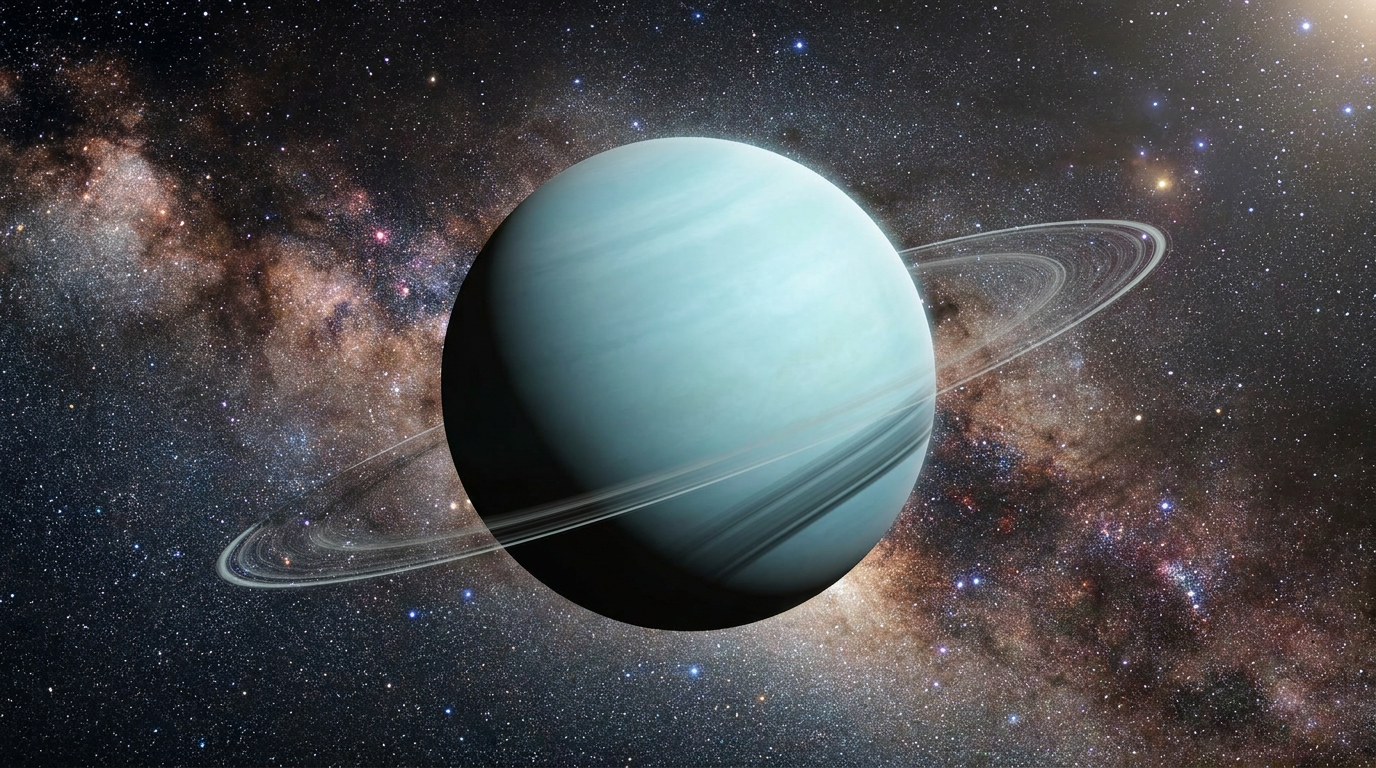
For decades, Uranus has been the Solar System's most perplexing outlier. Tilted entirely on its side, lacking significant internal heat, and shrouded in a featureless cyan haze, the seventh planet has defied easy categorization.[6]
Now, a new analysis of the gas deep within Uranus's atmosphere has provided a crucial clue to its origins. By measuring the abundance of carbon monoxide, researchers have determined that the planet's interior contains significantly more ice than rock.[1]
The findings, reported this week, suggest that Uranus formed much more like its sister planet, Neptune, than previously thought. This challenges older models that posited distinct formation pathways or vastly different building blocks for the two ice giants.[1][3]
To understand the significance of this discovery, one must look back to the chaotic early days of the Solar System. The giant planets—Jupiter, Saturn, Uranus, and Neptune—all formed from a swirling protoplanetary disk of gas and dust surrounding the young Sun.[2]

While Jupiter and Saturn swept up massive amounts of hydrogen and helium to become gas giants, Uranus and Neptune grew more slowly. By the time their cores were massive enough to capture gas, the solar nebula was already dissipating.[3]
As a result, Uranus and Neptune are classified as "ice giants." In planetary science, "ice" does not just mean frozen water; it refers to volatiles like water, ammonia, and methane that exist in a hot, dense, supercritical fluid state deep within the planet's mantle.[6]
The exact ratio of these ices to heavier rocky material has long been a subject of intense debate. Because Uranus's atmosphere is incredibly cold—dropping to −224 degrees Celsius—most of its heavier elements are locked away deep below the visible cloud tops, making them exceptionally difficult to measure.[6]
Carbon monoxide serves as a vital chemical tracer in this context. At the extreme pressures and temperatures found deep in the troposphere, thermochemical equilibrium dictates the balance of carbon-bearing molecules.[7]

Carbon monoxide serves as a vital chemical tracer in this context.
If a planet accreted a high proportion of icy planetesimals during its formation, its deep atmosphere should be highly enriched with oxygen, which in turn drives the production of carbon monoxide.[3][7]
The new data reveals a carbon monoxide signature that points definitively to an ice-dominated interior. The measured abundances indicate that Uranus's building blocks were rich in water and carbon monoxide ices, rather than dry silicate rock.[1]
This composition strongly implies that Uranus formed further out in the solar nebula, near the "carbon monoxide ice line"—the specific boundary where temperatures were low enough for carbon monoxide to freeze into solid grains.[5]
Previously, some dynamicists argued that Uranus might have formed closer to the Sun and migrated outward, or that it suffered a catastrophic giant impact that fundamentally altered its internal structure and knocked it onto its side.[4]

While the giant impact theory remains the best explanation for Uranus's extreme 98-degree axial tilt, the new chemical evidence suggests its fundamental building blocks were nearly identical to Neptune's.[1][4]
The alignment between Uranus and Neptune simplifies the narrative of the outer Solar System. It supports models which suggest the ice giants formed in a compact, volatile-rich configuration before being scattered outward by gravitational interactions with Jupiter and Saturn.[5]
This breakthrough also has profound implications for the study of exoplanets. Intermediate-mass planets similar in size to Uranus and Neptune are the most common type of world discovered in the galaxy, making our local ice giants the ultimate reference models.[2]
Despite these advances, remote observations can only pierce so far through the Uranian haze. The ultimate test of these formation models will require sending a spacecraft to sample the atmosphere directly.[4]

The planetary science community has already mobilized around this goal. The National Academies' most recent Decadal Survey prioritized a Uranus Orbiter and Probe as the flagship mission for the 2030s, designed to drop a sensor directly into the cyan clouds.[4]
Until that probe descends, astronomers will continue to rely on the faint chemical whispers of molecules like carbon monoxide. For now, those whispers are telling a clearer story: Uranus is a true ice giant, born in the deep freeze of the outer solar nebula.[2]
How we got here
1781
William Herschel discovers Uranus, the first planet found with the aid of a telescope.
1986
NASA's Voyager 2 spacecraft performs the first and only flyby of Uranus, revealing a featureless cyan atmosphere.
2022
The National Academies' Decadal Survey prioritizes a Uranus Orbiter and Probe as the next flagship planetary mission.
June 2026
New analysis of carbon monoxide in Uranus's deep atmosphere reveals the planet contains more ice than rock.
Viewpoints in depth
Planetary Formation Theorists
Scientists modeling the early Solar System use chemical tracers to reconstruct where and how the planets formed.
For dynamicists and formation theorists, the exact ratio of ice to rock in Uranus is a critical missing variable. If Uranus contained significantly more rock, it would suggest a formation pathway distinct from Neptune, perhaps involving different accretion rates or a different starting location in the protoplanetary disk. The confirmation that Uranus is heavily ice-dominated aligns it with Neptune, supporting models like the Nice Model which posit that both ice giants formed in a compact, volatile-rich region near the carbon monoxide ice line before migrating outward.
Observational Astronomers
Researchers utilizing advanced telescopes focus on piercing the planet's hazy upper atmosphere to read its chemical signature.
Observational astronomers face a daunting challenge with Uranus: its extreme cold traps most of its heavy elements deep below the visible cloud deck. By focusing on carbon monoxide—a molecule that is dredged up from the deep, hot interior where thermochemical equilibrium governs its production—astronomers can indirectly measure the planet's bulk oxygen content. This approach relies on cutting-edge infrared spectroscopy to detect faint absorption lines, turning the planet's upper atmosphere into a window into its hidden mantle.
Space Exploration Advocates
Mission planners argue that remote observations must eventually be validated by sending a spacecraft directly to the planet.
While telescopic breakthroughs are celebrated, space exploration advocates emphasize the hard limits of remote sensing. The National Academies' Decadal Survey highlighted that fundamental questions about Uranus's interior, noble gas abundances, and isotopic ratios can only be answered by an in situ atmospheric probe. For this camp, the new carbon monoxide data is a tantalizing preview that underscores the urgent scientific need to launch the proposed Uranus Orbiter and Probe in the 2030s.
What we don't know
- Whether Uranus and Neptune formed in their current orbits or migrated outward over time.
- The exact mechanism that caused Uranus's extreme 98-degree axial tilt.
- The precise isotopic ratios of noble gases within Uranus's atmosphere, which require an in situ probe to measure.
Key terms
- Ice Giant
- A class of giant planet composed mainly of elements heavier than hydrogen and helium, such as oxygen, carbon, nitrogen, and sulfur.
- Supercritical fluid
- A state of matter where distinct liquid and gas phases do not exist, occurring at extremely high temperatures and pressures deep inside planets.
- Protoplanetary disk
- The rotating disk of dense gas and dust surrounding a newly formed star, from which planets eventually coalesce.
- CO Ice Line
- The specific distance from a young star where temperatures drop low enough for carbon monoxide gas to freeze into solid ice grains.
Frequently asked
Why is Uranus called an ice giant?
Unlike Jupiter and Saturn, which are mostly hydrogen and helium gas, Uranus and Neptune contain a high proportion of heavier elements like water, ammonia, and methane. In planetary science, these volatiles are referred to as 'ices', even though they exist as a hot, dense fluid inside the planet.
How do scientists know what is inside Uranus?
Because the interior is hidden, scientists use chemical tracers in the upper atmosphere. Molecules like carbon monoxide are dredged up from the deep interior, and their abundance provides clues about the planet's overall composition and the building blocks it formed from.
What does the new carbon monoxide discovery mean?
It indicates that Uranus contains significantly more ice than rock, meaning its internal composition is very similar to Neptune's. This suggests both planets formed in a similar way and in a similar region of the early Solar System.
Will we ever send another spacecraft to Uranus?
The planetary science community has strongly recommended a flagship mission called the Uranus Orbiter and Probe (UOP) for the 2030s, which would drop a probe into the atmosphere to take direct measurements.
Sources
Source coverage
7 outlets
3 viewpoints surfaced







[1]New ScientistObservational Astronomers
Gas from Uranus reveals it has an icy centre
Read on New Scientist →[2]Factlen Editorial TeamSpace Exploration Advocates
Synthesis by Factlen editorial team
Read on Factlen Editorial Team →[3]Royal Society PublishingPlanetary Formation Theorists
The origin of the ice giants: constraints from elemental abundances
Read on Royal Society Publishing →[4]National AcademiesSpace Exploration Advocates
Origins, Worlds, and Life: A Decadal Strategy for Planetary Science and Astrobiology 2023-2032
Read on National Academies →[5]AstrobitesPlanetary Formation Theorists
The Measured Compositions of Uranus and Neptune from Their Formation on the CO Iceline
Read on Astrobites →[6]WikipediaObservational Astronomers
Uranus
Read on Wikipedia →[7]arXivObservational Astronomers
Carbon, oxygen and nitrogen-bearing species in deep atmospheres
Read on arXiv →


Every angle. Every day.
Get science stories with full source coverage and perspective breakdowns delivered to your inbox.