
Badminton's Quiet Revolution: The Engineering Race to Replace the Feather Shuttlecock
Facing supply chain shortages and sustainability concerns, the Badminton World Federation is officially trialing carbon-fiber synthetic shuttlecocks in international tournaments.
By Factlen Editorial Team
- Badminton Governing Bodies
- Focused on standardizing play, controlling costs, and ensuring the sport's long-term viability.
- Equipment Manufacturers
- Focused on the material science and engineering required to replicate nature.
- Players & Analysts
- Protective of the sport's historic feel and highly sensitive to equipment changes.
- Sustainability Advocates
- Focused on eliminating animal cruelty and managing the lifecycle of synthetic plastics.
What's not represented
- · Grassroots club treasurers managing equipment budgets
- · Poultry farmers supplying the traditional feather industry
Why this matters
The shift away from traditional feather shuttlecocks promises to make badminton significantly more affordable and environmentally sustainable, fundamentally changing how the world's fastest racket sport is played from local clubs to the international stage.
Key points
- The Badminton World Federation has approved two synthetic shuttlecock models for use in Grade 3 and Junior International tournaments.
- A decline in the global duck meat industry has caused severe feather shortages, doubling the cost of traditional shuttlecocks.
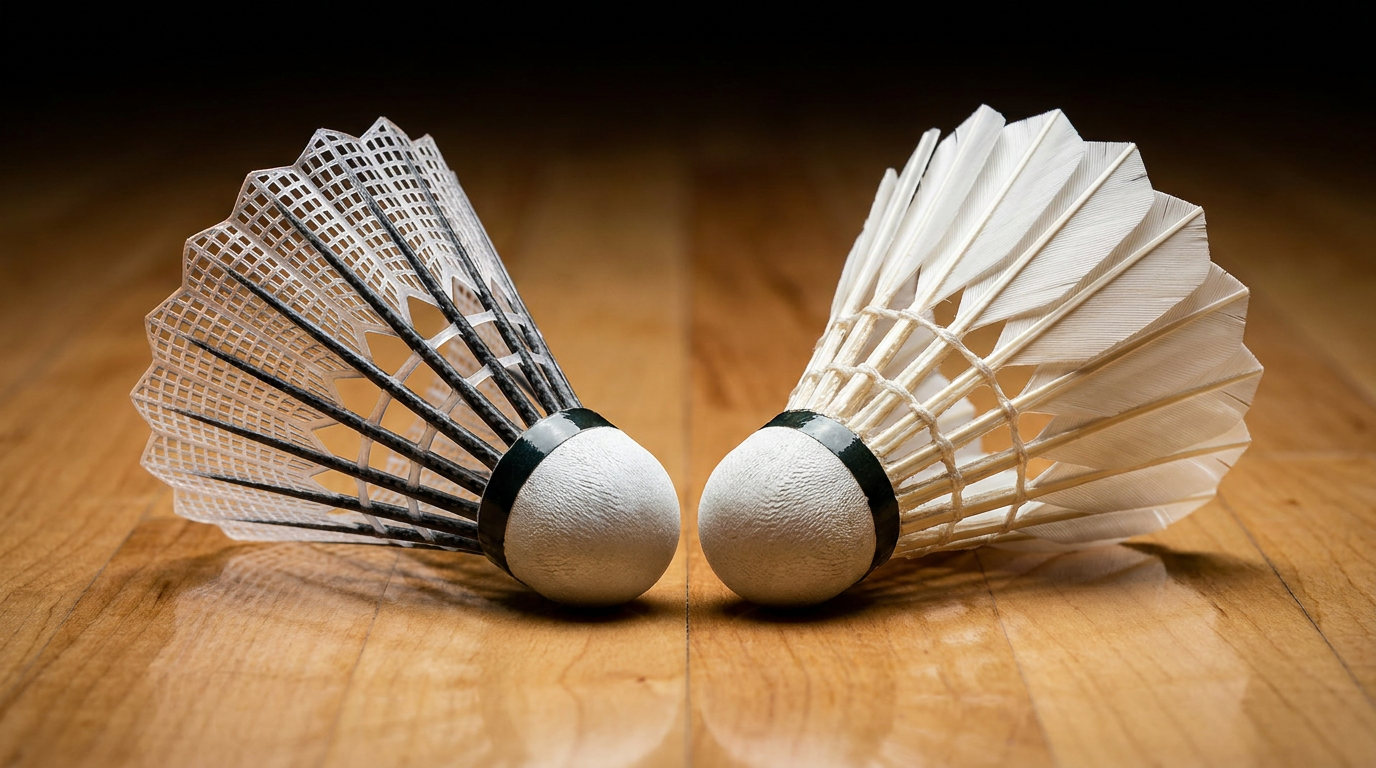
- New synthetic models use carbon-fiber shafts and nylon skirts to mimic the unique aerodynamic deceleration of natural feathers.
- While the transition addresses animal welfare and cost concerns, the industry must now manage the environmental impact of non-biodegradable plastics.
The crack of a badminton smash is one of the most distinctive sounds in sports, routinely heralding a projectile traveling at over 400 kilometers per hour. For over a century, that speed—and the sport's unique physics—has relied entirely on a highly specific natural resource: 16 overlapping goose or duck feathers glued into a cork base. But the traditional feather shuttlecock is facing an existential crisis. Driven by supply chain disruptions, soaring costs, and mounting pressure from animal welfare advocates, badminton is being forced to innovate. In a landmark shift, the Badminton World Federation (BWF) has officially approved the use of advanced synthetic shuttlecocks for select international competitions starting in 2026, marking the beginning of the end for the sport's reliance on bird feathers.[1][2]
The BWF's decision permits the use of two specific synthetic models—the Yonex Crosswind 70 and the Victor New Carbon Sonic Max—at Grade 3 and Junior International tournaments. This trial phase is designed to gather extensive performance data from players, technical officials, and tournament organizers. The governing body has framed the initiative as a crucial step in its long-term strategy to evaluate whether synthetic alternatives can eventually meet the exacting standards of elite, top-tier play, including the World Championships and the Olympics. For a sport deeply entrenched in tradition, the move represents a seismic technological shift.[1][2]
The catalyst for this transition is largely economic, rooted in shifting global agricultural trends. Historically, the badminton industry has relied on China's massive poultry sector, harvesting feathers as a byproduct of duck and goose meat production. However, recent years have seen a marked decline in the popularity of duck meat among consumers. As poultry farmers scale back production, shuttlecock manufacturers have found themselves struggling to secure the high-quality raw materials required for tournament-grade gear. This supply bottleneck recently led to a twofold increase in the price of certain feather stocks, threatening the financial accessibility of the sport at the grassroots level.[2]

Beyond economics, the sport has faced sustained criticism from animal rights organizations regarding the ethics of feather harvesting. Activists have long argued that the reliance on animal products—and the conditions under which feathers are sometimes obtained—is fundamentally incompatible with modern sporting values. By accelerating the transition to synthetic alternatives, the BWF is addressing these ethical concerns head-on, aiming to decouple the sport's growth from animal agriculture. The shift promises a more sustainable future, provided the engineering can match the performance of nature.[3]
Replicating the flight of a natural feather shuttlecock is widely considered one of the most complex engineering challenges in sports equipment. A feather shuttlecock possesses a unique aerodynamic profile: it accelerates violently off the racket but decelerates rapidly due to the parachuting drag of the overlapping feathers. This rapid deceleration allows players to execute full-power smashes that drop steeply within the boundaries of the court. For decades, traditional plastic or nylon shuttlecocks—often used in backyards and physical education classes—failed to mimic this "deceleration curve," resulting in a flight path that felt heavy, inaccurate, and entirely unsuited for competitive play.[5][6]
Replicating the flight of a natural feather shuttlecock is widely considered one of the most complex engineering challenges in sports equipment.
To bridge this gap, manufacturers have spent over a decade developing hybrid materials that mimic the structural integrity of a natural feather. The newly approved Yonex Crosswind 70, for instance, abandons the idea of a single molded plastic skirt. Instead, it utilizes a natural cork base connected to carbon fiber shafts, which act as the "spine" of the feather. These carbon spines are then fitted with specialized nylon synthetic feathers. This composite approach allows the shuttlecock to flex and recover upon impact much like a natural goose feather, preserving the crisp feel and aerodynamic drag that professional players demand.[4][5]

Early feedback from equipment testers and players indicates that while the new synthetics are remarkably close, they are not yet perfect clones of their natural counterparts. Reviewers note that the Victor New Carbon Sonic Max offers a flight experience that feels incredibly authentic to a traditional feather, though it sacrifices some durability. Conversely, the Yonex Crosswind 70 is praised for its near-indestructible nature—absorbing high-energy clears and smashes with ease—but feels slightly softer and heavier on the racket. Players have reported a brief adjustment period, particularly when executing delicate net spins and touch shots, where the synthetic materials interact differently with the racket strings.[4]
The primary advantage of these engineered synthetics is their sheer durability. In a professional men's match, the immense force of the rallies often destroys a natural feather shuttlecock within just a few points, requiring constant replacements and generating significant waste. Synthetic models, by contrast, can withstand prolonged punishment. Testing indicates that adopting synthetic shuttles could reduce overall shuttlecock consumption by 25 percent or more. For local clubs and training academies, this extended lifespan translates to massive cost savings, making the sport significantly more affordable to operate on a daily basis.[1][5]
However, the transition introduces a new environmental paradox that the sport must navigate. While moving away from animal products solves one ethical dilemma, it creates another: the reliance on petroleum-derived plastics. The nylon-6 and nylon-12 polymers used in synthetic skirts are not biodegradable, raising concerns about long-term plastic pollution if millions of synthetic shuttlecocks eventually end up in landfills. Environmental analysts warn that simply swapping feathers for plastic is not a complete sustainability solution unless it is paired with robust end-of-life management.[6][7]

To mitigate this, industry leaders are exploring circular economy models for badminton equipment. Proposals include partnering with specialized recycling firms, such as TerraCycle, to collect and repurpose broken synthetic shuttlecocks. Some manufacturers are also considering incentive programs that offer discounts to clubs that return used shuttles for recycling. As the BWF monitors the current trial phase, the environmental lifecycle of these new materials will likely be scrutinized just as closely as their aerodynamic performance on the court.[7]
Ultimately, the success of this technological leap will depend on the data gathered during the 2026 Grade 3 and Junior International tournaments. If the carbon-fiber synthetics prove they can maintain consistent flight characteristics under the pressure of elite competition, the BWF is expected to gradually expand their use into higher-tier events. For now, the sport stands at a fascinating crossroads, balancing a century of tradition against the pressing realities of modern supply chains, ethical standards, and material science.[1][3]
The broader implications for badminton's global growth are immense. By stabilizing equipment costs and reducing reliance on a volatile agricultural byproduct, the sport becomes more accessible to developing nations and grassroots programs. A durable, affordable, and high-performing synthetic shuttlecock lowers the barrier to entry, ensuring that the next generation of players can train with equipment that closely mirrors professional standards. As the synthetic revolution takes flight, badminton is proving that even the most traditional sports can re-engineer their core components to secure a sustainable and inclusive future.[7]
How we got here
2020
The BWF first announces long-term intentions to explore synthetic shuttlecocks to improve sustainability.
2024
A decline in the global duck meat industry leads to severe feather shortages, doubling the price of traditional shuttlecocks.
April 2026
The BWF officially approves the Yonex Crosswind 70 and Victor NCS Max for use in Grade 3 and Junior International tournaments.
Late 2026
Official trial phases begin, gathering performance data from players and officials to determine the future of elite competition.
Viewpoints in depth
Badminton Governing Bodies
Focused on standardizing play, controlling costs, and ensuring the sport's long-term viability.
The Badminton World Federation views the transition to synthetics as an inevitable and necessary evolution. By approving these shuttles for lower-tier tournaments, they are taking a measured, data-driven approach to ensure that the sport's unique physics are preserved. Their primary goal is to decouple badminton from volatile agricultural supply chains, ensuring that the sport remains affordable and accessible globally without compromising the elite competitive standard.
Equipment Manufacturers
Focused on the material science and engineering required to replicate nature.
Brands like Yonex and Victor have invested over a decade of research and millions of dollars into solving the "deceleration problem." They argue that hybrid materials—combining natural cork with carbon fiber and nylon—represent a triumph of modern engineering. For manufacturers, the challenge is balancing the extreme durability that recreational players demand with the delicate, precise feel required by professionals at the net.
Traditionalists & Pro Players
Protective of the sport's historic feel and highly sensitive to equipment changes.
Many elite players and traditionalists remain skeptical that a plastic and carbon composite can ever truly replace the nuanced touch of a goose feather. They point out that while synthetics handle powerful smashes well, they often behave unpredictably during delicate net spins and drop shots. This camp advocates for a slow, cautious rollout, warning that fundamentally altering the shuttlecock's flight could change the tactical nature of the sport itself.
What we don't know
- Whether top-tier professional players will fully accept the feel of synthetic shuttlecocks in World Championship or Olympic matches.
- How effectively the industry will be able to recycle the non-biodegradable nylon components of the new shuttles.
- Exactly how much the new synthetic models will cost at retail once mass-produced for the general public.
Key terms
- Shuttlecock skirt
- The flared, conical portion of the shuttlecock that creates aerodynamic drag, traditionally made of 16 overlapping feathers.
- Deceleration curve
- The rapid slowing down of a shuttlecock after being struck at high speed, a unique aerodynamic property essential to competitive badminton.
- Grade 3 Tournaments
- Lower-tier international badminton competitions used by the governing body to test emerging talent and trial new equipment rules.
- Carbon-fiber spine
- The stiff, lightweight synthetic shafts used in modern artificial shuttlecocks to replicate the structural flex and recovery of a natural feather quill.
Frequently asked
Why is badminton moving away from feather shuttlecocks?
A combination of supply chain shortages driving up the cost of goose and duck feathers, alongside growing pressure from animal welfare advocates, has prompted the shift toward sustainable synthetics.
Can synthetic shuttlecocks fly like feather ones?
Historically, no. However, new models using carbon-fiber shafts and engineered nylon skirts closely mimic the unique aerodynamic drag and rapid deceleration of natural feathers.
When will synthetic shuttlecocks be used in the Olympics?
The BWF is currently trialing them in lower-tier Grade 3 and Junior tournaments. If they meet elite performance standards, they may gradually be introduced to top-tier events in the future.
Are synthetic shuttlecocks better for the environment?
They save animal products and reduce overall waste due to their high durability, but they are made from non-biodegradable plastics, prompting the industry to explore new recycling programs.
Sources
Source coverage
7 outlets
4 viewpoints surfaced







[1]Badminton World FederationBadminton Governing Bodies
BWF Approves Use of Synthetic Shuttlecocks at Selected Tournaments
Read on Badminton World Federation →[2]The Indian ExpressSustainability Advocates
Badminton to test synthetic shuttles at smaller grade and junior tournaments with sustainability aims
Read on The Indian Express →[3]DD NewsSustainability Advocates
BWF clears synthetic shuttlecocks for select tournaments
Read on DD News →[4]CK YewPlayers & Analysts
Yonex Crosswind 70 vs Victor NCS Max Review
Read on CK Yew →[5]All RacketsEquipment Manufacturers
Yonex Crosswind 70
Read on All Rackets →[6]Badminton SupplierPlayers & Analysts
Disadvantages of Buying Cheaper Synthetic Badminton Shuttlecocks
Read on Badminton Supplier →[7]Factlen Editorial TeamSustainability Advocates
Synthesis by Factlen editorial team
Read on Factlen Editorial Team →

More in sports
See all 7 stories →WSL Transfers
Mary Earps Returns to WSL in Blockbuster Signing for Independent London City Lionesses
6 sources

Standings
Switzerland Claims Historic No. 1 Spot in IIHF World Rankings as Global Hockey Season Concludes
7 sources

Injury
MLB Injury Report: Lindor, Acuña, and De La Cruz Near Summer Returns
7 sources

Standings
LG Twins Hold Off Surging KT Wiz and Doosan Bears in Tight KBO Pennant Race
8 sources
Every angle. Every day.
Get sports stories with full source coverage and perspective breakdowns delivered to your inbox.