
Memory Stocks Are Having Their Best Year Ever. Why Do They Still Look So Cheap?
Driven by insatiable AI demand, memory chipmakers like Micron and SK Hynix are posting record profits and surging valuations. Yet despite the boom, their forward price-to-earnings ratios remain surprisingly low as Wall Street debates whether the notorious memory cycle has finally been broken.
By Factlen Editorial Team
- Structural Bulls
- Believe AI has permanently transformed memory from a cyclical commodity into a high-margin, contracted necessity.
- Cyclical Bears
- Argue that the massive capital expenditures currently underway will inevitably lead to a supply glut and price crash by 2028.
- Value Investors
- See the single-digit forward P/E ratios as a rare opportunity to buy into the AI boom at a reasonable price.
What's not represented
- · Consumer Electronics Manufacturers
- · Foundry Equipment Makers
Why this matters
For investors looking to participate in the AI boom without paying the massive premiums of mega-cap tech stocks, memory manufacturers offer a compelling backdoor play. Understanding the mechanics of the memory cycle is crucial to knowing whether these stocks are genuine bargains or cyclical value traps.
Key points
- Memory chipmakers are experiencing record growth driven by AI data center demand.
- High-Bandwidth Memory (HBM) has become the critical bottleneck for AI processing speeds.
- Despite massive stock rallies, forward P/E ratios for Micron and SK Hynix remain in the single digits.
- The industry's history of boom-and-bust cycles makes investors wary of a potential 2028 oversupply.
- Legacy storage providers like Seagate and Western Digital are also surging on data archiving needs.
The artificial intelligence revolution has minted trillion-dollar valuations across the tech sector, but the unsung heroes of the boom are the companies building the digital workbenches. Memory stocks are having a historic run in 2026, vastly outperforming the broader market as the global infrastructure build-out accelerates.[1][2]
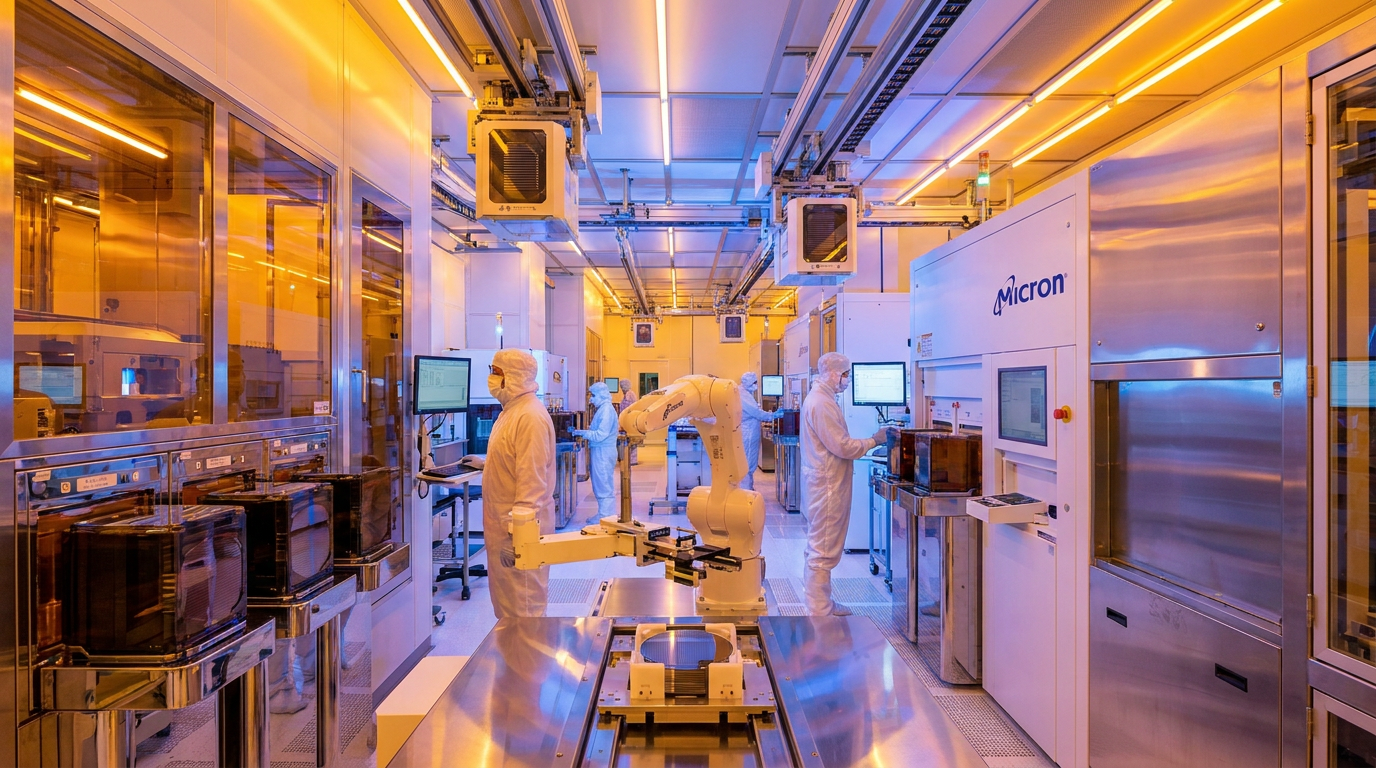
Companies like Micron, SK Hynix, and Samsung—effectively the "Big Three" of the global memory market—are seeing unprecedented demand. The primary catalyst is High-Bandwidth Memory (HBM), a specialized, ultra-fast chip architecture that has become the ultimate bottleneck for training and running large language models.[2][6]
An AI accelerator, such as an Nvidia GPU, can only process data as fast as it can pull it from memory. By stacking HBM directly next to the processor, data centers can feed the AI models at blistering speeds, preventing the highly expensive compute chips from sitting idle.[2][5]
The financial results of this architectural shift have been staggering. Micron recently reported a 196% year-over-year revenue surge, and the company has already sold out its entire HBM production capacity for the 2026 calendar year. Much of its 2027 output is already committed through binding, multi-year contracts.[3][4][5]

SK Hynix, the dominant player controlling roughly 57% of HBM revenue, recently crossed the $1 trillion valuation mark, closely following Micron's ascent past $800 billion. Both stocks have delivered extraordinary returns during the AI infrastructure boom.[2]
The boom isn't limited to the bleeding edge of HBM. The broader storage market is also catching fire. Legacy hard-drive and NAND flash makers like Seagate and Western Digital are seeing massive demand, as data centers require immense capacity to archive the cold data used to train AI models.[5]
For the first time in history, data centers now consume over 50% of the industry's total DRAM and NAND memory. This represents a structural shift from the previous era when consumer electronics and smartphones dictated the market's fortunes.[1]
For the first time in history, data centers now consume over 50% of the industry's total DRAM and NAND memory.
Yet, despite these astronomical growth rates and record profits, memory stocks look remarkably cheap on paper. Micron currently trades at roughly 9.6 times forward earnings, while SK Hynix sits at an astonishingly low 6.1 times.[2]

Compare that to the broader S&P 500 or high-flying software names trading at 30 to 40 times forward earnings, and memory makers appear to be the biggest bargains in the AI sector. To many retail investors, they look like a rare opportunity to buy hyper-growth at value prices.[1][6]
The catch lies in the industry's notorious history. Memory chips have traditionally been highly cyclical, interchangeable commodities. When prices rise, manufacturers build new fabrication plants; when those plants come online, the market floods, and prices crash.[3][4]
Wall Street is currently fiercely debating whether AI has permanently altered this boom-and-bust cycle. Bulls argue that the structural shift to long-term, price-committed contracts provides unprecedented visibility and stability, breaking the historical pattern of one-year handshake deals.[3][6]

Bears, however, point to the massive capital expenditures looming on the horizon. Micron plans to spend over $25 billion in 2026 alone, while SK Hynix is allocating roughly $27 billion to expand its manufacturing capacity.[3][4]
If historical patterns hold, this simultaneous capacity expansion by the Big Three could lead to a massive oversupply glut by 2027 or 2028, compressing those seemingly cheap forward multiples just as peak earnings arrive.[3][4]
For now, however, the "AI storage supercycle" continues unabated. As hyperscalers race to build ever-larger AI infrastructure, the companies supplying the memory remain the ultimate "pick-and-shovel" play of the 2026 market, offering a rare blend of explosive growth and single-digit valuations.[1][5]
How we got here
Pre-2023
Memory chips are viewed as highly cyclical, interchangeable commodities prone to boom-and-bust pricing.
Late 2023 - 2024
The generative AI boom creates an immediate shortage of High-Bandwidth Memory (HBM) required for Nvidia GPUs.
2025
SK Hynix and Micron lock in multi-year, price-committed contracts, a structural shift from traditional one-year handshake deals.
Early 2026
Data centers surpass 50% of total industry memory consumption for the first time in history.
June 2026
Memory stocks cross historic valuation milestones, yet forward P/E ratios remain in the single digits.
Viewpoints in depth
The Structural Bulls
Argue that AI has fundamentally changed the memory market's economics.
This camp believes that the transition to High-Bandwidth Memory has permanently altered the industry. Because HBM requires complex packaging and is sold through multi-year, price-committed contracts, bulls argue memory is no longer a pure boom-and-bust commodity. They view the current single-digit forward P/E ratios as a fundamental mispricing by a market stuck in the past.
The Cyclical Bears
Warn that the massive capital expenditures will inevitably lead to an oversupply glut.
Bears point to the $50 billion-plus in combined capital expenditures announced by Micron and SK Hynix for 2026. They argue that the laws of semiconductor economics haven't changed: when everyone builds new fabrication plants at the same time, the market floods. They predict that by 2028, this new capacity will crash margins, making today's 'cheap' valuations a classic cyclical trap.
The Legacy Storage Winners
Point out that traditional NAND and hard-drive makers are quietly reaping massive profits.
While HBM gets the headlines, this perspective highlights the explosion in demand for cold storage. Training AI models requires archiving petabytes of data, leading to a resurgence for legacy hard-drive and NAND flash manufacturers. Proponents argue these companies offer a less volatile, highly profitable way to play the AI storage supercycle.
What we don't know
- Whether the unprecedented demand for AI infrastructure will sustain through 2028 to absorb the massive new factory capacity coming online.
- How quickly emerging alternatives like 'compute-in-memory' might disrupt the current HBM dominance.
Key terms
- High-Bandwidth Memory (HBM)
- A specialized type of ultra-fast memory stacked directly next to AI processors to speed up data transfer.
- DRAM
- Dynamic Random-Access Memory, the standard working memory used in computers and servers to hold data temporarily.
- NAND Flash
- A type of non-volatile storage technology that retains data even without power, commonly used in solid-state drives (SSDs).
- Forward P/E Ratio
- A valuation metric that divides a company's current share price by its estimated future earnings per share.
- Hyperscalers
- Massive cloud service providers like Amazon AWS, Microsoft Azure, and Google Cloud that operate vast data centers.
Frequently asked
Why is memory so important for AI?
AI processors can only run as fast as they can pull data from memory. High-Bandwidth Memory acts as an ultra-fast workbench, preventing the processor from sitting idle while waiting for data.
Why do these stocks look cheap if they are growing so fast?
Investors are pricing in the risk of a future downturn. Because memory is historically a cyclical industry, markets are hesitant to assign high valuations to peak earnings that might not last.
What could cause the memory boom to end?
If the major manufacturers build too many new fabrication plants, the resulting oversupply could crash chip prices by 2028, especially if AI infrastructure spending by major tech companies slows down.
Sources
Source coverage
6 outlets
3 viewpoints surfaced






[1]MarketWatchValue Investors
Memory stocks are having their best year ever. Why do they still look so cheap?
Read on MarketWatch →[2]BenzingaValue Investors
Artificial intelligence has turned the memory-chip market into one of the most explosive trades on Wall Street
Read on Benzinga →[3]Seeking AlphaCyclical Bears
Micron: The Cheap Valuation Is The Whole Trap
Read on Seeking Alpha →[4]The Motley FoolCyclical Bears
Why Micron could reach $1,500 per share by late 2027
Read on The Motley Fool →[5]Zacks Investment ResearchStructural Bulls
4 AI Memory Stocks to Buy Now Before Prices Spike Even Higher
Read on Zacks Investment Research →[6]TradingKeyStructural Bulls
Micron vs. Samsung vs. SK Hynix: Is MU Stock the Best Memory Stock for 2026?
Read on TradingKey →
More in finance
See all 7 stories →Retirement Strategy
The Longevity Dividend: Why the 'Hard Stop' at 65 is Being Replaced by Phased Retirement
7 sources

Conservation Finance
How 'Debt-for-Nature' Swaps Are Turning Sovereign Liabilities Into Climate Solutions
7 sources

Assumable Mortgages
How Assumable Mortgages Are Unlocking 3% Rates for Homebuyers
7 sources

Career Strategy
Employers to College Students: Skip the Perfect GPA and Get a Summer Job
6 sources

Every angle. Every day.
Get finance stories with full source coverage and perspective breakdowns delivered to your inbox.