
U.S. and Iran Sign Interim Peace Deal, Reopening Strait of Hormuz and Sending Oil Prices Lower
A 60-day ceasefire agreement has lifted the naval blockade in the Persian Gulf, allowing millions of barrels of stranded oil to reach global markets. The deal provides immediate economic relief but leaves long-term questions about Iran's nuclear program and maritime transit fees unresolved.
By Factlen Editorial Team
- Market & Economic Analysts
- Focused on the unwinding of the war risk premium and the stabilization of global supply chains.
- Diplomatic & Geopolitical Observers
- Focused on the mechanics of the deal, the Versailles signing, and international relations.
- Domestic Political Watchdogs
- Focused on the administration's approval ratings, midterm risks, and hawkish backlash.
What's not represented
- · Commercial shipping insurers
- · Lebanese civilians affected by parallel conflicts
Why this matters
The reopening of the Strait of Hormuz immediately lowers global oil prices, reducing inflationary pressure on everything from gasoline to consumer goods. However, the fragile 60-day window means the threat of future supply shocks remains if a permanent nuclear deal cannot be reached.
Key points
- The U.S. and Iran signed an interim peace deal at Versailles, pausing a 3.5-month conflict.
- The Strait of Hormuz has reopened to commercial shipping, with Iran agreeing to 60 days of toll-free transit.
- Brent crude oil prices plummeted to roughly $80 a barrel following the resumption of energy flows.
- The U.S. granted immediate sanctions waivers for Iranian oil and agreed to unfreeze billions in restricted assets.
- The 60-day window will be used to negotiate a permanent resolution regarding Iran's nuclear program.
The three-and-a-half-month war that choked off one-fifth of the world's oil supply is officially pausing. Following a high-stakes summit at the Palace of Versailles, the United States and Iran have signed a memorandum of understanding to end hostilities and reopen the Strait of Hormuz.[1][4]
The immediate economic impact was felt within hours of the signing. The United States formally lifted its naval blockade of Iranian ports, prompting a flurry of maritime activity in the Persian Gulf as vessels that had been stranded for months finally began to move.[4][5]
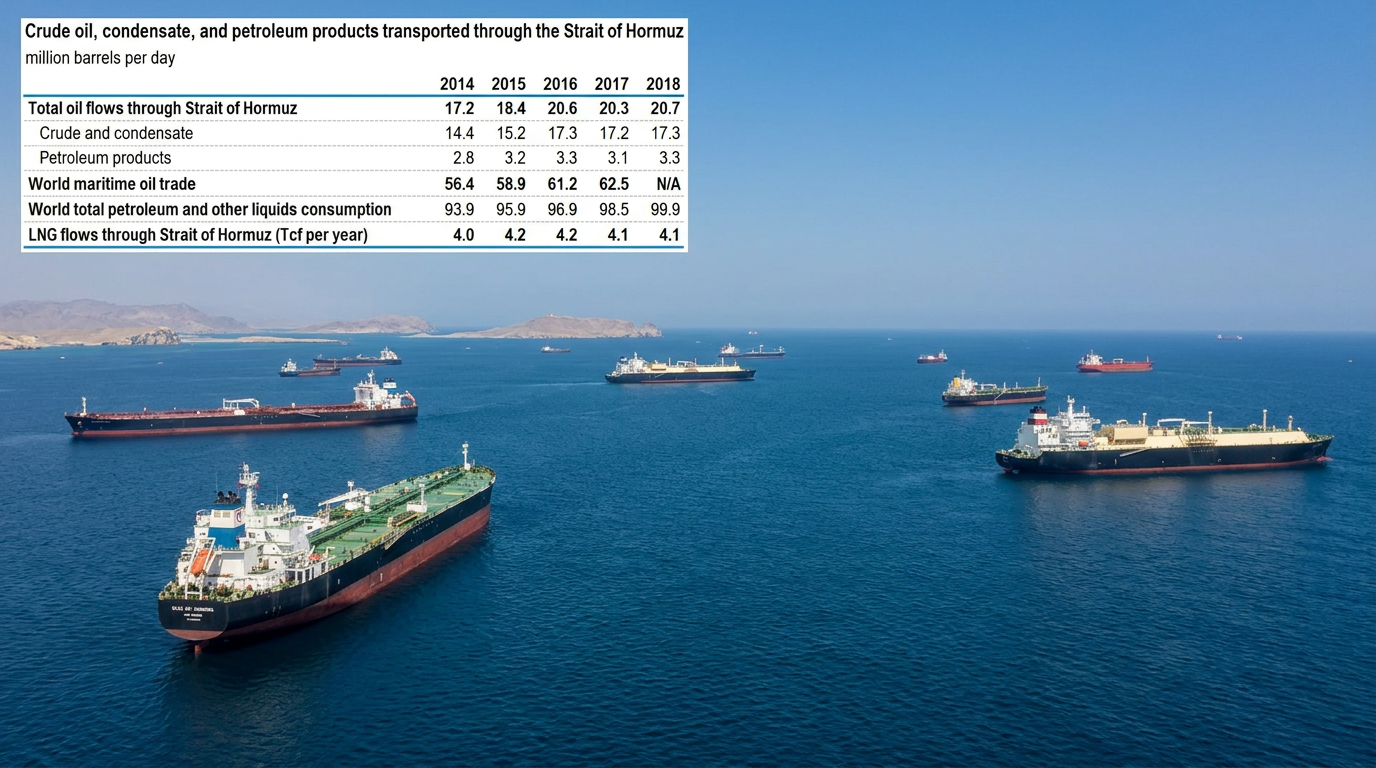
Massive crude carriers, including three Saudi supertankers carrying roughly six million barrels of oil, began transiting the strait for the first time since late February. They were joined by Qatari liquefied natural gas vessels and Iranian product tankers, signaling a cautious but definitive restart to commercial energy traffic.[2][5]
Global energy markets reacted with a collective sigh of relief. Brent crude futures tumbled to around $80 a barrel, a dramatic drop from the $126 peak seen at the height of the conflict in April, as traders unwound the massive war risk premium that had inflated prices.[5][8]

The mechanism of the interim deal relies on a 60-day grace period. During this window, Iran has committed to clearing naval mines and allowing commercial vessels to pass through the Strait of Hormuz without any transit fees or harassment.[3][4]
In exchange for these maritime concessions, the United States is granting immediate sanctions waivers that allow Iran to resume its oil exports. The agreement also establishes a framework to unfreeze an estimated $24 billion in restricted Iranian assets held abroad.[1][4]
In exchange for these maritime concessions, the United States is granting immediate sanctions waivers that allow Iran to resume its oil exports.
A highly scrutinized component of the diplomatic package is a proposed $300 billion reconstruction and economic development fund for the Islamic Republic. While the U.S. administration has explicitly stated it will not contribute taxpayer dollars to the fund, Gulf allies may provide the capital to ensure long-term regional stability.[1][4]
The 60-day ceasefire is primarily designed to buy time for negotiations over a permanent treaty regarding Iran's nuclear program. As a baseline concession, Tehran has agreed to down-blend its existing stockpile of highly enriched uranium under the direct supervision of the International Atomic Energy Agency.[4]

Despite the immediate resumption of traffic, Tehran is signaling that the era of unimpeded, free transit through the Gulf may be permanently altered. Iranian officials have announced plans to introduce a system of maritime fees for the Strait of Hormuz once the 60-day negotiation period expires.[3]
Iran's chief negotiator argued that managing the security and environmental safety of the strait incurs costs that international shipping must cover. This proposal has already drawn sharp rebukes from Saudi Arabia and other Gulf states, who insist the waterway must return to its pre-war status of free and open navigation.[3]
In Washington, the diplomatic breakthrough has exposed deep political vulnerabilities ahead of the midterm elections. Polling indicates that only about 36 percent of Americans approve of the administration's handling of the Iran conflict, with inflation and soaring gas prices having severely dragged down overall approval ratings.[6]

Conservative lawmakers have fiercely criticized the memorandum of understanding. Prominent senators have argued that the agreement concedes too much leverage to Tehran, comparing it unfavorably to past nuclear deals and warning against releasing billions of dollars to a hostile regime.[1][4]
For now, the global focus remains on clearing the backlog of stranded oil and stabilizing the macroeconomy. Analysts at Goldman Sachs suggest that if the peace holds and regional producers ramp up output, oil prices could grind lower toward a $70 to $75 floor as global inventories are steadily replenished.[7]
How we got here
Feb 28, 2026
The U.S.-Iran conflict begins, halting commercial traffic through the Strait of Hormuz and triggering a global energy shock.
April 2026
Brent crude prices peak at $126 per barrel as the naval blockade severely constricts global oil supplies.
June 18, 2026
The U.S. and Iran sign a memorandum of understanding at the Palace of Versailles to pause hostilities.
June 19, 2026
The U.S. lifts its naval blockade, allowing Saudi supertankers and other vessels to resume transit through the strait.
Viewpoints in depth
Energy Market Analysts
Focused on the unwinding of the war risk premium and the stabilization of global supply chains.
Commodity traders and financial institutions view the interim deal as a critical pressure release valve for the global economy. By allowing the resumption of traffic through a chokepoint that handles a fifth of the world's oil, the agreement immediately unwinds the 'war risk premium' that had driven crude prices to $126 a barrel. However, analysts caution that global inventories were severely depleted during the 3.5-month blockade. Markets are expected to remain highly sensitive to any diplomatic hiccups during the 60-day negotiation window, as a failure to secure a permanent treaty could instantly trigger another price shock.
U.S. Foreign Policy Hawks
Arguing that the memorandum concedes too much leverage and financial relief to Tehran.
Conservative lawmakers and defense analysts have fiercely criticized the Versailles agreement, characterizing it as a capitulation. They argue that lifting the naval blockade and unfreezing $24 billion in assets rewards Iran for disrupting global trade and attacking commercial shipping. Critics frequently compare the memorandum to the 2015 nuclear deal, asserting that a 60-day pause and a promise to down-blend uranium do not permanently dismantle Iran's nuclear infrastructure. They warn that the financial windfall will simply be used to fund regional proxies and strengthen the regime's military capabilities.
Iranian Leadership
Framing the ceasefire as a strategic victory that broke the blockade and secured vital economic lifelines.
For Tehran, the interim deal is being broadcast domestically as a historic triumph over Western pressure. Iranian officials emphasize that they successfully withstood a superpower's naval blockade while forcing the U.S. to grant immediate sanctions waivers for oil exports. Furthermore, Iran is using the agreement to assert long-term sovereignty over the Strait of Hormuz. By announcing plans to implement maritime transit fees after the 60-day grace period, the government is signaling that it intends to permanently alter the balance of power in the Persian Gulf and extract ongoing economic rent from international shipping.
What we don't know
- Whether the U.S. and Iran can successfully negotiate a permanent nuclear treaty within the 60-day window.
- How the international community will respond if Iran attempts to enforce maritime transit fees after the grace period.
- Whether Gulf allies will actually fund the proposed $300 billion reconstruction initiative for Iran.
Key terms
- Strait of Hormuz
- A narrow maritime chokepoint between the Persian Gulf and the Gulf of Oman through which roughly 20 percent of the world's oil supply passes.
- Brent Crude
- A major global benchmark for oil prices, used to price two-thirds of the world's internationally traded crude oil supplies.
- Sanctions Waiver
- A temporary exemption granted by the U.S. government allowing a country to sell goods—like oil—without facing financial penalties.
- Down-blending
- The process of mixing highly enriched uranium with lower-grade material to ensure it cannot be used to create a nuclear weapon.
Frequently asked
Is the Strait of Hormuz fully open to shipping?
Yes, for now. The U.S. lifted its naval blockade, and Iran has agreed to allow commercial vessels to pass toll-free for a 60-day period while clearing naval mines.
Why did oil prices drop so quickly?
Markets reacted to the immediate release of millions of barrels of stranded oil and the removal of the 'war risk premium' that had inflated prices during the conflict.
Will Iran charge ships to pass through the strait?
Iran has agreed to 60 days of free transit, but officials have announced plans to introduce maritime fees after that period, a move strongly opposed by Saudi Arabia and the U.S.
What happens after the 60-day interim period?
The 60 days are meant to provide a window for negotiating a permanent treaty regarding Iran's nuclear program. If talks fail, the blockade and hostilities could resume.
Sources
Source coverage
8 outlets
3 viewpoints surfaced








[1]BloombergDiplomatic & Geopolitical Observers
Traffic flows through Hormuz as U.S.-Iran deal takes effect, questions remain
Read on Bloomberg →[2]CNBCMarket & Economic Analysts
Oil tanker traffic in Strait of Hormuz jumps after U.S. and Iran implement deal to open sea lane
Read on CNBC →[3]The GuardianDiplomatic & Geopolitical Observers
Iran plans maritime fees for Strait of Hormuz after 60-day US deal
Read on The Guardian →[4]ForbesDiplomatic & Geopolitical Observers
Iran Signs Interim Peace Deal With U.S. Allowing Hormuz Strait To Reopen
Read on Forbes →[5]ReutersMarket & Economic Analysts
Oil dips as US-Iran deal takes effect, tankers return to Hormuz
Read on Reuters →[6]NewsweekDomestic Political Watchdogs
What Is Donald Trump's Approval Rating on Iran?
Read on Newsweek →[7]Goldman SachsMarket & Economic Analysts
Why Oil Prices Could 'Grind Lower' Amid the US-Iran Deal
Read on Goldman Sachs →[8]AxiosMarket & Economic Analysts
Oil prices sink on announcement of Iran deal
Read on Axios →

Every angle. Every day.
Get business stories with full source coverage and perspective breakdowns delivered to your inbox.