
Memory Stocks Are Posting Record Profits, But Wall Street Is Still Pricing Them for a Crash
Despite triple-digit earnings growth fueled by the AI boom, top memory chipmakers are trading at single-digit valuations as investors brace for historical boom-bust cycles.
By Factlen Editorial Team
- Structural Bulls
- Argue that AI and HBM have permanently transformed memory into a high-margin, supply-constrained strategic asset.
- Cyclical Skeptics
- Believe the current boom is a classic memory cycle peak that will inevitably bust when supply catches up.
- Hardware Analysts
- Focus on the technical bottlenecks, noting that HBM manufacturing complexity will keep supply tight through 2027.
What's not represented
- · Retail consumers facing higher device prices
- · Foundry operators managing wafer capacity
Why this matters
Understanding why highly profitable companies trade at steep discounts teaches investors how to separate structural market shifts from temporary cyclical peaks. For anyone looking to understand AI infrastructure, memory chips represent the most critical—and currently the cheapest—bottleneck in the supply chain.
Key points
- Memory chipmakers like Micron and SK Hynix are posting record, triple-digit earnings growth driven by AI demand.
- Despite the profit surge, these stocks trade at single-digit forward P/E ratios, far below the broader market.
- Investors remain skeptical due to the memory industry's historical tendency for brutal boom-and-bust cycles.
- Bulls argue that the complex manufacturing requirements of High Bandwidth Memory (HBM) will prevent oversupply and sustain high margins.
The artificial intelligence boom has minted fortunes across the technology sector, but while GPU designers capture the public imagination, the companies actually storing the data are quietly posting some of the most explosive profit growth in market history. Memory chipmakers are experiencing an unprecedented supercycle, driven by the insatiable data demands of large language models and global data centers.[1][3]
Yet, a glaring paradox sits at the center of the semiconductor market. Companies like Micron Technology, SK Hynix, and Samsung Electronics are seeing triple-digit stock gains and massive earnings beats, but they continue to trade at single-digit forward price-to-earnings multiples. Wall Street is effectively putting some of the AI era's biggest earners on the discount rack.[1][6]
The sheer scale of the earnings disconnect is striking. Micron recently posted a staggering 756% year-over-year growth in earnings per share, while Samsung's EPS jumped nearly 500%. Despite this, Micron's forward P/E ratio sits at roughly 9x, and both SK Hynix and Samsung hover around 6.5x. For context, Nvidia trades at roughly 23x forward earnings, and the broader S&P 500 averages above 20x.[1][2]

To understand the discount, investors have to look at history. For decades, the memory industry has been defined by brutal, wealth-destroying boom-and-bust cycles. The pattern is deeply ingrained in institutional memory: a surge in demand leads to a flood of new factory capacity, which inevitably results in oversupply and a catastrophic crash in chip prices.[2][7]
Because of this legacy, the market is treating the current AI windfall as a classic cyclical peak. Investors are paying exactly what they think these companies are worth today, but they are refusing to assign the premium multiples given to software or logic-chip companies because they assume the profits will eventually evaporate when supply catches up.[2]
Because of this legacy, the market is treating the current AI windfall as a classic cyclical peak.
However, a growing chorus of structural bulls argues that this time genuinely is different, pointing to the rise of High Bandwidth Memory (HBM). Traditional memory chips were largely commoditized, but AI accelerators require massive amounts of data fed at lightning speeds, turning memory into a highly specialized, strategic bottleneck.[3][5]
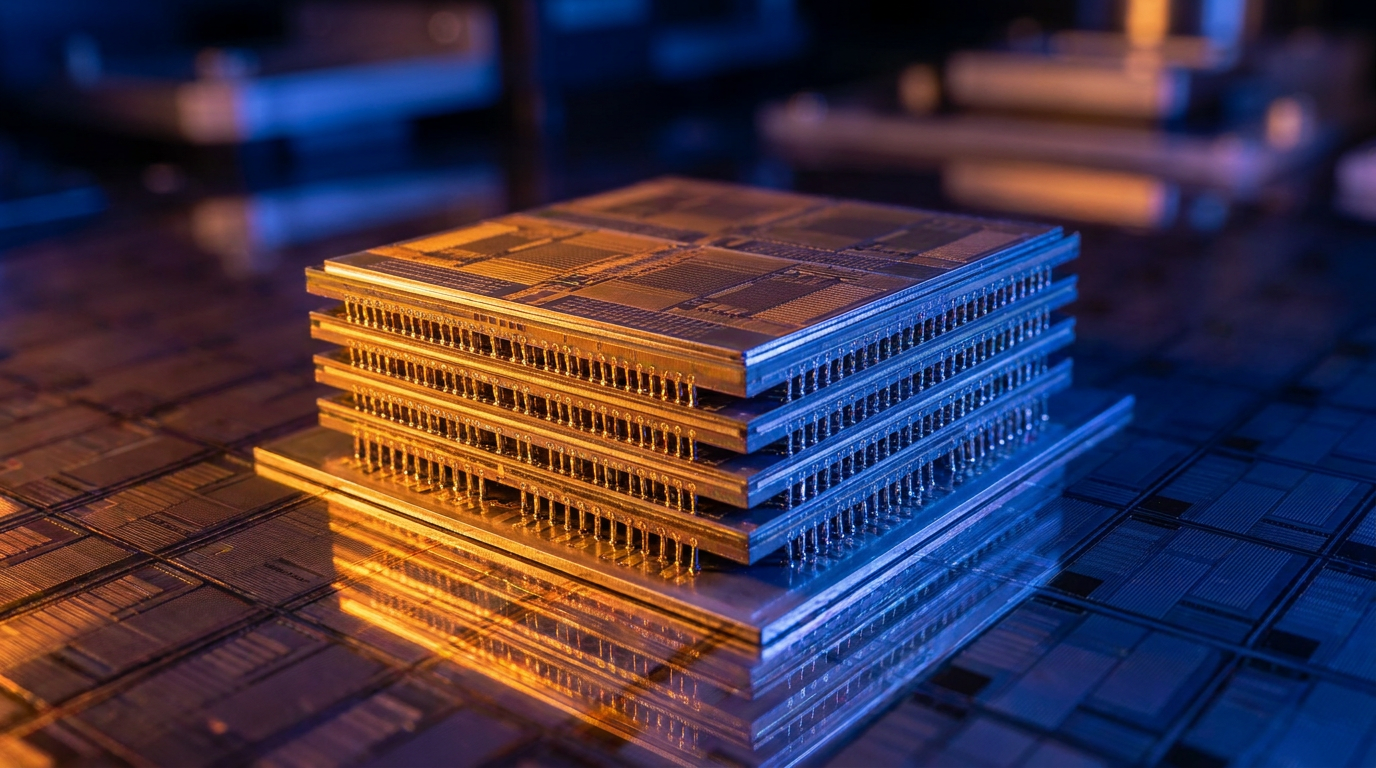
HBM is vastly more complex to manufacture than standard DRAM. It involves vertically stacking multiple memory chips and connecting them with microscopic pathways called through-silicon vias. This advanced packaging requirement creates a high barrier to entry, significantly constraining how quickly competitors can ramp up new supply and keeping profit margins elevated.[5]

The demand side of the equation shows no signs of cooling. Tech hyperscalers are projected to spend hundreds of billions on AI infrastructure this year alone. As a result, SK Hynix, Samsung, and Micron have already sold out large portions of their advanced HBM capacity through 2026 and into 2027, locking in revenue visibility that the industry has rarely enjoyed.[7]
Furthermore, the technology is advancing faster than the manufacturing base can comfortably support. The industry is already transitioning to HBM4, which doubles the interface width and pushes data transfer rates past 2 terabytes per second per stack. This relentless need for next-generation performance keeps pricing power firmly in the hands of the chipmakers.[4][5]

The ripple effects of this memory shortage are spreading downstream. With HBM consuming a massive share of global wafer capacity, standard memory prices are also rising. Device manufacturers are facing higher component costs for AI-enabled PCs and smartphones, a dynamic that could eventually lead to higher retail prices for consumers as the computing demands of edge AI grow.[4]
Ultimately, the valuation gap presents a defining question for the current market era. If the AI infrastructure buildout is a multi-year, structural supercycle, memory stocks currently represent one of the cheapest entry points in the technology sector. If it is simply a magnified version of a traditional hardware cycle, those single-digit multiples are a necessary warning sign.[1][6]
How we got here
Late 2022
The launch of ChatGPT triggers an industry-wide race to build AI infrastructure, suddenly spiking demand for specialized memory.
2024
Memory chipmakers begin aggressively shifting production lines from standard DRAM to High Bandwidth Memory to meet hyperscaler orders.
Early 2026
Micron, SK Hynix, and Samsung report record-breaking profit surges, with some earnings growing over 700% year-over-year.
Mid 2026
Despite massive stock rallies, memory companies continue to trade at single-digit forward P/E multiples due to lingering cyclical fears.
Viewpoints in depth
Cyclical Skeptics
Believe the current boom is a classic memory cycle peak that will inevitably bust when supply catches up.
This camp relies heavily on the historical precedent of the semiconductor industry. For decades, every memory shortage has been met with massive capital expenditure to build new fabrication plants. Once those plants come online, the market floods with supply, prices plummet, and profit margins evaporate. Skeptics argue that the current AI-driven demand spike is just a larger version of past cycles, and that paying premium multiples for peak cyclical earnings is a recipe for massive capital destruction.
Structural Bulls
Argue that AI and HBM have permanently transformed memory into a high-margin, supply-constrained strategic asset.
Bulls contend that High Bandwidth Memory is fundamentally different from the commoditized DRAM of the past. Because HBM requires advanced packaging and precise vertical stacking, the barriers to entry are significantly higher. This camp points to the fact that top manufacturers have already sold out their capacity through 2027. They argue that AI has transformed memory from a cheap, interchangeable component into a strategic bottleneck, meaning the historically low valuations represent a massive mispricing by the market.
Hardware Analysts
Focus on the technical bottlenecks, noting that HBM manufacturing complexity will keep supply tight through 2027.
Industry analysts look past the financial multiples and focus on the physics of chip manufacturing. They note that the transition to next-generation HBM4 requires doubling the interface width and managing immense thermal challenges. Because the technical difficulty of producing these chips is scaling faster than the industry's ability to build them, analysts project that the supply-demand imbalance will persist much longer than in previous cycles, naturally supporting higher prices and sustained profitability.
What we don't know
- Whether the massive capital expenditures by hyperscalers on AI infrastructure will eventually slow down.
- How quickly competitors or new entrants might overcome the technical hurdles of HBM manufacturing.
- To what extent the rising cost of memory will impact consumer demand for next-generation AI devices.
Key terms
- Forward P/E Ratio
- A valuation metric that compares a company's current stock price to its expected earnings per share over the next 12 months.
- High Bandwidth Memory (HBM)
- An advanced type of computer memory that stacks chips vertically to deliver massive amounts of data at high speeds, crucial for AI processors.
- Cyclical Stock
- A stock whose price is heavily affected by macroeconomic or industry-wide ups and downs, often experiencing extreme booms and busts.
- DRAM
- Dynamic Random Access Memory, the standard type of memory used in computers and servers to store data that is currently being processed.
Frequently asked
Why are memory stocks considered cyclical?
Historically, memory chips were treated as commodities. When demand rose, companies overbuilt factories, leading to massive oversupply and subsequent price crashes.
What makes High Bandwidth Memory (HBM) different?
HBM stacks multiple memory chips vertically to drastically increase data transfer speeds, which is essential for AI. It is much harder to manufacture, keeping supply tight and margins high.
Are these low valuations a guarantee the stocks will go up?
No. The low price-to-earnings ratios reflect Wall Street's belief that current record profits are temporary and will decline once supply catches up with AI demand.
Sources
Source coverage
7 outlets
3 viewpoints surfaced







[1]MarketWatchStructural Bulls
Memory stocks are having their best year ever. Why do they still look so cheap?
Read on MarketWatch →[2]MorningstarCyclical Skeptics
Investors assign low valuations to memory stocks due to their cyclical nature
Read on Morningstar →[3]ForbesHardware Analysts
Memory and Storage: Five Pillar Stocks for the AI Era
Read on Forbes →[4]TrendForceHardware Analysts
2026 HBM Outlook: HBM4 Delays and HBM3e Dominance
Read on TrendForce →[5]SemiAnalysisHardware Analysts
HBM Bit Demand Growth and the AI Accelerator Market
Read on SemiAnalysis →[6]24/7 Wall St.Structural Bulls
Micron Rises 7%, Western Digital Climbs as Memory Stocks Extend Parabolic Run
Read on 24/7 Wall St. →[7]FTR InvestorsStructural Bulls
AI has sent memory stocks sharply higher. Can the boom continue?
Read on FTR Investors →
More in finance
See all 7 stories →SpaceX IPO
SpaceX Options Trading Shatters Records Following Historic $75 Billion IPO
7 sources
Retirement Strategy
The Longevity Dividend: Why the 'Hard Stop' at 65 is Being Replaced by Phased Retirement
7 sources

Conservation Finance
How 'Debt-for-Nature' Swaps Are Turning Sovereign Liabilities Into Climate Solutions
7 sources

Assumable Mortgages
How Assumable Mortgages Are Unlocking 3% Rates for Homebuyers
7 sources

Every angle. Every day.
Get finance stories with full source coverage and perspective breakdowns delivered to your inbox.