
How North America is Finally Building True High-Speed Rail
After decades of delays, three massive infrastructure projects in California, Nevada, and Canada are actively laying the groundwork for a zero-emission, 200-mph future.
By Factlen Editorial Team
- Public Mega-Project Advocates
- View high-speed rail as an essential public good that requires sustained government investment.
- Private-Sector Model Proponents
- Believe private enterprise and targeted corridors are the fastest way to deliver high-speed rail.
- Fiscal & Community Skeptics
- Highlight the massive cost overruns and local disruptions caused by rail mega-projects.
- Neutral Analysts
- Evaluate the engineering, economic, and political viability of the competing rail models.
What's not represented
- · Airlines operating short-haul regional flights
- · Freight rail operators sharing adjacent corridors
Why this matters
True high-speed rail fundamentally alters the economic geography of a continent. By shrinking travel times between major hubs to under three hours, these projects promise to decarbonize regional travel, alleviate housing crunches by expanding commutable radiuses, and provide a reliable alternative to congested highways and airports.
Key points
- California High-Speed Rail awarded a major contract in June 2026 to begin installing electrified track in the Central Valley.
- Brightline West is advancing major construction to connect Las Vegas and Southern California by late 2029.
- Canada has upgraded its Toronto-to-Quebec City rail project to true high-speed rail, targeting speeds up to 320 km/h.
- All three projects utilize dedicated guideways, separating passenger trains from slow-moving freight traffic.
- The projects face ongoing challenges regarding massive capital costs, land acquisition, and political opposition.
For generations, North Americans traveling between major cities have faced a binary choice: navigate congested interstate highways or endure the friction of regional air travel. While Europe and Asia spent the last half-century weaving their continents together with high-speed rail, the United States and Canada remained tethered to legacy infrastructure.[8]
But in 2026, the continent is finally crossing a historic threshold. After decades of false starts, political battles, and ballooning budgets, North America is transitioning from the era of blueprints and environmental reviews into the era of laying electrified track.[7]
Three distinct mega-projects—spanning from the Mojave Desert to the Canadian Shield—are now actively advancing. Together, they represent a multi-billion-dollar bet that North Americans will embrace train travel if it can finally compete with the speed of flight and the convenience of a car.[1][8]
The most immediate catalyst is Brightline West, a privately funded venture aiming to connect Las Vegas to Rancho Cucamonga in Southern California. Covering 218 miles, the project promises to whisk passengers across the Mojave Desert in roughly two hours, cutting the typical driving time in half.[2][3]

Unlike public mega-projects, Brightline West operates on a private-sector timeline. Bolstered by a $3 billion federal grant awarded under the Infrastructure Investment and Jobs Act, the company broke ground in 2024 and is scaling up major construction in 2026. Revenue service is aggressively targeted for late 2029.[2][3]
Brightline's strategy relies on utilizing the existing median of Interstate 15. By building within an already established transportation corridor, the company bypasses the labyrinthine land-acquisition battles that typically paralyze American rail projects. The fully electric trains will reach speeds of 200 mph, removing an estimated 325,000 tons of CO2 emissions annually by taking cars off the road.[2]
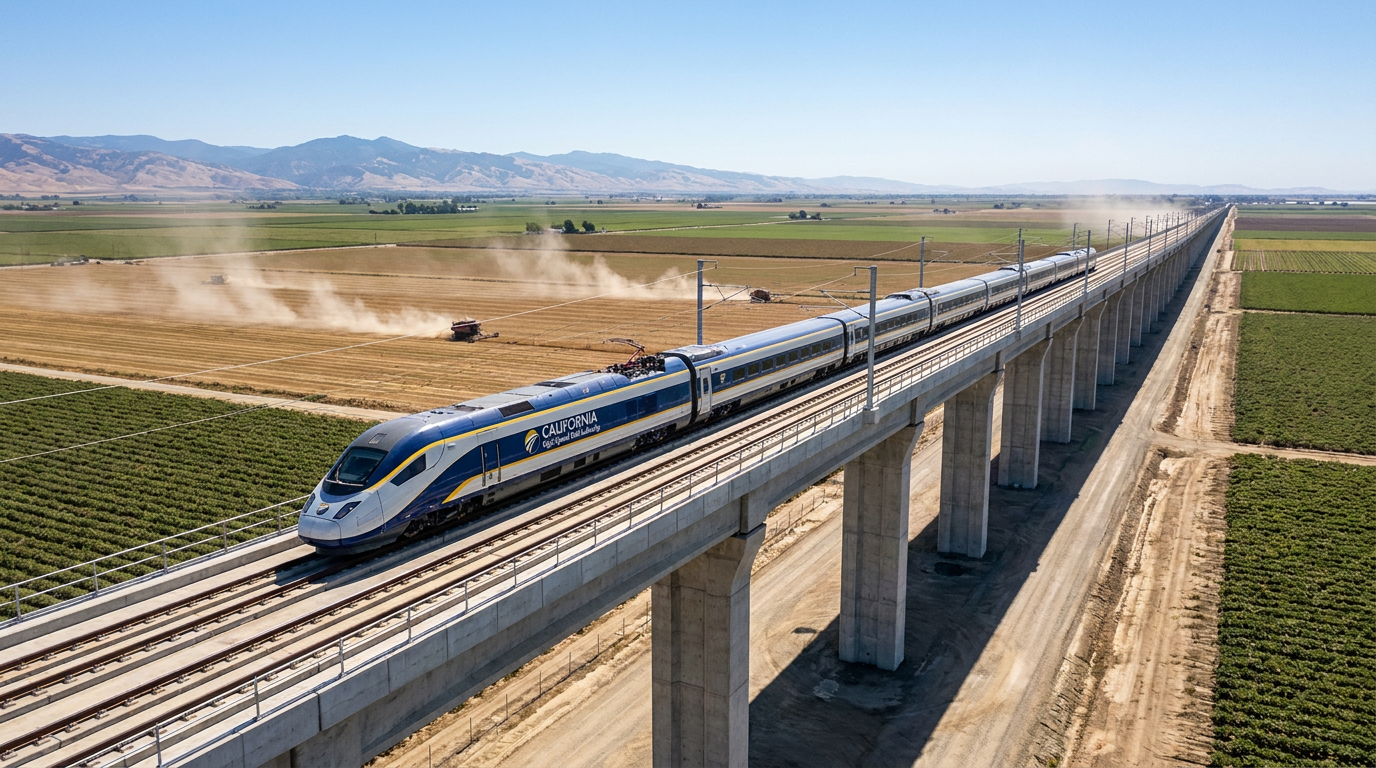
While Brightline West models private efficiency, the California High-Speed Rail (CAHSR) project represents the sheer scale—and staggering complexity—of public infrastructure. Designed to eventually link San Francisco to Los Angeles in under three hours, CAHSR has long been a lightning rod for fiscal criticism.[1][6]
Yet, the summer of 2026 marks a tangible turning point for the embattled project. In June, the CAHSR Authority awarded a massive contract to a joint venture of Kiewit, Stacy Witbeck, and Herzog to begin installing electrified track, signaling, and overhead contact systems.[1][6]
This transition from pouring concrete to laying steel is monumental. It means the 119-mile stretch of civil structures completed in the Central Valley—including the 6,333-foot Hanford Viaduct—will soon look like a functional railway. The initial operating segment between Merced and Bakersfield is slated to open by 2033.[1][4]

This transition from pouring concrete to laying steel is monumental.
However, the progress comes with a sobering price tag. The Authority's newly adopted 2026 Business Plan estimates that Phase 1 (San Francisco to Los Angeles) could cost up to $126 billion. Without dedicated, long-term funding streams, officials warn the project could be forced into a slow "pay-as-you-go" model.[4]
The route has also sparked local friction. Recent proposals to move the Merced station south of downtown and lease right-of-way land for battery storage facilities have drawn ire from Central Valley residents, who argue their communities are bearing the environmental and aesthetic costs for a train designed to serve coastal elites.[4]
North of the border, Canada is quietly advancing its own high-speed ambitions. Originally pitched as "High Frequency Rail," the federal government has officially pivoted the project to true high-speed rail, rebranding it as "Alto."[5][8]
The Alto network aims to connect Toronto, Ottawa, Montreal, and Quebec City. By upgrading the project's scope, Transport Canada now anticipates trains reaching speeds of up to 320 km/h (198 mph), transforming the economic geography of Canada's most densely populated corridor.[5]

In 2026, Alto entered a critical phase of environmental field studies, gathering data on wildlife, soil, and noise impacts between Ottawa and Montreal. The government is utilizing a "co-development" model, partnering with a private consortium named Cadence to design and price the network before committing to final construction.[3][5]
The defining feature of all three projects—Brightline, CAHSR, and Alto—is the mechanism of the "dedicated guideway." Historically, North American passenger trains, including Amtrak, have been forced to share tracks with massive, slow-moving freight trains, leading to chronic delays and capped speeds.[8]
True high-speed rail requires an entirely isolated ecosystem. These new networks feature complete grade separation—meaning the tracks never intersect with a roadway—and utilize overhead catenary systems to deliver high-voltage electricity directly to the trains.[1][2]

This dedicated infrastructure is what allows for the sweeping curve radiuses and uninterrupted straightaways necessary to sustain speeds over 200 mph safely. It is a fundamental engineering departure from incremental upgrades, like Amtrak's NextGen Acela launching on the Northeast Corridor in 2026, which still must navigate legacy commuter and freight bottlenecks.[8]
The stakes for these projects extend far beyond transportation. Proponents view them as essential climate solutions, capable of rapidly decarbonizing intercity travel while spurring dense, transit-oriented real estate development around new station hubs.[1][5]
Yet, the uncertainty remains high. The capital requirements are astronomical, and political winds can shift rapidly. A change in federal administrations or a severe economic downturn could easily sever the funding lifelines these projects rely upon.[4][7]
Despite the hurdles, 2026 will be remembered as the year the concrete was poured and the steel was ordered. For the first time in a century, North America is building a new paradigm of travel from the ground up, promising a future where the train is finally faster than the car.[8]
How we got here
2008
California voters approve Proposition 1A, authorizing the initial bond funding for high-speed rail.
2018
Fortress Investment Group acquires the XpressWest project, rebranding it as Brightline West.
2024
Brightline West officially breaks ground in Nevada following a $3 billion federal grant.
2025
Canada launches the co-development phase for its Alto high-speed network with the Cadence consortium.
June 2026
California High-Speed Rail awards the contract to begin installing actual track and systems on its completed Central Valley civil structures.
Viewpoints in depth
Public Mega-Project Advocates
View high-speed rail as an essential public good that requires sustained government investment.
This camp, which includes state authorities and transit advocacy groups, argues that the astronomical costs of projects like California High-Speed Rail are justified by their generational benefits. They point to the thousands of union jobs created, the massive reduction in greenhouse gas emissions, and the economic integration of disparate regions. For these advocates, the initial price tag is a necessary investment to build a sustainable alternative to endless highway expansion.
Private-Sector Model Proponents
Believe private enterprise and targeted corridors are the fastest way to deliver high-speed rail.
Led by developers like Brightline West, this perspective argues that public mega-projects are too easily bogged down by political infighting and scope creep. By focusing on highly profitable, point-to-point leisure corridors—like Las Vegas to Southern California—and utilizing existing highway medians, they believe high-speed rail can be delivered in a fraction of the time and cost. They advocate for a model where private capital takes the lead, supported by targeted federal grants.
Fiscal & Community Skeptics
Highlight the massive cost overruns and local disruptions caused by rail mega-projects.
This viewpoint emphasizes the stark reality of ballooning budgets, pointing to California's Phase 1 cost estimates surging to $126 billion. Skeptics argue that these funds could be better spent on incremental upgrades to existing transit or zero-emission highway infrastructure. Additionally, local community groups often voice concerns that the construction process and right-of-way acquisitions disproportionately burden rural and lower-income areas, which may not see the direct benefits of the expensive train service.
What we don't know
- Whether future federal administrations will continue to provide the grant funding necessary to complete these multi-decade projects.
- How accurately the ridership projections will translate to actual ticket sales once the lines open.
- If the 'co-development' procurement model used by Canada's Alto project will successfully prevent the cost overruns seen in California.
Key terms
- Grade Separation
- An intersection where a rail line passes over or under a roadway, eliminating level crossings to allow trains to maintain high speeds safely.
- Guideway
- The dedicated physical structure—often elevated viaducts or fenced ground-level tracks—built exclusively for high-speed trains.
- Overhead Catenary System
- The network of electrified wires suspended above the tracks that supplies power to the trains.
- Co-Development Phase
- A procurement model where the government partners with a private consortium to jointly design and price a mega-project before final construction begins.
Frequently asked
When will passengers actually be able to ride these trains?
Brightline West aims to begin passenger service between Las Vegas and Southern California by late 2029. California High-Speed Rail targets 2033 for its initial Central Valley segment, while Canada's Alto is still in the co-development phase.
Are these trains fully electric?
Yes. All three major projects—Brightline West, CAHSR, and Alto—are designed to run on fully electrified overhead catenary systems, producing zero direct emissions.
Why is high-speed rail so expensive to build in North America?
Costs are driven by complex land acquisition, the need for entirely new dedicated right-of-ways (to avoid sharing tracks with slow freight trains), environmental reviews, and the construction of massive grade separations like viaducts and tunnels.
How does this compare to Amtrak's Acela?
While Amtrak's NextGen Acela launching in 2026 improves speeds on the Northeast Corridor, it still shares legacy tracks with commuter and freight trains, limiting its top speed. The new projects are 'true' high-speed rail built on dedicated, grade-separated guideways.
Sources
Source coverage
8 outlets
4 viewpoints surfaced








[1]California High-Speed Rail AuthorityPublic Mega-Project Advocates
Track and Systems Installation Contract Awarded
Read on California High-Speed Rail Authority →[2]Brightline WestPrivate-Sector Model Proponents
Connecting Las Vegas to SoCal
Read on Brightline West →[3]Railway-NewsPrivate-Sector Model Proponents
Federal Investment Interest Grows for Brightline West Rail Line
Read on Railway-News →[4]ABC10Fiscal & Community Skeptics
California High-Speed Rail board adopts 2026 Business Plan
Read on ABC10 →[5]Transport CanadaPublic Mega-Project Advocates
High-Speed Rail Initiative Co-Development Phase
Read on Transport Canada →[6]APTA Passenger TransportPublic Mega-Project Advocates
Kiewit-Stacy Witbeck-Herzog JV Selected to Install High-Speed Rail Track and Systems
Read on APTA Passenger Transport →[7]High Speed Rail AlliancePublic Mega-Project Advocates
What We Can Accomplish in 2026
Read on High Speed Rail Alliance →[8]Factlen Editorial TeamNeutral Analysts
Synthesis by Factlen editorial team
Read on Factlen Editorial Team →
Every angle. Every day.
Get world stories with full source coverage and perspective breakdowns delivered to your inbox.