
Evidence Pack: The Efficacy of Deepfake Detection and AI Fact-Checking in 2026
As generative AI models achieve unprecedented realism, a new generation of forensic tools, provenance standards, and algorithmic prebunking systems are giving fact-checkers the upper hand.
By Factlen Editorial Team
- Forensic AI Developers
- Focus on building adversarial models to detect synthetic media after it has been created.
- Provenance & Standards Coalitions
- Advocate for embedding cryptographic trust into media at the point of capture and generation.
- Human-in-the-Loop Fact-Checkers
- Prioritize tools that accelerate human verification and build public media literacy.
What's not represented
- · Independent open-source developers struggling to access modern training data
- · Everyday users who lack the technical expertise to interpret cryptographic metadata
Why this matters
As generative AI makes it easier to create convincing fake audio and video, understanding the actual capabilities of detection tools helps organizations and individuals separate genuine threats from overhyped panic.
Key points
- Cryptographic provenance standards like C2PA are growing, bolstered by the EU AI Act's August 2026 enforcement deadline.
- Commercial AI models can now detect audio deepfakes in real-time with over 96% accuracy, vastly outperforming open-source tools.
- Researchers have pioneered 'listening deepfake' detection, catching AI models that fail to synthesize realistic human listening reactions.
- Fact-checkers are increasingly using AI to monitor short-form video and 'prebunk' false narratives before they go viral.
The narrative that deepfakes have permanently broken digital trust is being actively challenged by empirical data. A new suite of forensic tools, legislative mandates, and collaborative fact-checking networks has shifted the balance of power back toward verification. This evidence pack evaluates the strength of the three primary pillars of synthetic media defense in 2026: cryptographic provenance, forensic detection, and algorithmic prebunking.[7]
The first major claim evaluated by researchers is that cryptographic provenance standards can guarantee media authenticity. The evidence here is mixed but maturing rapidly. The Coalition for Content Provenance and Authenticity (C2PA) has grown to over 6,000 members, establishing a robust technical standard for embedding tamper-evident metadata into digital files at the exact point of creation.[2]
However, a February 2026 report from Microsoft Research cautioned that while the C2PA standard works reliably in controlled environments, its real-world adoption remains fragmented. The researchers warned of a structural "provenance gap," noting that metadata can be easily stripped by non-compliant social platforms, and that the absence of a C2PA label does not automatically prove a file is fake. Consequently, provenance is currently rated as a strong compliance tool but an insufficient standalone defense against adversarial attacks.[2]
This compliance aspect is about to undergo a massive, continent-wide stress test. Under Article 50 of the EU AI Act, which becomes fully enforceable on August 2, 2026, providers of generative AI systems must ensure their outputs are marked in a machine-readable format. Violations carry maximum fines of €15 million or 3 percent of global turnover, forcing major platforms to adopt C2PA or equivalent watermarking technologies by default.[5]

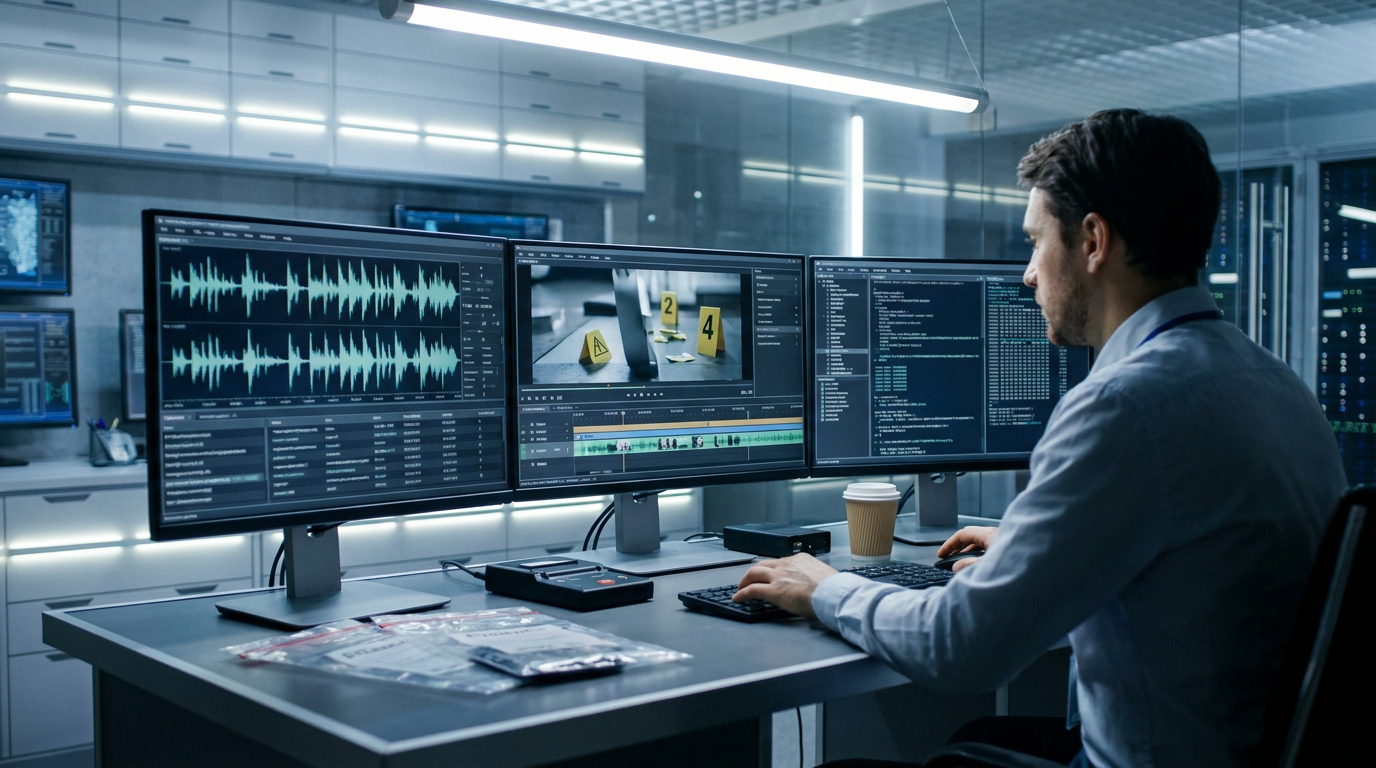
The second major claim is that audio deepfakes can now be reliably detected in real-time. The evidence for this claim is highly bifurcated: it is exceptionally strong for commercial enterprise systems, but alarmingly weak for open-source alternatives. Audio cloning has been a primary vector for financial fraud, successfully bypassing legacy voice biometric systems in call centers.[3]
A comprehensive May 2026 benchmark by the independent evaluator Podonos tested eight detection systems against modern voice-cloning attacks. The results showed that top-tier commercial models, such as Resemble AI and Aurigin AI, achieved accuracy rates of 98.1 percent and 96.8 percent, respectively. Crucially, these systems operate with sub-second latency, allowing them to intercept live phone-based social engineering attacks without disrupting legitimate callers.[3]
Conversely, the exact same benchmark revealed that open-source audio detectors accurately differentiated spoof attempts from real audio less than two-thirds of the time. These public models were largely trained on the ASVspoof 2019 dataset, which predates the current generation of advanced diffusion models, rendering them highly vulnerable to modern synthetic voices.[3]

Conversely, the exact same benchmark revealed that open-source audio detectors accurately differentiated spoof attempts from real audio less than two-thirds of the time.
The third claim asserts that video deepfake detection is successfully shifting from "speaking" anomalies to "listening" anomalies. The evidence here is emerging but highly promising. For years, forensic algorithms focused almost exclusively on the active speaker, analyzing lip-sync errors and unnatural blinking. As generative models perfected these active traits, detection accuracy naturally plateaued.[1]
In April 2026, researchers introduced a breakthrough methodology called "Listening Deepfake Detection." Attackers deploying real-time face-swaps in video calls often alternate between speaking and listening states to enhance the realism of the interaction. The researchers built the "ListenForge" dataset and demonstrated that while AI models can flawlessly mimic a person talking, they struggle immensely to synthesize the subtle, continuous micro-expressions of a person actively listening and reacting to a conversation.[1]
By deploying a Motion-aware and Audio-guided Network (MANet), the research team successfully captured these cross-modal inconsistencies. The system analyzes the mismatch between the speaker's audio semantics and the listener's physical reactions, achieving significantly higher detection rates than legacy models that only analyze the active speaker.[1]

The final claim evaluates whether AI can effectively "prebunk" misinformation before it achieves viral velocity. The evidence for this proactive approach is strong and actively scaling across borders. Traditional fact-checking is inherently reactive, often publishing debunks long after a false narrative has saturated social media feeds.[4]
To reverse this dynamic, the UK-based charity Full Fact, in partnership with the European Fact-Checking Standards Network, launched the "Prebunking at Scale" (PAS) initiative. The system uses AI to monitor short-form video platforms—such as TikTok and Instagram Reels—across multiple languages. It extracts speech and on-screen text, clustering the data to identify emerging deceptive narratives in their absolute infancy.[4]
By detecting these early signals, fact-checkers can publish "prebunks" that inoculate the public against specific tropes and tactics before the claims go viral. In 2026, the PAS tool expanded to support over 25 European languages, demonstrating that AI can be leveraged to accelerate human editorial workflows rather than replace them.[4]
This human-in-the-loop philosophy is also driving consumer-facing tools. The German government-funded ClaimGuard project, launched in early 2026, pairs citizens with an AI chatbot to collaboratively verify claims. Instead of simply labeling content as true or false, the app guides users through the verification process, teaching media literacy while crowdsourcing vital data for professional fact-checkers.[6]
Ultimately, the evidence from 2026 indicates that no single technology offers a silver bullet against synthetic media. However, the combination of cryptographic provenance at the point of creation, real-time forensic detection during transmission, and AI-assisted prebunking at the point of consumption has created a robust, multi-layered defense architecture that is successfully holding the line.[7]
How we got here
Feb 2021
The Coalition for Content Provenance and Authenticity (C2PA) is founded by major tech and media companies.
Nov 2025
Full Fact and European partners launch the 'Prebunking at Scale' initiative to monitor short-form video.
Feb 2026
Microsoft Research publishes a landmark report warning of the 'provenance gap' in media authentication.
Apr 2026
Researchers introduce 'ListenForge', pioneering the detection of deepfakes through listening anomalies.
May 2026
Independent benchmarks confirm commercial AI can detect audio deepfakes with over 98% accuracy in real-time.
Aug 2026
Article 50 of the EU AI Act becomes fully enforceable, mandating machine-readable labels for synthetic content.
Viewpoints in depth
Forensic AI Developers
Focus on building adversarial models to detect synthetic media after it has been created.
This camp argues that because malicious actors will always strip metadata and bypass voluntary standards, post-creation detection remains the most critical line of defense. They point to breakthroughs in sub-second audio analysis and 'listening' anomaly detection as proof that forensic AI can keep pace with generative models. Their primary concern is the performance gap between well-funded commercial APIs and the open-source tools available to independent researchers.
Provenance & Standards Coalitions
Advocate for embedding cryptographic trust into media at the point of capture and generation.
Led by industry groups like the C2PA and bolstered by mandates like the EU AI Act, this perspective argues that the internet must shift from a 'detect the fake' model to a 'prove the real' model. They maintain that the forensic arms race is ultimately unwinnable, and that establishing a secure, tamper-evident chain of custody from the camera sensor to the social media feed is the only sustainable way to rebuild digital trust.
Human-in-the-Loop Fact-Checkers
Prioritize tools that accelerate human verification and build public media literacy.
Organizations in this camp warn against relying on opaque algorithmic 'truth oracles.' They argue that AI is best used as a triaging tool—scanning massive volumes of short-form video to cluster narratives and flag anomalies—so that human experts can step in to provide context. Initiatives like Prebunking at Scale and ClaimGuard reflect their belief that the ultimate defense against disinformation is an educated, critical public equipped with transparent verification tools.
What we don't know
- Whether social media platforms will universally enforce the display of C2PA metadata on user feeds.
- How quickly open-source detection models can close the performance gap with commercial enterprise systems.
- If the EU AI Act's massive fines will be sufficient to force compliance from AI developers based outside of Europe.
Key terms
- Prebunking
- The practice of exposing the public to the tactics and tropes of misinformation before a specific false narrative goes viral, acting as a psychological inoculation.
- Cryptographic Provenance
- The use of digital signatures and secure metadata to create a tamper-evident record of a file's origin and edit history.
- False Positive Rate (FPR)
- The frequency with which a detection system incorrectly flags authentic, human-created media as a deepfake.
- Cross-modal Inconsistency
- A mismatch between different types of data in a media file, such as a person's physical facial reactions not aligning with the audio they are supposedly listening to.
Frequently asked
What is the C2PA standard?
The Coalition for Content Provenance and Authenticity (C2PA) is an open technical standard that embeds tamper-evident metadata into digital files, recording who created the content and what AI tools were used.
Can AI reliably detect deepfakes?
Yes, but performance varies. Top commercial systems can detect audio deepfakes with over 96% accuracy in real-time, while older open-source models struggle against modern generative AI.
What is a 'listening deepfake'?
In a video call, attackers often use face-swaps for both the speaking and listening participants. Researchers have found that AI struggles to accurately synthesize the subtle micro-expressions of a person actively listening, making it a new vulnerability for detection.
What does the EU AI Act require for deepfakes?
Starting August 2, 2026, Article 50 of the EU AI Act requires providers of generative AI systems to mark their synthetic outputs in a machine-readable format, making them detectable as artificially generated.
Sources
Source coverage
7 outlets
3 viewpoints surfaced







[1]arXivForensic AI Developers
Listening Deepfake Detection: A New Perspective Beyond Speaking-Centric Forgery Analysis
Read on arXiv →[2]Microsoft ResearchProvenance & Standards Coalitions
Media Integrity and Authentication: Status, Directions, and Futures
Read on Microsoft Research →[3]Biometric UpdateForensic AI Developers
Aurigin AI shows top-tier audio deepfake detection accuracy in new benchmark
Read on Biometric Update →[4]Full FactHuman-in-the-Loop Fact-Checkers
Prebunking at Scale: The next chapter for European fact checking
Read on Full Fact →[5]European UnionProvenance & Standards Coalitions
Article 50: Transparency Obligations for Providers and Deployers of Certain AI Systems
Read on European Union →[6]Center for Advanced Internet StudiesHuman-in-the-Loop Fact-Checkers
ClaimGuard: Collaborative Human-AI Fact-Checking to Combat Disinformation
Read on Center for Advanced Internet Studies →[7]Factlen Editorial Team
Synthesis by Factlen editorial team
Read on Factlen Editorial Team →
More in news politics
See all 7 stories →Climate Grants
Federal Judge Rules EPA's Cancellation of $2.8 Billion Climate Justice Grant Program Unlawful
7 sources
Crowdsourced Moderation
Does Crowdsourced Fact-Checking Actually Work? The Evidence on Community Notes
6 sources
Middle East Peace
Israel and Hezbollah agree to renewed ceasefire, saving fragile US-Iran peace deal
7 sources

Makerfield By-Election
Andy Burnham Wins Makerfield By-Election, Setting Stage for Labour Leadership Challenge
8 sources

Every angle. Every day.
Get news politics stories with full source coverage and perspective breakdowns delivered to your inbox.