
The Ultimate 2026 E-Bike Buying Guide: How to Choose the Right Electric Bicycle
Electric bikes have matured into sleek, reliable car replacements. Here is everything you need to know about motors, batteries, and safety standards to find your perfect ride.
By Factlen Editorial Team
- Urban Commuters
- Riders focused on replacing car trips with practical, sweat-free transit.
- Cargo & Family Riders
- Riders using heavy-duty e-bikes to haul groceries and transport children.
- Recreational & Fitness Riders
- Cyclists seeking a natural, athletic riding experience with a motorized tailwind.
- Safety Regulators
- Advocates focused on standardizing electrical safety to prevent battery fires.
What's not represented
- · Traditional Cyclists
- · Pedestrian Advocates
Why this matters
An e-bike is a significant investment that can transform your daily commute, improve your cardiovascular health, and drastically reduce your carbon footprint. Understanding the technical specifications ensures you buy a safe, capable machine rather than an expensive garage ornament.
Key points
- E-bikes in 2026 feature highly integrated designs, moving away from bulky, bolted-on components.
- Motor torque (measured in Nm) is a better indicator of real-world hill-climbing performance than wattage.
- UL 2849 certification is now considered a mandatory safety baseline to prevent electrical fires.
- Real-world battery range typically falls between 60% and 70% of manufacturer maximum claims.
- Step-through frames have become the industry standard for urban commuters due to their accessibility.
In 2026, the electric bicycle has officially shed its awkward adolescence. Gone are the days of bulky, bolted-on batteries and jerky motors that made e-bikes look like science experiments. Today’s models feature batteries hidden seamlessly within the frame and motors so quiet you might forget they are there. The market has matured into a landscape of highly specialized machines designed to replace car trips, haul groceries, and make cycling accessible to millions who previously avoided it due to hills or sweat.[1][2][5]
But with this maturity comes a dizzying array of technical jargon. Shopping for an e-bike today can feel like taking a pop quiz in electrical engineering, with manufacturers throwing around terms like Watt-hours, Newton-meters, and cadence sensors. Understanding these core concepts is the difference between buying a garage ornament and finding a daily driver that genuinely transforms how you navigate your city.[1][5][6]
At the heart of every e-bike is the motor, and the first decision a buyer faces is where that motor is placed. Hub motors, located in the center of the rear or front wheel, are the industry standard for affordable and commuter models. They push the bike forward independently of the gears. Mid-drive motors, positioned at the pedals, are the premium option. Because they power the bike's chain directly, they leverage the bicycle’s existing gears, making them vastly more efficient for climbing steep hills and providing a more balanced center of gravity.[1][5][6]
When evaluating motor power, most buyers fixate on wattage—typically 250W, 500W, or 750W. However, wattage only measures raw power consumption, essentially telling you how fast the battery will drain. The metric that actually matters for real-world riding is torque, measured in Newton-meters (Nm). If watts are the bike's top speed, torque is its muscle.[1][4][5]

Torque dictates how quickly the bike accelerates from a dead stop and how well it hauls weight up an incline. For flat urban commuting, a motor with 30 to 40 Nm of torque is perfectly adequate. The sweet spot for moderate hills and general use is between 50 and 60 Nm. But for heavy cargo bikes, fat-tire off-road models, or riders living in mountainous areas, 80 Nm or more is essential to prevent the motor from stalling on steep grades.[2][4]
How that power is delivered to the pedals is governed by the bike's sensors. Entry-level e-bikes typically use a cadence sensor, which acts like a light switch: once the pedals start turning, the motor kicks in at a predetermined speed. Premium models use a torque sensor, which acts like a volume dial. It measures exactly how hard the rider is pushing and matches that effort proportionally. Torque sensors provide a natural, bionic feel, whereas cadence sensors can sometimes feel like the bike is running away from you.[1][3][5][7]
The motor is useless without the battery, and battery capacity is the single biggest factor in an e-bike's price and range. Capacity is measured in Watt-hours (Wh). A standard commuter bike in 2026 typically carries a battery between 400Wh and 700Wh. When evaluating range, industry experts advise extreme skepticism toward manufacturer claims. Real-world range—factoring in wind, hills, rider weight, and stop-and-go traffic—is usually 60 to 70 percent of the advertised maximum.[2][5][6]
The motor is useless without the battery, and battery capacity is the single biggest factor in an e-bike's price and range.
Beyond capacity, the most critical aspect of any e-bike battery is safety. Following a spike in lithium-ion battery fires associated with cheap, uncertified micromobility devices in the early 2020s, the industry has aggressively pivoted toward strict safety standards. In 2026, purchasing an e-bike without UL certification is widely considered a dangerous gamble.[1][4]

Buyers should specifically look for UL 2849 certification. Unlike component-level tests, UL 2849 rigorously evaluates the entire electrical system—the battery, motor, controller, wiring, and charger—to ensure they operate safely together without overloading or catching fire. A secondary standard, UL 2271, applies specifically to the battery pack's resilience against impact and thermal runaway. Reputable brands proudly display these certifications, and their absence is a major red flag.[1][4]
Regulatory classification is another crucial filter. In the United States, e-bikes are divided into three classes. Class 1 bikes provide motor assistance only while the rider is pedaling, cutting off at 20 mph. These are widely accepted on standard bike paths and trails. Class 2 bikes also cap at 20 mph but include a throttle, allowing the bike to move without any pedaling at all—a feature beloved by commuters who want to avoid sweating in work clothes.[5]
Class 3 e-bikes are the speed demons of the commuter world. They are pedal-assist only (no throttle) but provide motor support up to 28 mph. Because of their higher speeds, Class 3 bikes are often restricted from multi-use paths and are best suited for riders sharing the road with vehicular traffic.[1][5]

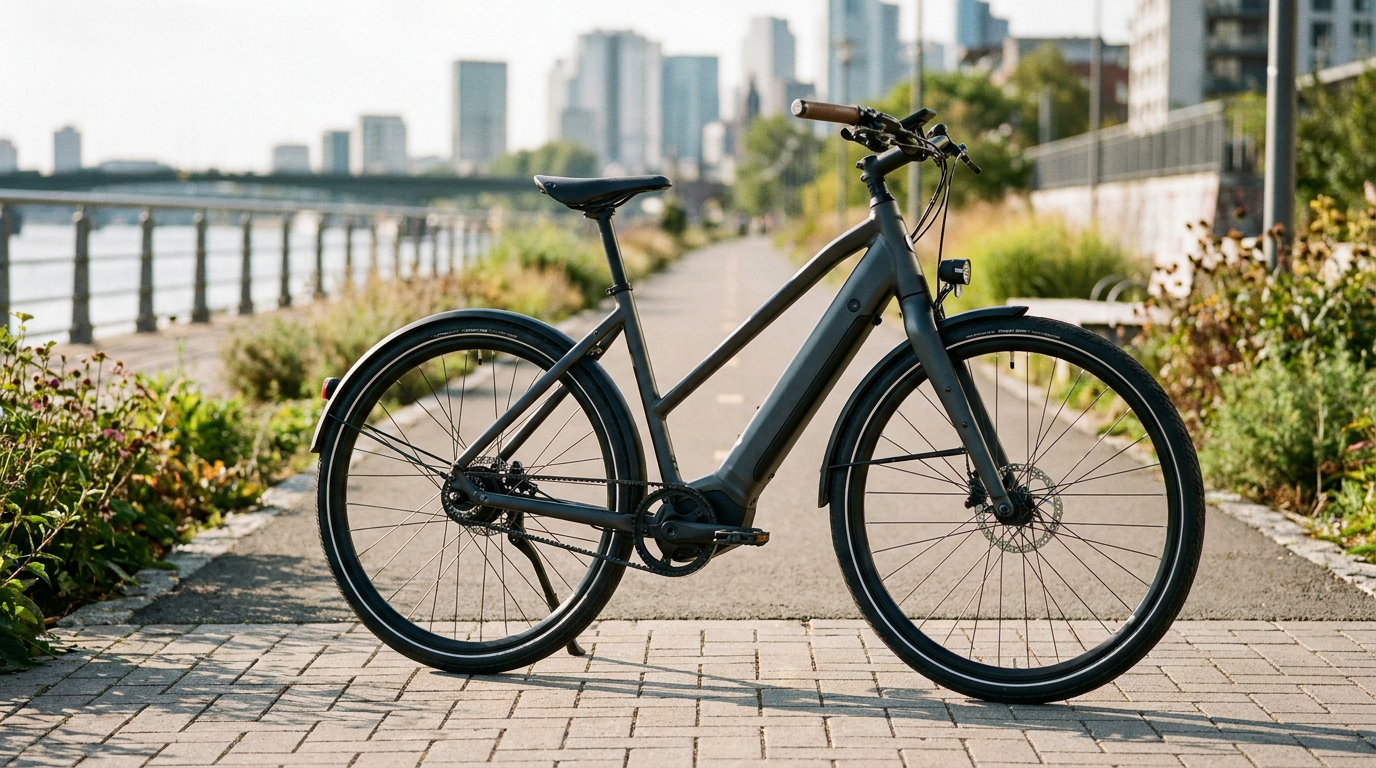
Once the technical specifications are settled, the physical design of the bike dictates its utility. The traditional "step-over" frame with a high top tube is rigid and sporty, but the "step-through" frame has become the dominant choice for urban riding. By removing the top tube, riders can easily mount and dismount without swinging a leg high in the air—a massive advantage when the bike is loaded with groceries or a child seat.[2][5][7]
For riders looking to replace a second car, electric cargo bikes have become the ultimate suburban utility vehicle. Models with elongated rear racks (long-tails) or front buckets can carry hundreds of pounds of payload, including multiple children. These heavy-duty machines require dual batteries, hydraulic disc brakes for safe stopping, and high-torque motors to handle the immense weight.[2][3][4]

Conversely, apartment dwellers and multi-modal commuters often gravitate toward folding e-bikes. Equipped with 20-inch wheels and hinges in the frame and handlebar stem, these bikes can be collapsed to fit under a desk or in the trunk of a car. While they sacrifice some ride stability compared to full-sized bikes, their convenience makes them highly popular in dense urban centers.[1][3][5]
Ultimately, an e-bike is a significant investment, with quality entry-level models starting around $1,000 and premium replacements for cars stretching past $4,000. While direct-to-consumer online brands offer aggressive pricing, purchasing from a local bike shop provides professional assembly, warranty support, and the irreplaceable opportunity to test ride the geometry before committing.[3][5][6]
How we got here
Pre-2010s
Early e-bikes are heavy, niche novelties relying on bulky lead-acid batteries with limited range.
2015
California introduces the three-class e-bike system, setting a regulatory template that spreads across the United States.
2020
The global pandemic triggers a massive bicycle boom, rapidly accelerating e-bike adoption for both recreation and commuting.
2022
Rising concerns over lithium-ion battery fires prompt a major industry push toward rigorous UL safety certifications.
2026
E-bikes reach mainstream maturity, featuring fully integrated batteries, natural-feeling torque sensors, and specialized frame styles.
Viewpoints in depth
Urban Commuters
Riders focused on replacing car trips with practical, sweat-free transit.
For the urban commuter, the e-bike is a utilitarian tool rather than a piece of sporting equipment. This camp prioritizes reliability, low maintenance, and practical features like integrated lighting, fenders, and rear racks. They heavily favor step-through frames for easy mounting in work clothes and often prefer Class 2 or Class 3 bikes to keep up with city traffic and avoid arriving at the office sweaty.
Cargo & Family Riders
Riders using heavy-duty e-bikes to haul groceries and transport children.
Cargo riders view e-bikes as direct replacements for minivans and SUVs. Because they are hauling hundreds of pounds of payload, this camp is uncompromising on motor torque—demanding 80 Nm or more to prevent stalling on hills. They require dual-battery setups for extended range under heavy load and insist on hydraulic disc brakes to safely stop a massive, fast-moving vehicle.
Recreational & Fitness Riders
Cyclists seeking a natural, athletic riding experience with a motorized tailwind.
Fitness-oriented riders want an e-bike that still feels like a traditional bicycle. They generally avoid throttles and heavy hub motors, strongly preferring lightweight mid-drive systems paired with highly responsive torque sensors. For this camp, the motor is meant to flatten out grueling climbs and extend their weekend range, not to do all the work for them.
Safety Regulators
Advocates focused on standardizing electrical safety to prevent battery fires.
Following a wave of catastrophic lithium-ion battery fires in dense urban centers, safety regulators and consumer advocates have drawn a hard line on electrical standards. They argue that uncertified, direct-to-consumer e-bikes pose an unacceptable risk to residential buildings. This camp pushes for mandatory UL 2849 certification across the industry, ensuring that the battery, motor, and charger are independently tested as a cohesive, fail-safe system.
What we don't know
- How future battery recycling infrastructure will scale to handle the millions of e-bike batteries reaching their end-of-life later this decade.
- Whether local municipalities will update multi-use path speed limits to accommodate the influx of heavier, faster Class 3 e-bikes.
Key terms
- Watt-hour (Wh)
- A measure of battery capacity indicating how much energy the battery holds, which directly impacts the bike's range.
- Torque (Nm)
- The rotational force of the motor, dictating how well the bike accelerates from a stop and climbs steep hills.
- Mid-Drive Motor
- A motor positioned at the bike's pedals that leverages the bicycle's existing gears for efficient hill climbing.
- Hub Motor
- A motor housed in the center of the front or rear wheel, common on more affordable commuter e-bikes.
- Torque Sensor
- A sensor that measures how hard the rider is pedaling and delivers proportional motor assistance for a natural, bionic feel.
- Cadence Sensor
- A sensor that detects if the pedals are turning, delivering a set amount of power regardless of the rider's physical effort.
- UL 2849
- The gold-standard safety certification for an e-bike's entire electrical system, designed to prevent fire hazards.
Frequently asked
Do I still get exercise on an e-bike?
Yes. Because e-bikes make riding more enjoyable and accessible by flattening hills, studies show owners ride more frequently and for longer distances, resulting in significant cardiovascular benefits.
How far can I actually go on a single charge?
Real-world range is typically 60% to 70% of the manufacturer's advertised maximum, depending heavily on terrain, rider weight, wind, and the level of motor assistance used.
What is the difference between Class 1, 2, and 3 e-bikes?
Class 1 assists up to 20 mph while pedaling. Class 2 includes a throttle that works without pedaling up to 20 mph. Class 3 assists up to 28 mph but requires the rider to pedal.
Why is UL certification so important?
UL 2849 and UL 2271 certifications ensure that the battery, motor, and charger have passed rigorous independent safety tests to prevent electrical overloads and fires.
Sources
Source coverage
7 outlets
4 viewpoints surfaced






[1]Factlen Editorial TeamSafety Regulators
Synthesis by Factlen editorial team
Read on Factlen Editorial Team →[2]BicyclingRecreational & Fitness Riders
The Best E-Bikes for 2026
Read on Bicycling →[3]ElectricBikeReviewCargo & Family Riders
Top 10 Electric Bikes for 2025-2026
Read on ElectricBikeReview →[4]MomentumSafety Regulators
UL Certified Electric Bikes - UL 2849 and UL 2271 Certification
Read on Momentum →[5]Riding5Urban Commuters
E-Bike Buying Guide: How to Choose
Read on Riding5 →[6]Bike24Recreational & Fitness Riders
E-Bike Buying Guide: Find the Right Electric Bike
Read on Bike24 →[7]Electric Bike ReportUrban Commuters
Our Best City and Urban Electric Bikes for 2026
Read on Electric Bike Report →

Every angle. Every day.
Get shopping stories with full source coverage and perspective breakdowns delivered to your inbox.