
Israel and Hezbollah Begin Ceasefire as U.S.-Iran Peace Talks Face Immediate Delays
A fragile ceasefire took effect in Lebanon following a deadly 24-hour flare-up, while planned U.S.-Iran negotiations in Switzerland were postponed amid regional tensions.
By Factlen Editorial Team
- U.S. & Iranian Pragmatists
- Focus on immediate economic relief, ending the five-week war, and reopening global trade routes.
- Israeli Security Establishment
- Focus on maintaining military deterrence and skepticism of Iran's ability to control its proxy network.
- Lebanese & Regional Observers
- Focus on the civilian toll, the fragility of the proxy ceasefire, and the immediate humanitarian impact.
What's not represented
- · Lebanese civilians displaced by the buffer zone
- · Global shipping companies navigating the Strait of Hormuz
Why this matters
The durability of this ceasefire directly impacts global energy markets, the trajectory of the U.S.-Iran nuclear negotiations, and the immediate safety of millions of civilians across the Middle East. If the broader 60-day diplomatic window collapses, the region risks plunging back into a devastating multi-front war.
Key points
- A ceasefire between Israel and Hezbollah took effect at 4 p.m. Friday after a deadly 24-hour escalation.
- The overnight violence killed four Israeli soldiers and at least 47 people in Lebanon.
- Planned U.S.-Iran technical talks in Switzerland were postponed amid the regional instability.
- Iran's new Supreme Leader Mojtaba Khamenei approved the U.S. deal despite expressing personal reservations.
- The U.S. has lifted its naval blockade on Iranian ports, and Tehran agreed to reopen the Strait of Hormuz.
- Israel will maintain a six-mile military buffer zone in southern Lebanon for the foreseeable future.
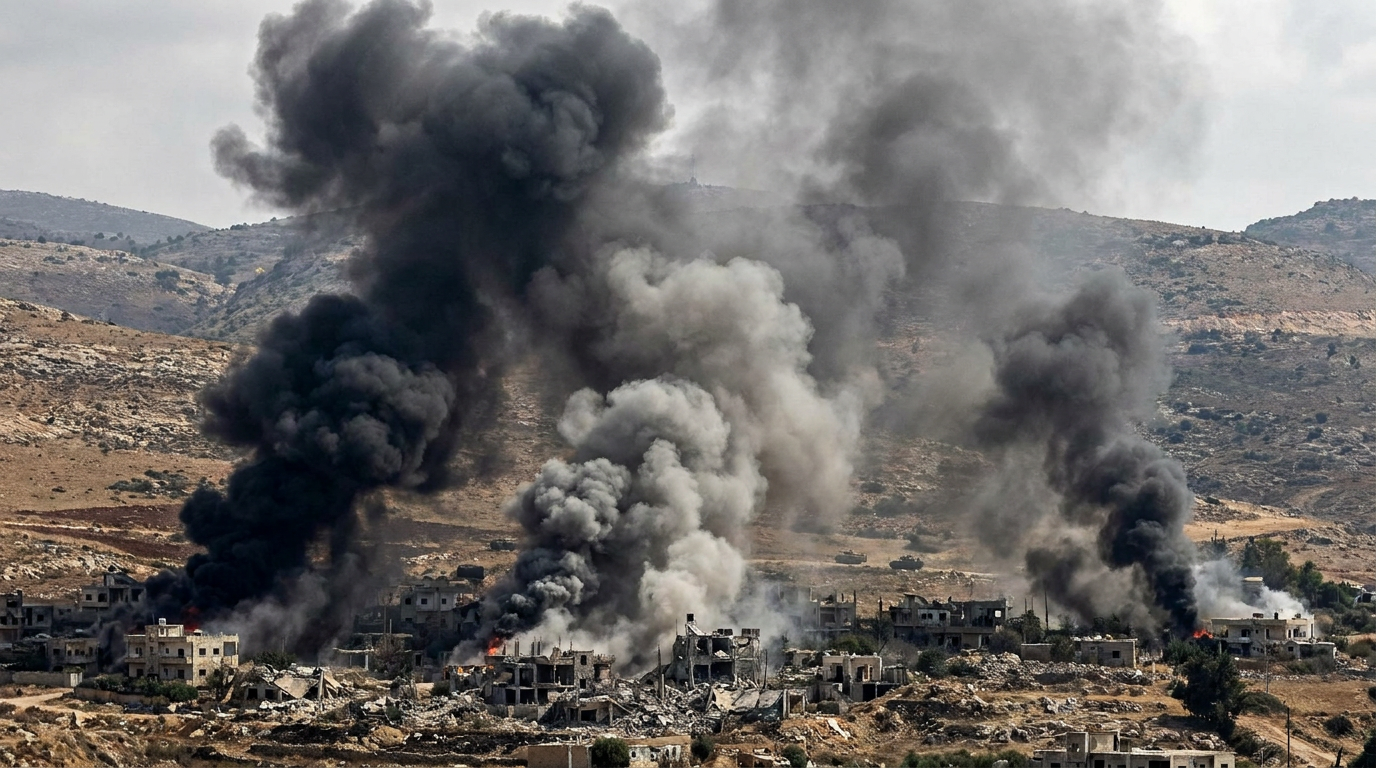
A fragile ceasefire between Israel and Hezbollah officially took effect at 4 p.m. local time on Friday, pausing a deadly 24-hour military escalation that threatened to shatter the newly signed peace framework between the United States and Iran. The truce, brokered by American and Qatari diplomats with back-channel assistance from Tehran, aims to halt hostilities across the volatile Israel-Lebanon border. The urgency of the diplomatic intervention was underscored by the sheer violence of the preceding hours, which marked the deadliest flare-up since Washington and Tehran agreed to an interim memorandum of understanding earlier in the week. The sudden explosion of cross-border fire served as a severe stress test for the broader geopolitical deal, raising immediate questions about whether an agreement negotiated by superpowers could successfully dictate the actions of regional proxies on the ground.[1][4][6]
The overnight bloodshed highlighted the perilous reality preceding the Friday afternoon deadline. The fighting reignited when Hezbollah fighters ambushed an Israeli tank in the Lebanese village of Kfar Tebnit. The sophisticated anti-armor attack resulted in the deaths of four Israeli soldiers, including a 32-year-old battalion commander from the 401st Brigade. For the Israeli military, the loss of senior officers in a single localized engagement represented a severe tactical blow, immediately prompting calls from hardline government ministers to intensify the northern campaign. The ambush demonstrated that despite the overarching diplomatic agreements being signed in foreign capitals, Hezbollah retained both the capability and the willingness to execute lethal strikes against advancing Israeli armor.[4][5]
In response to the tank ambush, the Israel Defense Forces launched a massive wave of retaliatory bombardments, striking at least 80 Hezbollah infrastructure targets across southern and eastern Lebanon. The aerial campaign targeted weapons depots, launch sites, and command centers in Nabatieh and surrounding districts. However, the civilian toll of the rapid escalation was severe. The Lebanese health ministry reported that at least 47 people, including women and children, were killed in the strikes, with nearly 100 others wounded before the guns finally fell silent. The sheer volume of the exchange threatened to spiral into a wider confrontation, forcing mediators in Washington and Doha to scramble to salvage the cessation of hostilities before the violence became irreversible.[2][4][5]
The mechanics of the resulting ceasefire reflect a delicate and highly conditional compromise. While Hezbollah agreed to halt its rocket and anti-tank fire, Israeli officials confirmed that the IDF will not withdraw its forces back to the internationally recognized Blue Line. Instead, Israeli troops will remain stationed within a newly established six-mile buffer zone inside southern Lebanon. Military spokespersons emphasized that the IDF will maintain this forward presence for "as long as required" to ensure the security of northern Israeli communities, warning that any further Hezbollah aggression will be met with immediate and overwhelming military force. This asymmetric arrangement leaves a heavily armed Israeli presence on Lebanese soil, a reality that Hezbollah has historically refused to accept long-term.[5][6]

The localized Lebanon ceasefire is inextricably linked to the broader, historic memorandum of understanding signed on Wednesday by U.S. President Donald Trump and Iranian President Masoud Pezeshkian. That 14-point framework was designed to formally end a devastating five-week regional war that erupted in late February following U.S. and Israeli strikes on Iranian leadership. The interim agreement represents a monumental shift in Middle Eastern geopolitics, attempting to replace decades of shadow wars and proxy conflicts with a structured, albeit fragile, diplomatic off-ramp. By explicitly linking the cessation of hostilities in Lebanon to the broader U.S.-Iran detente, the framework essentially places the burden of regional stability squarely on the shoulders of Washington and Tehran.[4][8]
The underlying mechanism of the U.S.-Iran deal relies on immediate, reciprocal economic and military concessions. On Thursday, the U.S. Central Command officially ended its naval blockade of Iranian ports, a move that immediately de-escalated tensions in the Persian Gulf. In return, Tehran committed to reopening the Strait of Hormuz to commercial shipping. Washington has also agreed to waive crippling oil sanctions, providing immediate economic relief to Iran's battered economy. In exchange, Iran is expected to enforce a cessation of hostilities across its entire "Resistance Front," which includes Hezbollah in Lebanon, militias in Iraq and Syria, and the Houthis in Yemen.[8]
The reopening of the Strait of Hormuz is perhaps the most globally consequential element of the interim agreement. As a critical maritime chokepoint between the Persian Gulf and the Gulf of Oman, the strait facilitates the transit of a significant portion of the world's daily oil supply. Iran's blockade of the waterway during the five-week conflict had sent shockwaves through global energy markets, spiking crude prices and threatening widespread economic disruption. Following the signing of the memorandum, oil prices immediately tumbled, reflecting market optimism that the free flow of energy shipments would resume. However, shipping activity remains muted as commercial vessels await concrete guarantees of safe passage.[8]

The reopening of the Strait of Hormuz is perhaps the most globally consequential element of the interim agreement.
Beyond immediate de-escalation, the interim agreement establishes a strict 60-day window for the United States and Iran to negotiate a final, comprehensive treaty. These talks are slated to address Iran's nuclear program, ballistic missile development, and broader regional security architecture. If a permanent resolution is reached within this timeframe, the framework stipulates that the U.S. will facilitate the release of a $300 billion regional reconstruction fund, supported by neighboring Gulf nations. This massive financial incentive is designed to rebuild infrastructure destroyed during the conflict and integrate Iran into the regional economy, theoretically raising the cost of any future return to armed conflict.[8]
However, the path to that final signature hit a significant diplomatic roadblock on Friday. A highly anticipated round of technical negotiations, scheduled to take place at the Bürgenstock mountaintop resort in Switzerland, was abruptly postponed. The White House announced that Vice President JD Vance, who was slated to lead the American delegation, had delayed his trip. The sudden cancellation threw the immediate timeline of the 60-day window into doubt, raising concerns that the momentum generated by the Wednesday signing ceremony was already beginning to stall amid the realities of ongoing regional violence.[7][8]
The reasons for the delay highlight the immense difficulty of synchronizing high-level diplomatic summits with the chaotic realities of active combat zones. U.S. officials cited logistical challenges that were neither "simple nor predictable," insisting that Washington still looked forward to beginning technical talks as soon as possible. Conversely, Hezbollah-linked media in Lebanon reported that the Iranian delegation suspended its participation specifically because of the ongoing Israeli airstrikes in southern Lebanon. The conflicting narratives underscore the fragility of the process, where a single tactical engagement on the ground can instantly derail strategic negotiations thousands of miles away.[7]

The pause in negotiations also provides a window into the complex internal politics currently navigating Tehran's corridors of power. The recent conflict fundamentally altered Iran's leadership structure. Ayatollah Mojtaba Khamenei ascended to the role of Supreme Leader after his father, Ali Khamenei, was killed in a U.S.-Israeli airstrike on the first day of the war on February 28. The younger Khamenei, who has yet to make a public appearance since taking power, faces the daunting task of consolidating authority among hardline factions while simultaneously managing the pragmatic necessity of economic relief through the U.S. deal.[8]
On Thursday, Mojtaba Khamenei used the diplomatic pause to issue his first major public statement regarding the peace framework. In a carefully worded written message read on state television, the new Supreme Leader revealed that he fundamentally held a "different view" on the memorandum of understanding. Despite his personal reservations, Khamenei stated that he authorized the agreement based on explicit commitments from President Pezeshkian and the Supreme National Security Council. By framing the deal as a pragmatic concession managed by the civilian government, Khamenei effectively insulated himself from potential hardliner backlash if the agreement ultimately collapses.[3][8]
Attempting to project strength to his domestic audience, Khamenei claimed that the U.S. administration had pursued the deal "out of desperation," utilizing all available leverage to force an end to the conflict. He drew a firm red line for the upcoming 60-day negotiation period, warning that any future face-to-face negotiations would not equate to accepting the "enemy's position." He explicitly stated that Iran would not submit to excessive American demands, signaling to Washington that while Tehran is willing to accept economic relief, it will not fundamentally dismantle its regional security architecture or its core ideological tenets.[3][8]
For Israel, the U.S.-Iran framework presents a profound and complex strategic dilemma. The Israeli government was not a direct signatory to the memorandum, yet the deal's terms explicitly call for an immediate and permanent termination of military operations on all fronts, including Lebanon. Prime Minister Benjamin Netanyahu has offered a notably lukewarm response to the overarching agreement. In public statements, he has emphasized the delicate balance between preserving Israel's vital security relationship with the United States—which brokered the deal—and maintaining the independent military deterrence necessary to protect Israeli citizens from proxy threats.[4][8]

The insistence on maintaining the six-mile buffer zone in Lebanon reflects Israel's deep skepticism regarding the diplomatic framework. Israeli defense officials fundamentally doubt Iran's willingness, or ability, to permanently rein in Hezbollah's military capabilities. From the perspective of the Israeli security establishment, relying on a U.S.-Iran memorandum to secure the northern border is an unacceptable risk. By keeping troops on Lebanese soil, Israel is signaling that it will rely on physical military presence, rather than diplomatic assurances, to prevent a repeat of the devastating cross-border attacks that triggered the wider conflict.[5][6]
As the 4 p.m. ceasefire takes hold, the Middle East enters a highly precarious 60-day transition period. The immediate halt to the violence in Lebanon provides a necessary tactical pause, saving civilian lives and preventing a further spiral of retaliation. However, the underlying mechanisms of the U.S.-Iran deal rely on an unprecedented and untested level of trust between historic adversaries. With the Switzerland technical talks currently in limbo, and heavily armed forces still mobilized within striking distance of one another along the Blue Line, the durability of the peace framework remains deeply in question. The events of the past 24 hours have starkly demonstrated that the region remains just one miscalculation away from reigniting a devastating wider war.[1][4][7]
How we got here
Feb 28, 2026
A regional war erupts following U.S.-Israeli strikes on Iran, which killed former Supreme Leader Ali Khamenei.
April 2026
A fragile initial ceasefire is announced between the U.S. and Iran, temporarily pausing direct hostilities.
June 17, 2026
U.S. President Donald Trump and Iranian President Masoud Pezeshkian sign a 14-point interim memorandum of understanding.
June 18, 2026
The U.S. lifts its naval blockade on Iranian ports, and Iran agrees to reopen the Strait of Hormuz to commercial shipping.
June 19, 2026
A renewed Israel-Hezbollah ceasefire takes effect at 4 p.m. after a deadly escalation, while U.S.-Iran talks in Switzerland are postponed.
Viewpoints in depth
U.S. & Iranian Pragmatists
Focus on immediate economic relief, ending the five-week war, and reopening global trade routes.
For the administrations in Washington and Tehran, the interim agreement is a necessary pragmatic step to avert a wider regional catastrophe. U.S. officials view the deal as a way to stabilize global energy markets and pivot foreign policy focus, while Iranian moderates, led by President Pezeshkian, see it as a vital lifeline to lift crippling sanctions and secure a $300 billion reconstruction fund. This camp argues that localized flare-ups, while tragic, must not derail the broader 60-day diplomatic window.
Israeli Security Establishment
Focus on maintaining military deterrence and skepticism of Iran's ability to control its proxy network.
Israeli defense officials and political leaders view the U.S.-Iran framework with profound skepticism. Because Israel was not a direct party to the memorandum, the security establishment argues that relying on diplomatic assurances from Tehran to secure the northern border is an unacceptable risk. This perspective insists on maintaining a physical military presence—such as the six-mile buffer zone in southern Lebanon—to actively degrade Hezbollah's capabilities and prevent future cross-border attacks, regardless of the broader geopolitical agreements being signed.
Iranian Hardliners
Focus on ideological resistance and framing the diplomatic concessions as a tactical maneuver rather than a surrender.
Within Iran's complex political structure, hardline factions and elements of the Islamic Revolutionary Guard Corps (IRGC) remain deeply opposed to normalizing relations with the United States. Supreme Leader Mojtaba Khamenei's public statement that he held a 'different view' on the deal caters directly to this camp. They view the agreement not as a permanent peace, but as a temporary tactical pause forced by U.S. 'desperation,' ensuring that Iran's core ideological stance against Western influence remains intact even as sanctions are temporarily lifted.
What we don't know
- When the postponed U.S.-Iran technical talks in Switzerland will officially be rescheduled.
- Whether Hezbollah will accept the long-term presence of Israeli troops in the southern Lebanon buffer zone.
- If the 60-day negotiation window will be sufficient to reach a final agreement on Iran's nuclear program.
Key terms
- Memorandum of Understanding (MoU)
- An interim diplomatic agreement outlining the broad terms of a peace deal before a final, binding treaty is negotiated.
- Strait of Hormuz
- A critical maritime chokepoint between the Persian Gulf and the Gulf of Oman, through which a significant portion of the world's oil supply passes.
- Buffer Zone
- A designated area in southern Lebanon, currently extending about six miles from the border, where Israeli forces intend to remain to prevent Hezbollah attacks.
- Resistance Front
- A network of political and armed groups across the Middle East, including Hezbollah, backed by Iran to oppose U.S. and Israeli influence.
Frequently asked
Why was the ceasefire delayed until Friday afternoon?
A deadly overnight flare-up, including a Hezbollah ambush that killed four Israeli soldiers and retaliatory Israeli strikes that killed 47 Lebanese, delayed the implementation until mediators secured a 4 p.m. halt to hostilities.
What happens to the U.S.-Iran talks in Switzerland?
The technical negotiations have been postponed due to logistical challenges and the violence in Lebanon. U.S. Vice President JD Vance delayed his planned trip, though officials say preparations are still ongoing.
Does Iran's Supreme Leader support the deal?
Ayatollah Mojtaba Khamenei stated he had a 'different view' on the agreement but authorized it based on assurances from Iran's president that they would not submit to excessive U.S. demands.
Will Israeli troops leave southern Lebanon?
Not immediately. Israeli officials stated that the IDF will maintain its six-mile buffer zone in southern Lebanon for as long as required to ensure security.
Sources
Source coverage
8 outlets
3 viewpoints surfaced








[1]Fox NewsIsraeli Security Establishment
Israel-Hezbollah ceasefire becomes first test of Trump Iran framework after talks delay
Read on Fox News →[2]Al JazeeraLebanese & Regional Observers
Israel continues attacks on Lebanon despite agreeing to ceasefire
Read on Al Jazeera →[3]NYTU.S. & Iranian Pragmatists
Iran’s Supreme Leader Says He Dislikes Deal With U.S., but Allowed It
Read on NYT →[4]CBS NewsLebanese & Regional Observers
Israel and Hezbollah agree to Lebanon truce, officials say, as fighting delays U.S.-Iran talks
Read on CBS News →[5]The Washington PostIsraeli Security Establishment
After 4 Israeli soldiers' deaths, Israel and Hezbollah agree to renew ceasefire
Read on The Washington Post →[6]The Times of IsraelIsraeli Security Establishment
New Israel-Hezbollah truce takes effect after being brokered by US and Qatar
Read on The Times of Israel →[7]BBC NewsU.S. & Iranian Pragmatists
US-Iran talks postponed as Vance pulls out of Switzerland trip
Read on BBC News →[8]The New ArabU.S. & Iranian Pragmatists
Iran's Mojtaba Khamenei approves deal, US lifts ports blockade
Read on The New Arab →
More in news politics
See all 8 stories →Deepfake Defense
Evidence Pack: The Efficacy of Deepfake Detection and AI Fact-Checking in 2026
7 sources

State vs Federal
DOJ Sues Virginia Over Laws Banning ICE Masks and Limiting Immigration Enforcement
7 sources
Immigration Enforcement
DOJ Sues Virginia to Block New Laws Restricting ICE Agents and Banning Masks
7 sources
FISA Standoff
Trump Halts DNI Confirmation and FISA Renewal to Force Vote on SAVE America Act
8 sources
Every angle. Every day.
Get news politics stories with full source coverage and perspective breakdowns delivered to your inbox.