
How Towering Rigid Sails Are Bringing Wind Power Back to Global Shipping
Faced with strict new carbon taxes, the maritime industry is retrofitting massive cargo ships with airplane-like rigid wings and spinning rotor sails, cutting fuel consumption by up to 30%.
By Factlen Editorial Team
- Commercial Fleet Operators
- Focused on the immediate return on investment, fuel savings, and carbon tax mitigation.
- Maritime Regulators
- Focused on the operational risks, crew training, and navigational safety of wind-assisted vessels.
- Aerospace & Naval Engineers
- Focused on maximizing aerodynamic efficiency, material sustainability, and automated control systems.
What's not represented
- · Seafarers' Unions
- · Alternative Fuel Producers
Why this matters
Shipping accounts for roughly 3% of global greenhouse gas emissions. By proving that wind can reliably power massive modern cargo vessels, this technology offers a scalable, immediate way to decarbonize the global supply chain without waiting for next-generation alternative fuels.
Key points
- Over 100 large commercial vessels will be equipped with wind-assisted propulsion by the end of 2026.
- Rigid wing sails function like vertical airplane wings, automatically adjusting to maximize aerodynamic thrust.
- Trials on the Pyxis Ocean bulk carrier proved the technology can save up to 11 tonnes of fuel in a single day.
- The 2026 phase-in of the EU's maritime carbon tax has drastically accelerated the financial viability of wind propulsion.
- New safety guidelines address the unique challenges of navigating ships with massive aerodynamic structures on deck.
For thousands of years, the global economy was entirely dependent on the wind. That centuries-long dominance ended abruptly in the late 19th century with the rise of steam engines and cheap heavy fuel oil, relegating sails to recreational yachts and historical replicas. But as the maritime industry faces mounting pressure to decarbonize, naval architects are taking ship design back to the future. Today, the wind is returning to the high seas, but the billowing canvas sheets of the clipper era have been replaced by towering columns of steel, fiberglass, and recycled plastic.[7]
The shift is no longer theoretical. By the end of 2026, the global commercial fleet is on track to surpass 100 large vessels equipped with some form of wind-assisted propulsion system (WAPS), representing a rapid doubling of installations over a two-year period. These systems are being bolted onto the decks of massive bulk carriers, oil tankers, and roll-on/roll-off car ferries. The technology aims to solve a massive environmental math problem: international shipping consumes over 300 million tons of fuel annually, accounting for roughly 3% of all global greenhouse gas emissions.[6][7]
The catalyst for this sudden adoption is a combination of engineering breakthroughs and regulatory sticks. In 2024, the European Union expanded its Emissions Trading System (ETS) to include maritime shipping, forcing shipowners to purchase carbon allowances for their voyages. By 2026, that phase-in reached 100% of reported emissions, fundamentally altering the economic calculus of ocean freight. Suddenly, any technology that could shave even a few percentage points off a vessel's daily fuel consumption became a highly lucrative investment.[7]
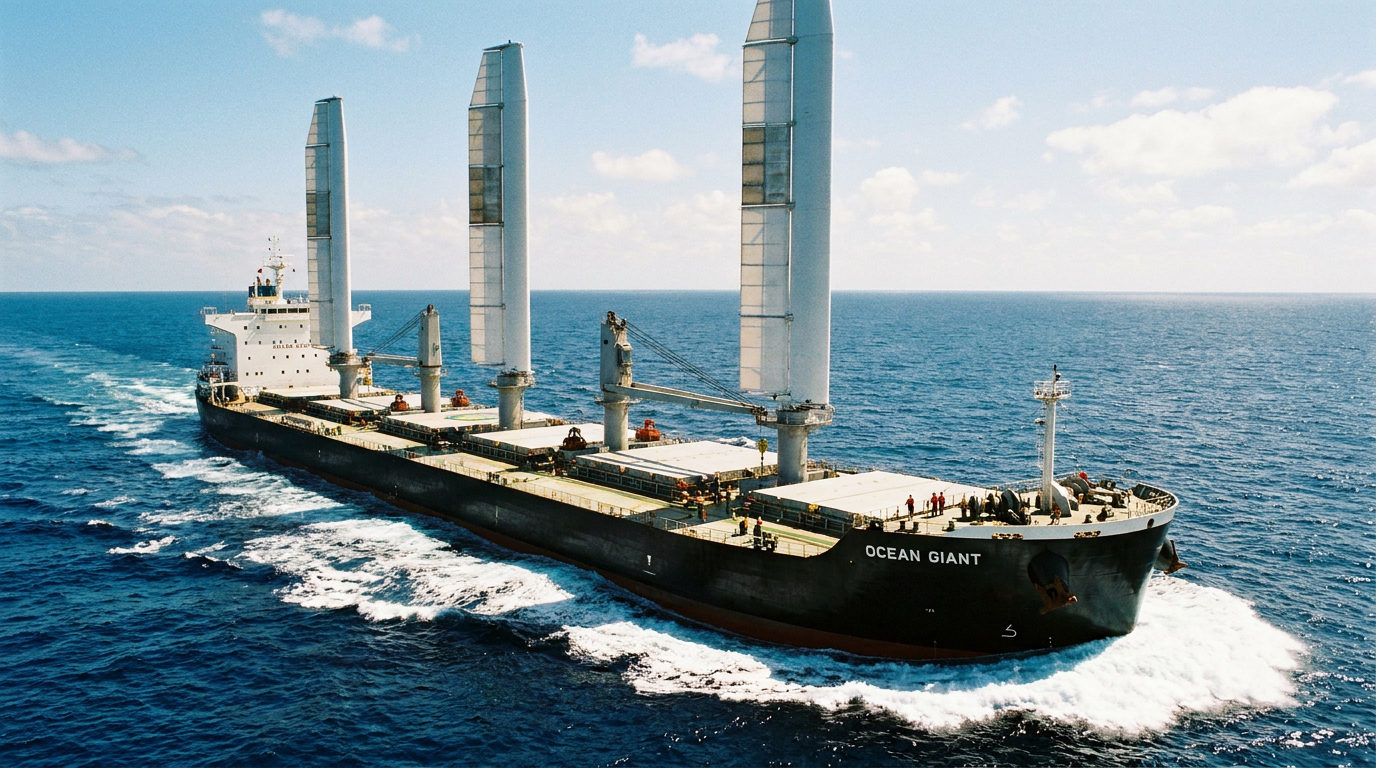
Leading the charge is a technology known as the rigid wing sail. Developed by aerospace engineers, these structures look and function exactly like the wings of a commercial airliner, except they are mounted vertically on a ship's deck to generate horizontal thrust rather than vertical lift. Unlike traditional cloth sails that simply catch the wind, rigid wings slice through the air to create a pressure differential, pulling the massive steel hulls forward with remarkable aerodynamic efficiency.[6]

The most prominent example is the WindWings system, designed by UK-based BAR Technologies. Each wing stands 37.5 meters tall and 20 meters wide, constructed from three distinct moving elements. Much like an airplane wing deploying slats and flaps for takeoff, the WindWings can automatically adjust their camber—their asymmetric curve—to maximize thrust depending on the wind's angle and speed. When the wind is dead ahead, the flaps retract to flatten the wing, minimizing aerodynamic drag.[6]
The maritime industry is notoriously conservative, demanding hard data before adopting new hardware. That data arrived via the Pyxis Ocean, a Kamsarmax-class bulk carrier chartered by agricultural giant Cargill, which was retrofitted with two WindWings and sent into open waters. Over a rigorous testing period, the vessel traversed the Indian and Pacific Oceans, crossed the Atlantic, and rounded both Cape Horn and the Cape of Good Hope to expose the sails to every conceivable weather condition.[3][4]
The results, independently verified by the classification society DNV, validated the aerospace models. In favorable weather conditions, the two sails reduced the main engine's energy consumption by 32% per nautical mile. On average, across all global routes and seasons, the system saved 1.5 tonnes of heavy fuel oil per wing per day. In near-optimum sailing conditions, the Pyxis Ocean achieved total fuel savings of 11 tonnes in a single day, translating to a reduction of 41 tonnes of carbon dioxide emissions.[3][4][8]

The results, independently verified by the classification society DNV, validated the aerospace models.
The thrust generated by these rigid wings is so substantial that, during one ballast passage with highly favorable winds, the Pyxis Ocean was able to cut its main engine entirely and sail at 9 knots using only the power of the wind. While modern cargo ships will never rely exclusively on wind—schedules are too tight and weather too unpredictable—this "free sailing" capability proves that wind-assist is no longer a marginal efficiency tweak, but a primary propulsion source.[8]
Rigid wings are not the only technology vying for deck space. The second major category of wind propulsion is the rotor sail, or Flettner rotor. First tested in the 1920s but largely abandoned when oil was cheap, a rotor sail is a massive upright cylinder that is mechanically spun by a small electric motor. As the wind hits the spinning cylinder, it creates a phenomenon known as the Magnus effect—the same aerodynamic force that causes a tennis ball with topspin to curve downward in flight.[7]
On a ship, the Magnus effect creates a powerful pressure difference across the spinning cylinder, generating forward thrust that is perpendicular to the wind direction. Because they have a small footprint and no moving external flaps, rotor sails are highly favored for vessels with limited deck space, such as oil tankers and container ships. Recent iterations have grown massive; engineers in China recently completed testing on a rotor sail measuring 35 meters in height and 5 meters in diameter, capable of spinning at 180 revolutions per minute to generate immense thrust.[7]
Meanwhile, material science is pushing the boundaries of sustainability even further. In late 2025, a Swedish joint venture named Oceanbird—backed by Alfa Laval and Wallenius Lines—unveiled its Wing 560 prototype. Standing 40 meters tall, the rigid sail features a high-strength steel core, but its aerodynamic surfaces are constructed from a composite sandwich of glass fiber and 380,000 recycled plastic bottles.[1][2]
The Oceanbird prototype was erected at a drydock in Landskrona, Sweden, serving as a towering testbed for crew training and automation optimization. The company is currently assembling a second, identical wing that will be installed on the Tirranna, an 8,000-car roll-on/roll-off carrier, in early 2026. Developers project that a single Wing 560 installation can reduce a vessel's fuel consumption and emissions by up to 10% on optimal routes.[1][2]

Operating these massive structures requires virtually no traditional sailing knowledge from the crew. The systems are highly automated, relying on arrays of sensors that constantly measure wind speed and direction. On the bridge of the Pyxis Ocean, the crew monitors a simple touch panel featuring a traffic light system. When the light turns green, the crew pushes a button to raise the sails; from there, onboard computers take over, continuously trimming the wings to the optimal angle of attack.[3]
However, strapping 40-meter-tall obstructions to the deck of a commercial ship introduces severe operational complexities. In May 2026, the Baltic and International Maritime Council (BIMCO) and the Maritime Technologies Forum published comprehensive safety guidelines for wind-assisted vessels. The framework addresses critical risks, including radar blind spots, restricted lines of sight from the bridge, and the altered maneuverability of a ship being pushed horizontally by the wind.[5]
Port logistics present another major hurdle. Every terminal and berth is different, and cargo cranes cannot easily reach over towering sails. To solve this, modern wings and rotors are designed to fold down flat against the deck or tilt horizontally when approaching a port or passing under bridges. Even so, the heavy steel foundations required to support the sails add significant weight to the ship—roughly 1,590 metric tons of deadweight loss in the case of the Pyxis Ocean—which slightly reduces the total amount of cargo the vessel can legally carry.[2][3][8]

To mitigate these retrofitting penalties, the industry is rapidly shifting toward "Wind-Ready" newbuilds. By designing the structural reinforcements and hydraulic routing into the ship's original blueprints, shipyards can drastically reduce the cost and deadweight penalties of adding sails later. Experts argue that ordering a new commercial vessel today without wind-ready structural preparations is a massive financial oversight, given the tightening regulatory noose around carbon emissions.[7]
The maritime industry is currently navigating the most profound technological transition since the death of the steam engine. While alternative fuels like green methanol and ammonia remain scarce and expensive, the wind is free, globally distributed, and entirely zero-carbon. By blending the oldest propulsion method in human history with the aerodynamics of modern aviation, commercial shipping is finally charting a course toward a sustainable horizon.
How we got here
August 2023
The Pyxis Ocean bulk carrier embarks on its maiden voyage equipped with two 37.5-meter WindWings.
January 2024
The European Union expands its Emissions Trading System to include maritime shipping.
August 2025
Oceanbird unveils its 40-meter Wing 560 prototype, constructed partly from 380,000 recycled plastic bottles.
January 2026
The EU ETS shipping carbon tax reaches its 100% phase-in, drastically increasing the cost of burning heavy fuel oil.
May 2026
BIMCO and the Maritime Technologies Forum publish the first comprehensive safety guidelines for wind-assisted ships.
Viewpoints in depth
Commercial Fleet Operators
Focused on the immediate return on investment, fuel savings, and carbon tax mitigation.
For fleet operators, wind propulsion is strictly a math equation. With the EU ETS carbon tax fully phased in by 2026, every ton of heavy fuel oil burned carries a steep financial penalty. Operators view wind-assist not as a total replacement for engines, but as a highly effective "shaving" tool that cuts daily fuel consumption by 10% to 30%. Their primary concerns revolve around the deadweight loss of installing heavy steel foundations and the potential for port delays if the sails interfere with cargo loading.
Maritime Regulators & Safety Bodies
Focused on the operational risks, crew training, and navigational safety of wind-assisted vessels.
Organizations like BIMCO and the Maritime Technologies Forum are racing to standardize safety protocols for a technology that fundamentally alters how a ship handles. Regulators are deeply concerned about radar blind spots created by 40-meter steel towers, restricted visibility from the bridge, and the unpredictable maneuverability of a ship experiencing massive horizontal thrust during a storm. They are pushing for mandatory, role-specific simulator training for crews who are suddenly being asked to operate complex aerodynamic systems.
Aerospace & Naval Engineers
Focused on maximizing aerodynamic efficiency, material sustainability, and automated control systems.
The engineering community views wind-assist as a fascinating crossover between aviation and maritime architecture. Their focus is on pushing the boundaries of the Magnus effect and rigid wing camber to extract the maximum possible thrust from the wind. Engineers are also pioneering the use of sustainable composite materials—such as recycled plastic bottles—to build the sails, and developing sophisticated "digital twin" routing software that automatically steers the ship into optimal wind corridors without requiring human intervention.
What we don't know
- How well the complex hydraulic and composite structures will withstand 25 years of exposure to corrosive saltwater and extreme ocean storms.
- Whether smaller, less-equipped ports will be able to efficiently load and unload cargo from vessels with massive folded sails on their decks.
Key terms
- Wind-Assisted Propulsion System (WAPS)
- Any technology that harnesses wind to supplement a ship's main engine, reducing overall fuel consumption.
- Rigid Wing Sail
- A solid, airplane-like vertical wing mounted on a ship's deck to generate forward thrust from the wind.
- Rotor Sail (Flettner Rotor)
- A large spinning cylinder that uses the Magnus effect to create aerodynamic lift and propel a vessel.
- Magnus Effect
- The observable phenomenon where a spinning object drags air with it, creating a pressure difference that generates thrust.
- Deadweight Loss
- The reduction in a ship's total cargo-carrying capacity caused by the added weight of heavy equipment, such as steel sail foundations.
- EU Emissions Trading System (ETS)
- A carbon market that requires shipowners to purchase allowances for the greenhouse gases their vessels emit.
Frequently asked
Can these cargo ships sail on wind power alone?
Generally, no. The sails are designed to assist the main engine, reducing fuel use by 10% to 30%. However, in perfect wind conditions, ships like the Pyxis Ocean have occasionally been able to cut their engines and sail at low speeds using only wind thrust.
What happens to the sails during a severe storm?
Modern rigid sails and rotors are highly automated and designed to fold down flat against the deck, retract, or stop spinning at the push of a button to minimize their surface area and avoid structural damage in extreme weather.
Do the massive sails get in the way of loading cargo?
They can pose logistical challenges, as port cranes cannot reach over them. To solve this, the sails are engineered to fold horizontally or are installed on the extreme edges of the deck, allowing normal loading and unloading operations to continue.
Why did the shipping industry stop using sails in the first place?
In the late 19th and early 20th centuries, steam engines and cheap heavy fuel oil offered reliable, predictable transit times that wind could not guarantee. Today's carbon taxes and climate goals have changed that economic equation, bringing wind back as a supplementary power source.
Sources
Source coverage
8 outlets
3 viewpoints surfaced








[1]The Maritime ExecutiveAerospace & Naval Engineers
Oceanbird Unveils Prototype Wing Sail as it Moves to Commercial Application
Read on The Maritime Executive →[2]Seatrade Maritime NewsAerospace & Naval Engineers
Oceanbird demonstrates first rigid wing sail in Sweden
Read on Seatrade Maritime News →[3]Riviera Maritime MediaCommercial Fleet Operators
Pyxis Ocean wind-propulsion trial yields 11 tonnes/day fuel savings
Read on Riviera Maritime Media →[4]Offshore EnergyCommercial Fleet Operators
DNV verifies WindWings performance on Pyxis Ocean
Read on Offshore Energy →[5]BIMCOMaritime Regulators
New guidelines support safe uptake of wind-assisted propulsion
Read on BIMCO →[6]ASMEAerospace & Naval Engineers
Rigid Sails Cut Cargo Ship Fuel Use
Read on ASME →[7]Ocean JournalMaritime Regulators
Wind-assisted propulsion systems for green shipping: A techno-economic review
Read on Ocean Journal →[8]North StandardCommercial Fleet Operators
Wind Propulsion: Pyxis Ocean and AirWing
Read on North Standard →
Every angle. Every day.
Get transportation stories with full source coverage and perspective breakdowns delivered to your inbox.