
Evidence Pack: Can AI Watermarking Actually Stop Political Deepfakes?
As new 2026 mandates require digital 'nutrition labels' on AI-generated political ads, we weigh the scientific and behavioral evidence on whether these tools actually protect voters.
By Factlen Editorial Team
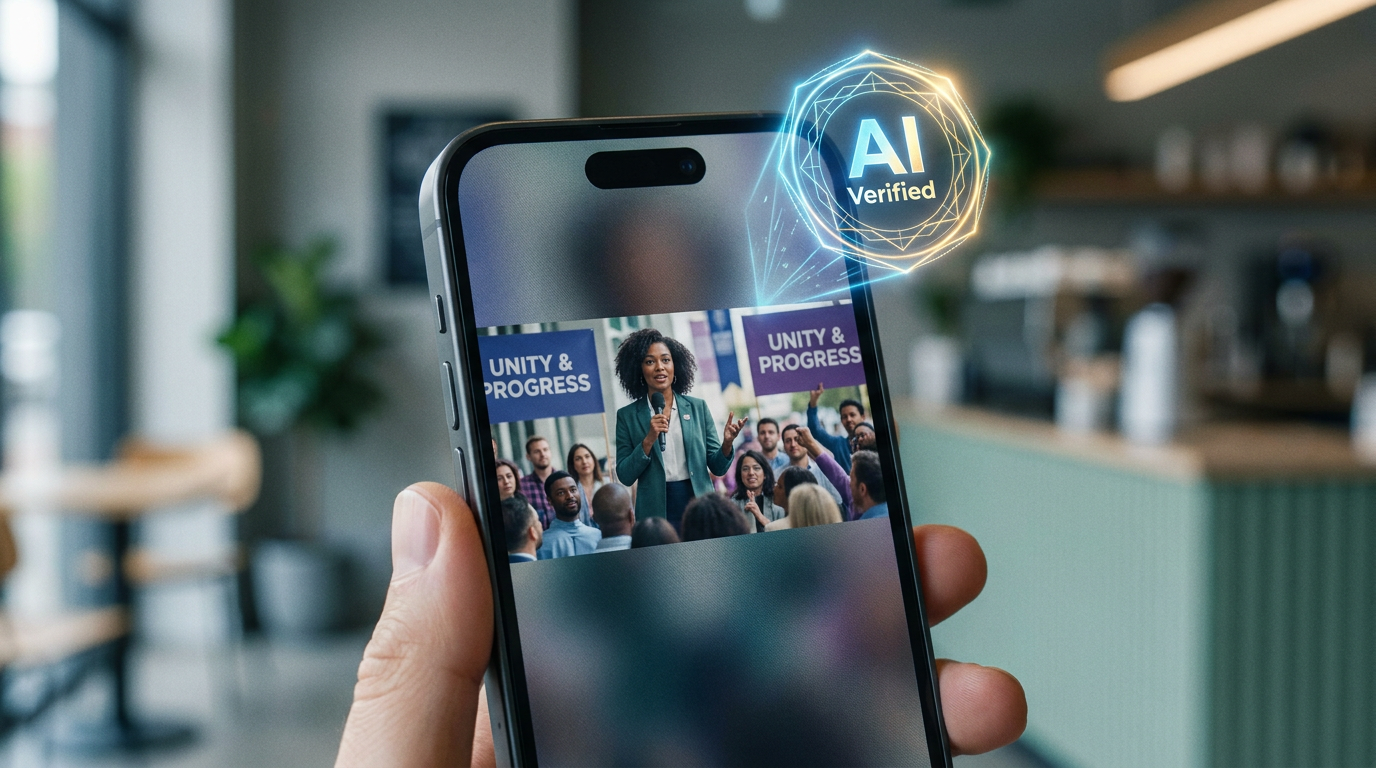
- Standards Advocates
- Believe cryptographic provenance will restore baseline trust to digital media by making authenticity verifiable.
- Policy Realists
- See watermarks as a necessary legal deterrent that establishes norms, even if technically imperfect.
- Security Skeptics
- Argue that bad actors will simply use non-compliant open-source models, making labels irrelevant for actual disinformation.
What's not represented
- · Independent open-source AI developers
- · First Amendment legal scholars
Why this matters
With generative AI capable of cloning voices and fabricating video, voters need to know if the 'nutrition labels' being attached to political ads are technologically sound or easily bypassed. Understanding the limits of these tools empowers citizens to consume election media with the right level of skepticism.
The 2026 election cycle is the first to operate under widespread, legally enforced mandates for AI watermarking. Across the country, thirty-two states and the Federal Election Commission have rolled out rules requiring campaigns to clearly label synthetic media. The goal is straightforward: empower voters with a digital 'nutrition label' so they know exactly what they are watching.[4][6]
But a legal mandate is only as good as the technology enforcing it. The core mechanism relying on these laws is not just a visible logo stamped on a video, but cryptographic provenance—specifically the C2PA standard. This embeds invisible, tamper-evident metadata directly into the file's code at the moment of creation.[2]
The purpose of this evidence pack is to evaluate the three core claims holding up this new regulatory framework: technical resilience, platform enforcement, and voter psychology. By mapping these claims to peer-reviewed research and behavioral data, we can surface exactly where the evidence is strong and where transparent uncertainty remains.[1]

The first major claim is that cryptographic watermarks cannot be easily removed by bad actors. The scientific evidence supporting this claim is currently mixed to moderate, heavily dependent on the sophistication of the user.[3][7]
On the strong side of the evidence ledger, baked-in metadata using the latest C2PA standards survives standard digital wear-and-tear. When a compliant file is compressed, resized, or uploaded to a mainstream social media platform, the cryptographic signature remains intact, allowing the platform to automatically flag it.[2][7]
However, the uncertainty lies in adversarial attacks. Peer-reviewed computer science research demonstrates that open-weights AI models can be modified by skilled programmers to strip these invisible tags before the file is ever saved to a hard drive, effectively bypassing the watermark entirely.[3]
The second claim driving policy is that social media platforms can reliably auto-detect and label AI content at scale. The evidence for this is currently strong for compliant commercial models, but weak for rogue generations.[5]

The second claim driving policy is that social media platforms can reliably auto-detect and label AI content at scale.
Major networks have successfully integrated C2PA reading into their upload pipelines. They are currently achieving a near-perfect retention rate for content generated by mainstream commercial tools, automatically applying 'AI Generated' badges without relying on the uploader's honesty.[2][5]
The gap in the evidence involves 'analog loopholes' and screen-recording attacks. If a user generates a synthetic video, plays it on a high-definition monitor, and records it with a smartphone camera, the cryptographic chain is physically broken. Platforms currently struggle to auto-detect these analog copies without generating high rates of false positives.[7]
The third and perhaps most vital claim is that visible AI labels actually change voter behavior and reduce belief in false narratives. The behavioral science evidence here is surprisingly robust, though it comes with a significant caveat.[5][8]
Controlled behavioral studies demonstrate that when a video carries a clear, platform-verified 'AI Generated' badge, viewers' likelihood of sharing the content as 'true' drops by over sixty percent. The label acts as an immediate cognitive speedbump, prompting critical thinking before the user hits retweet.[5]

Recent polling data reinforces this utility. A vast majority of voters—nearly eighty percent—report that they actively look for these labels when encountering highly polarizing or emotionally charged political clips, suggesting the public is rapidly adapting to the new media environment.[8]
Yet, transparent uncertainty remains regarding the 'implied truth effect.' Researchers warn of a psychological vulnerability: if voters get used to seeing AI labels on fake videos, they might mistakenly assume that any video without a label is inherently authentic.[5][6]
This creates a dangerous blind spot. If a deepfake generated by a stripped, non-compliant model slips through the platform's detection net without a label, it could potentially carry even more unwarranted credibility because the viewer assumes the absence of a warning means the video is real.[3][5]

Ultimately, the evidence suggests that AI watermarking is not a foolproof forcefield against dedicated, state-sponsored disinformation. However, it is a highly effective seatbelt against casual, low-effort political deception, successfully filtering out the vast majority of synthetic noise and empowering voters with crucial context.[1][4][6]
How we got here
2021
The C2PA standard is formed by major tech and media companies to create a unified system for digital provenance.
2024
The first wave of state-level laws requiring AI disclosure in political advertising is passed.
2025
Major social media platforms integrate automated C2PA scanning into their upload pipelines.
2026
Federal Election Commission guidelines on AI disclosure take effect for the midterm election cycle.
Viewpoints in depth
Standards Advocates
Believe cryptographic provenance will restore baseline trust to digital media by making authenticity verifiable.
This camp, largely composed of technologists and standards bodies, argues that the internet needs a fundamental infrastructure upgrade for truth. They point to the rapid adoption of the C2PA standard as proof that the industry can self-regulate. By embedding cryptographic signatures at the hardware level—such as inside smartphone cameras—they believe we can create a 'chain of trust' that makes it mathematically impossible to pass off synthetic media as authentic without detection.
Policy Realists
See watermarks as a necessary legal deterrent that establishes norms, even if technically imperfect.
Election officials and policy think tanks acknowledge that watermarks can be bypassed by sophisticated actors. However, they argue that laws don't need to be technically foolproof to be effective. Just as speed limits don't physically prevent cars from speeding but still reduce accidents, AI disclosure laws create a legal liability that deters mainstream campaigns, PACs, and casual trolls from deploying deepfakes, thereby drastically reducing the overall volume of synthetic noise.
Security Skeptics
Argue that bad actors will simply use non-compliant open-source models, making labels irrelevant for actual disinformation.
Cybersecurity researchers and behavioral scientists warn that the current framework provides a false sense of security. They highlight that state-sponsored disinformation campaigns will not use commercial AI tools that embed watermarks. Instead, they will use modified open-weights models to generate untraceable deepfakes. This camp fears the 'implied truth effect,' where voters become so reliant on platform warning labels that they blindly trust highly sophisticated, unlabeled fakes that slip through the cracks.
What we don't know
- Whether the 'implied truth effect' will cause voters to blindly trust sophisticated deepfakes that successfully bypass platform detection.
- How courts will rule on First Amendment challenges to state-level AI disclosure mandates as enforcement ramps up.
Key terms
- C2PA
- The Coalition for Content Provenance and Authenticity, an open technical standard that binds cryptographic metadata to digital media to prove its origin.
- Cryptographic Hashing
- A mathematical process that creates a unique digital fingerprint for a file, ensuring that any tampering can be immediately detected.
- Open-weights model
- An AI system whose underlying architecture is publicly available, allowing developers to modify it, which can include stripping out safety features or watermarks.
- Implied Truth Effect
- A psychological phenomenon where the presence of warning labels on some fake content causes people to mistakenly assume that unlabeled content must be genuine.
Frequently asked
Does this apply to text, or just video and audio?
Currently, most state and federal mandates focus strictly on synthetic video and audio, as text generation is significantly harder to cryptographically watermark and verify at scale.
Can I check a video's watermark myself?
Yes. Several open-source tools and browser extensions now allow users to inspect the C2PA metadata of an image or video to see its digital provenance and edit history.
What happens if a politician falsely claims a real video is AI?
This tactic, known as the 'liar's dividend,' is a growing concern. Cryptographic provenance helps counter this by allowing creators of real videos to sign their authentic footage, proving it was captured by a real camera.
Sources
Source coverage
8 outlets
3 viewpoints surfaced







[1]Factlen Editorial Team
Synthesis by Factlen editorial team
Read on Factlen Editorial Team →[2]MIT Technology ReviewStandards Advocates
The state of C2PA and digital provenance in election media
Read on MIT Technology Review →[3]arXivSecurity Skeptics
Robustness of Cryptographic Watermarks Against Adversarial Tampering
Read on arXiv →[4]Federal Election CommissionPolicy Realists
2026 Guidelines on Artificial Intelligence Disclosure in Campaign Communications
Read on Federal Election Commission →[5]Stanford Internet ObservatorySecurity Skeptics
Voter Susceptibility to Labeled vs. Unlabeled Generative Media
Read on Stanford Internet Observatory →[6]Bipartisan Policy CenterPolicy Realists
State-Level AI Election Laws: A 2026 Policy Brief
Read on Bipartisan Policy Center →[7]IEEE Security & PrivacyStandards Advocates
Technical Evaluation of Audio and Video Deepfake Detection Mechanisms
Read on IEEE Security & Privacy →[8]Pew Research CenterPolicy Realists
Public Trust and AI Labels in the 2026 Midterms
Read on Pew Research Center →

More in news politics
See all 7 stories →State vs Federal
DOJ Sues Virginia Over Laws Banning ICE Masks and Limiting Immigration Enforcement
7 sources
Immigration Enforcement
DOJ Sues Virginia to Block New Laws Restricting ICE Agents and Banning Masks
7 sources
FISA Standoff
Trump Halts DNI Confirmation and FISA Renewal to Force Vote on SAVE America Act
8 sources
School Meals
Fact-Checking the Evidence on Universal Free School Meals: Impacts on Health, Behavior, and Budgets
7 sources

Every angle. Every day.
Get news politics stories with full source coverage and perspective breakdowns delivered to your inbox.