
Lab-Grown vs. Natural Diamonds: The 2026 Trade-Off Analysis
With lab-grown diamonds now capturing over 55 percent of the engagement ring market, the choice between manufactured and mined stones comes down to a stark trade-off between price efficiency and long-term value retention.
By Factlen Editorial Team
- Traditional Luxury Advocates
- Prioritizes the geological rarity, heritage, and long-term value retention of natural stones.
- Value-Driven Consumers
- Prioritizes maximizing the visual aesthetic and carat size for the lowest possible price.
- Eco-Conscious Buyers
- Prioritizes minimizing the ecological and human impact of their jewelry purchases.
- Gemological Scientists
- Focuses strictly on the chemical, physical, and optical properties of the carbon crystals.
What's not represented
- · Industrial Diamond Manufacturers
- · Artisanal Diamond Miners
Why this matters
For consumers making one of the most expensive emotional purchases of their lives, the diamond market has fundamentally changed. Understanding the stark trade-offs between price, resale value, and environmental impact is now essential to avoid overpaying or buying an asset that doesn't align with your long-term expectations.
Key points
- Lab-grown diamonds now account for over 55% of the US engagement ring market in 2026.
- Chemically and optically, lab-grown and natural diamonds are completely identical.
- A 1-carat lab-grown diamond costs 80 to 85 percent less than a comparable natural stone.
- Natural diamonds retain 20 to 60 percent of their resale value, while lab-grown stones depreciate rapidly.
- Lab-grown diamonds use significantly less water, but their carbon footprint depends heavily on the laboratory's energy source.
The 2026 diamond market has officially fractured into two distinct industries. For the first time in history, laboratory-grown diamonds account for more than 55 percent of all engagement ring sales in the United States, crossing a threshold that was unthinkable just a decade ago.[2][4]
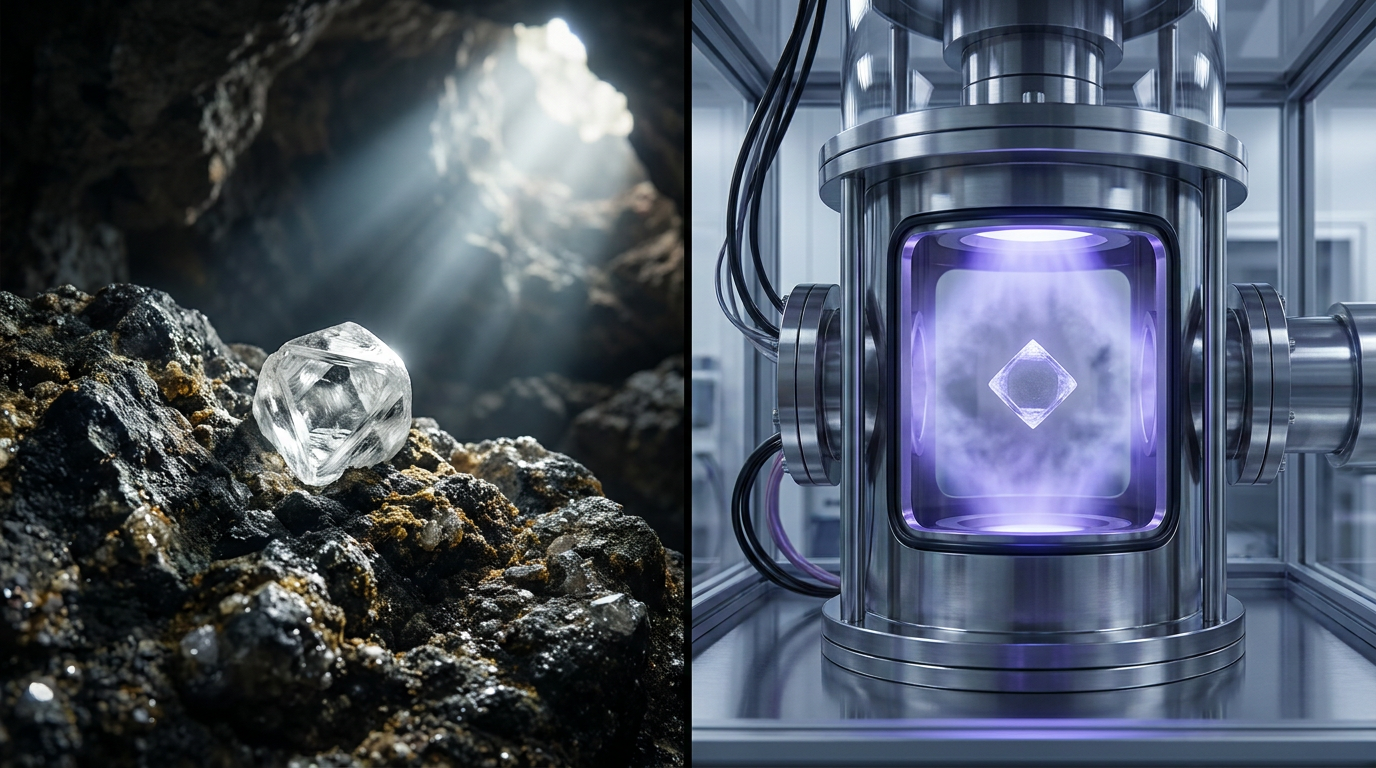
This shift is not merely a passing trend; it is a fundamental restructuring of how consumers approach luxury purchases. The choice between a stone pulled from the earth and one grown in a plasma reactor is now the defining decision for millions of couples and fashion buyers.[6]
The core of this debate rests on a scientific reality: laboratory-grown diamonds are not simulants like cubic zirconia or moissanite. They are pure carbon crystallized in the isometric cubic system, sharing the exact chemical, physical, and optical properties as mined diamonds.[1]
The Gemological Institute of America, the world's foremost authority on diamond grading, uses the exact same criteria—the famous Four Cs of cut, color, clarity, and carat—to evaluate both types of stones. To the naked eye, and even to a trained jeweler using a standard loupe, a high-quality lab-grown diamond is indistinguishable from its natural counterpart.[1]
The argument for laboratory-grown diamonds begins with overwhelming price efficiency. In 2026, a one-carat lab-grown diamond of high quality costs between $725 and $1,500, representing an 80 to 85 percent discount compared to a natural diamond of identical specifications.[4]
The evidence of this price gap's impact is visible in the jewelry itself. Because buyers can stretch their budgets significantly further, the average center stone for a lab-grown engagement ring has ballooned to 2.5 carats, compared to the 1.0 to 1.2 carat average for natural stones.[4]

The argument against laboratory-grown diamonds centers entirely on long-term value retention and the economics of infinite supply. Because they can be manufactured in virtually unlimited quantities, their wholesale prices have plummeted by more than 70 percent over the past five years as production scaled up in India and China.[3][4]
The evidence shows that lab-grown diamonds are rapidly depreciating assets. Secondary market data indicates that a lab-grown stone currently resells for only 10 to 40 percent of its original purchase price, and that percentage continues to fall as new production gets cheaper.[4]
Conversely, the argument for natural diamonds is rooted in geological rarity and historical prestige. A natural diamond took billions of years to form deep within the earth's mantle under extreme heat and pressure, making each stone a finite, one-of-a-kind artifact.[1][2]
Conversely, the argument for natural diamonds is rooted in geological rarity and historical prestige.
The evidence supporting the natural diamond market's resilience comes from major trade hubs. While overall volume has shifted toward synthetics, natural diamonds maintain a much stronger resale value, typically holding 20 to 60 percent of their retail price. Furthermore, global rough diamond production is actually declining, which analysts expect will support long-term price stability for investment-grade natural stones.[3][4]
The environmental trade-off presents another stark comparison. The argument for lab-grown stones heavily emphasizes ecological preservation. Traditional diamond mining requires moving massive amounts of earth, which permanently alters landscapes and disrupts local ecosystems.[5]
The evidence quantified by environmental analysts shows a massive disparity in resource consumption. The mined diamond industry uses approximately 480 liters of water per carat extracted, whereas lab-grown production uses roughly 70 liters, much of which is recirculated in closed-loop systems.[5]

However, the argument against lab-grown diamonds on environmental grounds points to their immense energy requirements. Replicating the heat and pressure of the earth's mantle requires massive amounts of electricity. If a laboratory is powered by a coal-heavy grid, its carbon footprint can actually exceed that of a modern, highly regulated mining operation.[5][6]
The evidence here is highly conditional: a lab-grown diamond produced using 100 percent renewable solar energy emits less than 20 kilograms of carbon dioxide per carat, making it the undisputed ecological winner. But a stone grown using fossil fuels can emit upward of 500 kilograms per carat, complicating the blanket claim of sustainability.[5]
Beyond the tangible metrics of price and carbon, the psychological aspect of luxury remains a powerful differentiator. Recent consumer acquisition studies reveal that despite the surge in lab-grown sales, natural diamonds remain the most desired luxury jewelry product among American women, ranking ahead of synthetics, other gemstones, and plain gold.[2]
This enduring desirability highlights the emotional weight of rarity. For many buyers, the knowledge that a stone is a billion-year-old piece of the earth carries a romantic significance that a factory-produced crystal, no matter how optically perfect, simply cannot replicate.[2][6]

Ultimately, navigating this fractured market requires aligning the purchase with the buyer's primary values. The laboratory-grown option fits well when the consumer prioritizes maximizing the visual impact of the jewelry, desires a larger carat size on a fixed budget, or holds strict ethical objections to earth mining.[6]
It does not fit when the buyer views the jewelry as a financial store of value, expects to upgrade or resell the stone in the future, or places a high premium on geological rarity and traditional luxury heritage.[4][6]
How we got here
1950s
The first synthetic diamonds are created in laboratories, primarily for industrial cutting and drilling purposes.
2018
The Federal Trade Commission drops the word 'natural' from its official definition of a diamond.
2019
The Gemological Institute of America stops using the term 'synthetic' on its grading reports for lab-grown stones.
2024
Wholesale prices for lab-grown diamonds drop by 74 percent over a five-year period as production scales globally.
2026
Lab-grown diamonds officially surpass 55 percent market share for engagement rings in the United States.
Viewpoints in depth
Traditional Luxury Advocates
Prioritizes the geological rarity, heritage, and long-term value retention of natural stones.
This camp, heavily represented by legacy mining companies and high-end auction houses, argues that true luxury is defined by scarcity. They emphasize that natural diamonds are finite miracles of geology that took billions of years to form. From their perspective, the infinite reproducibility of lab-grown diamonds inherently strips them of emotional and financial value, pointing to the rapid depreciation of synthetic stones as proof that they are a technological commodity rather than a luxury asset.
Value-Driven Consumers
Prioritizes maximizing the visual aesthetic and carat size for the lowest possible price.
For this rapidly growing demographic, the origin of the carbon is irrelevant compared to the final optical result. They argue that if the Gemological Institute of America grades a lab-grown stone exactly the same as a natural one, paying a 500 percent premium for 'dirt' makes no financial sense. This camp views diamonds as beautiful fashion accessories rather than financial investments, leveraging the price drop to purchase multi-carat stones that would have been completely inaccessible a decade ago.
Eco-Conscious Buyers
Prioritizes minimizing the ecological and human impact of their jewelry purchases.
This perspective focuses entirely on the supply chain. They argue that traditional mining permanently destroys landscapes, disrupts wildlife, and carries a legacy of human rights concerns. While they acknowledge that fossil-fuel-powered laboratories have high carbon emissions, they champion the new wave of solar-powered and hydro-powered diamond labs. For these buyers, a certified net-zero lab-grown diamond represents the only ethically defensible way to participate in the diamond market.
What we don't know
- Whether the resale value of lab-grown diamonds will eventually hit a hard floor or continue to approach zero.
- How the natural diamond mining industry will adjust its long-term supply to counter the synthetic market's dominance.
- If emerging government regulations will require stricter carbon-footprint labeling on lab-grown jewelry.
Key terms
- Chemical Vapor Deposition (CVD)
- A laboratory method that grows diamonds by breaking down carbon-rich gases into atoms that deposit onto a diamond seed.
- High Pressure High Temperature (HPHT)
- A laboratory method that mimics the extreme conditions of the earth's mantle to crystallize carbon into a diamond.
- The Four Cs
- The universal grading system for diamonds based on Cut, Color, Clarity, and Carat weight.
- Kimberlite Pipe
- A volcanic rock formation deep within the earth where natural diamonds are typically found and mined.
Frequently asked
Are lab-grown diamonds real diamonds?
Yes. They are pure carbon crystallized in the isometric cubic system, sharing the exact chemical, physical, and optical properties as mined diamonds.
Do lab-grown diamonds hold their value?
No. Because they can be manufactured in unlimited quantities, lab-grown diamonds depreciate rapidly, currently reselling for only 10 to 40 percent of their original purchase price.
Can a jeweler tell the difference?
Not with the naked eye or a standard jeweler's loupe. Identifying a lab-grown diamond requires advanced spectroscopic equipment used by professional gemological laboratories.
Are lab-grown diamonds better for the environment?
They require no earth mining and use significantly less water. However, their carbon footprint depends entirely on the laboratory's power source; solar-powered labs are highly sustainable, while fossil-fuel labs can emit more carbon than traditional mines.
Sources
Source coverage
6 outlets
4 viewpoints surfaced





[1]Gemological Institute of AmericaGemological Scientists
The Difference Between Natural and Laboratory-Grown Diamonds
Read on Gemological Institute of America →[2]De Beers GroupTraditional Luxury Advocates
2026 US Diamond Acquisition Study
Read on De Beers Group →[3]Antwerp World Diamond CentreTraditional Luxury Advocates
AWDC 2025-2026 Global Trade Figures
Read on Antwerp World Diamond Centre →[4]Paul Zimnisky Diamond AnalyticsValue-Driven Consumers
Global Rough Diamond Price Index 2026
Read on Paul Zimnisky Diamond Analytics →[5]Frost & SullivanEco-Conscious Buyers
Environmental Impact Analysis: Mined vs. Grown Diamonds
Read on Frost & Sullivan →[6]Factlen Editorial TeamValue-Driven Consumers
Synthesis by Factlen editorial team
Read on Factlen Editorial Team →


Every angle. Every day.
Get shopping stories with full source coverage and perspective breakdowns delivered to your inbox.