
How the 'Library of Things' Movement is Transforming Neighborhoods
Public libraries and community centers are increasingly lending out power tools, camping gear, and kitchen appliances, saving residents money and reducing carbon emissions.
By Factlen Editorial Team
- Community Advocates
- Focus on the social equity, skill-sharing, and neighborhood resilience fostered by shared resources.
- Environmentalists
- Emphasize the circular economy, waste reduction, and the lowering of carbon emissions through decreased consumption.
- Civic Administrators
- Focus on the logistical challenges, funding, liability management, and modernization of public services.
What's not represented
- · Traditional hardware retailers
- · Power tool manufacturers
Why this matters
By transforming how we access rarely used items, the Library of Things movement allows households to save thousands of dollars while drastically reducing their environmental footprint. It represents a fundamental shift from individual ownership to community resilience, making expensive tools and technologies accessible to everyone.
Key points
- The 'Library of Things' movement allows residents to borrow physical items like power tools and camping gear using a standard library card.
- These programs provide significant financial relief, with some local pilots saving residents tens of thousands of dollars annually.
- Pooling resources drastically reduces the carbon emissions and waste associated with manufacturing and shipping new goods.
- Beyond lending items, these spaces foster community connection through skill-sharing workshops and volunteer-led repair collectives.
- Libraries are increasingly using smart lockers to provide 24/7 access to borrowed items, accommodating non-traditional work schedules.
- Scaling the movement requires municipalities to navigate logistical challenges, including storage space and liability management.
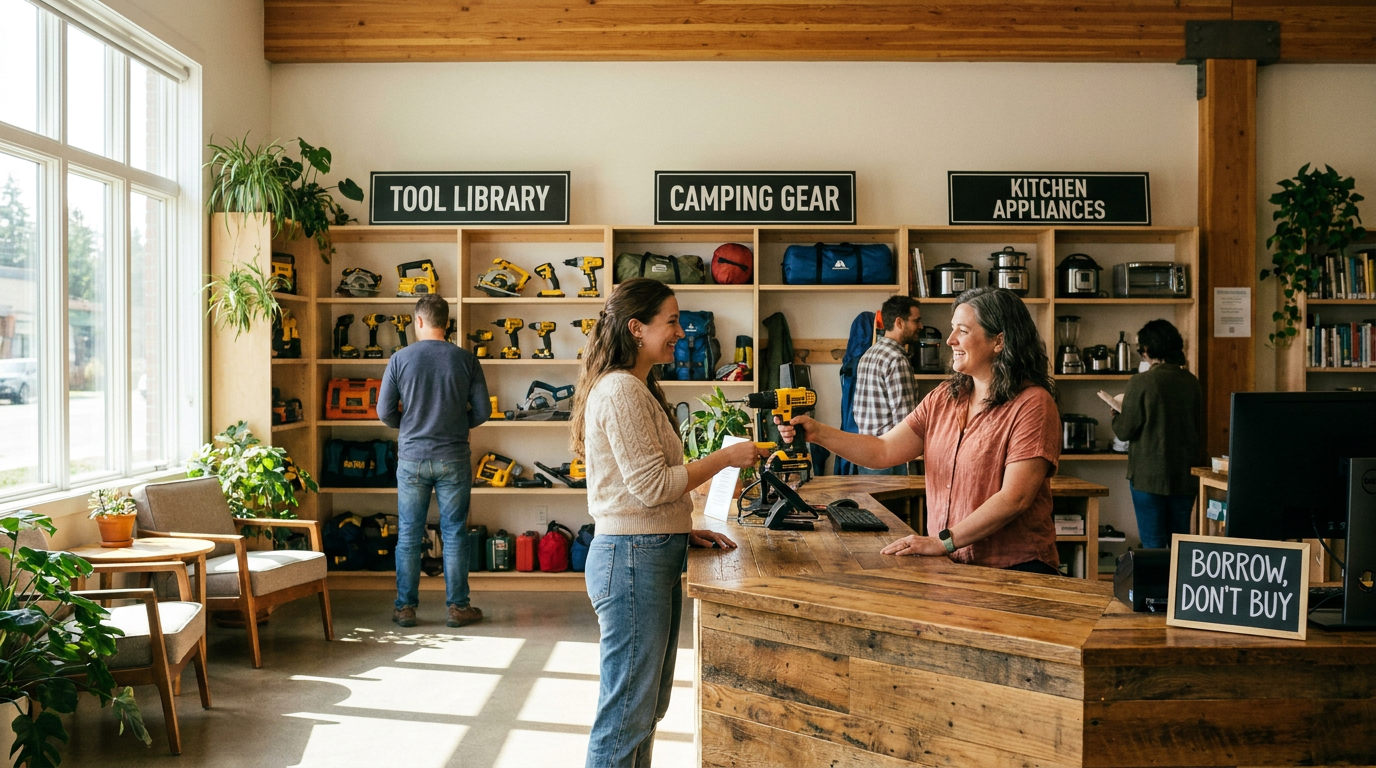
Imagine walking into your local public library, bypassing the fiction section, and checking out a power drill, a pasta maker, and a telescope. For decades, the civic promise of the library was built on the democratization of information. Today, that promise is expanding into the physical realm. The "Library of Things" (LoT) movement is transforming traditional book repositories and neighborhood community centers into hubs of shared physical capital, allowing residents to borrow everything from camping gear to thermal leak detectors.[7]
The premise is elegantly simple: most households harbor closets full of items that are used only once or twice a year. A pressure washer, a specialized gardening tiller, or a high-end sewing machine often represents a significant upfront investment, only to spend 99 percent of its lifespan gathering dust. By applying the traditional library lending model to these objects, communities are unlocking massive economic and environmental efficiencies.[7]
While the concept of tool lending dates back to initiatives like the Berkeley Public Library's program in the 1970s, the modern Library of Things has evolved into a comprehensive civic service. Today's iterations are sophisticated operations. They utilize the same digital cataloging systems used for books, allowing patrons to reserve a circular saw or a digital projector online, check it out with a standard library card, and return it after a specified lending period.[2]
The economic impact on local households is immediate and quantifiable. In an era marked by inflation and rising living costs, the ability to borrow rather than buy removes a significant financial burden. For example, a 2025 impact report from the Charlton Kings Parish Council in the United Kingdom revealed that their local Library of Things pilot saved residents an estimated £53,490 in a single year. Across just 482 borrowed items, the financial relief for the community was substantial, proving that shared resources can act as a direct subsidy for household budgets.[3]

Beyond individual savings, the movement is a practical application of the circular economy, directly challenging the modern paradigm of hyper-consumption. Manufacturing, shipping, and eventually disposing of rarely used consumer goods carries a heavy environmental toll. By pooling resources, a single power drill can serve fifty households instead of one, drastically reducing the demand for new plastic and metal components.[1][7]
The environmental dividends of this model are striking. That same Charlton Kings pilot project calculated that their lending operations avoided approximately 16.74 tonnes of CO2 equivalent emissions in one year. When scaled across hundreds of emerging tool libraries and LoT programs globally, the reduction in manufacturing demand and landfill waste represents a meaningful, grassroots intervention against climate change.[3]
The inventory of a modern Library of Things extends far beyond hammers and wrenches. Institutions like the West Chicago Public Library District have curated diverse collections tailored to the specific curiosities and needs of their patrons. A resident might borrow a digital camera to test a new hobby, a telescope kit for a weekend camping trip, or specialized baking pans for a birthday party. This lowers the barrier to entry for new skills and experiences, allowing people to explore without the risk of a costly commitment.[4]
The inventory of a modern Library of Things extends far beyond hammers and wrenches.
Furthermore, these collections are increasingly being used to bridge the digital divide. Many libraries now offer Wi-Fi hotspots, laptops, and home energy monitors. By providing free access to these crucial technologies, libraries are ensuring that lower-income residents are not locked out of the digital economy or the tools needed to make their homes more energy-efficient.[4]
Yet, the true power of the Library of Things lies not just in the objects themselves, but in the social infrastructure they build. These spaces naturally evolve into community hubs where neighbors interact, share advice, and collaborate. When someone borrows a tile saw, they often receive a quick tutorial from the librarian or a fellow patron who just returned it, sparking conversations that might not otherwise happen.[1]

This collaborative spirit has given rise to "fixer collectives" and repair cafes, which frequently operate in tandem with tool libraries. Instead of simply discarding broken items, volunteers gather to maintain the library's inventory and teach community members how to repair their own belongings. This revives fading maintenance skills and fosters a culture of stewardship rather than disposability.[1][2]
For under-resourced neighborhoods, the social equity implications are profound. Organizations like the Sierra Service Project, which operates the North Sacramento Free Tool Library, view these services as essential tools for neighborhood resilience. Access to home repair equipment allows residents to maintain their properties, build spending power, and preserve their dignity without taking on debt to hire contractors or purchase expensive gear.[6]
Despite the overwhelming benefits, scaling a Library of Things presents unique logistical challenges for civic administrators. Unlike books, physical objects come in wildly varying shapes and sizes, requiring significant storage space. A 2025 survey of library professionals by D-Tech International highlighted this hurdle, noting that 60 percent of respondents prioritized multiple locker sizes when investing in smart locker technology to accommodate the diverse dimensions of LoT items.[5]

Maintenance and liability also require careful management. A broken book spine is an inconvenience; a malfunctioning power saw is a safety hazard. Successful programs rely on dedicated staff or skilled volunteers to inspect, clean, and repair items between checkouts. Establishing robust liability waivers and safety protocols is a necessary administrative hurdle that libraries must clear before launching power tools into the community.[2][7]
To meet the modern consumer's expectations, libraries are also adapting their delivery methods. The push for 24/7 access is driving the installation of automated smart lockers outside library buildings. This allows a patron who works late shifts to pick up a borrowed carpet cleaner at midnight, ensuring that the service is accessible to everyone, regardless of their work schedule.[5]

As the movement matures, it is transitioning from a series of isolated, hyper-local pilots into permanent, integrated civic infrastructure. County-wide library systems are beginning to share LoT inventories across multiple branches, utilizing internal transit systems to move a specialized tool from one town to another, much like an interlibrary loan for a book.[3][7]
Ultimately, the Library of Things is not a new invention, but a high-tech return to an ancient human tradition. For most of history, communities pooled their resources, sharing the tools necessary for survival and prosperity. By leveraging modern cataloging technology and existing public infrastructure, today's libraries are proving that the future of community resilience looks a lot like its collaborative past.[1][7]
How we got here
1970s
Early tool lending libraries emerge, such as the Berkeley Public Library's program, to help residents access home improvement equipment.
2012
Pioneering programs like Kitchen Share Southeast in Portland expand the concept beyond tools to culinary and household items.
2020
The COVID-19 pandemic accelerates the movement as communities seek local resilience and shared resources amid economic hardship.
2024
Pilot programs, such as the one in Charlton Kings, demonstrate massive quantifiable savings and carbon reductions for local municipalities.
2025
Libraries increasingly adopt smart locker technology to provide 24/7 automated access to physical items.
Viewpoints in depth
Community Advocates' View
Shared resources are a vital tool for social equity and neighborhood resilience.
For community organizers and social equity advocates, the Library of Things is primarily a tool for economic empowerment. By removing the financial barrier to entry for home maintenance, gardening, and specialized hobbies, these libraries allow lower-income residents to improve their living conditions without taking on debt. Advocates emphasize that the physical items are secondary to the social infrastructure created; the true value lies in the workshops, the skill-sharing, and the revival of neighborhood trust that occurs when people collaborate on local projects.
Environmentalists' View
Borrowing instead of buying is a necessary step toward a sustainable circular economy.
Environmental groups view the hyper-consumption of rarely used goods as a critical flaw in the modern economy. From their perspective, manufacturing a complex power tool that will be used for only a few hours over its entire lifespan is an unjustifiable waste of raw materials and carbon emissions. By institutionalizing the sharing economy, environmentalists argue that communities can drastically reduce their collective carbon footprint, minimize landfill waste, and build a culture that values stewardship and repair over disposability.
Civic Administrators' View
Scaling these programs requires solving complex logistical and liability challenges.
For the librarians and municipal officials tasked with running these programs, the enthusiasm for sharing must be balanced with practical logistics. Administrators are focused on the operational realities: securing funding for inventory, finding adequate storage space for bulky items, and implementing technology like smart lockers to facilitate 24/7 access. Furthermore, they must navigate the complex liability issues associated with lending out potentially dangerous equipment, necessitating rigorous maintenance schedules and clear legal waivers to protect the municipality.
What we don't know
- How traditional hardware retailers and manufacturers will respond if community borrowing significantly impacts local sales.
- Whether municipal budgets will permanently expand to cover the ongoing maintenance and staffing costs required for large-scale tool libraries.
- How liability laws might evolve if a borrowed piece of heavy machinery causes a severe injury.
Key terms
- Library of Things (LoT)
- A collection of physical objects, such as tools or electronics, that are made available for community members to borrow, operating on the same principles as a traditional book library.
- Circular Economy
- An economic system aimed at eliminating waste and the continual use of resources by sharing, leasing, reusing, repairing, and recycling existing materials and products.
- Fixer Collective
- A community gathering where volunteers with repair skills help others fix broken items, promoting sustainability and teaching maintenance skills.
- Digital Divide
- The gap between demographics and regions that have access to modern information and communications technology, and those that don't or have restricted access.
Frequently asked
What exactly is a Library of Things?
A Library of Things is a service, often hosted by a public library or community center, that allows residents to borrow physical items—such as tools, kitchen appliances, and camping gear—instead of buying them.
Do I have to pay to borrow these items?
Most programs are completely free and only require a standard library card, though some independent community co-ops may charge a small annual membership fee to cover maintenance costs.
What happens if an item breaks while I am using it?
Libraries expect normal wear and tear. While policies vary, patrons are generally not penalized for accidental breakages, as many libraries host 'fixer collectives' or have volunteers dedicated to repairing the inventory.
How do these libraries acquire their inventory?
Many items are donated by community members who no longer need them, while specialized or high-demand items are often purchased using municipal grants or community funding.
Sources
Source coverage
7 outlets
3 viewpoints surfaced






[1]ShareableCommunity Advocates
How Libraries of Things are Building Community and Resilience
Read on Shareable →[2]Eco Farming DailyCivic Administrators
How to Start a Tool Library in Your Community
Read on Eco Farming Daily →[3]Charlton Kings Parish CouncilEnvironmentalists
Library of Things Impact Report 2025
Read on Charlton Kings Parish Council →[4]West Chicago Public Library DistrictEnvironmentalists
The Library Goes Beyond Books with the Library of Things Collection
Read on West Chicago Public Library District →[5]D-Tech InternationalCivic Administrators
The Future of Libraries Survey 2025
Read on D-Tech International →[6]Sierra Service ProjectCommunity Advocates
Get to know SSP's North Sacramento Free Tool Library
Read on Sierra Service Project →[7]Factlen Editorial TeamCivic Administrators
Synthesis by Factlen editorial team
Read on Factlen Editorial Team →
Every angle. Every day.
Get community stories with full source coverage and perspective breakdowns delivered to your inbox.