
Lab-Grown vs. Mined Diamonds: The 2026 Buyer's Guide
With lab-grown diamonds capturing over 55 percent of the market and prices hitting a production floor, the calculus of buying fine jewelry has fundamentally changed. Here is the definitive breakdown of the trade-offs between lab-grown and mined stones in 2026.
By Factlen Editorial Team
- Lab-Grown Disruptors
- Argues that lab-grown diamonds democratize luxury and eliminate the ethical compromises of traditional mining.
- Traditional Jewelers
- Maintains that only natural diamonds possess the rarity and heritage required for true luxury and value retention.
- Market Analysts
- Focuses on the structural bifurcation of the jewelry industry into two distinct asset classes.
What's not represented
- · Diamond Mining Communities
- · Pawn Shop Appraisers
Why this matters
The diamond market has permanently fractured, offering consumers unprecedented purchasing power. Understanding the 2026 pricing floors and absolute dollar loss metrics ensures buyers do not waste thousands of dollars on outdated assumptions about jewelry investment.
Key points
- Lab-grown diamonds captured over 55% of the US engagement ring market in 2026.
- Lab-grown prices have stabilized after an 88% drop from their 2020 peak.
- Both lab-grown and mined diamonds are chemically and optically identical.
- Natural diamonds retain 20-50% of resale value, while lab-grown retain 10-30%.
- The absolute dollar loss at resale is often lower for lab-grown stones due to the lower initial price.
The diamond market has fundamentally fractured in 2026, creating a landscape where consumers have more power and transparency than ever before. For the first time in modern history, lab-grown diamonds have captured over 55 percent of the engagement ring market, crossing a threshold that was unthinkable just a decade ago. This shift is not merely a passing trend; it represents a structural transformation in how fine jewelry is manufactured, priced, and purchased. Buyers are no longer restricted by the artificial scarcity of mined stones, allowing a new generation to prioritize size, ethics, and budget without sacrificing optical perfection.[4][8]
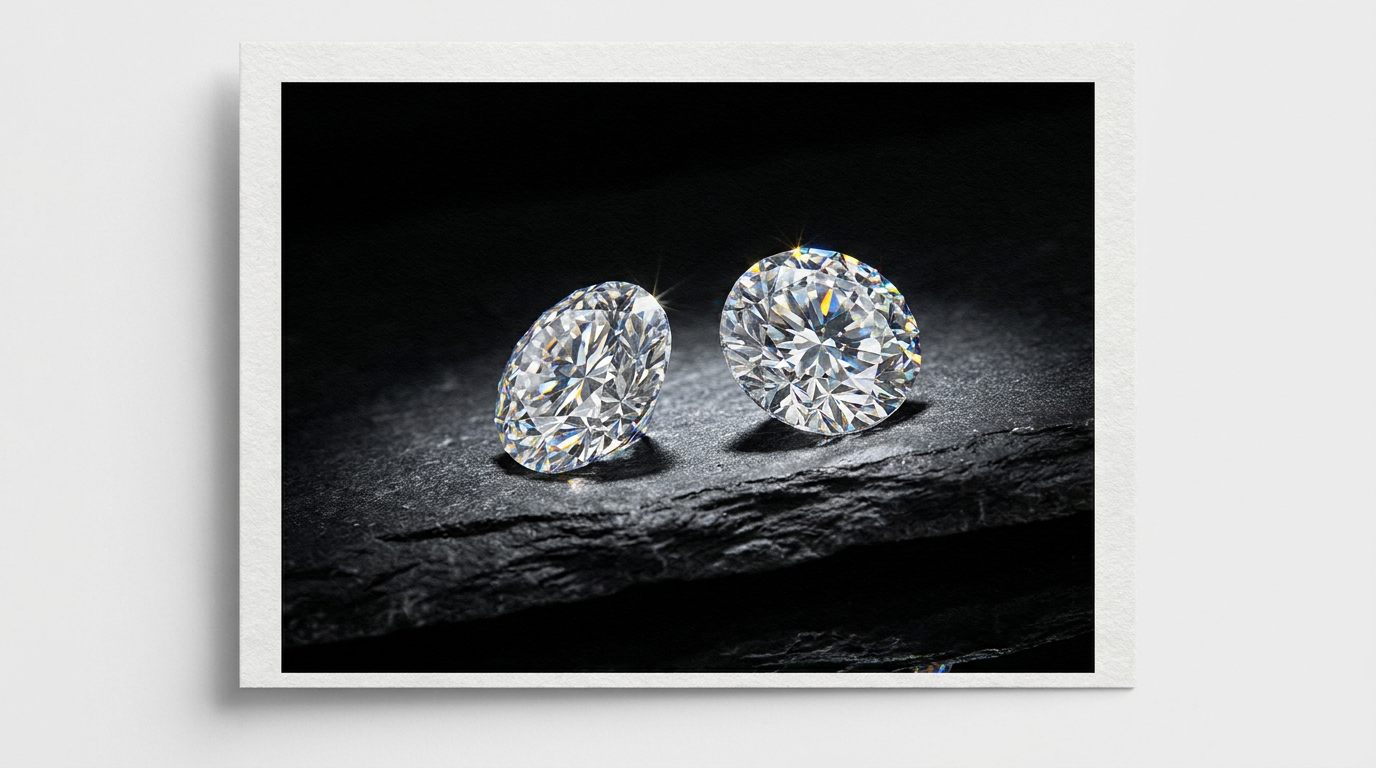
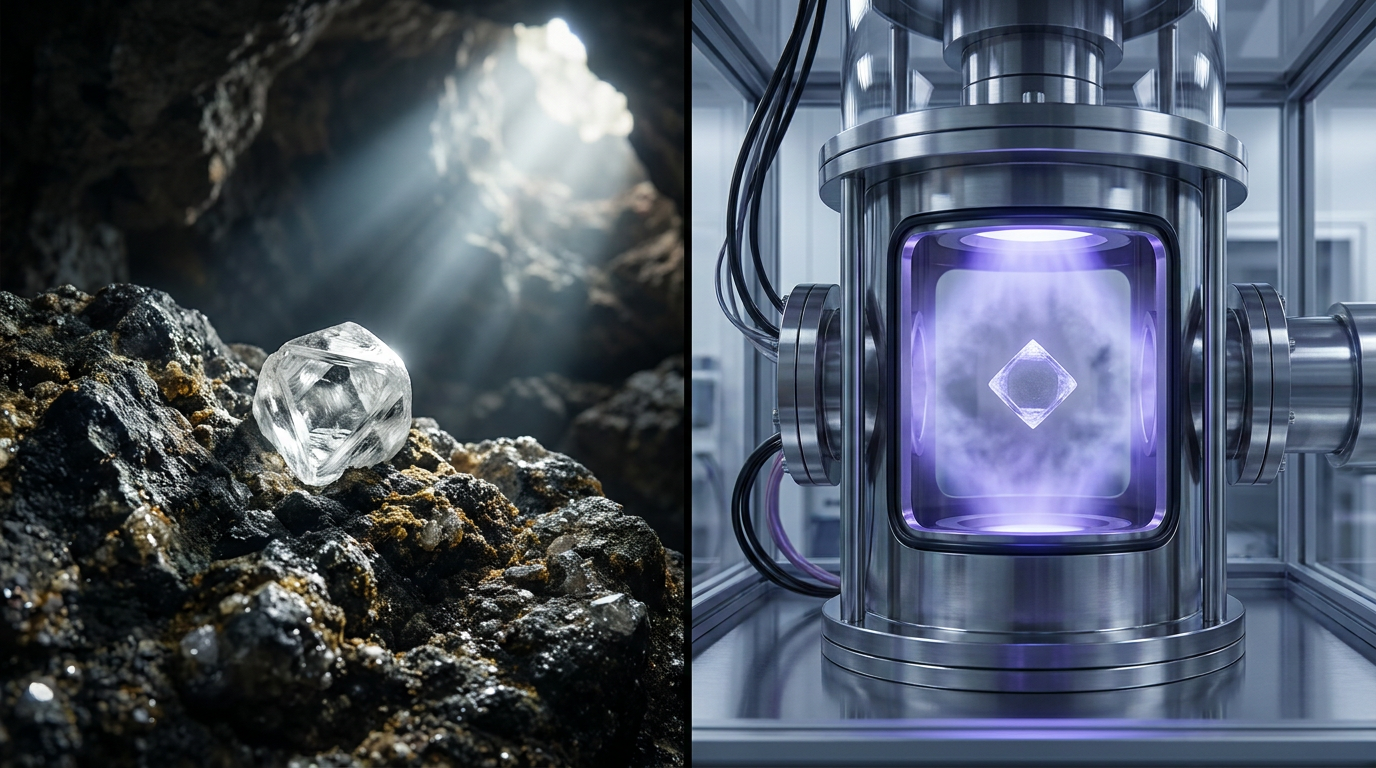
To understand this shift, one must first understand the science. Lab-grown diamonds are not simulants like cubic zirconia or moissanite; they are pure carbon, crystallized into the exact same physical, chemical, and optical structure as mined diamonds. Using High Pressure High Temperature (HPHT) or Chemical Vapor Deposition (CVD) methods, laboratories recreate the extreme conditions of the Earth's mantle. The result is a gemstone that even veteran jewelers cannot distinguish from a mined diamond without specialized spectroscopic equipment. They share the same perfect 10 on the Mohs hardness scale and the identical brilliance that has defined the diamond industry for centuries.[2][4]
The most dramatic development of 2026 is the stabilization of the lab-grown price collapse. Between 2020 and early 2026, the per-carat price of lab-grown diamonds plummeted by roughly 88 percent as global manufacturing capacity scaled and technology matured. A premium one-carat lab-grown stone that retailed for over $3,400 in 2020 now sits at a functional price floor of roughly $400 to $725. Analysts note that because wholesale rough now trades near the actual cost of production, the era of waiting for steeper discounts is effectively over.[3][7]

In contrast, the natural diamond market has experienced its own turbulence, though driven by different forces. After a period of post-pandemic inflation, natural diamond prices softened significantly through 2025, with smaller commercial-grade stones under half a carat dropping by as much as 26 percent. However, by early 2026, the natural market began a measured recovery. Global mining output has fallen to multi-decade lows, and the inherent scarcity of large, high-quality natural stones has helped them maintain a premium baseline that lab-grown stones simply do not possess.[1][6]
This massive price divergence has birthed what industry insiders call the "3-Carat Standard." Because a buyer can now acquire a flawless lab-grown diamond for a fraction of the historical cost, the average center stone size for lab-grown engagement rings has surged past 2.5 carats in 2026. Consumers are taking the thousands of dollars saved and reinvesting them into larger stones, higher clarity grades, or custom platinum settings, fundamentally altering the visual landscape of modern bridal jewelry.[4][8]

In the case for lab-grown diamonds, the primary argument centers on democratized luxury and ethical certainty. Buyers gain access to visually spectacular, chemically identical gemstones at an 80 to 85 percent discount compared to natural equivalents. Furthermore, lab-grown stones bypass the murky supply chains and human rights concerns historically associated with diamond mining. Environmentally, the contrast is stark: extracting a single carat of natural diamond requires moving nearly 250 tons of earth and consumes roughly one billion joules of energy, whereas lab creation requires only a fraction of that energy and zero earth displacement.[1][3]
In the case against lab-grown diamonds, the main drawback is the complete absence of long-term financial retention. Because they are manufactured products subject to technological scaling, lab-grown diamonds lack the inherent rarity that underpins traditional luxury assets. The market is flooded with virtually unlimited supply, meaning that a lab-grown stone purchased today will compete with cheaper, newly manufactured stones tomorrow. For buyers who view fine jewelry as an heirloom or a store of value, this infinite reproducibility strips the gemstone of its historical mystique.[5][6]
In the case against lab-grown diamonds, the main drawback is the complete absence of long-term financial retention.
The evidence regarding lab-grown resale value is sobering but mathematically nuanced. Secondary market data from 2026 shows that lab-grown diamonds typically resell for only 10 to 30 percent of their original retail price, with some jewelers refusing to buy them back entirely. However, the absolute dollar loss tells a different story. Losing 80 percent on a $2,800 lab-grown diamond results in a $2,240 loss. In contrast, losing 50 percent on a comparable $29,500 natural diamond results in a $14,750 loss. For many consumers, the lower initial buy-in makes the steeper percentage depreciation entirely acceptable.[3][5]

In the case for mined diamonds, the primary argument rests on geological heritage, emotional resonance, and relative value retention. A natural diamond is a finite piece of the Earth's history, formed billions of years ago under extraordinary natural forces. This inherent scarcity provides a psychological weight that a factory-grown stone cannot replicate. Furthermore, natural diamonds benefit from a globally established pricing benchmark—the Rapaport Price List—which provides a structured, albeit fluctuating, secondary market that recognizes the stone as a tradable commodity.[4][6]
In the case against mined diamonds, the drawbacks are the exorbitant entry price and the unavoidable environmental toll. To purchase a premium two-carat natural diamond in 2026, a buyer must commit tens of thousands of dollars, a financial hurdle that often requires compromising on stone size or clarity. Additionally, despite the implementation of the Kimberley Process, the traditional diamond supply chain remains opaque, and the ecological scarring caused by open-pit mining continues to alienate eco-conscious younger demographics.[1][3]
The evidence regarding mined diamond resale confirms their status as better stores of value, though they are still not true financial investments. In 2026, a well-cut natural diamond with a recognized grading report typically retains 20 to 50 percent of its original retail price on the secondary market, occasionally reaching 60 percent for exceptionally rare stones. While this is significantly higher than the retention rate of lab-grown stones, buyers must still accept that retail markups, brand positioning, and showroom costs evaporate the moment the ring leaves the store.[4][5]
Ultimately, the decision between the two origins requires a clear-eyed assessment of what the buyer actually values. The 2026 market has proven that neither option is objectively superior; they simply serve entirely different consumer priorities. The industry has bifurcated into a technology-driven fashion sector and a scarcity-driven heritage sector, and the most satisfied buyers are those who align their purchase with their personal philosophy rather than marketing narratives.[9]

Lab-grown diamonds fit well when the buyer's primary goal is maximizing the visual impact of the jewelry within a strict budget. They are the definitive choice for consumers who want a large, flawless center stone without taking on debt, or for those who prioritize guaranteed conflict-free origins and lower environmental footprints. They are also ideal for everyday fashion jewelry, travel rings, and statement pieces where the aesthetic result is the only metric that matters.[9]
Lab-grown diamonds do not fit when the buyer views the purchase as a financial investment or an heirloom meant to retain monetary value across generations. They are the wrong choice for traditionalists who derive emotional significance from the geological rarity of a gemstone, or for those who expect to trade the stone back to a jeweler for an upgrade at a later date, as the trade-in value will be negligible.[9]
Mined diamonds fit well when the buyer places a premium on heritage, natural scarcity, and the romanticism of a billion-year-old artifact. They remain the standard for high-net-worth individuals purchasing exceptionally rare colored diamonds or massive stones that serve as alternative asset classes. They are the right choice for families looking to pass down a piece of jewelry that holds a recognized, albeit fluctuating, baseline value in the global commodity market.[9]
Mined diamonds do not fit when the buyer is operating on a tight budget but desires a substantial carat size, as the necessary compromises in cut and clarity will result in a visibly inferior stone. They are also a poor fit for consumers with strict environmental or ethical mandates, as the ecological footprint of industrial mining cannot be entirely erased, regardless of modern sustainability initiatives.[9]
How we got here
2018
Lab-grown diamonds enter the mainstream market, priced at only a 20% discount to natural stones.
2020 - 2022
Global manufacturing capacity scales rapidly, triggering a steep 36% single-year price drop for lab-grown stones.
2024
Lab-grown diamonds capture 50% of the US engagement ring market for the first time.
Early 2026
Lab-grown prices hit a functional production-cost floor, stabilizing after an 88% total decline from their 2020 peak.
Viewpoints in depth
Lab-Grown Disruptors
Argues that lab-grown diamonds democratize luxury and eliminate the ethical compromises of traditional mining.
This camp, driven by direct-to-consumer brands and younger buyers, views the diamond strictly as a beautiful consumer product rather than a financial asset. They point to the 88% price drop not as a failure of value, but as a triumph of technology making flawless stones accessible. They emphasize that the environmental savings—avoiding 250 tons of displaced earth per carat—make lab-grown the only morally justifiable choice for modern bridal jewelry.
Traditional Jewelers
Maintains that only natural diamonds possess the rarity and heritage required for true luxury.
Heritage brands and mining advocates argue that a luxury good must be inherently scarce to hold emotional and financial weight. They view the infinite reproducibility of lab-grown stones as a race to the bottom, comparing them to consumer electronics that depreciate the moment they are purchased. For this camp, the billions of years required to form a natural diamond provide a romantic and geological significance that a factory simply cannot replicate.
Market Analysts
Focuses on the structural bifurcation of the jewelry industry into two distinct asset classes.
Financial and industry analysts observe that the two products are no longer truly competing; they are diverging into separate categories. They note that the lab-grown market has hit a production-cost floor in 2026, meaning the steepest price collapses are over. Meanwhile, they track the natural diamond market's reliance on supply constraints to maintain a premium baseline, predicting that the future of the industry will see lab-grown dominate everyday fashion while natural stones retreat to the ultra-high-end bespoke market.
What we don't know
- Whether the natural diamond market will experience a severe supply shortage in the 2030s that drives prices back up.
- How the secondary market will handle the massive influx of large lab-grown diamonds over the next decade.
- If traditional luxury houses will eventually embrace lab-grown stones for their high jewelry collections.
Key terms
- CVD (Chemical Vapor Deposition)
- A high-tech manufacturing method that grows diamonds layer by layer from a carbon-rich gas in a vacuum chamber.
- HPHT (High Pressure High Temperature)
- A diamond-creation process that mimics the extreme heat and pressure found deep within the Earth's mantle.
- The 4Cs
- Cut, Color, Clarity, and Carat—the universal grading standard applied identically to both lab-grown and mined diamonds.
- Rapaport Price List
- The traditional diamond industry's benchmark pricing matrix, which dictates the wholesale value of natural diamonds.
Frequently asked
Can a jeweler tell the difference between lab and mined?
Not with the naked eye or a standard jeweler's loupe. Because they are chemically identical, distinguishing them requires specialized laboratory equipment that detects microscopic growth patterns.
Do lab-grown diamonds pass a diamond tester?
Yes. Lab-grown diamonds are made of pure carbon and possess the exact same thermal and electrical conductivity as mined diamonds, so they test as real diamonds on standard equipment.
Will lab-grown diamond prices keep dropping?
Analysts indicate the steepest drops are over. By 2026, wholesale prices have reached a production-cost floor, meaning future price declines will likely be minimal.
Sources
Source coverage
9 outlets
3 viewpoints surfaced









[1]MoneyTraditional Jewelers
Diamond prices have plunged by 50% since 2022
Read on Money →[2]Persistence Market ResearchMarket Analysts
Lab Grown Diamonds Market Size, Share, and Growth Forecast 2026 - 2033
Read on Persistence Market Research →[3]Liori DiamondsLab-Grown Disruptors
Lab Grown Diamonds Resale Value and Market Share 2026
Read on Liori Diamonds →[4]Tashvi AI Market DataLab-Grown Disruptors
2026 Market Update: Lab-Grown vs Natural Diamonds
Read on Tashvi AI Market Data →[5]AupulentMarket Analysts
Do Diamonds Have Resale Value? The Truth Every Buyer Should Know in 2026
Read on Aupulent →[6]OM Jewels IncTraditional Jewelers
Lab-Grown Diamonds: The Price Floor Has Arrived
Read on OM Jewels Inc →[7]Edahn Golan Diamond ResearchMarket Analysts
State of the Diamond Market 2026
Read on Edahn Golan Diamond Research →[8]The KnotMarket Analysts
2026 Real Weddings Study: Engagement Ring Trends
Read on The Knot →[9]Factlen Editorial TeamMarket Analysts
Synthesis by Factlen editorial team
Read on Factlen Editorial Team →
More in shopping
See all 7 stories →Used EV Market
How to Buy a Used EV in 2026: Battery Health, Depreciation, and Tax Rules Explained
6 sources
Wearable Tech
Smart Rings for Health Tracking: An Evidence-Based Review
8 sources
Handheld PCs
Steam Deck OLED vs. ASUS ROG Ally X: Which Premium Handheld Wins in 2026?
6 sources
Sleep Tech
Do Smart Rings Actually Know How You Sleep? The Evidence on Wearable Accuracy
8 sources
Every angle. Every day.
Get shopping stories with full source coverage and perspective breakdowns delivered to your inbox.