
How Multi-Agent AI Systems Are Automating the Scientific Method
Researchers are moving beyond single chatbots, deploying teams of specialized AI agents that can autonomously design experiments, write code, and operate robotic labs 24/7.
By Factlen Editorial Team
- Automation Optimists
- Believes multi-agent systems will fundamentally rewrite the speed limits of human discovery.
- Human-in-the-Loop Advocates
- Argues that science requires human judgment to determine what is actually worth discovering.
- Domain Scientists
- Focuses on the practical application of these workflows to solve specific bottlenecks in fields like materials science.
What's not represented
- · Regulatory bodies overseeing AI-generated research
- · Laboratory technicians whose manual roles are being automated
Why this matters
By delegating the tedious execution of experiments and data analysis to teams of specialized AI agents, researchers can accelerate the discovery of life-saving drugs and sustainable materials from years to mere weeks.
Key points
- Multi-agent AI systems use teams of specialized algorithms to break down and solve complex problems collaboratively.
- These 'agentic workflows' are being deployed to automate the entire scientific research process, from hypothesis generation to data analysis.
- When paired with physical robotics, AI agents can operate 'self-driving labs' that run experiments 24/7 without human intervention.
- The technology is already accelerating discoveries in materials science, climate technology, and battery development.
- Experts emphasize that while AI can automate data production, human scientists remain essential for evaluating the societal value of new discoveries.
For the past three years, the public's interaction with artificial intelligence has largely been a solitary experience: a human typing a prompt into a single chatbot. But in the laboratories of top research universities and cutting-edge tech firms, a quiet revolution is underway. Scientists are abandoning the single-chatbot model in favor of "agentic workflows"—ecosystems where multiple specialized AI models collaborate, debate, and execute complex tasks together.[7]
This multi-agent approach mimics a human organization. Instead of asking one general-purpose AI to design an experiment, write the code, and analyze the results—a process prone to errors and hallucinations—researchers are deploying teams of digital experts. A "Planner Agent" breaks down the scientific goal, a "Researcher Agent" mines decades of published literature, an "Executor Agent" writes the simulation code, and a "Reviewer Agent" checks the output against the laws of physics.[2][3][7]
The results are fundamentally altering the pace of scientific discovery. In a landmark demonstration of this capability, researchers recently unveiled systems capable of handling the entire research lifecycle autonomously. These frameworks can independently generate novel hypotheses, design computational experiments, analyze the resulting data, and even draft a scientific paper detailing their findings.[1]

The mechanism behind these agentic workflows relies on strict role division and shared memory contexts. When tasked with discovering a new battery electrolyte, for example, the AI team does not simply guess a chemical structure. The Planner Agent consults a database of known polymorphs, while the Executor Agent interfaces directly with specialized simulation software to run complex atomistic simulations.[2]
By chaining these specialized tools together, multi-agent systems can complete complex analytical tasks three to five times faster than single-agent systems, while drastically reducing the rate of factual errors. The AI agents cross-check each other's work, simulating a rigorous peer-review process before a human scientist ever sees the final output.[6][7]
The impact is particularly pronounced in materials science and climate technology. At institutions like MIT, multi-agent generative AI frameworks are being deployed to accelerate the discovery of sustainable biomaterials. These systems ingest vast knowledge graphs of patents and chemical properties, allowing specialized models to reason deeply about how different molecular structures will behave in the real world.[3]

The impact is particularly pronounced in materials science and climate technology.
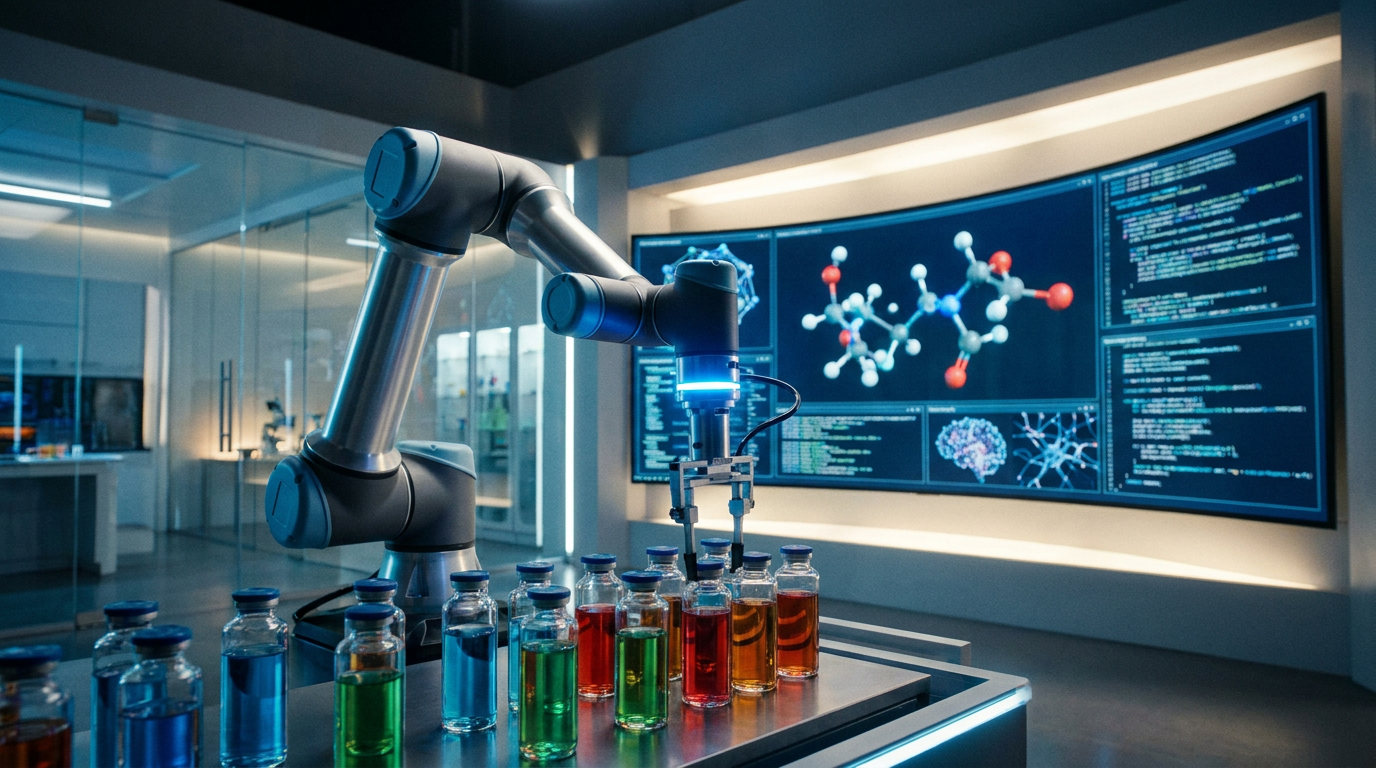
But the most visually striking application of agentic workflows is their integration with physical robotics, creating what researchers call "self-driving labs." At facilities like the newly opened AI-Robotic Scientist Lab at Xi'an Jiaotong-Liverpool University, the digital AI agents are connected directly to high-throughput robotic experimental platforms.[4]
In these closed-loop systems, the AI formulates a hypothesis and then commands robotic arms to mix reagents, expose samples to light, and run gas chromatography. Because the AI agents and robots do not need to sleep, these self-driving labs can operate 24 hours a day, seven days a week, conducting hundreds of experiments in the time it would take a human team to complete a dozen.[4][7]
This continuous, automated experimentation allows scientists to explore highly speculative avenues of research that would normally be deemed too risky or time-consuming for human lab assistants. Even negative results—often discarded or unpublished by human researchers—are meticulously logged by the AI, refining its internal models for the next cycle of hypothesis generation.[1][4][7]

Despite these breakthroughs, the transition to fully autonomous science is not without friction. Coordinating multiple Large Language Models requires significant computational power, and the latency involved in agents "talking" to one another can be high. Furthermore, while agents are excellent at executing well-defined protocols, they still struggle with the intuitive leaps required for paradigm-shifting discoveries.[5][7]
This limitation has sparked a philosophical debate within the scientific community about the true nature of discovery. Critics argue that the concept of a fully "autonomous AI scientist" is a mirage, because science is fundamentally a human endeavor driven by human values. An AI might be able to synthesize a million new chemical compounds, but it cannot decide which of those compounds is most important to society.[5]
As AI systems take over the rote production of data and the execution of routine experiments, the role of the human scientist is shifting. Rather than spending their days pipetting liquids or writing simulation scripts, tomorrow's researchers will act as high-level managers of AI teams. Their primary job will be resource allocation, hypothesis selection, and the rigorous evaluation of the AI's findings.[5][6][7]

Ultimately, the rise of agentic workflows does not spell the end of the human scientist. Instead, it promises a powerful symbiosis. By combining the tireless execution and massive data-processing capabilities of multi-agent AI with the judgment, creativity, and ethical grounding of human researchers, the scientific community is building an engine capable of solving some of the 21st century's most intractable problems.[4][7]
How we got here
2023–2024
Large Language Models (LLMs) gain widespread adoption as single-agent chatbots for coding and writing.
Late 2024
Researchers begin experimenting with 'agentic workflows,' chaining multiple LLMs together to solve complex, multi-step problems.
2025
The first 'AI Scientist' frameworks are published, demonstrating end-to-end automation of computational research papers.
Early 2026
Universities launch integrated 'self-driving labs' where multi-agent AI systems directly control physical robotic equipment.
Viewpoints in depth
Automation Optimists
Believes multi-agent systems will fundamentally rewrite the speed limits of human discovery.
Proponents of fully autonomous AI scientists argue that the traditional research bottleneck is human endurance. By deploying multi-agent systems that can formulate hypotheses, write code, and command physical robots 24/7, this camp believes we are entering an era of exponential discovery. They point to self-driving labs that can run hundreds of experiments a week as proof that AI is no longer just a tool, but a tireless collaborator capable of scaling scientific output beyond human biological limits.
Human-in-the-Loop Advocates
Argues that science requires human judgment to determine what is actually worth discovering.
This perspective cautions against the 'mirage' of fully autonomous science. While acknowledging that AI can generate millions of data points and hypotheses, these advocates argue that science is ultimately a problem of resource allocation. An AI can synthesize a novel chemical, but it cannot understand its societal value or ethical implications. Therefore, they argue the future of science is not replacing humans, but shifting their role from data producers to high-level evaluators who guide the AI's immense computational power.
What we don't know
- How effectively multi-agent systems can make intuitive, paradigm-shifting leaps rather than just optimizing known processes.
- The long-term computational costs and energy requirements of running continuous, multi-LLM workflows at scale.
- How traditional peer-review systems will adapt to evaluating thousands of AI-generated research papers.
Key terms
- Agentic Workflow
- A process where multiple specialized AI agents collaborate autonomously to complete a complex, multi-step task.
- Large Language Model (LLM)
- The foundational AI technology that powers individual agents, enabling them to understand and generate human-like text or code.
- Self-Driving Lab
- A laboratory setup where AI agents directly control robotic equipment to design, execute, and analyze physical experiments without human intervention.
- Atomistic Simulation
- Computational methods used to simulate the behavior of materials at the atomic level, often orchestrated by AI agents to test new compounds.
Frequently asked
Will AI replace human scientists?
No. While AI can automate the execution of experiments and data analysis, human scientists are still needed to set goals, evaluate the importance of discoveries, and allocate resources.
How is a multi-agent system different from ChatGPT?
ChatGPT is a single general-purpose assistant. A multi-agent system is like a specialized team where one AI plans, another writes code, a third runs simulations, and a fourth analyzes the results.
What scientific fields are using this technology?
Materials science, chemistry, and drug discovery are seeing the fastest adoption, as AI agents can rapidly simulate and test thousands of new molecular combinations.
Sources
Source coverage
7 outlets
3 viewpoints surfaced







[1]NatureAutomation Optimists
Towards end-to-end automation of AI research
Read on Nature →[2]Royal Society of ChemistryDomain Scientists
A multi-agent artificial intelligence framework for autonomous atomistic simulations
Read on Royal Society of Chemistry →[3]MIT Generative AI Impact ConsortiumDomain Scientists
Agentic AI for Interpretative and Predictive Bio-inspired Materials Discovery
Read on MIT Generative AI Impact Consortium →[4]Xi'an Jiaotong-Liverpool UniversityAutomation Optimists
XJTLU opens AI-Robotic Scientist Lab
Read on Xi'an Jiaotong-Liverpool University →[5]Towards Data ScienceHuman-in-the-Loop Advocates
The Mirage of the Autonomous AI Scientist
Read on Towards Data Science →[6]Frontiers in Soil ScienceDomain Scientists
Multi-agent AI systems in soil science research
Read on Frontiers in Soil Science →[7]Factlen Editorial TeamHuman-in-the-Loop Advocates
Synthesis by Factlen editorial team
Read on Factlen Editorial Team →

Every angle. Every day.
Get ai stories with full source coverage and perspective breakdowns delivered to your inbox.