
The Ventless Revolution: How Heat Pump Dryers Are Reshaping the American Laundry Room
Heat pump dryers recycle warm air instead of venting it outside, cutting energy use by up to 50% while protecting clothes. With new federal rebates lowering the upfront cost, this European staple is rapidly becoming the new standard in US homes.
By Factlen Editorial Team
- Energy Efficiency Advocates
- Focus on the massive reduction in household carbon footprints and grid strain.
- Appliance Industry Analysts
- Emphasize market growth, premium features, and installation flexibility.
- Consumer Reviewers
- Balance the long-term savings against upfront costs and longer drying times.
What's not represented
- · Large families with high laundry volume
- · Multi-family building developers
Why this matters
Laundry is one of the most energy-intensive chores in a home. Switching to a heat pump dryer can save hundreds of dollars a year, reduce household carbon emissions, and eliminate the need for exterior venting—making them perfect for apartments and interior closets.
Key points
- Heat pump dryers use a closed-loop refrigeration cycle to dry clothes without needing an exterior exhaust vent.
- The technology recycles warm air, cutting electricity consumption by up to 50% compared to standard dryers.
- Lower operating temperatures prevent fabric shrinkage and extend the lifespan of delicate garments.
- Drying cycles typically take 30 to 60 minutes longer than traditional vented models.
- The Inflation Reduction Act provides up to $840 in rebates to help offset the higher upfront purchase price.
For decades, the standard American laundry routine has relied on a brute-force approach to drying clothes: pulling in room-temperature air, blasting it with a heating element, tumbling it through wet fabrics, and venting the hot, damp exhaust out a hole in the wall.[6]
It is a system that works quickly but wastes a staggering amount of energy. Traditional vented dryers are among the most energy-hungry appliances in a modern home, literally blowing paid-for climate control into the outdoors while driving up monthly utility bills.[4]
But a quiet revolution is reshaping the appliance aisle. Heat pump dryers—a technology that has been a staple in European homes for years—are rapidly gaining traction in the United States, driven by a combination of tightening building codes, consumer demand for efficiency, and new federal incentives.[3]
The global market for heat pump tumble dryers is expanding aggressively. Valued at $6.8 billion in 2025, the sector is projected to more than double to $14.2 billion by 2034, with North America representing the fastest-growing regional market as adoption accelerates.[3]

To understand why the industry is shifting, it helps to look at the mechanism. Unlike conventional electric or gas dryers, a heat pump dryer does not generate new heat continuously, nor does it require an exhaust vent. Instead, it operates on a highly efficient closed-loop system.[4]
The technology works essentially like a refrigerator running in reverse. A compressor circulates a refrigerant to heat the air inside the drum. This warm air passes through the tumbling clothes, absorbing moisture from the wet fabrics as it circulates.[4]
Once the air is saturated with moisture, it moves out of the drum and passes over a cold evaporator coil. The sudden drop in temperature causes the moisture to condense into liquid water, which is then collected in a tank or pumped directly into a drain line.[5]
The crucial step happens next: rather than venting the now-dry air outside, the system reheats it and sends it right back into the drum to absorb more moisture. This continuous recycling loop is what makes the technology so transformative for household energy use.[5]

The crucial step happens next: rather than venting the now-dry air outside, the system reheats it and sends it right back into the drum to absorb more moisture.
By reusing the same air, heat pump models consume significantly less electricity. According to Energy Star, heat pump dryers are at least 28% more efficient than standard models, with some manufacturers demonstrating energy reductions of up to 50% compared to traditional condenser or vented units.[1][5]
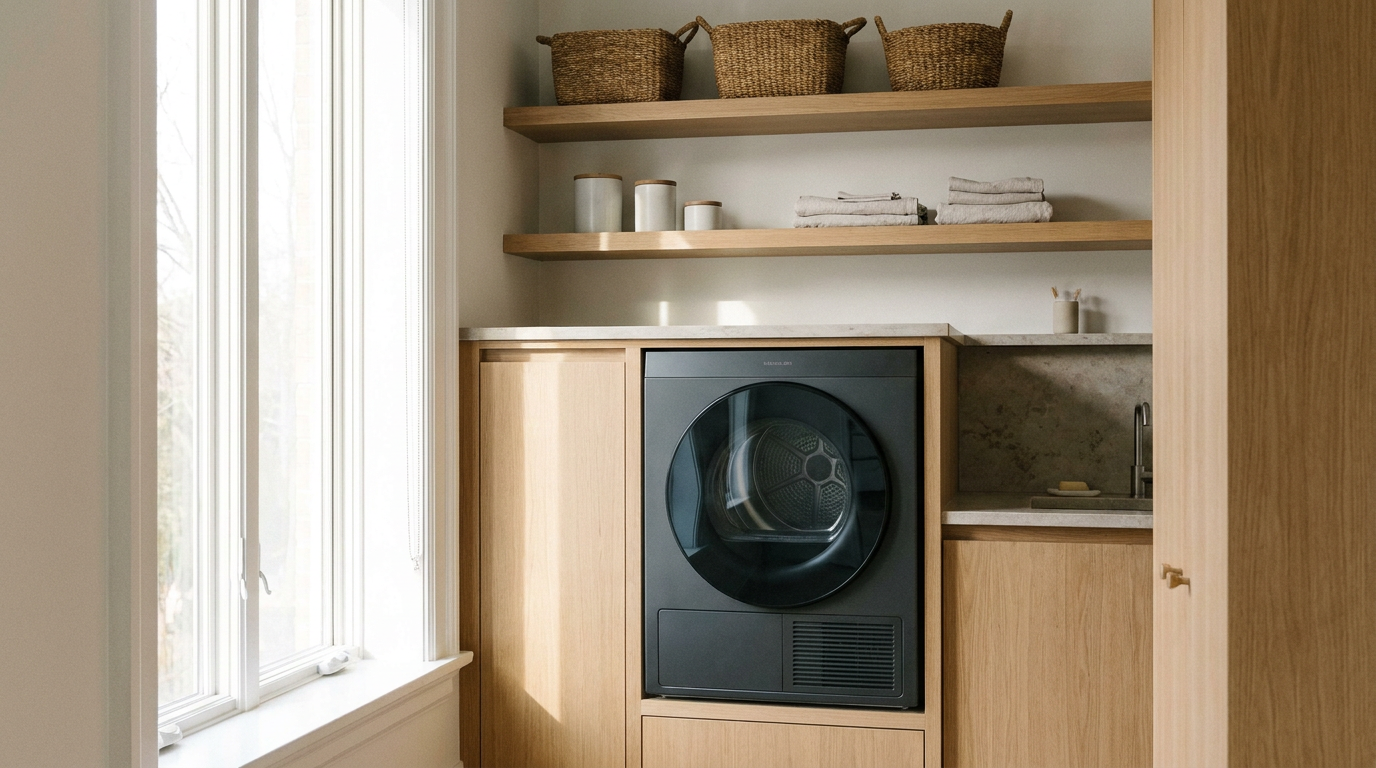
Beyond utility bills, the closed-loop design offers a major architectural advantage: ventless installation. Because they do not require an exterior exhaust duct, heat pump dryers can be installed in interior closets, under kitchen counters, or in high-rise apartments where venting is structurally impossible.[4]
The technology is also fundamentally kinder to fabrics. Because heat pump dryers rely on dehumidification rather than sheer thermal force, they operate at significantly lower temperatures than conventional models, treating garments with a much gentler touch.[4]
This lower operating temperature prevents the over-drying, shrinking, and fabric degradation that often plagues delicate garments in standard electric dryers. Clothes emerge softer, and elastane-based fabrics maintain their stretch and structural integrity for much longer.[4]

However, the technology does require some compromises. The most notable trade-off is time. Because they use lower heat to protect fabrics and save energy, a standard cycle in a heat pump dryer typically takes 30 to 60 minutes longer than a conventional vented dryer.[4]
For households accustomed to churning through back-to-back laundry loads on a Sunday afternoon, the extended cycle time requires a slight adjustment in routine, though many modern units now include optimized sensors to minimize the wait and prevent over-tumbling.[4]
The other primary hurdle is the upfront cost. Entry-level heat pump dryers generally command a premium of $200 to $700 over comparable traditional electric models, which can deter budget-conscious shoppers at the point of sale despite the promise of long-term utility savings.[4]
That financial calculus, however, is changing dramatically in 2026. Under the federal Inflation Reduction Act, the High-Efficiency Electric Home Rebate Act is actively rolling out across various states, fundamentally altering the appliance market for middle- and low-income buyers.[2]

Income-qualified households can now access point-of-sale rebates of up to $840 specifically for electric heat pump clothes dryers. When combined with potential state-level incentives and long-term utility savings, the upfront premium can be entirely neutralized.[2]
As the electrical grid modernizes and homes become increasingly sealed for efficiency, the era of punching a hole in the wall just to dry clothes is drawing to a close. The ventless heat pump dryer is no longer a niche eco-upgrade; it is rapidly becoming the new baseline for the American laundry room.[6]
How we got here
1997
The first heat pump tumble dryer is invented and introduced to the European market by a Swiss appliance manufacturer.
2014
Heat pump dryers are introduced to the United States market, initially as a niche, premium eco-appliance.
August 2022
The US Congress passes the Inflation Reduction Act, allocating billions for residential electrification rebates.
2025-2026
State energy offices roll out HEEHRA point-of-sale rebates, offering up to $840 off heat pump dryers for eligible households.
Viewpoints in depth
Energy Efficiency Advocates
Focus on the massive reduction in household carbon footprints and grid strain.
Environmental organizations and energy grid operators view the transition to heat pump dryers as a critical step in residential electrification. Because laundry is one of the most energy-intensive household tasks, cutting that consumption by up to 50% significantly reduces peak load on the electrical grid. Advocates argue that eliminating the exterior vent also improves the overall thermal envelope of the home, preventing heated or air-conditioned room air from escaping outdoors.
Appliance Manufacturers & Retailers
Emphasize the premium features, fabric care, and installation flexibility.
For the appliance industry, heat pump technology represents a high-margin growth category. Manufacturers highlight the gentler, lower-temperature drying process as a premium fabric-care feature that extends the life of expensive garments. Retailers also lean heavily into the 'ventless' selling point, which allows them to market full-sized laundry setups to apartment dwellers and homeowners who previously lacked the exterior wall access required for traditional units.
Traditional Consumers & Skeptics
Express concern over longer cycle times and higher upfront purchase costs.
Despite the long-term savings, some consumers remain hesitant due to the immediate sticker shock and the operational differences. Skeptics frequently point out that heat pump models can take 30 to 60 minutes longer to dry a heavy load of towels compared to a standard electric or gas dryer. For large families accustomed to rapidly cycling multiple loads in a single day, this slower pace can be a frustrating bottleneck, leading some to prefer the brute-force speed of legacy vented models.
What we don't know
- How quickly landlords and property managers will adopt the technology for multi-family rental units.
- Whether the extended cycle times will permanently deter large households accustomed to rapid laundry turnover.
Key terms
- Heat Pump
- A device that transfers thermal energy from one place to another using a refrigeration cycle, rather than generating heat through electrical resistance or combustion.
- Closed-Loop System
- A system that continuously recycles the same air inside the machine rather than pulling in fresh air and exhausting it outside.
- Evaporator Coil
- A cold component inside the dryer that rapidly cools the warm, damp air, causing the moisture to condense into liquid water.
- Point-of-Sale Rebate
- A discount applied immediately at the cash register when purchasing an appliance, rather than requiring the buyer to mail in a form or wait for a tax return.
Frequently asked
Do heat pump dryers need to be vented outside?
No. Heat pump dryers use a closed-loop system that condenses moisture into water, meaning they do not require an exterior exhaust vent and can be installed anywhere.
Do heat pump dryers take longer to dry clothes?
Yes. Because they operate at lower, fabric-safe temperatures, a typical drying cycle can take 30 to 60 minutes longer than a conventional vented dryer.
How much energy does a heat pump dryer save?
They are significantly more efficient, using between 28% and 50% less electricity than standard electric or gas dryers by recycling warm air.
Are there rebates available for buying one?
Yes. Under the Inflation Reduction Act, income-qualified households can receive up to $840 in point-of-sale rebates for purchasing an electric heat pump clothes dryer.
Sources
Source coverage
6 outlets
3 viewpoints surfaced






[1]Energy StarEnergy Efficiency Advocates
Heat Pump Dryer Technology and Energy Savings
Read on Energy Star →[2]NYSERDAEnergy Efficiency Advocates
Inflation Reduction Act: Homeowners and Appliance Rebates
Read on NYSERDA →[3]DatainteloAppliance Industry Analysts
Heat Pump Tumble Dryers Market Research Report 2034
Read on Dataintelo →[4]The Appliance BlogConsumer Reviewers
Heat Pump Dryers Explained — Are They Worth It?
Read on The Appliance Blog →[5]BekoAppliance Industry Analysts
Heat Pump Tumble Dryers: Efficiency, Pros & Cons
Read on Beko →[6]Factlen Editorial TeamConsumer Reviewers
Synthesis by Factlen editorial team
Read on Factlen Editorial Team →

Every angle. Every day.
Get shopping stories with full source coverage and perspective breakdowns delivered to your inbox.